Masking abuse as restraints and behaviour management in Segregated Education Settings
By Iyiola Olafimihan, ALLFIE’s Campaigns and Justice Lead
ALLFIE firmly opposes the use of force or restraint in any educational setting, whether deemed reasonable or not. We believe it necessary to raise public awareness about the findings of research commissioned by the Department of Education (DfE). This report, entitled “Reasonable force, restraint & restrictive practices in alternative provision and special schools”, aims to inform the review of DfE Guidance published in 2013 which allows the use of restraints and other so-called behaviour management techniques in special schools.
It is also worth noting that the Education and Inspections Act 2006 (Section 93) states that “members of staff” have the “power to use force” “on pupils either on school premises or elsewhere, provided they have lawful control or charge of the pupil.” This law permits the use of “reasonable force.” As evidence gathered over many years shows, many of these settings are misusing law and policy to justify abusive practices, as recently highlighted in ALLFIE’s End Torture campaign.
The latest findings reinforce our position that segregated settings are spaces ripe for the abuse of Disabled people’s human rights and should not be tolerated by society. The report aims to inform the review of DfE Guidance published back in 2013 which allows the use of restraints and other so-called behaviour management techniques in special schools. The research findings reinforce our position that segregated settings are spaces ripe for the abuse of Disabled people’s human rights and should not be tolerated by society.
In this year’s Spring edition of Inclusion Now we published articles and other information connected to our End torture of Disabled people campaign which demands an end to the abuses inflicted upon Disabled people in segregated educational settings and other institutions.
The DfE commissioned research organisation, Revealing Reality, to carry out research to understand how Special and alternative provision schools in England currently use “reasonable force, including physical restraint and other restrictive practices” (Page 3), and to learn how these schools can effectively minimise the need to use such methods. The report was commissioned to support the DfE’s plans to review and update the DfE Guidance 13 July 2013 (Use of reasonable force Advice for headteachers, staff and governing bodies). The guidance states it provides school staff with advice on how to ‘minimise the use of physical restraint’ and, in instances where it is ‘absolutely necessary and lawful to use reasonable force or restrictive practices’, to do so as safely as possible. However, this form of restraint constitutes violence and puts Disabled Children and Young people in the same category as suspected perpetrators of a crime in the disguise of so-called behavioural policies and techniques.
Our views about the research
Our overarching view was that the research was a public relations exercise for Special and alternative provision schools and seems to only centre views of the school/colleges and not children/Young people and their families. The voices of children/Young people and their families are missing, they were not interviewed or considered – their voices were erased!
Disabled children and Young people are still being subjected to traumatic practices in segregated educational settings masked as restraints and restrictions and these settings are legally allowed to supplement DfE’s “use of reasonable force” (page 4 of the research). The reason given was that the guidance was not detailed enough (page 16 of the research), and some schools welcomed the ambiguity or lack of details because they claimed it enabled them to tailor it to suit their individual settings. Our view is that lack of uniformity and standards can allow abuse and violence by empowering schools to make their own guidance. It is easy for a rogue leadership team to use the guidance as an excuse to harm Disabled children/Young people in their care.
Some school leaders felt the guidance should make it mandatory for schools to share details of incidents involving the use of reasonable force with parents/guardians, the local authority, the DfE or Ofsted. We agree with their observation and would also like a more standard definition of “what is reasonable” (Page 19 of the research). There are various practices and reporting mechanisms that schools use that are not standardised and thus subject to school leaders’ prerogatives.
The use of language in some schools to mask the potentially harmful treatment of Disabled children and Young people is disturbing. In the report (page 11 of the research) some schools prefer terms like supportive holding instead of restraining. This does not stop the use of reasonable force or restraint and allows law enforcement culture to be mimicked in these schools. It is very concerning that the definition of the term “reasonable force and restraint” (page 4) is so broad that even Special school leaders cringe at its lack of detail. This can be used by some schools to perpetuate harm and use disproportionate restraint on pupils (page 15 of the research).
There was a concern in the report that not all staff in the sampled schools were trained to “enforce” these practices (page 19 of the research). We ask what the ratio of trained staff to non-trained staff is and what happens if the trained staff are unavailable?
We can also assume from the report that the training industry on the use of these methods is thriving. How else can you explain the fact, pointed out in the report, that training providers often roll out the same training programmes previously used with minor tweaks and charge exorbitant fees, thus reinforcing our long-held belief that so much money is being made off the backs of Disabled people. (page 22 of the research)
When it came to recording data, the DfE guidance was very vague and allowed schools too much freedom in what they could record. (page 32 of the research)
We also noted that the system of capturing data is not standard across the sector. While some schools have invested in technology (online systems) others are still using paper bound books to record data. Paper bound books to log data are not secure enough in our opinion.
As we have always suspected, there is segregation even in Special schools as one case study on a Special school in Essex demonstrated (Annex 1 case study one page 35 of the research). In the case study it was observed that some Disabled children labelled as extra complex were not allowed in the same space as other Disabled children in the same segregated setting. ALLFIE has always maintained that segregation provisions do not prevent further discriminations and other harmful practices that some have argued do not exist in those places. In the case study it was observed that some Disabled children labelled as extra complex were not allowed in the same space as other Disabled children in the same segregated setting.
Final thoughts
We have gone to great lengths to outline our thoughts, reflections and observations on this research and again link the use of these so-called behaviour management techniques to our End Torture of Disabled People campaign, which highlighted abuse and torture happening in dual-registered residential special schools, care homes, and special schools funded by taxpayers.
Our Human rights
We believe a system that allows violence (and has never considered researching alternative methods of behaviour control and management) to be used on Disabled children and Young people in the guise of managing so called misbehaviours, lends itself to bestowing on a group of Disabled people a life cycle of abuse, torture and dehumanisation.
We are therefore calling on the DfE and relevant authorities for the removal of the Education and Inspections Act 2006 (Section 93) and other such laws and policies, that give staff the power to “use reasonable force” on pupils in schools or elsewhere. Segregation and institutionalisation reinforce abuse. Masking these techniques by using lofty terminologies, or claiming that certain staff and personnel are adequately trained, does not stop the fact that Disabled people’s human rights are being breached and their access to education lost.
ALLFIE Research: Experiences of Black/Global Majority Disabled Pupils & Families in Education
By ALLFIE’s Michelle Daley (Director) and Navin Kikabhai (Chairperson)
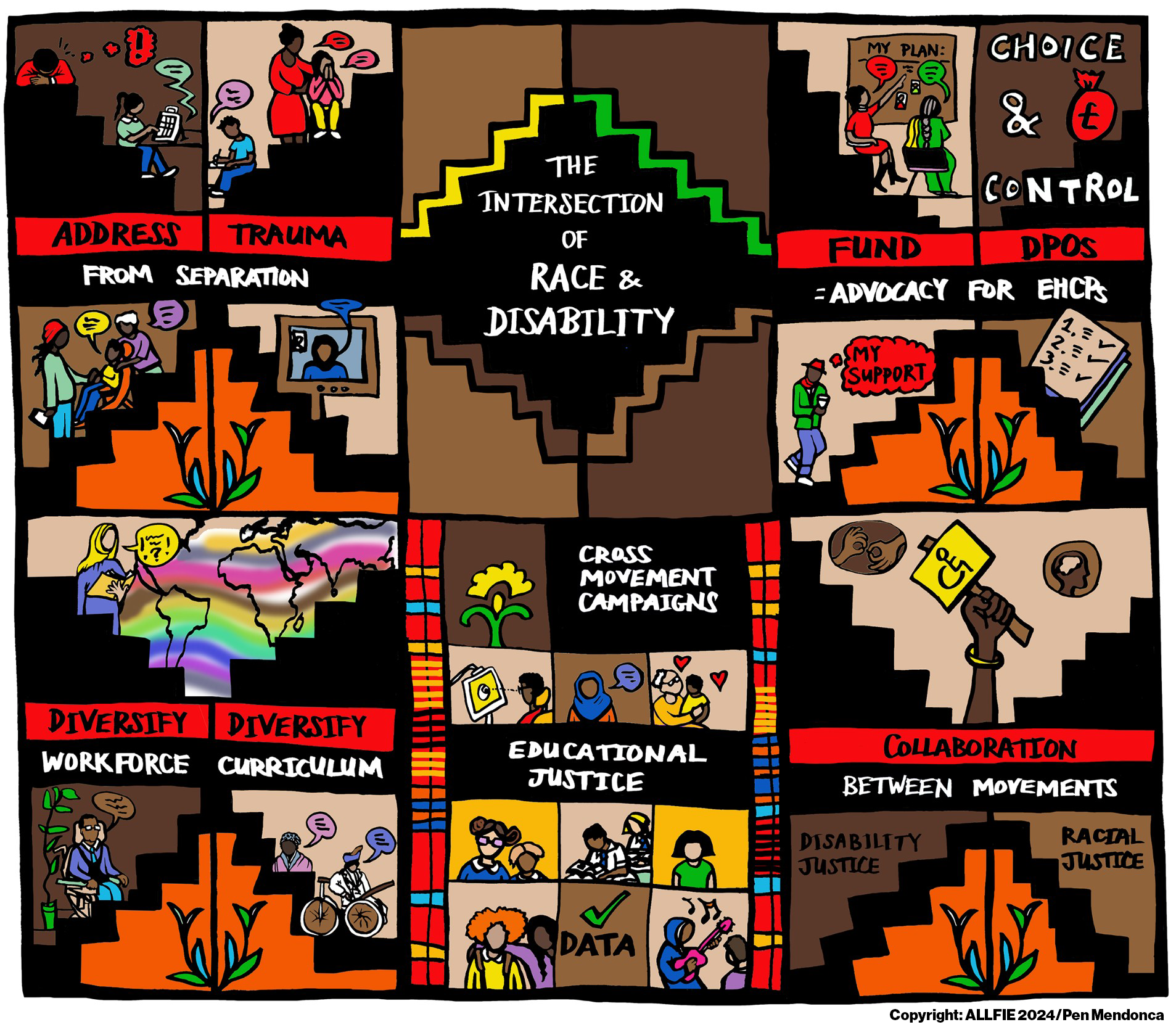
In April 2024, ALLFIE published a report focusing on the educational experiences of Black/Global Majority Disabled pupils and their parents within London. This research, in partnership with the Runnymede Trust, a racial justice organisation, supports our campaign for inclusive education as a social justice issue for all.
While there is plenty of research on inclusive education, ALLFIE’s Disabled Black Lives Matter (DBLM) was concerned about the lack of studies conducted by Black/Global Majority Disabled people that utilised a disability justice and rights framework. Most research views experiences as one-dimensional, but as Audrey Lorde said, people “do not live single-issue lives”. Recognising this, it was important for this research to address failures, not only in research approaches, but also in areas like school placements, staff support, and participation, ensuring intersectionality in the education system for Black/Global Majority Children. In our press release, ALLFIE’s Chairperson, Dr Navin Kikabhai, stressed the importance of this adopted research approach, stating:
“We envision this research as a powerful tool to drive the campaign for inclusive education forward, ensuring that no one is left behind. Our collective social justice efforts must confront intersectional erasure head-on.”
Central to the research were the voices of the children and parents who were reflective, honest and insightful about their experiences. For the research this was an example of participants advocating for change and seeking a safe place to speak truth to power. For this article, we will focus on the findings section of the report, which directly includes the voices of the children and parents. The findings covered the following themes: school placement, experiences with EHCPs, teacher attitudes, disciplinary procedures and surveillance, and social participation.
Children described how segregation affected them, reinforcing social division and discriminatory practices within schools. Noeline, one of the Young participants, shared a worrying observation about this social division, saying:
“[There’s] a place where wheelchair and Disabled pupils go there, and nobody’s allowed there, it’s locked… Like only there’s, there’s not a buzzer. The teacher has to get the card [for the door].”
As was noted in the research report, parents often choose mainstream schools based solely on SEND services and support, sometimes “overlooking the complex intersections of disability, race, gender, and other experiences.”
Another key finding emphasised the children’s lack of autonomy in their support at school, revealing “limited agency and lack of centring the student’s voices in their support”.
With reference to disciplinary procedures and surveillance, experiences varied by impairment, gender, and race. Parents expressed concerns about racial and disability injustices in school policies, evident in disproportionately high rates of exclusion among Disabled pupils and Black boys. Furthermore, “none of the pupils were able to share school experiences when they received a lesson that had examples of Black/Global Majority Disabled people.”
It was concerning that none of the pupils had role models from their community or knew of any Black/Global Majority Disabled people who could be sources of positive support for their values and identities. This absence of representation affects their perception and self-identity. The report stressed the importance of diverse curriculum content to help establish friendships and meaningful social participation. It is crucial for children to identify with individuals in the curriculum as well as to gain a sense of belonging.
The report concluded with six recommendations to support campaigns, advocacy services, and policy decisions. These are:
Improve understanding and recognition of intersectional experiences.
Tackle the trauma experienced through grouping and separation.
Promote independence, choice and control in EHCPs.
Challenge negative attitudes and promote positive representation.
Expose harmful disciplinary procedures and surveillance.
Challenge segregation, promote participation.
It is important that these recommendations are accounted for in future work. It is also important to recognise, as was reaffirmed in the report, that:
“Inclusive education is a human rights issue; it requires the removal of barriers and the recognition of intersectionality and cross-movement working.”
The proposal has since been formalised in the SEND and Alternative Provision Improvement Plan (Department for Education 2023) and the new NPQ is due to be introduced in Autumn 2024. With such significant changes afoot, this article draws on our recent research (Richards, Brewster, Knowler and Done, 2023) and asks whether the new training can fully equip SENCos for what is a challenging and complex role (Done et al. 2022).
Like the SEND Code of Practice (2015) the 2023 Plan identifies that every teacher should be able to adapt their practice to meet the needs of every child in their classroom. It also identifies the importance of Initial Teacher Training and Early Career Frameworks to better equip teachers to meet the needs of Disabled children and Young people. However, our experience and research have identified tensions around teachers’ perceptions of ‘every teacher a teacher of SEND’ and the specialist roles of a SENCo.
Of even greater concern is that this reform is not presenting existing definitions of inclusive education which recognise the centrality of Disabled people’s experiences. Furthermore, there is no mention of the United Nations Convention on the Rights of Persons with Disabilities (UNCRPD) which in turn directly ignores Disabled children and Young people’s education as a human right. The Plan effectively promotes segregated education and fails to support the collaborative professionalism essential to enacting fully inclusive education.
SENCOs and leadership
SENCo practice is multi-faceted and entails dilemmas and challenges associated with leadership. Whilst we welcome the Plan’s intention to support excellent SEND leadership, SENCos enacting their advocacy role must sometimes navigate discriminatory and/or exclusionary practices. The drivers for these are often both financial and related to academic results. We are concerned that the NPQ may depart from the critically rigorous requirements of the existing NASENCO and that this poses risks to equipping SENCos with the necessary resources for agency to ensure inclusive school cultures and to challenge unfair practices.
SENCos have a critical leadership role to play, not just for Disabled learners but for inclusion in its widest sense. The outgoing National Award equipped SENCos with Masters-level research skills which aimed to enable inclusion-related research at the school level and so facilitate transformatory evidence-based practice. Like Lopes et al (2023), we recognise the interconnection of knowledge, skills and agency and the power that transformative learning can have to drive these. Whilst we are mindful of the very real contexts and constraints SENCos operate in, we also recognise they play a pivotal role in social justice. But in the words of one of our NASENCo students, the NPQ must continue to equip SENCos to “champion the needs of SEND children in all curriculum areas”, and to continue to do what is right rather than what is easy.
SENCo practice is shaped by wider historical, political, legislative and ideological discourses and by the local manifestations it is positioned within. As university tutors delivering the existing course, we investigated what impact NASENCo students felt Masters-level study had on their professional practice (Richards, Brewster, Knowler and Done, 2023). Our research revealed the most important benefits SENCO students felt they gained from doing the course were:
Growing confidence, for example to challenge, question, engage critically with senior leadership and outside agencies and parents/carers/families. This confidence then directly supported their potential career development.
Growing research literacy, to support their engagement with evidence of effective practice and embed evidence-informed practices in their settings.
Students working across a range of setting types and age phases demonstrated their willingness to delve deeper into the issues they face within their settings. Many showed their growing insight into the causes of underachievement and the role of evaluation in looking at the efficacy of interventions within their schools. What was also evident was their growing awareness of how theory could improve their understanding, and of how tools taught on the course could improve teaching and learning through the professional development of staff in their settings. While no qualification will guarantee effective enactment of the SENCO role – building accountability into the system is needed to do this – it was apparent that the outgoing course did indeed support participants’ deep critical engagement with inclusive educational practice.
SENCOs as leaders of inclusion
Tronto (2013) argues that organisations (like schools) should be alert to situations where it is possible for some people not to care about issues of inclusion. SENCos need to be confident members of leadership teams that hold inclusive practice as a core ethos across their whole setting and staff. SENCOs can do much to promote knowledge and skills in support of inclusive education among their staff groups when given the time and space to do so.
How the new NPQ will succeed in equipping SENCos with the insight, skills and confidence to challenge unjust practice and champion inclusion remains to be seen. Indeed, a change in course title and format of the mandatory training may make no difference to SENCOs’ personal commitment to social justice, and the demonstration of this through their leadership. Whilst we accept this situation is where we are at, we issue a call for continued vigilance as training providers develop their NPQ courses, to retain as far as possible the many strengths of the old NASENCO in the pursuit of improved outcomes for Disabled children and Young people.
And finally…
… a message to SENCOs at whatever stage of professional development they are at, in the words of Knowler, Richards and Brewster (2023, p117):
“We recognise your commitment to removing barriers to learning, advocating for, and supporting parents and families as they negotiate the SEND systems, and for showing that an inclusive system where diverse classrooms with learners from all backgrounds can learn and thrive together is possible.”
Knowler, H, Richards, H and Brewster, S (Eds) 2023. Developing Your Expertise as a SENCo; Leading Inclusive Practice. St Albans; Critical Publishing.
Lopes, A., Folque, A., Marta and Tavares de Sousa, R. (2023) Teacher professionalism towards transformative education: insights from a literature review, Professional Development in Education, DOI: 1080/19415257.2023.2235572
Richards, H, Brewster, S, Knowler, H and Done, E. (2023) Professional development for SENCos (Special Educational Needs Coordinators): the future of an accredited National Award. European Conference on Educational Research, August, University of Glasgow.
Tronto, J. C. (2013) Caring Democracy: Markets, Equality, and Justice. New York: NYU Press
In June 2024, a BBC Panorama documentary called ‘Undercover School: Cruelty in the Classroom’ reported the abuse experienced by Disabled pupils at LIFE School in the Wirral in the North-West of England. Documentary reporter, Sasha Hinde, gained work in the school as a member of the support staff and carried out an undercover investigation using a hidden camera. What she exposed was an appalling catalogue of abuse, including violent verbal and physical attacks on Disabled pupils and students.
LIFE School is a for-profit company, for pupils and students who are 11-18 years of age. The school specialises in sports and most of the pupils have labels of ADHD and Autism. Wirral Council fund places at the school, and it has been rated “good” by Ofsted. In the previous year, February 2023, a whistle blower raised the alarm about the school, saying that pupils had confided in her about the types of abuse they witnessed. Throughout the programme there is disturbing footage showing teachers physically abusing pupils. The examples include teachers putting pupils into headlocks and using police style restraint on them. Teachers routinely used discriminatory, ableist and other offensive language and derogatory slurs, targeting pupils and at times other staff. Teachers also speculate about one Young person’s sexuality, taunting him and using homophobic language. In another instance, sexist and misogynistic language is used to describe a female pupil, and about the investigative reporter.
As ALLFIE explains in our current manifesto, social injustice in education must be combated. The Government should “adopt educational policies and practices that address all forms of social injustice in education, recognising the diversity of Disabled people’s lived experience”.
Teaching staff should be representative of people from different cultural backgrounds, and respect should be fostered for the diversity of Disabled people that they are teaching.
Another major concern which the programme highlighted, is the vast amount of money being spent on segregated schools. All the children at Wirral Life School are on Education, Health and Care plans (EHCPs), and according to the Department for Education (DfE) the number of children with an EHCP has doubled to 6,000 in the last 9 years. The number of pupils in independent schools with an EHCP has risen to about 150% since 2015. Since the school opened in 2021, Wirral Council has paid the school more than £2.2 million pounds. There is also offsite provision, a local football pitch, for one pupil who has 2 hours a day of lessons for 4 days a week. The lessons cost the local authority £150,000 a year. The teacher, a senior leader, leads the offsite provision and is captured on camera repeatedly verbally abusing the pupil, using ableist slurs, and being disrespectful and rude about the pupil’s mother.
The former Director of the Council for Disabled Children (CDC), Christine Lenehan, also appeared throughout the film, commenting on footage of the abuse. Christine said that she is concerned about schools in the private sector who purely just want to make money. She was clear in advocating for the children to be included in local community schools, with the right support. This aligns with ALLFIE’s campaign for inclusion in mainstream community schools, as explained in our manifesto demand number 2 which calls for an end to all forms of segregated schooling. Also, ALLFIE’s Manifesto demand number 3 strongly emphasises that all SEND Government funding must be redirected from segregated schools and units to improve mainstream education.
Additionally, the programme shows ineffective senior leadership, neglectful management, and poor practice within the school. The CEO of LIFE Wirral, a former professional rugby player who used to be chief executive of Bournemouth Football club, made explicit his primary motivation for money over the Young people’s education and wellbeing. A measure of this questionable drive for money was made clear when he was captured on camera saying that he wanted Life Wirral “to be the first billion-pound educational division in the country”. He also added that he wants his headteacher “to be the richest headteacher in the country”. He appears gloating as he describes using a police style restraint on a child who was “lashing out.” For many watching, they would be aghast that this individual had no experience in education and used to work for the police but was sacked for gross misconduct. For ALLFIE, it is no surprise that many segregated settings attract staff who have experiences and have worked, for example, in either custodial, protective, emergency, and armed services.
In the programme the reporter, Sasha, meets the headteacher to review her performance. The headteacher was recorded saying that she was aware of staff behaviour and their anger towards the children and Young people. Further footage showed a teacher grabbing a pupil by the head and drawing on his head. This happened in front of the headteacher who does nothing, and then walks away. It leaves us wondering whether this non-intervention by the headteacher is an indication of the comfortableness of the perpetrators, and that their abuse was being conducted in plain sight of senior staff?
It is incredible that only a few weeks earlier, a completely different story was being reported, one which commemorated the death of rugby sporting great, Rob Burrows. Rob was diagnosed with Motor Neurone Disease (MND), and campaigned alongside his family, friendship groups, strangers and sporting people. It was remarkable that the vehicle of sport brought people together in such a way and under such adversity. And yet, another group of Young Disabled people at LIFE School in the Wirral, a so-called specialist sport school, are being abused. I wonder, what would Rob Burrows have thought?
For many, it is hard to understand that Ofsted rated this as a ‘good’ provision in April 2023, suggesting that ‘leader’s arrangements to safeguard pupils are effective’. For others, Ofsted are defunct and devoid of holding educational providers to account, particularly when it comes to issues of disability justice. It is of course credible to question this lead inspector’s observations. How is it possible that such abuse went unnoticed? This Panorama investigation also revealed that Wirral Council had been aware of accusations of abuse. It would be no surprise to ALLFIE, that such perpetrators would have checked the equality box in terms of receiving training in Disability issues. It should also be no surprise that defenders of segregated provision will question the investigation, or even allege that it was the undercover investigator who put the children at risk – this is in fact a position taken by a nameless spokesperson at LIFE Wirral who issued a defensive statement on their website.
It is disturbing that much of the terminology related to Disability goes unchecked and is often used to dehumanise individuals. There is a long history which reveals the way language is used to justify segregation. Even the term ‘special’ has been argued to be offensive. Absurdly, there are also segregated provision which claim to be inclusive – how, given that they exclude non-disabled people? For many, ‘special’ translates to meaning ‘less than’, ‘different to’, ‘failure’ and so on. It routinely results in segregation. The realities of Disabled people and segregation seldom report remarkable stories of survival, resistance and escape, why?
Watching this programme was upsetting and would have been extremely disturbing to many people. Much of the social media commentary noted the depravity of the perpetrators, name calling, physical abuse, torture, degrading and inhumane treatment by so-called professionals, who parents entrusted with their children. Sadly, and again, this is indicative of what ALLFIE has campaigned against in our End Torture campaign over the past year.
When all is said and done…
For many it is unfathomable that Young Disabled people are being treated as they are at LIFE School in the Wirral. At ALLFIE we have too often heard from parents being coerced into ‘choosing’ segregated ‘special’ provision, usually assuming that their son/daughter will be free from bullying, that they will be ‘looked after’ and so on. For some parents, thinking of what happens after their child has completed their schooling is too far away. For sure, parents agonise over ‘choosing’ a school. Mainstream teachers also buy into this special school industry, reneging on their commitment to equality and social justice, convincing parents that they don’t have the resources and/or skills. In this segregated system, it is necessary to have failing mainstream schools, there is a manufactured industry in servicing this so-called ‘failure’. Inclusion and exclusion have become two sides of the same coin. Educational segregation has become normalised, as thousands of pounds are being syphoned into segregation. There is a ‘special’ school industry, its economy is lopsided and tightly regulated. There is also profit to be made.
Unfortunately, the abuse of Young and older Disabled people in segregated provision is all too common. It is not a ‘one-off’. In the coming weeks we will hear in the news the usual platitudes of ‘never again’, ‘lessons learnt’ and so on. If there are court hearings and possible prosecutions we should not be surprised, in this topsy turvy world, to learn that perpetrators themselves have some association with the issue of Disability. These are disturbing and confusing times. Even the legal system is lopsided and many of the perpetrators will, if taken to court, receive disproportionately community service, rather than custodial sentences.
This abuse of Disabled people is systemic, it cuts across intersectional experiences and identities, and it threads through the fabric of society. Ashamedly, the UK government has placed a reservation on United Nations Convention on the Rights of Persons with Disabilities (UNCRPD) Article 24 on Education, which basically means that so-called ‘special’ schools are part of an apparent ‘inclusive offer’, presented in the guise of ‘parental choice’. It should be of national shame that the United Nations has called out the UK for its lack of progress towards inclusive education. The UK as well as other State parties are expected to demonstrate their ‘progressive realisation’ towards inclusive education. A previous UN observation in 2016 reported that there were ‘grave and systemic’ violations against Disabled people more broadly, and its most recent report published in March 2024 stated in its conclusion that the UK has ‘failed to take appropriate measures’ to resolve these violations and in some areas have regressed. Whilst it may be the case that LIFE School in Wirral will be shut down, there are numerous historical examples of the repeated abuse in segregated educational provision, and it should be no surprise that there will be others which come to light. This is a complex system of segregation, riddled with inequality, implicating and coercing individuals. These are structural and systemic issues. When all is said and done, when it comes to segregated ‘special’ or so-called ‘specialist’, ‘free’ and ‘alternative’ provision’, and the way society discriminates against Disabled people thereafter; history will judge us to be cruel, we have no doubt about that!
Yewande, who leads ALLFIE’s Young Disabled people’s group called Our Voice, was also sickened and angered by what she witnessed in the documentary. It made her think of the Young Disabled people who still constantly have to fight for freedom and liberation at school and fight to enjoy their education. The Our Voice group summed it up best in the ALLFIE manifesto, when calling for inclusive education for Young Disabled people. They said:
“Inclusive education isn’t just about dreaming about the future. We don’t just want you to plan for the next generation. We want justice and liberation for those currently in segregated education.”
“In my role as Senior Development Officer for Goalball UK, I have been approached by Blind pupils attending different mainstream secondary schools, expressing their dissatisfaction at being excluded from participating in Physical Education (PE) lessons. These pupils want to take PE as a GCSE subject, with ambition to become PE teachers, and are actively involved in community sport. The pupils are also excluded from participating in their schools’ sports days, which denies them opportunity to represent their schools so they can feel valued and have a sense of belonging.
Their parents have raised concerns with the schools about their children’s exclusion from PE lessons. The schools have responded saying they are low on staffing levels and feel it would be too dangerous to include Blind pupils in uncontrolled physical activities. They argue it would be too challenging for Blind pupils to participate without any risk, and they are told to use the time to do homework or develop their Braille skills.
Unsurprisingly, the pupils and their parents are dissatisfied with their school’s response to their exclusion from PE, a curriculum subject. What rights do they have to challenge the school’s action to remove their children from PE lessons?”
Having a significant visual impairment is a protected characteristic under the Equality Act 2010. This means that there is a duty on schools not to discriminate against students who are Blind.
There are numerous protections under the Equality Act but the most relevant to this situation is the duty to ensure that those with a disability do not suffer discrimination ‘arising from’ their disability.
A disability is defined under the Act as:
“P has a physical or mental impairment, and the impairment has a substantial and long-term adverse effect on P’s ability to carry out normal day-to-day activities.”
Being Blind clearly meets this definition.
Section 15 of the Act prohibits discrimination arising from disability which it defines as:
“A person (A) discriminates against a disabled person (B) if—
“(a)A treats B unfavourably because of something arising in consequence of B’s disability, and
(b)A cannot show that the treatment is a proportionate means of achieving a legitimate aim.”
In the situation set out above, it could be interpreted that schools are not treating pupils unfavourably simply because they are Blind but instead because of the additional risk which arises from Blind pupils doing sport. The discrimination therefore arises from the consequences of the disability.
As can be seen above, a school should not discriminate in this way unless it can show that the treatment (the ban from sports) is a proportionate means of achieving a legitimate aim.
The schools in question have stated that safety is their aim and it probably would not be disputed that this is a legitimate aim. The question is therefore whether the ban is proportionate to maintaining this aim.
In considering whether a ban is proportionate, it should be considered whether reasonable adjustments can be made. The provision of additional staff and/or changes to the way the lessons or sports days are managed for example. Schools are under a duty to make reasonable adjustments and can never show that discrimination is a proportionate means of achieving a legitimate aim in circumstances where they have failed to do make reasonable adjustments. What is reasonable is dependent on specific facts. If schools show that the adjustments would be of significant cost and they simply cannot afford them then this might not be considered reasonable but they would have to demonstrate this clearly and that they have considered other lower cost alternatives where available.
In addition, most Blind students will have or should have an Education, Health and Care plan. Where support is needed but costs more than what a mainstream school can be reasonably be expected to cover from within their existing resources then provision should be specified in that plan and funded by the Local Authority. This means that, in reality, children who are Blind should participate in sports and it is simply a question of who pays for the cost of the additional support needed to ensure accessibility and safety of the pupils when participating. This should either be the school or the Local Authority but the answer cannot be a ban on sports for Blind pupils.
Parents of children in this situation may need to look at changes to their child’s EHCP plan and/or consider a disability discrimination claim. Advice on the most appropriate option should be sought as this may be different for different people.
Inclusion Now 69 | Summer 2024
Welcome to the latest edition of Inclusion Now magazine, inclusive education news including the Children and Families Act: Ten Years On, the exploitation of Young Disabled people in internships, Mount Stuart Primary School visit, abuse in segregated educational settings, SENCos development, and more.
Welcome to the 69th edition of Inclusion Now magazine. Text and audio versions are in the articles below, or you can read it in magazine format on Issuu.
To receive three issues of Inclusion Now a year, on the publication date, you can subscribe here. Subscribing supports our work and helps us plan for the future.
ALLFIE demands that all Disabled pupils and students are included and participate in Physical Education (PE), as part of the education curriculum. Ahead of the 2024 Paralympic games, Channel 4 broadcast the documentary, Equal Play, on Monday 26th August 2024:
“This compelling documentary uncovers the transformative power of sport for Disabled people, through the experiences of two British children who are striving to be included”
ALLFIE’s Michelle Daley and Edmore Masendeke worked with Channel 4 and production company Rising phoenix Global, in collaboration with Paralympics GB, to ensure Disabled people’s demands for inclusive education were represented.
This blog highlights some of the key messages and concerns for Disabled people’s education.
Context
The documentary focuses on the lived experiences of two Young Disabled people, Marley who is 14 years old and training to become a boxing coach, and Tammy who is 11 years old and has enrolled in a wheelchair racing club.
It also includes the views of Marley’s parents, Paralympian Hannah Cockroft OBE, Professor Brett Smith, UK Government Advisor on PE for Disabled Children, and Michelle Daley, Director of the Alliance for Inclusive Education (ALLFIE).
The key messages and issues raised in Equal Play documentary align with ALLFIE’s Manifesto demands, including to:
End all forms of segregated education
Redirect government SEND funding towards supporting and improving mainstream services
Combat Social Injustice in Education and establish inclusive education as a human rights issue
End all forms of curriculum systemic injustice
On ending all forms of segregated education…
The UK government recommends 120 minutes of physical activity per week for Disabled children. However, in the documentary this alarming figure emerges:
“75% of Disabled kids are not doing physical exercise within school… Sport is for all. Sport is something that everyone should be able to join in with.” (Hannah Cockcroft)
Quotes from Disabled students Marley and Tammy back up the critical importance of inclusion in school sports (Trigger warning for mention of suicide):
“If you want to do sports, you have to fight for it. At my first secondary school… I was basically secluded from the rest of the building… I was just feeling really down. It got so bad I legit told my mum I wanted to kill myself… Sport has been quite a major factor in my life. So, if I’d never done sport in my life, I’d be pretty miserable.” (Marley)
“I’m in a wheelchair, but I can do most of the same things that the other children do. Why should I be treated differently?… When my classmates are doing PE, I either do my physio or make a sandwich… Doing physio instead of PE makes me frustrated. I do think it’s unfair that I am left out… When I am in the water, I feel relaxed, calm. Swimming makes me feel that the weight of my body has been taken off me.” (Tammy)
Marley’s parents, Sarah and Marlon, also added:
“Marley’s secondary school said that they couldn’t transition him into Year 9. So, we had to fight to get Marley into a new school… (The new school) was absolutely life-changing for Marley.” (Sarah)
“Sports changed Marley massively in terms of communication, confidence, stability skills.” (Marlon)
ALLFIE demands the UK government:
Provides sufficient resources to ensure the accessibility and provision of adjustments for Disabled people at all mainstream educational settings.
Ensures that all mainstream educational settings are equipped and resourced to address the support needs of all Disabled people.
Adopts a unified and better coordinated approach to addressing Disabled people’s educational, health and care needs.
On redirecting government SEND funding towards supporting and improving mainstream services…
“Inclusive education is not just about the child going to a mainstream school. It is about the child being able to access the full school life. The external activities that come with that inclusive education experience.” (Michelle Daley)
Many schools urgently require more resources and training to implement the government’s own guidelines on physical education.
“It shouldn’t be down to children having parents who have to advocate for their child to achieve and have the opportunity to have meaningful inclusive education.” (Michelle Daley)
ALLFIE demands the UK government:
Provides clear goals to provide sufficient resources to ensure the accessibility and provision of adjustments for Disabled people at all mainstream educational settings.
Ensures that all mainstream educational settings are equipped and resourced to address the support needs of all Disabled people.
Call to Action
Post Paralympics, there will be an open letter asking the UK Government to invest more in access to sport for Disabled children and young people, which we will ask for your support in signing and sharing the letter as widely as possible.
On combatting social injustice in education, and establishing inclusive education as a human rights issue…
ALLFIE’s work is underpinned by UNCRPD article 24 as well as the Social Model of Disability, which states that we are “disabled” not by our impairments but by society’s failure to take our different needs into account. Within education, this includes systems, structures and practices that lead to our marginalisation and exclusion from mainstream educational settings and society at large. We believe that this is oppressive and a social injustice.
This is highlighted in Equal Play documentary:
“It’s not uncommon for Disabled children, Disabled young adults in schools to be discriminated against… We need leaders within education, and particularly from the government, to be able to say, ‘Disabled people, Disabled young children, it’s a human right, it’s simply a human right that they should have good quality access to physical education.’ and to do that we really need appropriate resourcing.” (Professor Brett, UK Government Advisor on PE for Disabled Children)
“We need to recognise that Disabled people are not homogenous. We need to recognise we come in all shapes and forms. And recognise that being disabled is beautiful. The difference is beautiful. And recognise the difference we all bring to the world in a really positive way.” (Michelle Daley)
ALLFIE demands the UK government:
Re-evaluates the objectives of education and learning to ensure that they are not discriminatory to Disabled people. This includes withdrawing all reservations to Article 24 of the UNCRPD and following the EHRC position with the recognition of a just and equitable inclusive education system for everyone.
On ending all forms of curriculum injustice…
“When you remove a child out of PE, you’re removing their right to the full range of the education curriculum. So, to remove them from PE and substitute that for physio, that is not an equal substitution. That is a medical need. A medical need is not a learning need.” (Michelle Daley)
ALLFIE demands the UK government:
Develops more dynamic curriculum and assessment systems that do not disadvantage Disabled people on account of their impairments and the lack of appropriate support in PE as well as the wider curriculum.
Re-evaluate the objectives of education and learning, including in PE, to ensure that they are not discriminatory to Disabled people.
More…
The Equal Play wider campaign launch will take place at an event in Paris on Monday 2nd September 2024.
Support inclusive education as a social justice and human rights issue by putting your name to our six demands: Sign ALLFIE’s manifesto
Disabled children and young people’s equal access to education in Wales
In July 2024, the Welsh Assembly’s Children, Young People and Education Committee published a report on Disabled children and young people’s education. Our Campaigns and Justice Lead, Iyiola Olafimihan, reflects on some of the findings in relation to our inclusive education campaign.
ALLFIE has always held the view and campaigned (backed by Article 24 (on inclusive education) of the UN Convention on the Rights of Persons with Disabilities (UNCRPD) and one of the main pillars of independent living, Article 19) for an equitable inclusive education system, as the foundation to the inclusion and citizenship of Disabled people from childhood into adulthood in mainstream societies.
The new report published by the Welsh Assembly’s Children, Young People and Education Committee, ‘Do Disabled children and young people have equal access to education and childcare?’, touches on some of the arguments for inclusion in the education system that ALLFIE has often campaigned on. However, there are still some actions needed to fully convince us that inclusive education will be fully committed to in Wales.
The opening remark from the committee Chair, Buffy Williams MS gives us some encouragement, as she stated:
“Good early years childcare followed by education is essential for all children and young people to develop into the adults they want to be. Yet too many disabled and neurodivergent children and young people are not getting these opportunities. I believe this report is an important moment for policymakers to acknowledge this, and start to make the changes to deliver more inclusive childcare and education” (Buffy Williams MS, Chair of the Children, Young People and Education Committee)
The new Additional Learning Needs (ALN) system, which is further reforming the 2018 system, is being introduced over four years: September 2021 to August 2025. In the latest Inclusion Now 69 Summer Edition, Helen Borley head teacher at Mount Stuart Primary School in Cardiff, in an interview with Yewande Akintelu-Omoniyi (Our Voice Project Youth Officer), and Michelle Daley (Director), described the process for Individual Development Plans (IDPs) as being:
“Run by the schools, and they are for children with identified additional learning. To be deemed to have a need that is different from and in addition to anything you would normally offer in a classroom. So, for example, a child may have a diagnosis of autism, or a child may have ADHD, or it may be that they have Global Delay. That system is then supported by the Cardiff Council who have to then agree with the school that the child has identified an ALN (Additional Learning Need). That then goes to a panel and the children are given support via a team. It might be a Learning Team, it might be an Autism Team, it might be a Speech and Language Team, it might be Disability Team. It might be whatever team they are most suited to.”
Helen further provided context to ALNET Bill reforms including funding changes:
“If a child has an identified, agreed ALN they are not automatically given funding to meet those additional needs.” She further explained that “At the moment, we are given a pot of money that we are to use with all children with ALN, not just those with IDPs, to ensure they make progress. Now that is complex because for some children the funding is ringfenced, so for children with an identified Disability funding is ringfenced. So, a child with VI [visual impairment] or a wheelchair user they get ringfenced funding which is separate to that.”
On the school’s challenges, she noted:
“As with all pots of money it does not meet the needs that you have in the school so inevitably, there is a fairly large amount of budget that is spent on supporting learning in classrooms, either by additional adults… usually, or additional support via interventions or reading support or emotional and social support.”
The language of the reforms introduced to replace the SEN system and these ongoing reforms and implementation, ALLFIE believes, need to change from a needy position to an entitlement position because inclusive education, as we have referenced above, is a human and equality rights issue. We however applaud the committee’s call to the Labour led Welsh Government to engage with the report, and recommendations therein should apply to all the nations of the United Kingdom. If this happens, our campaign to see an inclusive education law will one day become a reality, guaranteeing a right to access education in mainstream settings for all Disabled people.
We were also encouraged by the use of language and framework of the report. They acknowledged on page 15 that all of their work is framed through the prism of the UN Convention on the Rights of the Child (UNCRC) and, for the inquiry, they have also been very mindful of the UN Convention on the Rights of Persons with Disabilities (UNCRPD). They have also used the Social Model of Disability to frame their work.
Highlights and reflections
There are 32 recommendations to the Welsh Government in the Report, but our reflections are focused on those with clear principles within the Social Model of Disability. We have also highlighted where there are mentions of inclusive education as a right for all Disabled people:
Recommendation 19. The Welsh Government commissions the development of a mandatory training module for all school staff on ‘disability awareness’. This should cover the Social Model of Disability and equip all staff in a school with a 12 basic level of awareness, as well as signposting them to other resources if they want to develop their skills and expertise. It should also be in line with the latest research and clinical knowledge, and be kept up to date to reflect any subsequent changes or developments – ALLFIE reflects: this mandatory training should go further, to include mandatory courses on inclusive education training for teachersin their training courses (Demand 5 ALLFIE Manifesto 2024 on Inclusive Education), and instead of disability awareness, Inclusive Education training should be based on the Social Model, the Equality Act and the UN Convention on the rights of Disabled people.
Recommendation 20. The Welsh Government should issue guidance to schools and local authorities to ensure that either new buildings, or changes to current school estates, are based on the experiences and evidence of children, young people, families and staff with lived experience. This engagement should also ensure that future needs are considered so that buildings are fully accessible to all who may attend in the future. ALLFIE completely supports this recommendation and would like to see it strengthened by referencing The Equality Act 2010
Recommendation 24. The Welsh Government undertakes further work to ensure a streamlining of services to fully deliver a no wrong door approach across all public services, but with particular reference to the interaction between health and education services. This work should identify the barriers to effective coordination between services, as well as identifying best practice, and mechanisms for sharing this best practice. ALLFIE was encouraged by this, recognising that the scattered approach to support by different education, health and social care services have caused a lot of harm to Disabled children/young people and their families.
We noted that page 76 of the report referenced the Equality and Human Rights Commission assertion that: “Wales does not have a fully inclusive system and that the numbers of children in ‘specialist provision’ is increasingly “significantly”. This meansWales isn’t really moving in the direction the UN would recommend”. The committee further referenced the UN Committee’s criticism of the reservations that the UK Government has placed on the UNCRPD. The report went on to quote the EHRC statement, that the UN Committee recommended that the right thing to do is for every child to have an inclusive education in mainstream school, properly supported and properly funded. This is a welcome development to see an acknowledgement in a UK legislative related report quoting views ALLFIE holds and been campaigning on for over 30 years. Sadly, on the same page the report dampened our excitement by quoting another EHRC’s statement acknowledging there may be some children and young people for whom ‘specialist’ provision is more appropriate. ALLFIE insists inclusive education is a human right that must be implemented for all Disabled people in mainstream education settings.
The report gave voice to a wide range of people including those who are comfortable with segregation in education, but ALLFIE was particularly enthused to in see in paragraph 240 (page 83) the amplification of the voice of one parent for inclusion who testified and said, “if their child was not in a mainstream setting “his non-disabled peers wouldn’t know that he exists.” In support of inclusive education, Fair Treatment for the Women of Wales said that this segregation “can only serve to exacerbate perceptions of ‘difference’ and perpetuate both internalised and societal ableism.” The report again quoted the Equality and Human Rights Commission which said inclusive education “benefits the whole community, the whole school community”. They said when you go to “fully resourced schools where children are fully integrated, the benefits for all the pupils, both the children and their families is huge.” ALLFIE is demanding a redirection of resources and funding from segregated settings into mainstream settings, as per Demand 3 of ALLFIE Manifesto 2024 on Inclusive Education. Learning Disability Wales said there was the need for “much, much more support for non-disabled children to understand how to support their peers.
At ALLFIE we know that inclusive education covers more than just curriculum justice or even academics. It was therefore very encouraging to know that the committee took evidence from organisations and parents about social and physical education inclusion in schools. They visited a school where they wanted to have more opportunities, including having PE on a weekly basis, and wanted access to a wider range of sports. RNIB Cymru said that assumptions are often made about what children and young people with vision impairments can do, citing a lack of access to PE and sport, which can have long term impacts. While Fair Treatment for the Women of Wales also said that PE often does not cater to “needs outside of the default ‘non-disabled’ person, which can have implications for health and well-being far into the future.”
In concluding our reflections and observations to this report, we would like to restate what the committee said about inclusive education: “On the basic question as to whether Wales should move to a fully inclusive system as set out by the UNCRPD, we agree that that a fully inclusive education system is what we should be striving for, but we are very far away from that. This does not mean we do not believe the work should start on how we can move toward a fully inclusive system, but we acknowledge that is a huge piece of work that will take time. In the meantime, we need a laser like focus on what can be done to improve for children and young people now”
The Welsh Government was also quoted on page 90 and paragraph 267 of the report stating that they seek to: “…transform the expectations, learning experiences and outcomes for children and young people. Both emphasise an inclusive education system which balances equity of access to the curriculum for all learners with addressing the needs of individual learners.”
Conclusion
This report, we believe, fed into so many views and testimonies which reinforce the need for all UK countries to reconsider their position and establish inclusive education as a fundamental human right for all Disabled people. Also, for this to be the only approach in the education system, and wider society beyond. The report however fell short of endorsing a complete inclusive education system, which ALLFIE demands. We found that, although it referenced a lot of views from many Disabled young people, families and organisations, and visited many schools, including mainstream schools that championed an inclusive system based on the UNCRPD and the Social Model of Disability, it sat on the fence by also suggesting inclusive education cannot practically be achieved now. It also failed to establish that what should always be in high consideration is the best interest of the child.
By Iyiola Olafimihan, ALLFIE’s Campaigns and Justice Lead
Sign the manifesto
Stand up for inclusive education and put your name to our six demands – sign the manifesto
What’s in the King’s Speech on Inclusive Education?
During the State Opening of Parliament on 17 July 2024, the King set out the government’s priorities for the coming months. ALLFIE’s Policy and Research Officer, Edmore Masendeke, explains what the King’s Speech means for Disabled children and Young people in education.
King Charles III delivered the King’s Speech at the State Opening of Parliament, in London on 17July 2024. Through the speech, the King set out the legislative priorities and intentions for the newly elected Labour government. This includes plans “to raise educational standards and break down barriers to opportunity.”
Enrolment of Disabled children and Young people in mainstream schools
The King said, “A bill will be introduced to raise standards in education and promote children’s wellbeing [Children’s Wellbeing Bill].”
According to the briefing notes, among other things, this bill will:
“require all schools to cooperate with the local authority on school admissions, SEND inclusion, and place planning, by giving local authorities greater powers to help them deliver their functions on school admissions and ensure admissions decisions account for the needs for communities.”
“the Bill will remove barriers to opportunity for children and their families by keeping children safe, happy and rooted in their communities and schools by strengthening multi-agency child protection and safeguarding arrangements.”
In the context of Disabled people and Young people and their families, this implies avoiding all forms of institutionalisation, including segregated education for Disabled children and Young people. This sounds like the government wants local authorities to ensure that Disabled children and Young people are enrolled in the mainstream schools in their communities. The new government has made clear that it intends to improve Disabled children and Young people’s enrolment in mainstream schools in a previous press release and a news report.
This would be positive development towards the progressive realisation of inclusive education in line with Article 24 of the UNCRPD. Inclusive education benefits everyone; it is only through Disabled and non-disabled people playing, learning, working, growing up together, and establishing relationships that we will achieve an inclusive society that welcomes all.
However, the government still wants to maintain special educational settings. ALLFIE believes that the government should phase out special educational settings and reallocate the proposed budget from the SEND and alternative provision improvement plan into supporting inclusive education for every child and Young person. Furthermore, the goal should not be just to improve Disabled children and Young people’s enrolment in mainstream schools without ensuring that they have the right support and resources. Every Disabled child and Young person that is enrolled in a mainstream school should be given the right support and resources to facilitate their learning, social inclusion and full participation in that setting. Anything otherwise fails to realise inclusive education. As the government has not yet provided a detailed plan of how it intends to implement this measure, we can only wait and see whether it will be done right.
Raising education standards
As indicated above, the King also said that the bill will raise standards in education. It seems like this will involve “requiring all schools to teach the national curriculum” and ranking schools based on pupils’ performance in national exams. ALLFIE is concerned that this will make schools less welcoming to Disabled children and Young people as they try to maintain league standards. ALLFIE believes that the government should develop and implement a more dynamic curriculum and assessment system that addresses the systemic injustices of the existing curriculum and assessment system.
On 19 July 2024, two days after the King’s speech, the Department for Education launched a Curriculum and Assessment Review. The press release states that:
“The review will look closely at the key challenges to attainment for Young people, and the barriers which hold children back from the opportunities and life chances they deserve – in particular those who are socioeconomically disadvantaged, or with special educational needs or disabilities (SEND).”
ALLFIE is unclear what this means but hopes that the government will take this opportunity to review and address all the systemic injustices of the existing curriculum and assessment system.
Removal of the exemption from Value Added Tax (VAT) for private school fees
The King also announced that “Measures will be brought forward to remove the exemption from Value Added Tax (VAT) for private school fees, which will enable the funding of six and a half thousand new teachers.”
ALLFIE believes that this should extend to removing the exemption from VAT for independent special schools and redirecting resources towards ensuring adequate support and resources for Disabled pupils and students in mainstream settings. Also, as the government will ensure that “any new teacher entering the classroom has, or is working towards, Qualified Teacher Status,” ALLFIE calls on the government to also ensure that training on inclusive education is mandatory in all teacher training programmes.
Skills England
The government also plans to “establish Skills England which will have a new partnership with employers at its heart [Skills England Bill].”
According to the briefing notes, the Bill will “pave the way for the establishment of Skills England by transferring functions from the Institute for Apprenticeships and Technical Education.”
The Bill seeks to address the skills gaps in the labour market. The briefing notes are silent on the situation of Disabled people and whether there will be any changes to the operation of alternative apprenticeship programmes such as supported internship. ALLFIE recommends that the government should make all apprenticeships inclusive and end all alternative apprenticeship programmes as they are segregated and based on medical model of disability. These alternative apprenticeship programmes are also a form of social injustice and oppressive to Disabled people.
High-quality infrastructure and housing
The King also announced that the government also “seeks to accelerate the delivery of high quality infrastructure and housing.”
Accessible infrastructure and housing enable Disabled people to live in their communities, including attending the mainstream schools in their communities. There is no mention of accessibility standards in the briefing notes. ALLFIE therefore recommends that the government should enforce good accessibility standards in infrastructure and housing construction.
Measures to halve violence against women and girls
The government will “bring forward plans to halve violence against women and girls,” the King said.
The details of these plans seem not to be available yet as this announcement was not linked to any bill. ALLFIE urges the government to increase measures to address the violence and abuse experienced by Disabled women and girls in all educational settings, residential institutions and other settings, in these plans.
Addressing thecost-of-living crisis
Finally, the King said that the government will seek to help “the country move on from the recent cost of living challenges by prioritising wealth creation for all communities.”
The cost-of-living crisis has disproportionately affected Disabled children and Young people and their families. The briefing notes indicate that the Children’s Wellbeing Bill will remove barriers to opportunity for children and their families by “requiring free breakfast clubs in every primary school” and “introducing legislation to limit the number of branded items of uniform and PE kits that a school can require.”
While these are positive measures that will benefit many children and Young people from under-resourced backgrounds, ALLFIE is concerned that these measures do not go far enough in addressing the situation of Disabled children and Young people. The briefing notes are silent on whether there will be any support for Disabled children and Young people who are prevented from accessing breakfast previsions due to accessibility issues and the lack of appropriate support staff at schools. Additionally, there is no mention of support for Disabled children and Young people who require tailor-made uniforms. The government also fails to address the additional disability-related costs that impact the educational experiences of Disabled people.
ALLFIE is disappointed that the new government did not take this opportunity to outline a clear plan for the progressive realisation of the UNCRPD and to make inclusive education a reality. This plan would legislate inclusive education as a legal right for every Disabled person.
By Edmore Masendeke, ALLFIE’s Policy and Research Officer
Inclusive Education Election Guide 2024
ALLFIE sets out key findings from the four main political party manifestos, alongside our six manifesto demands for inclusive education.
With the General Election 2024 fast approaching, the leading political parties are campaigning for every vote they can secure, and many people are thinking about the changes they would like to see from the next government. For supporters of inclusive education, we have analysed the main party manifestos and put together an election guide, with side-by-side comparison table of the four main political parties’ position in relation to our manifesto, ‘Inclusive Education for All‘.
The guide sets out the Conservative, Liberal Democrat, Labour and Green Party education policies and approaches to securing human rights to inclusive education, alongside ALLFIE’s six Manifesto demands.
Demand 1: Adopt an Inclusive Education Legislation in the UK
None of the political parties mention of any plans to adopt legislation on inclusive education or amend existing legislation. However, the Liberal Democrats promise to incorporate the United Nations Convention on the Rights of Persons with Disabilities (UNCRPD) into UK law to make it easier for Disabled people to access public life. ALLFIE assumes that this will include implementing Article 24 of the UNCRPD.
Demand 2: End all forms of Segregated Education
Government will continue to invest in and create an environment that is conducive for segregated education, regardless which political party wins the election. However, Labour promises to take a community-wide approach, improving inclusivity and expertise in mainstream schools. This can go a long way towards ending segregated education. Regrettably, Labour also promises to ensure that special schools cater to Disabled children and young people labelled with “complex needs”. This works against ending all forms of segregated education.
Demand 3: Redirect government SEND funding towards supporting and improving mainstream services
Overall, none of the political parties promises to redirect SEND funding towards supporting and improving mainstream services. However, the Green Party and Liberal Democrats promise to increase funding for SEND provision. This can go a long way towards improving mainstream services. Labour and Liberal Democrats promise to decentralise decision-making for SEND provisions. This can improve efficiency but may also lead to quality and resource disparities between local authorities. The ‘Tutoring Guarantee’ that the Liberal Democrats promises to introduce may benefit disadvantaged children, however they party does not provide any details on whether this will be used to meet Disabled children’s specific needs.
Demand 4: End all forms of Curriculum and Assessment systematic injustice
The changes the Conservatives, Labour and the Liberal Democrats promise to make to the curriculum and assessment system emphasise enhancing pupils’ productivity and competitiveness on the international stage. The push towards this is one of the factors that have contributed towards the marginalisation of and injustice against Disabled people in education. The Green Party promises to end testing at primary and secondary schools and abolish OFSTED. This may help end some forms of curriculum and assessment systemic injustice. However, nothing is mentioned about addressing the specific systematic injustices that affect Disabled people.
Demand 5: Make Inclusive Education Training mandatory nationwide
None of the political parties mention any plans to make inclusive education training mandatory nationwide.
Demand 6: Combat Social Injustice in Education
Most of the political parties promise to support the education sector in ways that addresses some of the underlying issues behind ALLFIE’s sixth demand but lack details on whether and how Disabled people’s specific needs will be met. Promises by the Conservatives and Liberal Democrats to create or set up a register of children who are not in school will make schools less welcoming and more hostile towards enrolling Disabled children and young people. On the other hand, work to understand and remove underlying barriers to attendance, as the Liberal Democrats have promised, can help combat systematic injustice in education.
By Iyiola Olafimihan (Campaigns and Justice Officer), Edmore Masendeke (Policy and Research Officer), and Maresa MacKeith (Youth Parliamentary Officer)
Manifesto 2024: Inclusive Education for All
ALLFIE’s manifesto seeks to promote the realisation of the equity, equality and the right to inclusive education for ALL Disabled people, through the necessary supports in mainstream settings. It sets out six demands of the government, to create an inclusive education system and achieve justice in action.
We urge you to Sign our Manifesto and add your comments. Our Manifesto 2024 is also available to download in various formats, including Easy Read:
ALLFIE’s manifesto seeks to promote the realisation of the equity, equality and the right to inclusive education for ALL Disabled people, through the provision of necessary supports and adjustments in mainstream settings. This manifesto sets out six demands for creating an inclusive education system:
Adopt an Inclusive Education legislation in the UK
End all forms of segregated education
Redirect government SEND funding towards supporting and improving mainstream services
End all forms of Curriculum and Assessment systemic injustice
Make Inclusive Education Training mandatory nationwide
Combat Social Injustice in Education
About ALLFIE
We are a Disabled People’s Organisation (DPO), led by and for Disabled people, campaigning to abolish all systemic barriers to our participation in mainstream education. For over 30 years, ALLFIE has demanded equality and equity in education for Disabled people, and their families. We know inclusion works. We believe that an inclusive education system that meets the needs of all Disabled people from childhood, and supports life-long learning, is the foundation to an inclusive society.
Our work is underpinned by the Social Model of Disability, which states that we are “disabled” not by our impairments (such as blindness or autism) but by society’s failure to take our different needs into account. Within education, this includes systems, structures and practices that lead to our marginalisation and exclusion from mainstream educational settings and society at large. We believe that this is oppressive and a social injustice.
What we do
Our work is centred on the lived experiences of Disabled people as a process to understand and initiate ideas for our campaigns. We aim to redress power imbalances and promote Disabled people’s full and effective participation in decision-making, to bring about radical change in law and policy relating to inclusive education.
Our practice takes account of intersectionality to respond to the diverse experiences of Disabled people including other protected characteristics such as gender, race, religion, and sexual orientation as well as different socioeconomic backgrounds.
The UNCRPD and the Right to Inclusive Education
Our manifesto demands are framed within the provisions of the UNCRPD, in particular Article 24, which states:
“States Parties recognise the right of persons with disabilities to education. With a view to realising this right without discrimination and on the basis of equal opportunity, States Parties shall ensure an inclusive, education system at all levels, and life-long learning.” (UNCRPD 2006)
In 2017, its committee concluded that the UK Government is making insufficient progress in realising inclusive education, and that its present education and Special Education Needs and Disabilities (SEND) frameworks are inadequate and discriminatory. It recommended that the UK Government should:
“Develop a comprehensive and coordinated legislative and policy framework for inclusive education and a timeframe to ensure that mainstream schools foster real inclusion of children with disabilities in the school environment and that teachers and all other professionals and persons in contact with children understand the concept of inclusion and are able to enhance inclusive education.” (UNCRPD Committee 2017).
UK law and policy on inclusive education should be guided by this recommendation so that there is confidence that inclusive education settings will welcome everyone. A parent of a Disabled pupil said:
“We need to be speaking about a system that is for all, regardless of ability. In an inclusive world there wouldn’t be mainstream – there would just be education that included all.” (ALLFIE 2019)
What is inclusive education, and do you know why it is a social justice issue?
“Inclusive education isn’t just about dreaming about the future. We don’t just want you to plan for the next generation. We want justice and liberation for those currently in segregated education” (ALLFIE’s Our Voice Young Disabled people, 2024)
Inclusive educational settings are those where non-disabled and Disabled people (including pupils/students labelled with “special educational needs”) learn together in mainstream nurseries, schools, colleges, universities and adult learning in the same classrooms, attending the same classes, lectures and seminars. This means the education system must adapt to include Disabled people and should not require Disabled people to adapt to the education system. Thus, inclusive education involves the removal of the structural and systemic barriers Disabled people encounter in mainstream education settings. It also involves addressing the systemic oppression of Disabled people in mainstream education settings. As articulated by the UNCRPD Committee:
“Inclusion involves a process of systemic reform embodying changes and modifications in content, teaching methods, approaches, structures and strategies in education to overcome barriers with a vision serving to provide all students of the relevant age range with an equitable and participatory learning experience and environment that best corresponds to their requirements and preferences.” (UNCRPD General Comment no. 4 on Article 24).
Inclusive education is a social justice issue because it is about confronting the underlying systemic barriers that perpetuate the marginalisation and discrimination of Disabled people within the education system and wider society. This includes tackling issues such as inadequate funding for inclusive education (especially in under-resourced neighbourhoods), discriminatory policies and practices, disproportionate disciplinary actions, and barriers to higher education for Disabled people. It also includes tackling the barriers that hinder Disabled children and Young people labelled with “complex needs” from accessing mainstream schooling, both in the classroom and in extracurricular activities. In the words of Gray Group International (2024):
“Social justice aims to counter these challenges by ensuring equitable resource distribution, dismantling systemic obstacles, and fostering environments where all individuals can thrive.”
We recognise that it will take time to move from the current education system to one that is inclusive, and it will require radical changes in thinking, policy and practice. As part of a transition process, separate special education settings can be repurposed and used as community resource centres that offer outreach services to support Disabled people in inclusive mainstream education settings and provide community access to resources and equipment.
How Disabled people are being failed by the current education system
Throughout history successive Governments have carried out various reforms to the education of Disabled people and its provisions. Current provisions are based on the Children and Families Act 2014, which sets out a presumption that children should be in mainstream education. Despite this, Disabled Children and Young people, especially those of us who are labelled with “complex needs”, encounter barriers to accessing mainstream education. Barriers are experienced both in the classroom and in extracurricular activities.
Meanwhile, schools and local authorities are not adequately resourced to support, or make adjustments, for Disabled children and young people in mainstream settings. Some local authorities are failing to give pupils the support that is recommended in their EHC plans. This is driving Disabled children and young people into special schools or substandard alternative provisions such as PRU (pupil referral unit) and EOTAS (education otherwise than at school) and is denying them the opportunity to access and experience mainstream schooling.
Most local authorities have financial deficits in their overall education budgets – known as Dedicated Schools Grant (DSG) – because the budget for SEND provisions has not increased since 2015 when the government extended the age range of young people who qualify for SEND Support. The Department for Education (DfE) has provided additional funding and support for local authorities with the largest DSG deficits through the Safety Valve and theDelivering Better Value (DBV) programmes.
The Government plans to replace A levels and T levels with a Baccalaureate-style qualification called the Advanced British Standard in England in the next 10 years. This qualification will combine A levels and T levels into a single qualification, including compulsory study of English and Maths to age 18. Students will also be required to study five subjects instead of the usual three and have more teaching hours in the classroom.
High absenteeism in schools has been a major challenge during the post-pandemic period, with Disabled pupils registering higher absenteeism rates compared to non-disabled pupils. The Government response is to introduce a plan for new ‘attendance hubs’ run by schools with low absenteeism records. The Government also plans to introducelegislation that requires schools to share their daily school registers. We fear that these measures will make schools less welcoming to Disabled children. Current schools that welcome Disabled children, will become more reluctant to continue doing so, as it will be another factor that will impact their school ratings.
Disabled people are overrepresented among those who are in segregated education, not in employment or not in training. Too many Young Disabled people are labelled as NEET. Young Disabled people are also disadvantaged in transition from school to employment workplace training opportunities, with the Supported Internship being exploitative. This is a cause and consequence of marginalisation.
Our Demands – Justice In Action
The following is a list of ALLFIE’s demands in relation to what needs to be done to achieve the vision of an inclusive education system.
1. Adopt an Inclusive Education Legislation in the UK
We demand the recognition of inclusive education as an inherent right for ALL people, and for the voices of Disabled people to be heard and respected on matters of inclusive education.
To achieve this, the Government should:
Adopt legislation that domesticates the UNCRPD and recognises inclusive education in mainstream settings as a right for ALL Disabled people in line with Article 24 of the UNCRPD. This legislation should:
Secure Disabled people’s right to equal access to education and learning in mainstream settings at all levels of education and promote life-long education for Disabled people.
Prohibit all forms of discrimination and systemic injustices against Disabled people in education provision.
Have measures to address the systemic exclusionary barriers that result in Disabled people being denied equal access to education and learning in mainstream settings.
Aim to end all forms of segregated education and dual registered provisions in recognition that inclusive education is the foundation to an inclusive society.
Withdraw all reservations to Article 24 of the UNCRPD and follow the EHRC position with the recognition of a just and equitable inclusive education system for everyone.
Engage Disabled people and Disabled People’s Organisations (DPOs) as equal partners from the formulation through to the implementation and evaluation of all legislation on inclusive education. This should be done in line with the principles of co-production and collective work, embedding the slogan of the Disabled People’s Movement: Nothing about us without us.
2. End all forms of Segregated Education
We demand clear goals to systematically phase out special nurseries/schools/ colleges/units and other segregated educational settings, prioritising inclusive learning environments for everyone.
To achieve this, the Government should:
Learn from the good practice and success of other countries (such as Australia) in systematically phasing out segregated schools/colleges/ units, as tools to move forward on making inclusive education a human rights matter for everyone.
Stop all initiatives to build new special schools and redirect resources towards achieving inclusive education for all Disabled people in mainstream settings.
End all segregated post-16 programmes such as Supported Internships because these are exploitative.
Develop a plan to systematically phase out special nurseries/schools/ colleges/units and other segregated educational settings while at the same time ensuring that all Disabled people achieve their right to inclusive education in mainstream settings with appropriate support and resourcing. This will be a move towards the progressive realisation and implementation of the right to inclusive education, in line with the UNCRPD.
Provide sufficient resources to ensure the accessibility and provision of adjustments for Disabled people at all mainstream educational settings. Ensure that all mainstream educational settings are equipped and resourced to address the support needs of all Disabled people.
Adopt a unified and better coordinated approach to addressing Disabled people’s educational, health and care needs.
Support Disabled people in building relationships with peers in mainstream settings. At the same time, ensure that Disabled people are protected from all forms of violence, abuse, torture, bullying, humiliation, and degrading treatment in education settings.
Inclusive education should be achieved within and across the entire education system. All segregated educational institutions, classrooms and programmes should be systematically phased out including at institutions of higher education. Disabled people should be given meaningful and equitable opportunities to participate in apprenticeships, internships and other work-based learning programmes. This should be realised by providing the support that Disabled people require to do so.
3. Redirect government SEND funding towards supporting and improving mainstream services
We demand that inequalities in SEN provisions and disability services are immediately addressed, aiming to dismantle barriers to mainstream education for ALL Disabled people and ensuring provision of consistent and accessible services.
To achieve this, the Government should:
Establish robust and efficient systems and procedures for delivery of SEN support and disability services that enable Disabled people to enrol and remain in mainstream settings, with the aim of phasing out all segregated schools and units.
Establish and implement policies and guidelines that are guided by inclusive education principles to ensure consistency and equality within and across the education system.
Appropriately fund and resource educational settings to ensure Disabled people are not denied admission, excluded or placed at a disadvantage compared to other students.
Remove all targets that would place Disabled people at a disadvantage within the education system such as Safety Valve and the Delivering Better Value programmes.
Develop and implement accountability systems for assessing and determining good practices of inclusive education within mainstream settings.
4. End all forms of Curriculum and Assessment systematic injustice
We demand action to address systematic injustice by changing both the curriculum design and the administration of assessment systems, ensuring just and equitable outcomes for all students.
To achieve this, the Government should:
Develop more dynamic curriculum and assessment systems that do not disadvantage Disabled people on account of their impairments and the lack of appropriate support.
Re-evaluate the objectives of education and learning to ensure that they are not discriminatory to Disabled people.
Adopt inclusive teaching practices and stop teaching practices that are discriminatory to Disabled people.
Address intersectional biases within the curriculum design and teaching practices.
Adopt flexible assessment and examination practices that do not disadvantage Disabled people.
Provide adequate resources and support for Disabled people in examinations and assessments.
End parallel programmes and curriculums designed for Disabled people only.
Engage Disabled people with the relevant skills and experience on how to make the curriculum and assessment system inclusive.
Ensure that the introduction of the British Advanced Standard does not disadvantage Disabled people, reducing their chances of progressing to further-, higher-education and employment.
5. Make Inclusive Education Training mandatory nationwide
We demand comprehensive inclusive education training for all teachers and administrators.
To achieve this, the Government should:
Make training and professional development on inclusive education compulsory in teacher training and have systems for measuring performance.
Develop and implement in-service training, professional development and capacity building programmes for teachers and administrators to ensure that they are aware of Disabled people’s right to inclusive education and address attitudinal barriers (including stereotypes and misconceptions).
Ensure shared accountability of addressing and supporting the delivery of SEND provisions and disability services within and across educational settings.
Provide the required resources and support to effectively teach and support Disabled people in achieving inclusive education.
6. Combat Social Injustice in Education
We demand action to address all forms of social injustice in education, including intersecting disadvantages.
To achieve this, the Government should:
Adopt educational policies and practices that address all forms of social injustice in education, recognising the diversity of Disabled people’s lived experience and the intersectional disadvantages that some Disabled people experience due to their gender, race, ethnicity, sexual orientation, and socio-economic background. For example, a Black Disabled girl might face discrimination due to a combination of the two or more of her separate protected characteristics (race, disability and gender) as well as other intersecting experiences.
Give due recognition to the intersection of segregated education provisions, poverty, poor housing, and social capital and put in place appropriate policies and measures to achieve more equitable outcomes in the education system.
Ensure that the education system responds to the needs of Disabled people from different cultural backgrounds and fosters respect for this diversity.
Increase representation of Disabled people from different backgrounds in teaching staff and administration.
Glossary
Accessible – a product, service or building that is designed, or has been modified, in a way that allows Disabled people to use it or access it without encountering accessibility barriers. Accessibility is about ensuring that everyone can access information, products, services, and environments in a way that is inclusive and equal.
Advanced British Standard – a new educational framework that will combine A-levels and T-levels into a single qualification for 16- to 19-year-olds in England. Under this qualification students will be able to take a mix of technical and academic subjects.
A-Levels – subject-based qualifications that can lead to university, further study, training, or work. You normally study three or more A levels over two years.
Alternative Provision (AP) – education outside of mainstream settings, arranged by local authorities or schools.
Attendance hubs – government initiative aimed at reducing school absences. These will not address the wider issues of school non-attendance.
Dedicated School Grant – a ring-fenced specific grant that supports local authorities’ Schools budgets.
Delivering Better Value (DBV) programme – a Department for Education (DfE) initiative focused on local authorities reducing spend on EHC plans.
Disabled People’s Organisation (DPO) – an organisation run and controlled by Disabled people.
Education other than at school (EOTAS) – the education or special educational provision of children or young people outside of a formal educational setting.
Education, Health and Care plan (EHC plan) – a legal document describing the special educational needs of a child or young person’s aged up to 25 as well as the support they need, and the outcomes they would like to achieve.
Intersectionality – people’s different experiences based on protected characteristics such as age, gender, race, religion or sexual orientation and socioeconomic background.
Marginalisation – Marginalisation means to treat a person or social group as though they are of less value than others. This can happen when individuals are treated differently from the majority and experience exclusion and segregation.
NEET – Young people (aged 16 to 24 years) not in education, employment or training (NEET).
Oppression – being treated cruelly or prevented from having the same opportunities, freedom, and benefits as others.
Safety Valve programme – a Department for Education (DfE) initiative focused on local authorities reducing spend on SEND provisions.
Segregation – Disabled people are placed away from ordinary experiences with others. For example, Disabled children placed in special schools are given an inferior education to non-disabled people, such as EOTAS.
SEND – Special Educational Needs and Disabilities.
Social Model – The social model of disability is a way of viewing the world that was developed by Disabled people. The model says that people are Disabled by barriers in society, not by their impairment or difference.
Socioeconomic background – A person’s socioeconomic background is measured through specific factors such as income, education, class and occupation. It refers to the background you are from, including the class and education status of your parents.
Systemic barriers – established policies, procedures or practices that discriminate against people and prevent them from participating fully in education, employment and other areas of life.
Teacher – anyone who performs a teaching role in a nursery, school, college, university or adult learning setting.
T-Levels – a two-year qualification for 16 to 19-year-olds designed in collaboration with employers. Each T Level is equivalent to 3 A Levels, with the aim to support the young person to develop their skills, knowledge and to thrive in the workplace.
Research into lived experience of Black/Global Majority Disabled pupils and their families uncovers systemic injustice and intersectional erasure in mainstream education.
Research findings released today emphasise the need for radical collaborative efforts between the Disabled Peoples Movement and the Racial Justice Movement, to dismantle oppressive structures and amplify the voices of Black/Global Majority Disabled children and young people within mainstream educational settings. The Alliance for Inclusive Education (ALLFIE) has launched a research report on ‘The Lived Experiences of Black/Global Majority Disabled Pupils and their Families in Mainstream Education’. This explores crucial aspects such as placement, participation, support, and staff attitudes, and recognises failings in these areas as a critical social justice issue.
The research found that there is inadequate support for Black/Global Majority Disabled pupils and their families in terms of advocacy, peer support to share information and provide clarity on entitlement and help to empower them and protect children’s right to mainstream education. The report’s key recommendations demand cross-movement collaboration and activism to end segregation and marginalisation, acknowledging the trauma caused, and services and support made available to address the intersections of race and disability for Black/Global Majority Disabled children and young people and their families. Additionally, the recommendations confront the lack of representation of Black/Global Majority Disabled people in the curriculum and highlight issues of choice and control over support teaching assistants. The report also advocates for increased representation in the workforce and curriculum and, most significantly, urges implementing practices to give children and young people choice and control over their support services, ensuring their autonomy and dignity.
This research is rooted in social justice principles reflected in the United Nations Convention on the Rights of Persons with Disabilities (UN CRPD) regarding Inclusive Education, an intersectional approach, lived experiences, and the social model of disability. It was resourced by the Runnymede Trust and produced by a collective of Black/Global Majority Disabled individuals, including Dr Navin Kikabhai, ALLFIE Chairperson, who stated:
“We envision this research as a powerful tool to drive the campaign for inclusive education forward, ensuring that no one is left behind. Our collective social justice efforts must confront intersectional erasure head-on.”
Research data was collected via focus group interviews with Disabled young people/children aged 11-16, and parents of Black / Global Majority Disabled pupils/young people. Analysis discovered there is inadequate support in terms of advocacy, peer support to share information and provide clarity on entitlement, help to empower them and protect children’s right to mainstream education.
Children and young people told us that they would like:
Better choice and control over their support, to be better able to join in and participate in the range of school activities and opportunities.
An end to the separation of Black/Global Majority Disabled pupils and recognition of their proud intersectional experiences, not ones based on deficit.
To have a say in writing school rules and policy, to coproduce practise and build a sense of belonging.
Parents highlighted concerns including:
Little support and limited or no choice about where and how their children are educated.
Excessive use of disciplinary procedures and practices of surveillance towards Disabled pupils and Black children that result in negative consequences or exclusion.
Difficulties navigating an education system that is complex and often overlooks intersectional experiences of disability and race.
The current lack of support makes it hard to address any tensions around the intersections between disability and race when navigating the education system.
Report Recommendations:
Improve understanding and recognition of intersectional identities. Increase the representation of Black/Global Majority Disabled pupils within the education setting and social justice work.
Tackle the trauma experienced through grouping and separation. Encourage work in schools to address the effects and trauma caused by segregation on all pupils.
Promote independence, choice and control in EHCPs. Develop advocacy support to ensure EHCPs achieve independent living and human rights of Black/Global Majority Disabled pupils.
Challenge negative attitudes and promote positive representation. Diversify the teaching workforce, profile more diverse identities in school and promote learning about intersections between disability and racial justice.
Expose harmful disciplinary procedures and surveillance. Build a campaign between disability and racial justice organisations to highlight and end disciplinary procedures that lead to exclusion and discrimination of young people.
Challenge segregation, promote participation. Highlight school intake discriminatory practices affecting Black/Global Majority Disabled pupils, showcase practical and applied solutions that demonstrate how inclusive education can and does work elsewhere.
Collaborative Co-production
On the process and production, ALLFIE’s Director, Michelle Daley, stated:
“The writing of this report was made possible through unity and collective action of activists committed to inclusive education as a human rights issue for everyone. ALLFIE extends its gratitude to the children and their families, ALLFIE’s Disabled Black Lives Matter, staff, Trustees, The Runnymede Trust for resourcing the research, every radical body and mind who contributed from the initiation to completion of this necessary endeavour.”
ALLFIE is a Disabled People’s Organisation which campaigns for inclusive education for Disabled people. ALLFIE is a unique voice. Formed in 1990, we are the only organisation led by Disabled people focused on campaigning and information-sharing on education, training and apprenticeship issues. We campaign for the right of all Disabled pupils and students to be fully included in mainstream education, training and apprenticeships with all necessary supports.
ALLFIE’s campaign for Inclusive Education as a human right is backed by funders and donors who reject the systemic segregation of Disabled people from society.
![ALLFIE [logo]](https://pedantic-shannon.91-238-163-161.plesk.page/wp-content/themes/allfie-2025/assets/img/allfie-logo-original.svg)