Please ensure Javascript is enabled for purposes of website accessibility Skip to main content

The Government is consulting on major reforms to the university admissions system. ALLFIE wants Disabled university student views to inform our consultation response.

Please complete our Higher Education Admissions System Survey by Tuesday 4 May 2021: Government’s changes in the Higher Education Admissions System Survey

More information on Higher Education Admissions Reforms:

Higher Education Admission System Reform

If you have any questions or need assistance completing the survey please contact Simone Aspis

In solidarity.

Download full document (pdf): Impact of Sexism on Black Disabled Women and Girls

Discussion points:

  1. What does Sexism, Disablism, Racism and Intersectionality mean?
  2. What are the problems Black Disabled Women and Girls in the UK experience?
  3. What is the Impact of Sexism for Black Disabled Women and Girls?
  4. What do we need to do to stop intersectional inequality and discrimination?

This resource was first delivered as a presentation by Michelle Daley (ALLFIE Director), to local Labour Party members in Islington, for International Women’s Day March 2021.

Please visit ALLFIE’s Disabled Black Lives Matter (DBLM) pressure group, for more information.

Foreword

“This resource is based on our human rights. We know that the entrance door for many individuals to education and learning is not open, or is layered with complications. It is from this context I will explore the experiences of Black Disabled women and girls, and how different identities determine our treatment, privileges and how we are privileged/disadvantaged within society.

I will begin by presenting some questions for discussion, alongside definitions of key terms, followed by accounts of two important Black Disabled Women in our history and intersectional struggle for equality – Mary Prince and Elizabeth Gertrude Suggs.

Finally, I will discuss the problems for Disabled Black women and girls in the UK today, and what we can do to help eradicate these”

Michelle Daley, Alliance for Inclusive Education (ALLFIE) Director

Download full document (pdf): Impact of Sexism on Black Disabled Women and Girls

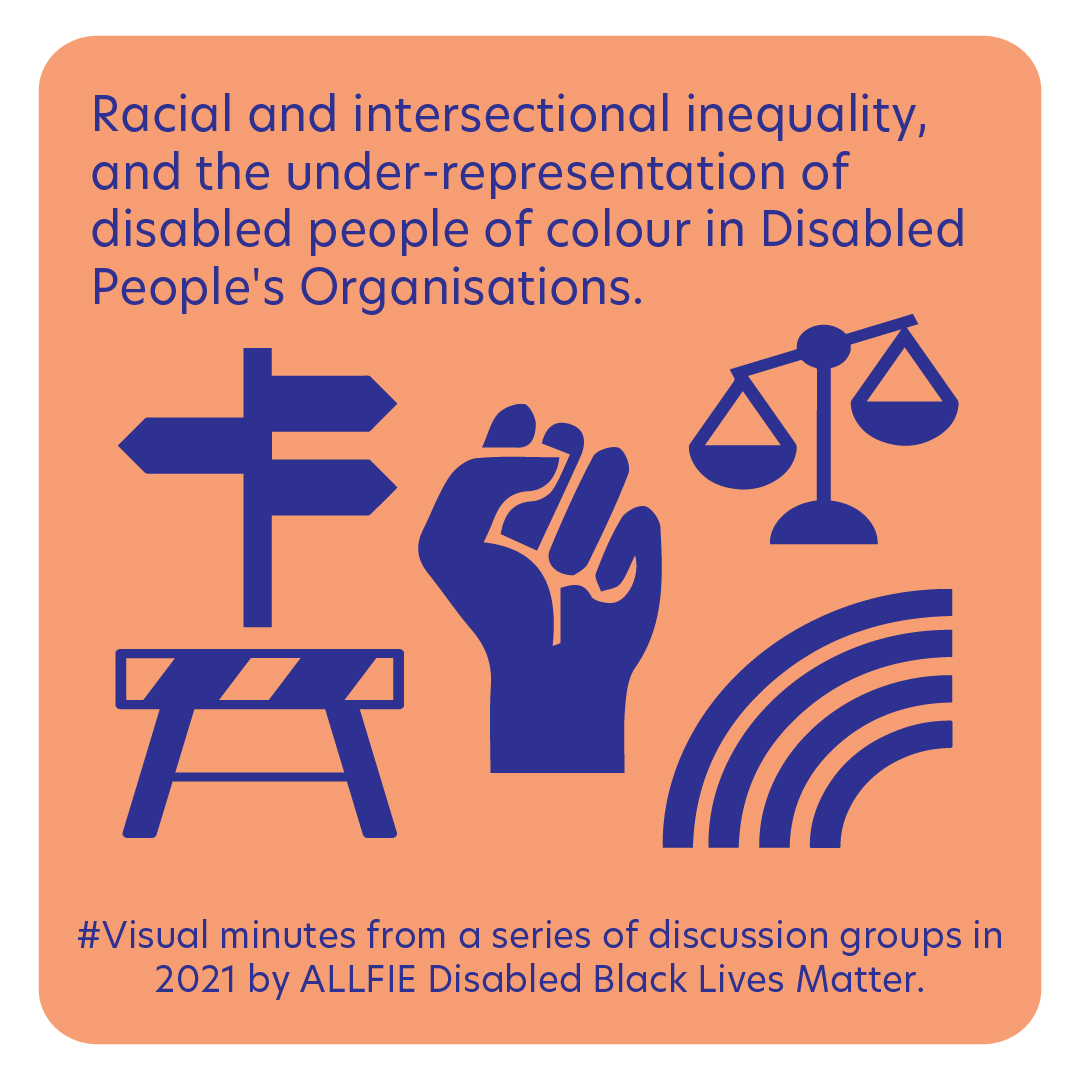
Racial and intersectional inequality, and under-representation of people of colour in Disabled People’s Organisations

‘You can’t get rid of one oppression without getting rid of all of them’

This toolkit includes visual  minutes from a series of discussion groups in 2021 by ALLFIE’s Disabled Black Lives Matter pressure group.

Contents

  1. Key concepts
  2. Key questions
  3. Key ideas for change

1. Key concepts

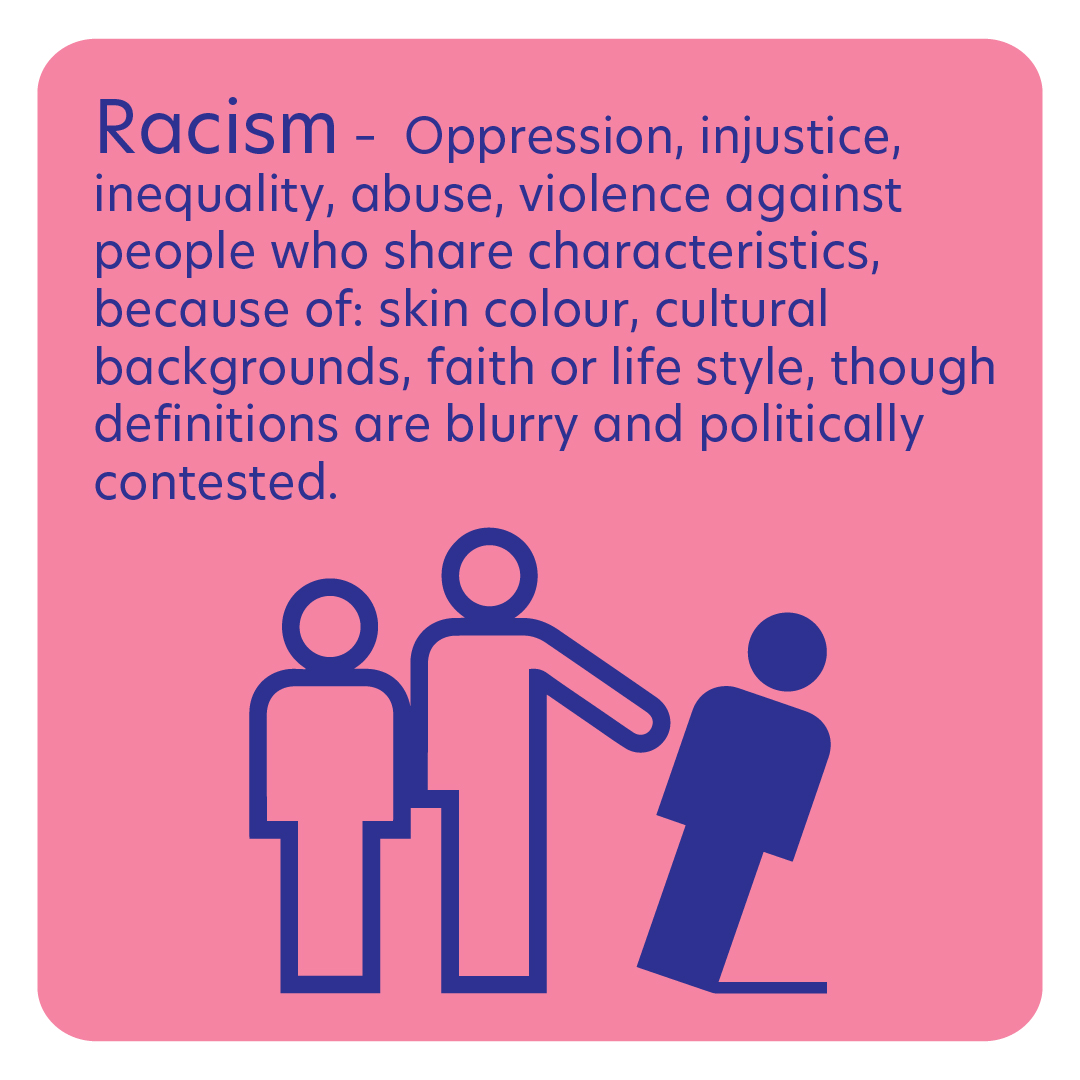
Racism

Oppression, injustice, inequality, abuse, violence against people who share characteristics, because of: skin colour, cultural backgrounds, faith or life style, though definitions are blurry and politically contested.

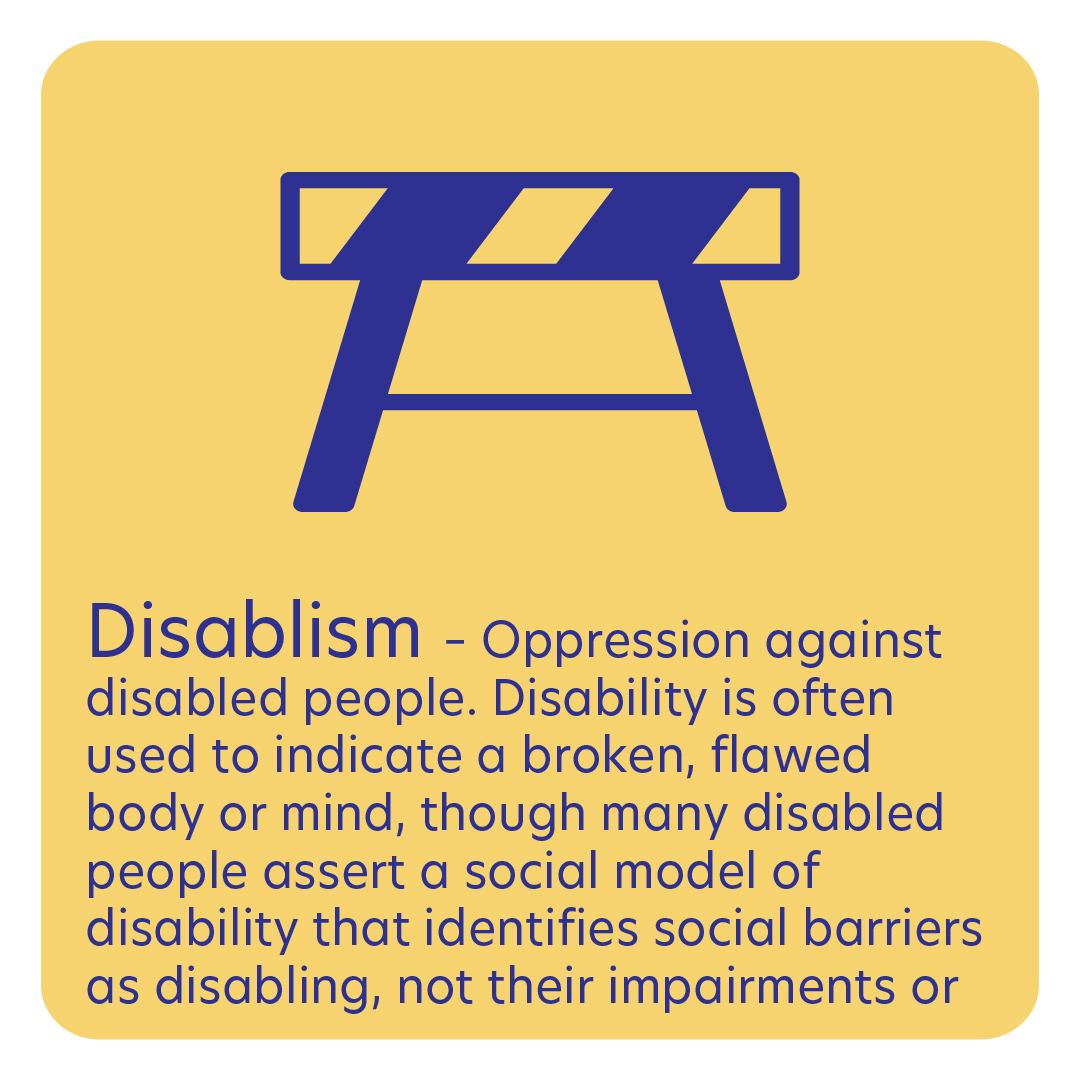
Disablism

Oppression against disabled people. Disability is often used to indicate a broken, flawed body or mind, though many disabled people assert a social model of disability that identifies social barriers as disabling, not their impairments or medically defined conditions.

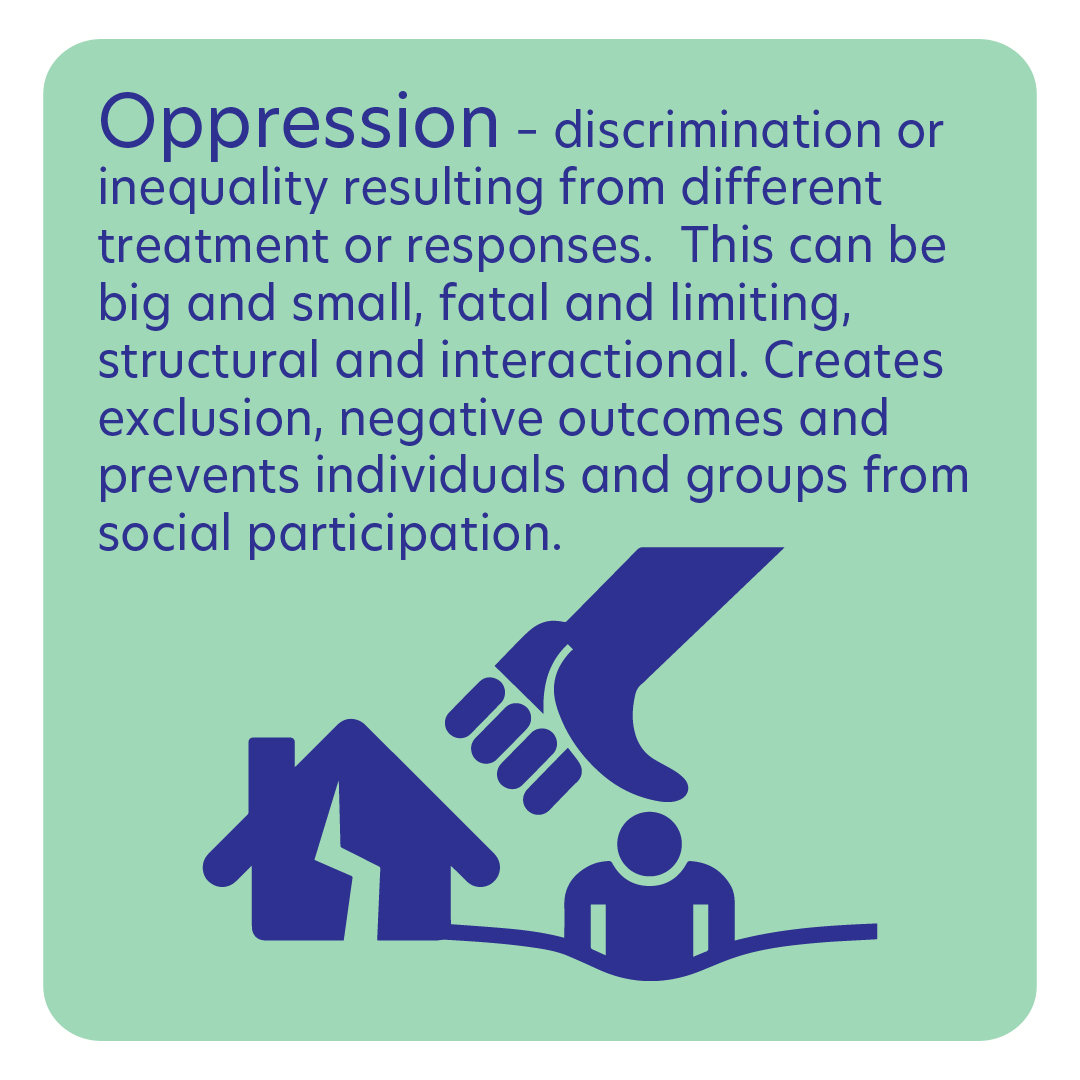
Oppression

Discrimination or inequality resulting from different treatment or responses. This can be big and small, fatal and limiting, structural and interactional. Creates exclusion, negative outcomes and prevents individuals and groups from social participation.

White privilege

Having greater access to power and resources than black people in the same situation.

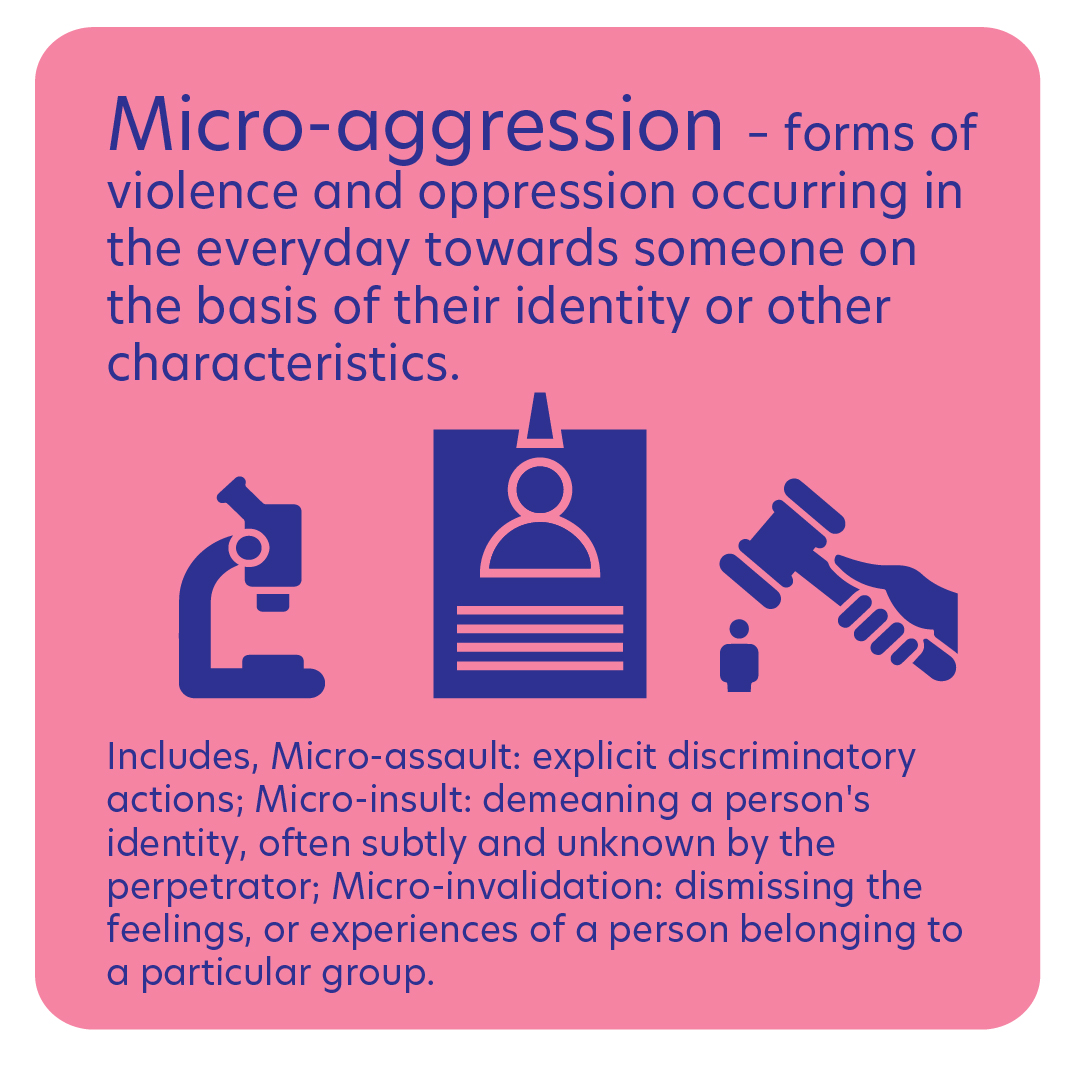
Micro-aggression

Forms of violence and oppression occurring in the everyday towards someone on the basis of their identity or other characteristics. Includes, Micro-assault: explicit discriminatory actions; Microinsult: demeaning a person’s identity, often subtly and unknown by the perpetrator; Micro-invalidation: dismissing the feelings, or experiences of a person belonging to a particular group.

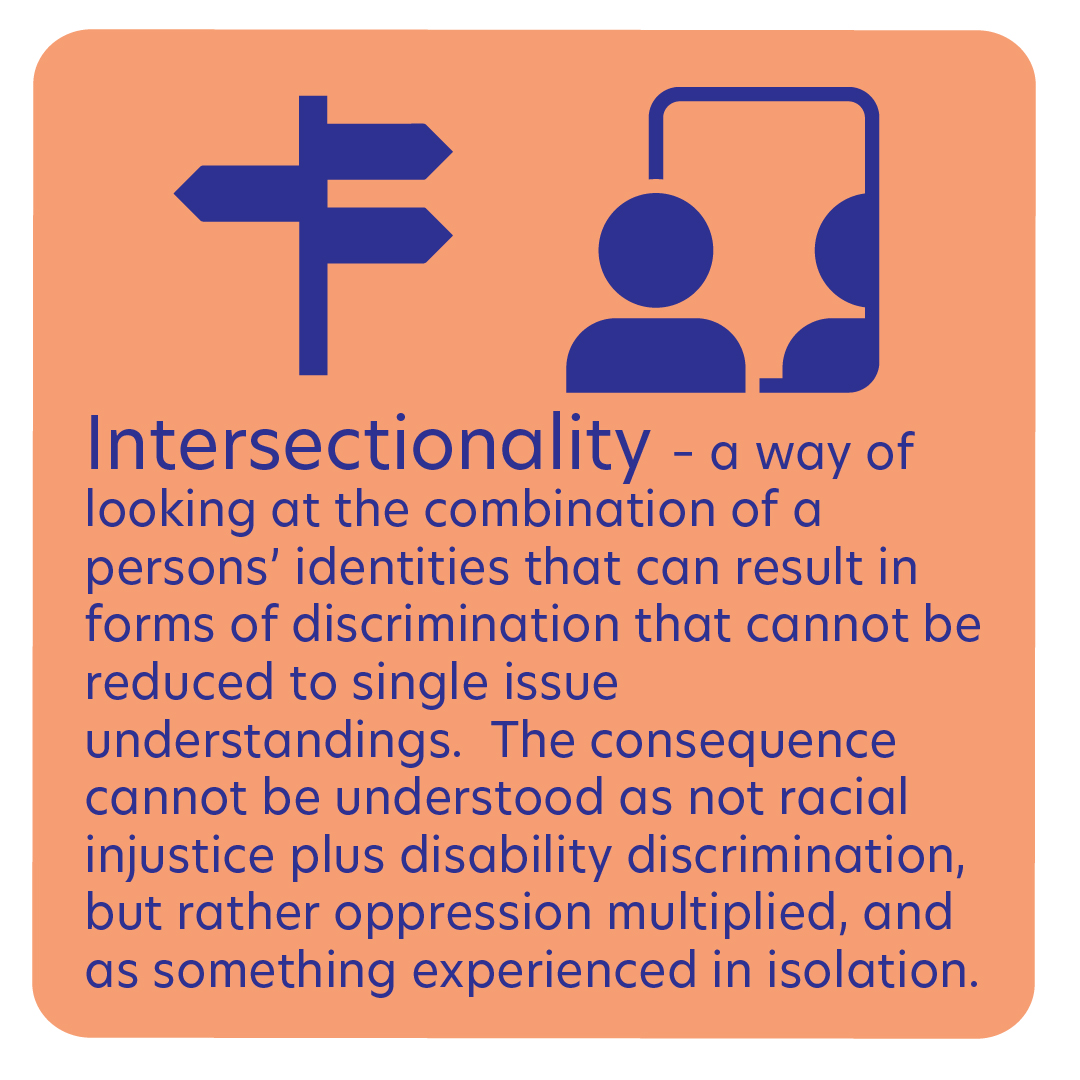
Intersectionality

A way of looking at the combination of a persons’ identities that can result in forms of discrimination that cannot be reduced to single issue understanding. The consequence cannot be understood as not racial injustice plus disability discrimination, but rather oppression multiplied, and as something experienced in isolation.

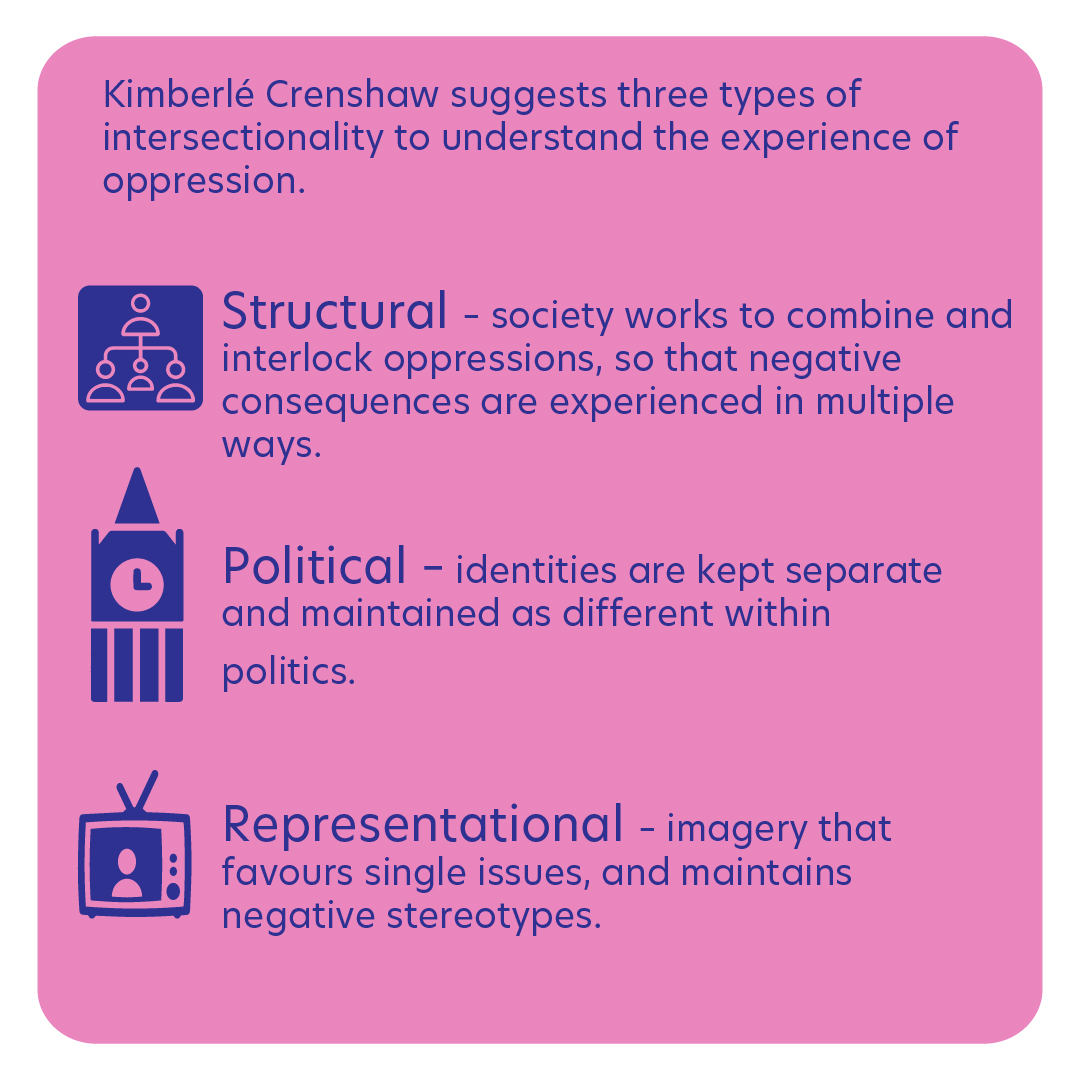
Kimberlé Crenshaw suggests three types of intersectionality to understand the experience of oppression:

Structural

– society works to combine and interlock oppressions, so that negative consequences are experienced in multiple ways.

Political

– identities are kept separate and maintained as different within politics.

Representational

– imagery that favours single issues, and maintains negative stereotypes.


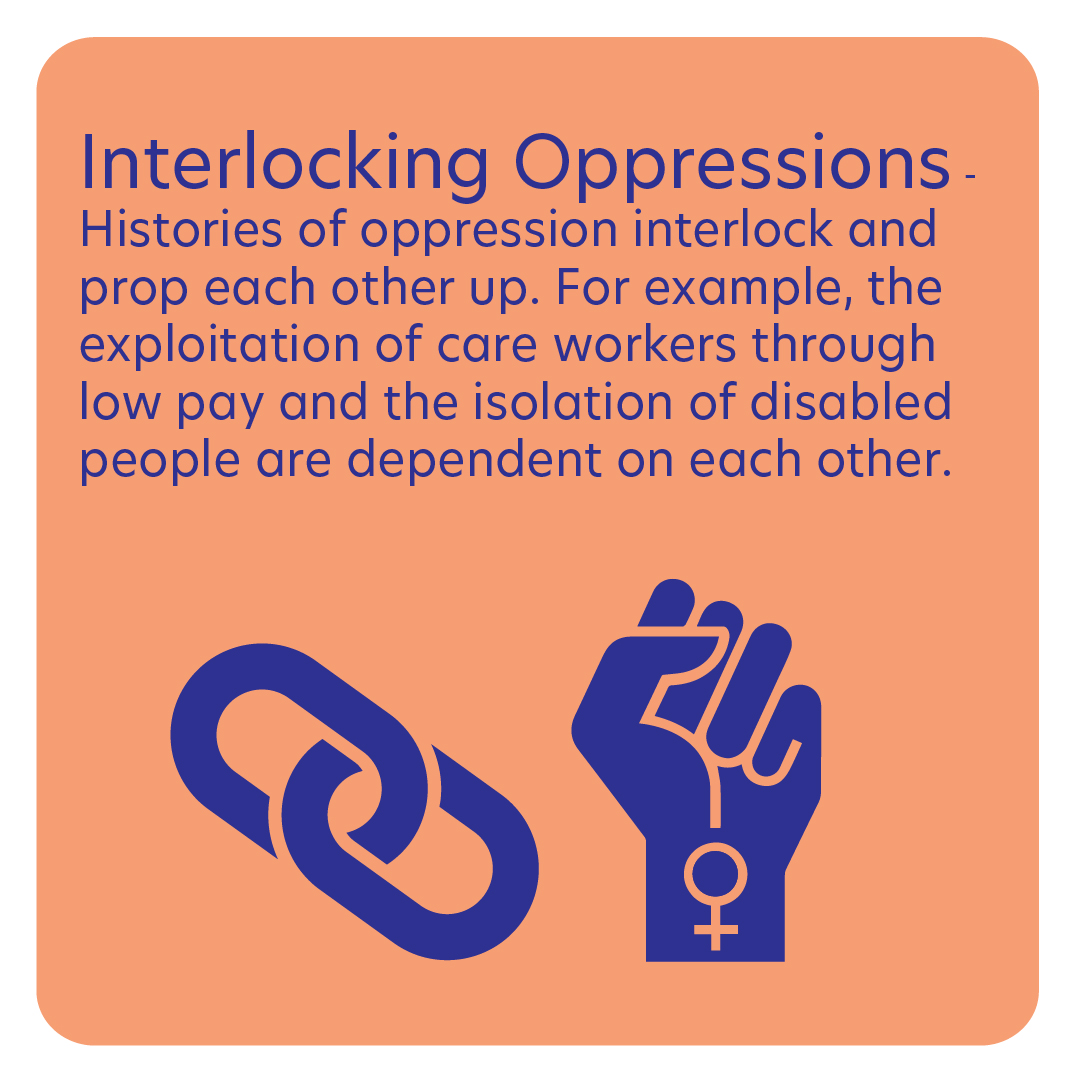
Interlocking Oppressions

– Histories of oppression interlock and prop each other up. For example, the exploitation of care workers through low pay and the isolation of disabled people are dependent on each other.

2. Key questions.

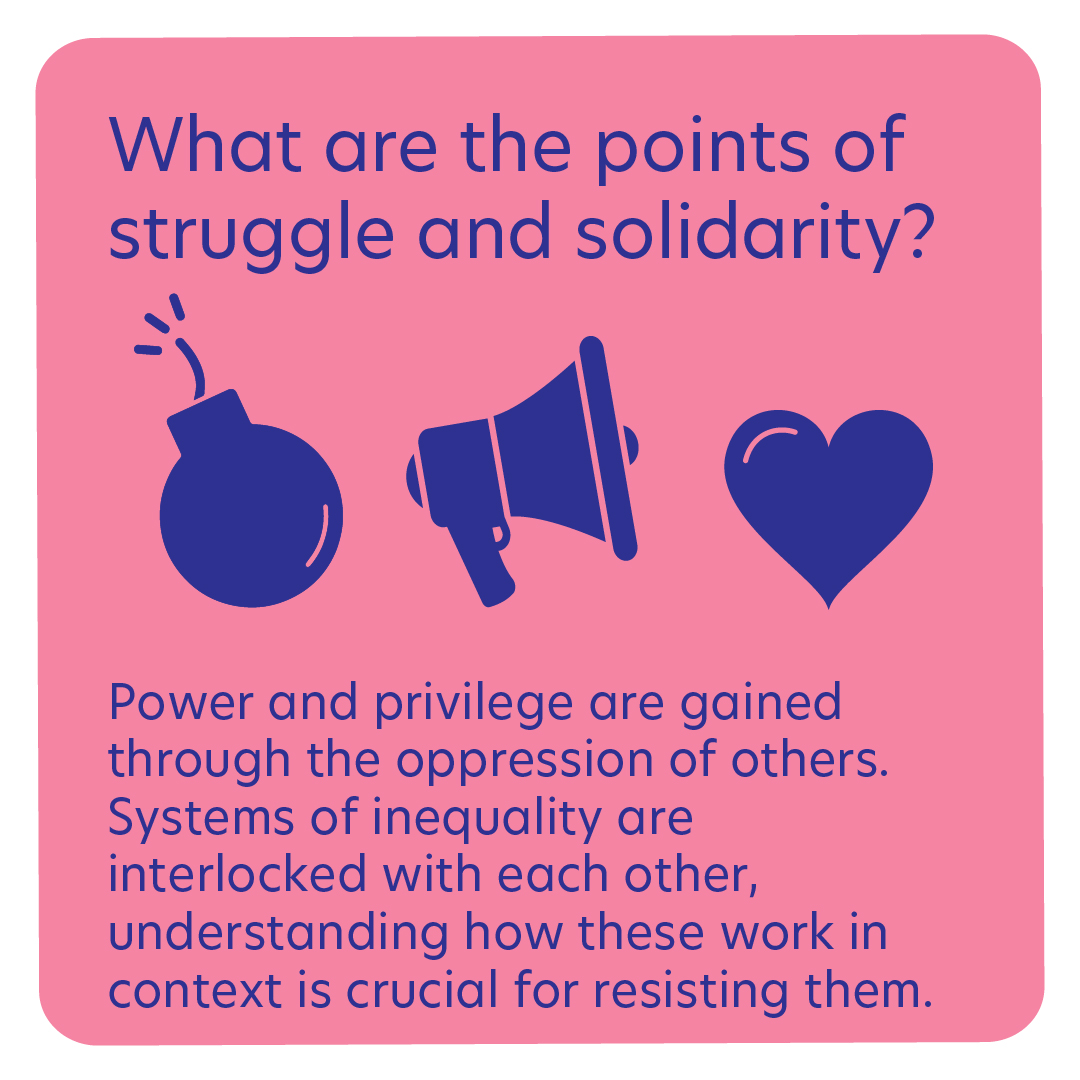
What are the points of struggle and solidarity?

Power and privilege are gained through the oppression of others. Systems of inequality are interlocked with each other, understanding how these work in context is crucial for resisting them.

How do we understand who is visible and who has the power?

Who is privileged? Who is erased? Whose voice is missing? And how do we enable, share and give power away?

How do we move to achieving social justice for all?

For example, a Black Disabled boy who has an Education, Health and Care plan has a 58% chance of receiving a fixed period exclusion. What does an intersectional approach to making a more inclusive curriculum look like?

3. Key ideas for change

1) Create opportunities for more conversations about race and intersectionality experienced by disabled people to document the specific and represent different experiences of people within the rights movement.

2) Develop practical strategies to tackle the injustices and inequalities arising from the intersectional link of race, gender and other intersectional identities experienced by disabled people

3) Challenge default thinking, combat oppression and microaggression in the everyday life, focusing on inclusion of all people as the goal.

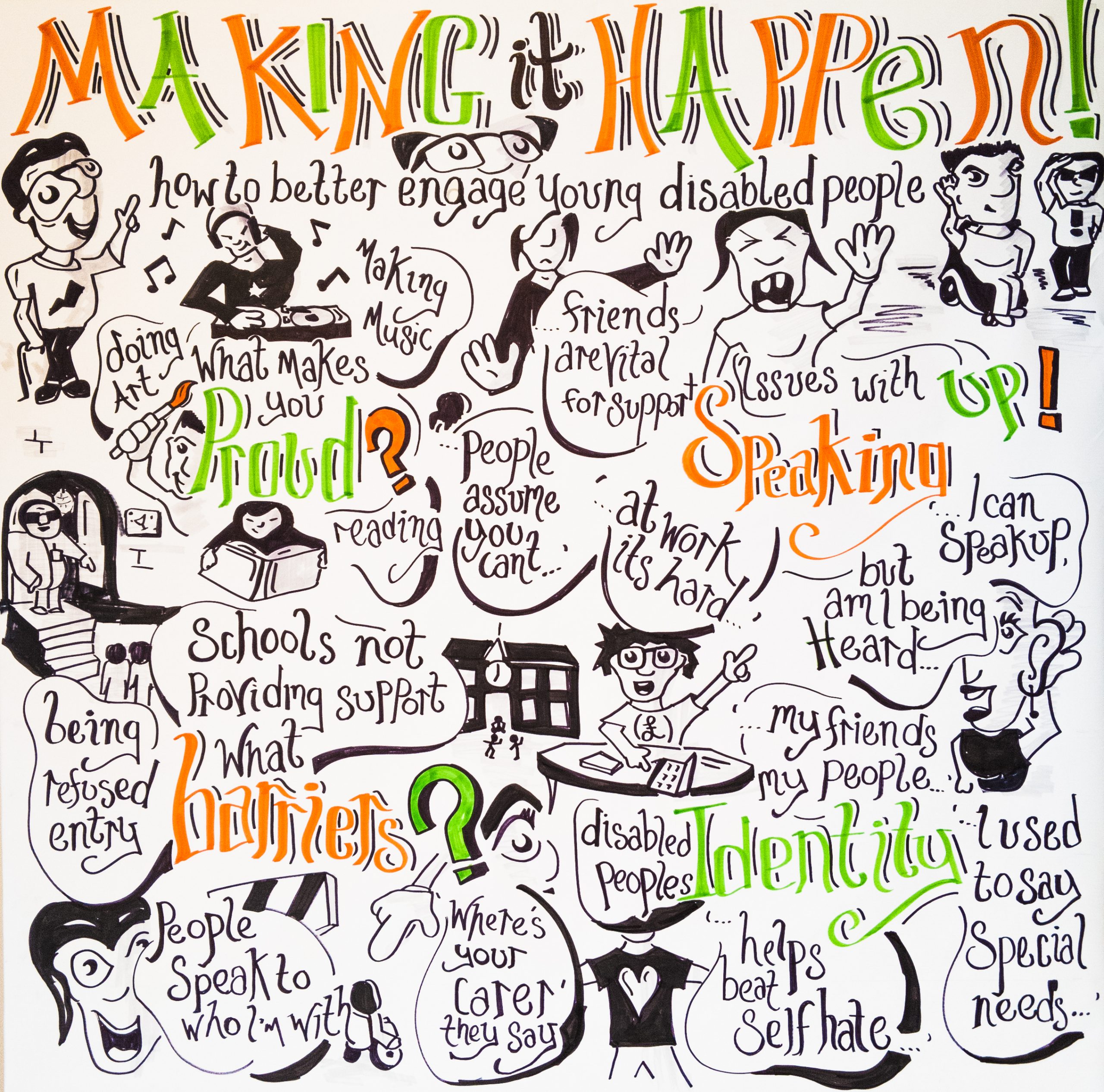
Visual minutes from the workshop: Making Things Happen - how to better engage Young Disabled peopleALLFIE feels that Disabled Young people’s voices have been ignored, especially during COVID-19.

Support for Independent living needs and control over what support remains has decreased during the pandemic. ALLFIE feels that this has increased the levels of Disabled Young people’s isolation. So, in response to this, ALLFIE has created a project called ‘Our Voice’ to make Disabled Young people’s opinions heard and put them out there.

What is the ‘Our Voice’ project? 

The aim of the project is to enable Disabled Young people to have a say on what matters to them, and to address the isolation and intersectional exclusion of Disabled Young people during the pandemic. We have recruited 9 Young people, aged between 16 and 25, to share their experiences on:

The participants are also bringing topics of their own for us all to discuss, so that we don’t miss the things that are important to Disabled Young people.

How it works

The participants meet with some of the ALLFIE team via video-conference for about 90 minutes every few weeks to have conversations and share their experiences. Additionally, ALLFIE are providing training sessions, so our participants increase their knowledge and experience on disability rights and inclusive education.

What will come out of Our Voice project?

From the conversations we have, participants will write blogs, articles and other resources, that will be posted on ALLFIE’s webpage and in other publications. This will cover their experiences during the COVID-19 pandemic, as well as other things they want you to know about.

In June 2021, we plan to hold a panel conversation to conclude the project, highlighting what has been discussed and learned, and at the end of the project, we will have a wealth of evidence and information.

We are also wanting to develop our participants’ skills, and through increased knowledge and experience on disability rights and inclusive education, they can go on to further leadership opportunities with the disability rights movement. ALLFIE will be creating leadership opportunities and are working with other organisations to see if similar roles can be created.

Look out for articles with the #OurVoice and if you want to know more, please contact project lead Armineh Soorenian

In solidarity.

Sign up for ALLFIE updates

Support our campaign for an inclusive society

Resources

  1. Samuel Bartley has created ‘Song About P.A.s’ for the Our Voice project. This instrumental music soundtrack is:

“A happy song, because when P.A.’s (Personal Assistants) are working with me we do fun things together and play games and activities which make me happy. So this piece of sound music is what I have created for being privileged to have supportive P.A’s working with me. I hope you like it!” (Samuel Bartley, Our Voice Project, April 2021)

Music composed by Samuel Bartley especially for the Our Voice Panel Event ‘Disabled Lives, Young Voices’.

Blogs

  1. Turns out, being a disabled young person in lockdown isn’t great, by Remmington
  2. Our voice on intersectionality, by Melody Powell (she/her)
  3. Disability and Happiness, by Matt Smith

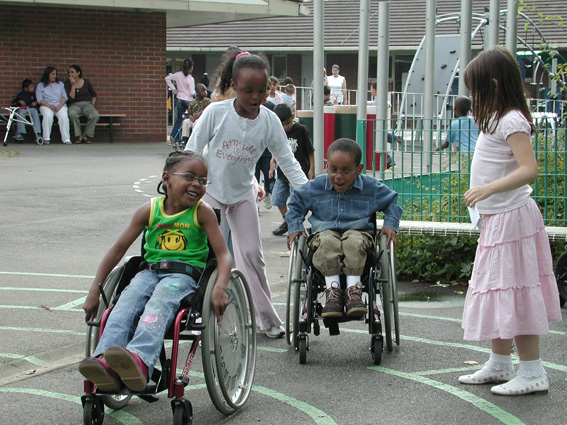
Children playing together, some in wheelchairs, some notALLFIE has sent a joint letter, alongside our allies Inclusion London, Liberty and Disability Rights UK, to Gavin Williamson MP, the Secretary of State for Education. We urge him to remove easements allowing local authorities to depart from their duties to arrange the special education needs and disabilities (SEND) provision necessary for Disabled children and Young people in schools and colleges, as contained within the Coronavirus Act 2020 under Schedule 17 covering the relevant sections of the Children and Families Act 2014.

Letter to Gavin Williamson – Children and Families Act easements: Word version

Letter to Gavin Williamson – Children and Families Act easements: Pdf version

Dear Mr Williamson

We are writing today from leading Disabled people’s organisations, mental health and human rights charities to ask that you remove the easements allowing local authorities to depart from their duties to arrange the special education needs and disabilities (SEND) provision necessary for Disabled children and Young people in schools and colleges, as contained within the Coronavirus Act 2020 under Schedule 17 covering the relevant sections of the Children and Families Act 2014.

We welcome the Government’s acknowledgement of the need to protect Disabled people’s rights in its road to recovery, including through its most recent announcement that it will expire the Care Act 2014 easements, as contained in s.15 of the Coronavirus Act 2020, and its repeal of the Mental Health Act 1983 easements in October 2020.

We are concerned, however, by the omission of the Children and Families Act 2014 easements from the Government’s most recent announcement. As you know, these easements allow for the temporary modification of local authorities’ absolute duty to secure special educational needs and disabilities (SEND) provisions for Disabled students into an obligation to only use their ‘reasonable endeavours’ to do so.

The Government reinstated Disabled children and Young people’s entitlements under the Children and Families Act 2014 in September 2020. However, across local authorities, there remains significant confusion around whether these easements are still in place.

The on-going evidence is that neither local authorities nor schools are consistently complying with their duties to arrange provision for Disabled children within either school or home settings. The Disabled Children’s Partnership have identified that just under half of families reported that their children with education, health and care plans have been without some or any SEND provisions whilst attending school during lockdown.

The Government has a duty to secure every child’s right to an inclusive education. It must leave no child behind in its pandemic response—and that includes Disabled children and Young people. For this reason, we are calling on the Government to repeal the Children and Families Act 2014 easements as contained in the Coronavirus Act 2020, in the interests of clarity, fairness, and equity.

Apart from repealing the Children and Families Act 2014 easements, we are also calling for the Government to implement statutory guidance on remote education provision that includes minimum and universal standards of accessible and inclusive remote education for Disabled children and Young people.

We would also welcome the opportunity to discuss how the Government can better secure every child’s right to an inclusive education in its roadmap to recovery.

We look forward to hearing from you.

Yours sincerely,

Simone Aspis, Campaigns and Policy Co-ordinator, Alliance for Inclusive Education

Fazilet Hadi, Head of Policy, Disability Rights UK

Svetlana Kotova, Director of Campaigns and Justice, Inclusion London

Sam Grant, Head of Policy and Campaigns, Liberty

Sign up for ALLFIE updates

Support our campaign for an inclusive society

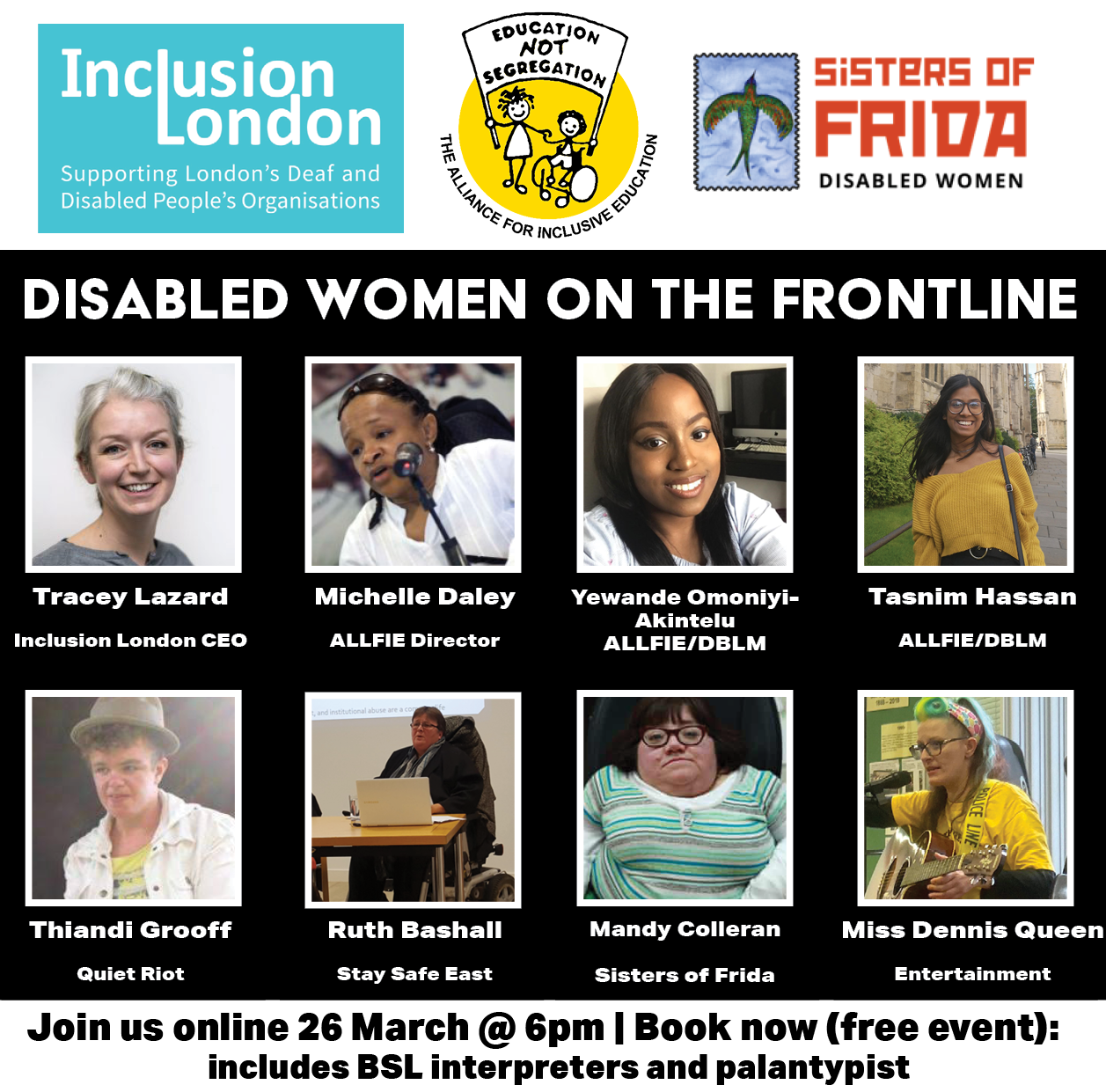
Disabled Women on the Frontline event flyer listing panelists: Tracey Lazard; Michelle Daley; Yewande Omoniyi-Akintelu; Tasnim Hassan; Thiandi Groof; Ruth Bashall; Mandy Colleran; Miss Dennis Queen. Includes logos for Inclusion London, ALLFIE and Sisters of Frida.

ALLFIE, Inclusion London, Sisters of Frida and guests explore the issues for Disabled women at the frontline and leading, amplifying our voices and celebrating the contributions of Disabled Women and Girls within the disability rights movements.

Information about the panelists 

Entertainment:

“The Government’s response to the pandemic has left some people behind. It’s time for a fresh approach, one that prioritises support and human rights, so that everyone is protected during this public health emergency” Liberty UK

Welcome to ALLFIE’s March Covid-19 campaign briefing, covering:

  1. The Coronavirus Rights and Support (‘Protect Everyone’) Bill
  2. What ALLFIE is doing
  3. What you can do: Write to your MP

1. The Coronavirus Rights and Support (‘Protect Everyone’) Bill

The Coronavirus (Rights And Support) Bill – better known as the ‘Protect Everyone’ Bill – is a joint response from Liberty and Disabled People’s Organisations (DPOs) including ALLFIE, calling for the removal of Children and Families and Care Act’s easements under the Coronavirus Act.

On 25th March the Government is debating ‘the bill’.

“When this pandemic hit, we needed a Government response that we could be confident would protect us. But we got the Coronavirus Act.

Instead of hope and support, the Government has watered down our rights, plunged millions into extended lockdowns with confusing communications and prioritised punishment over support – hitting already marginalised communities hardest.

The Government’s pandemic response both oversteps the mark and under-delivers for those who need support most.

When the Coronavirus Act is up for renewal in the coming weeks, MPs must vote against this harmful approach. This will trigger a three-week window to create its replacement. That work is already done.

We’ve teamed up with expert charities, NGOs and lawyers to present a positive alternative: The Protect Everyone Bill.

The Government has said it wants to ‘build back better’. The Protect Everyone Bill is how we do so.” Liberty ‘Protect Everyone’ briefing 25 February

For more information: https://www.libertyhumanrights.org.uk/fundamental/coronavirus/

Background

The Coronavirus Act 2020 was passed in Parliament in March 2020. This emergency legislation provided the UK Government with powers to deal with the Covid-19 pandemic. ALLFIE reported throughout 2020 and 2021 how this has eroded Disabled people’s rights, including for education, health and care.

ALLFIE’s lockdown inclusive education survey highlighted how many Disabled pupils and students have had no education for over a year, or remain without the necessary support within mainstream educational settings – with severe and long lasting impact upon their lives. The important data and findings gathered from this survey enabled ALLFIE to make numerous submissions to Parliamentary committees and inquiries, including:

  1. Women and Equalities Committee Inquiry: Unequal impact? Coronavirus, disability and access to services
  2. Joint Committee on Human Rights Inquiry: The Government’s Response to COVID-19: Human Rights Implications
  3. Education Committee Inquiry: Impact of COVID-19 on Education and Children’s Services
  4. SEND All Party Parliamentary Group on Covid-19 Inquiry

2. What ALLFIE is doing

As we move into the recovery phase of the Covid-19 pandemic and the UK Government’s ‘roadmap’ out, ALLFIE is working with Liberty, and Deaf and Disabled People’s Organisations (DDPOs) including Inclusion London, to demand  the removal of easements to the Children and Families Act and Care Act.

Work with Liberty

ALLFIE has been working with Liberty to demand  the removal of easements to the Children and Families Act and Care Act. This includes contributing to the Coronavirus Rights and Support ‘Protect Everyone’ Bill – a rights-respecting legislative response to the coronavirus pandemic. It repeals the powers contained in the Coronavirus Act 2020 which put civil liberties at risk, and establishes measures which provide people with the protections they need in a public health crisis.

For more information: https://www.libertyhumanrights.org.uk/fundamental/coronavirus/

Work with DDPOs

ALLFIE has produced this joint Deaf and Disabled People’s Organisations (DDPOs) briefing with Inclusion London and Disability Rights UK, calling for the Government to Restore the Rights of Disabled People:

Restore the Rights of Disabled People: Coronavirus Act 1 Year Review

3. What you can do: Write to your MP

Write to your MP/Minister ahead of the debate on 25th March (suggested wording below):

Find your MP using Liberty’s useful tool: Liberty Human Rights

Mr Gavin Williamson MP
Secretary of State for Education
Sanctuary Buildings
Great Smith Street,
London SW1P 3BT

Date: (add)

Dear Mr Williamson

I am writing to ask that you remove the easements allowing local authorities to depart from their duties to arrange the special education needs and disabilities (SEND) provision necessary for Disabled children and young people in schools and colleges, as contained within the Coronavirus Act 2020 under Schedule 17 covering the relevant sections of the Children and Families Act 2014.

I also want to ask you to expand the Right for Remote education guidance to include minimum and universal standards of accessible and inclusive remote education for Disabled children and young people.

The on-going evidence is that neither local authorities nor schools are consistently complying with their duties to arrange provision for Disabled children within either school or home settings.

I am not alone in asking this of you. The Disabled Children’s Partnership have identified that just under half of families reported that their children with education, health and care plans have been without some or any SEND provisions whilst attending school during lockdown.[i]

ALLFIE have also experienced various difficulties in supporting Disabled children and young peoples’ right to access inclusive remote education. According to the Nuffield Foundation, 30% of families have limited IT access, and many pupils have struggled to engage with online learning due to their needs.[ii]

As the country moves out of the pandemic and into the recovery phase, it is vital that Disabled children and young people do not face continued disruption and further educational disadvantages.

I am thus looking forward to hearing from you about removing the education easements and developing inclusive remote education statutory guidance.

Yours sincerely

(add name)

[i] Disabled Children’s Partnership. (2020). The return to school for disabled children during lockdown. Retrieved from https://disabledchildrenspartnership.org.uk/wp-content/uploads/2020/11/Back-to-school-poll-report.pdf

[ii] Amy Skipp, Vicky Hopwood & Rob Webster. (2021). Special education during lockdown: providers’ and parents’ experiences. Retrieved from https://mk0nuffieldfounpg9ee.kinstacdn.com/wp-content/uploads/2021/02/Special_Education_Lockdown_ASKResearch.pdf

As we head into spring, we’re delighted to hear from so many Disabled Young writers, who bring a fresh perspective to these pages. There is an air of positivity emerging from their Covid-19 education experiences, for example from established Disabled Young author, Jonathan Bryan’s via his interview and poetry (page 10).

As we approach International Women’s Day, March is a time to celebrate and raise-up women globally, and this issue highlights the voices of Young women writers within the Disability Movement. Melody Powell’s article about online university (page 3) kicks off the Spring issue and is a great guide for any Young Disabled person who is considering studying online. On page 5, Fifteen-year old Kadijah Adam writes her first article for the magazine – bringing her positive perspective on Covid-19 remote education – as she shares her personal experiences of lockdown learning.

Melody Powell’s later review (page 14) of the BBC’s ‘Criptales’ delves into current media and societal representations of disability. ALLFIE’s Disabled Black Lives Matter group follow this theme and go further (page 16). Their joint critical review of the BBC’s recent documentary: ‘Silenced: The Hidden History of Disabled Britain’, exposes the erasure of intersectional voices and contributions, in both historical and contemporary representations of Disabled people and their movements.

On a legal note, Thandi Groof discusses Inclusive Education in the European Court, referring to recent case G.L. vs Italy (page 7); while the Legal Question (page 26) addresses legal responsibility for British Sign Language (BSL) on Covid-19 virtual education platforms.

In solidarity,

Catherine Bebbington

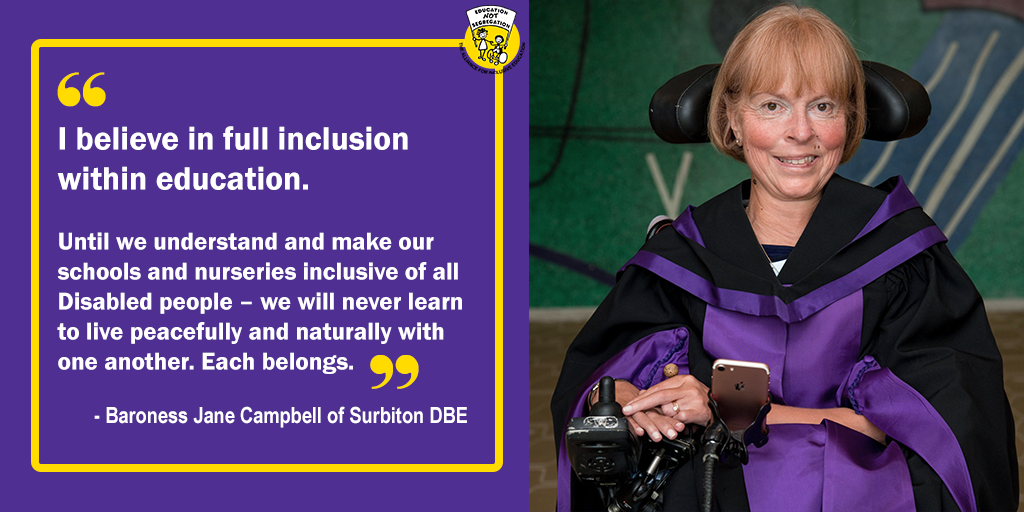
Graphic box with image of Jane Campbell of Surbiton DBE alongside her quote: "I believe in full inclusion within education. Until we understand and make our schools and nurseries inclusive of all Disabled people – we will never learn to live peacefully and naturally with one another. Each belongs."

Online University Empowers Disabled Students

The year 2020 was a tough and emotional experience for most of us. It forced us to adapt to new situations and find alternative ways to continue with our education. By Melody Powell (She/Her)

Online studying quickly became the new normal for many, an experience that was unknown and challenging for most. I have been studying online since 2018 through the Open University and have a lot of appreciation for its flexible and accessible ethos. I hope that by sharing my experiences of online study, fellow university students can confidently approach university life online, whether that be as a temporary solution or permanent change

My Online University Journey

My university experience began a year later than most, at age 19, as my unpredictable health caused problems with the set schedules of a brick (in-person) university. When I eventually discovered online learning via the Open University, I felt that further education was finally achievable for someone like me as I could study at my own pace. The application process was remarkably straightforward too, with student support assisting with any accessibility needs along the way, nothing was too much trouble. I was then directed to Disabled Students Allowance (DSA), a government scheme that provides equipment that you need to study, such as height adjustable tables, screen readers and text to speech software. The university can also provide you with accessible module materials, things like comb-bound books, audio books and print outs from the website can be sent to you if you need them.

Even with my extra equipment, I felt full-time study would be too much for me, so I decided to work on a part-time schedule. This means that my degree will take six years, rather than the standard three. Although that means it will take me longer to complete, I know that I won’t burn myself out studying and can reach my academic potential. The great thing is that if your circumstances change at all, you can even break down the work further as you can defer for a year or two on most courses. The ability to attend lectures in the morning or evening is also well suited to those with unpredictable lives, you just book onto whichever time suits you best. This has increased my productivity greatly as I do not have to rely on people to take notes or email over missed lectures while I’m absent from university. It’s also great to be able to study from anywhere – I no longer have to worry if I am too tired to get out of bed or need to stay overnight in hospital – as I can always take my virtual university with me and study any time.

Looking After Physical and Mental Health is Important

The ability to customise your educational journey is not the only highlight of online university, the support you receive for physical and mental health is amazing. If at any point you need guidance or an assignment extension due to unexpected life events, your tutor is contactable 24/7 via email or phone and gets back to you within 2 working days. For more urgent queries about your study, or if you feel the workload is too much, you can always contact student support for advice. The online student forums and social media groups are a great source of encouragement too. Having fellow students from all walks of life to form study groups and discuss everyday problems with is very comforting.

Why Access to Online Education is Important

Education is such an empowering thing and should be accessible to anyone wanting to learn. Unfortunately, most schools only promote brick universities, which cannot always cater to everyone’s unique needs and learning styles. This lack of advertising for online study causes people, including my past self, to wrongly believe that online degrees are easier and of a lesser standard. Online university provides the same respectable qualifications as any other university and deserve to be praised for the accessibility they provide. Lives are constantly being changed thanks to online university, as people have the chance to achieve things they could only ever dream of before. With flexible online education, the possibilities are now endless.

My Positive Experience of Lockdown Learning

Kadijah Adam – a Disabled teenager studying in her local mainstream school – is interviewed by Michelle Daley, ALLFIE Director, for Inclusion Now magazine. We hear about her positive mainstream inclusion experiences at St Paul’s Catholic School in Milton Keynes, including how Covid-19 remote learning has enhanced her inclusive education experience.

My name is Kadijah Adam, I am 15 years old and experience sensory, physical and learning difficulties. I’m currently studying Year 10 at my local mainstream school, St. Paul’s Catholic School in Milton Keynes where, out of 800 pupils, only a few are Disabled pupils. Before I started at St Paul’s there were discussions around me attending a special school, but fortunately my parents rejected the idea and I remained in mainstream education.

Why is it important that Disabled children attend mainstream school?

It’s a bit scary being in mainstream school – for example you get can red marks for things like late attendance – but I developed a small friendship circle, which is very important to me. I believe all Disabled children should have the opportunity to mix, to learn together, which increases our friendship circles, so nobody is segregated from the experiences of community life.

How have you found home-schooling and remote learning during lockdown?

I really enjoy home-schooling and remote learning. In a formal classroom setting, I find the size and structure difficult to cope with. This causes barriers which impact on how I work in groups and communicate with other pupils in the classroom, including forming relationships. At school, before lockdown, I often felt a lack of motivation and was considered by others as socially awkward. I was made to feel  that my epilepsy and other impairments were an issue to my learning. With remote learning, I find it easier and less stressful because I don’t have to deal with the school processes and structures. I have my own routine, I don’t have to move from one class to another, and I have my own desk with my laptop and phone to do school work. As a result, I now spend the week working on subjects which I do well in, which makes me happy and I feel motivated to do more work in my own environment. I also have fewer distractions, which gives me time to pursue topics and subjects I love. Remote education gives me control over what I’m doing with my learning, and motivates me to dig deeper into the topics I have learnt.

As a result of home-schooling/remote learning I was awarded the pupil of the week in English for the first week of December. I have also been nominated for 2019/2020 learning support achieved at key stage 3 – without home-schooling I wouldn’t have achieved this. I have also improved my cooking skills, which I’m passionate about. Over lockdown, I have done a lot of cooking and baking at home with my mum and sisters. Unfortunately, I don’t have access to my learning support assistant, but my parents have provided my support, which has worked well.

What should school look like after the lockdown?

I think that the Department for Education should talk with pupils to find out about our experiences on the good and bad things about home-schooling and remote learning. I don’t think we should go back to the old ways of schooling, children should have access to both in person classroom and/or remote learning and this should include: flexible timetable, choice of in-person classroom or remote learning, and access to support assistance outside of the classroom. I think these changes would improve accessibility of schooling and learning for all children.

I want more Disabled children like myself to be able to attend mainstream school so that everyone can learn together, which will help us to learn about unity and respect.

We all want inclusive education, right? Although we also know that governments (except Italy) are generally not very eager to realize it. But in a verdict in September 2020, the European Court for Human Rights has endorsed inclusive education as a right that is fundamental to enjoy other rights. Because, if society excludes you, they dehumanise you; you are told that you are a failure that needs to be fixed before entering the society. And a human society does not want to dehumanise you, right?

What is the European Court for Human Rights?

Europe has its own United Nations, which is called the Council of Europe (CoE), with 47 States (the EU has only 27 States). The Council of Europe was founded in 1949 to prevent another war and to protect human rights and democracy after the terrible holocaust in World War II. Nearly all of the European States are members. These states adopted the European Convention of Human Rights. If a citizen thinks that the State has violated a person’s rights they can go to the European Court of Human Rights, but only after they’ve been to all the national courts. The Court decides if a country has violated the rights of their citizens as recorded in the Convention. For the UK (and Europe), an important judgment is the Osman case (a young man stalked by a teacher which resulted in a murder), in which the Court judged that the state has to protect the life of their citizens. This can be used against the local authorities when they do nothing against hate crime. Another famous verdict is the Cosans and Campbell case, in which the Court judged that parents don’t have to sign a paper that allows the school to execute corporal punishment. States usually comply with the verdict, and because of this the European Court has a strong influence on states to take their obligations seriously.

The right to education.

One of the human rights is the Right to Inclusive Education. While the European Council at the start spoke only on the Right to Education (Article 2 of the first Protocol), the article gradually was extended to inclusive education by the Committee of Ministers of the Council of Europe and by exchanging views with other international courts. However, it is not consolidated yet in the European Court, where in every case there might be different judges with different attitudes. In light of this, it is so important that in the latest verdict of G.L. against Italy, the Court explained the merits of, and the necessity for inclusive education so thoroughly.

What was the case about?

The case involved a Young person with severe learning difficulties who had been provided with enough learning support and care in nursery school (4-6 years of age) “to enable her to benefit from the educational and social service offered by the school on an equal footing with the other pupils”, as Italian law prescribes. But after starting the elementary school, the local authorities stopped the support by telling the parents that the local support budget was spent on adults with a muscle disease, and that therefore they couldn’t provide support for this Young person. The parents went to the local judge, the appeal court and the supreme court of Italy, who all confirmed that the local authorities’ lack of budget was a good enough argument to not be able to give the desired support. The European Court, however, disagreed by calling this discrimination because the lack of budget affected only this Young person and not the other pupils. The Court argued further:

“without support the [Young person] was unable to continue attending prima ry school under conditions equivalent to those enjoyed by non-Disabled pupils, and that this difference in treatment was due to her disability.”

And:

“support was needed to promote her autonomy and personal communication and to improve her learning, relationship life and school integration, in order to eliminate the risk of marginalization.”

The Court also mentioned the huge advantage for other children in reiterating the Council of Europe Ministers:

“providing Disabled persons with the opportunity to participate in ordinary educational structures is important not only for them, but also for non-Disabled people who will become aware of disability as part of human diversity.”

In her decision, the Court mentions the obligation of each State under the European convention, by stating:

“due diligence [by the state is] required to ensure that the applicant enjoys her right to education on an equal footing with other students.”

And the Court stresses the necessity of inclusive education for social integration:

“the discrimination suffered by the applicant is all the more serious because it took place in the context of primary education, which provides the basis for education and social integration and the first experiences of living together.”

Paragraph 54 is interesting:

“The Court also recalls that when a restriction of fundamental rights applies to a particularly vulnerable class of population that has in the past suffered significant discrimination, the state’s discretion is then significantly reduced.”

This means that the state must have very strong appropriate arguments to restrict the right to inclusive education.

What do we learn from this verdict?

  1. That now we have the European Court on our side to convince local authorities about inclusive education.
  2. Lack of budget is no excuse for not giving a pupil the support she needs. Budget cuts must be divided evenly between Disabled and non-disabled pupils.
  3. The court might be the place to fight discrimination on the grounds of disability, like in the US, the case Brown v the board of education, accelerated the civil rights movement. (If you have no money to start a legal process, then the state must give you the money, because the right to have practical access to a court (Article 6.1) is a very strong one since the Irish Airey case).
  4. How much will this affect things in the UK? Even though the United Kingdom has left the European Union in January 2021, the UK is still a member of the European Convention on Human Rights, as such, it is still bound by the ruling of the European Court on Human Rights. For Disabled people in the United Kingdom, this means that the people are still able to hold the UK Government accountable with regards to it’s obligations to protect the rights of Disabled people.

Further reading

The Case itself can be found here: HUDOC: ECHR no59751/15

“Like a bird released from a cage, I am free to fly in the open fields”

Jonathan Bryan, a 14-year-old author, poet, charity founder, campaigner, and Disabled non-verbal champion for inclusion, is interviewed by Richard Rieser for Inclusion Now.

Jonathan, tell us about your home, family and friends – how does your household operate?

“I live in a small village in Wiltshire with my parents, two younger sisters and our golden retriever; and along with a team of personal assistants (PA) we make a busy household which never sleeps, as my night PA are awake all night.”

And what about the nature of your impairment and the impact it had/has on your functioning?

“When my mother was pregnant she was in a car accident and I suffered a placental abruption, which starved my body of blood and oxygen. Following this, I was diagnosed with cerebral palsy and end stage renal failure and received a kidney transplant just before my fourth birthday. After my transplant I contracted Adenovirus (they have adapted a chimp version of the Adenovirus to make the Coronavirus vaccine), which left me oxygen dependent. The combination of these impairments has left me with a worn out body but an alive mind.”

What were the pluses and minuses of attending your special school?

“When I was four, I started at special school where I was taught by a lovely teacher and made good friends. I was labelled as PMLD (Profound and Multiple Learning Disability) so was given a sensory curriculum. When I was in reception this was fun, but as the years went on it was obvious that there was no expectation of progression and no teaching of literacy, or even understanding that we develop in interests beyond pre-school. This was frustrating and demeaning.”

Tell us how your mother and others found out about your eye pointing method of communicating and developed it with you?

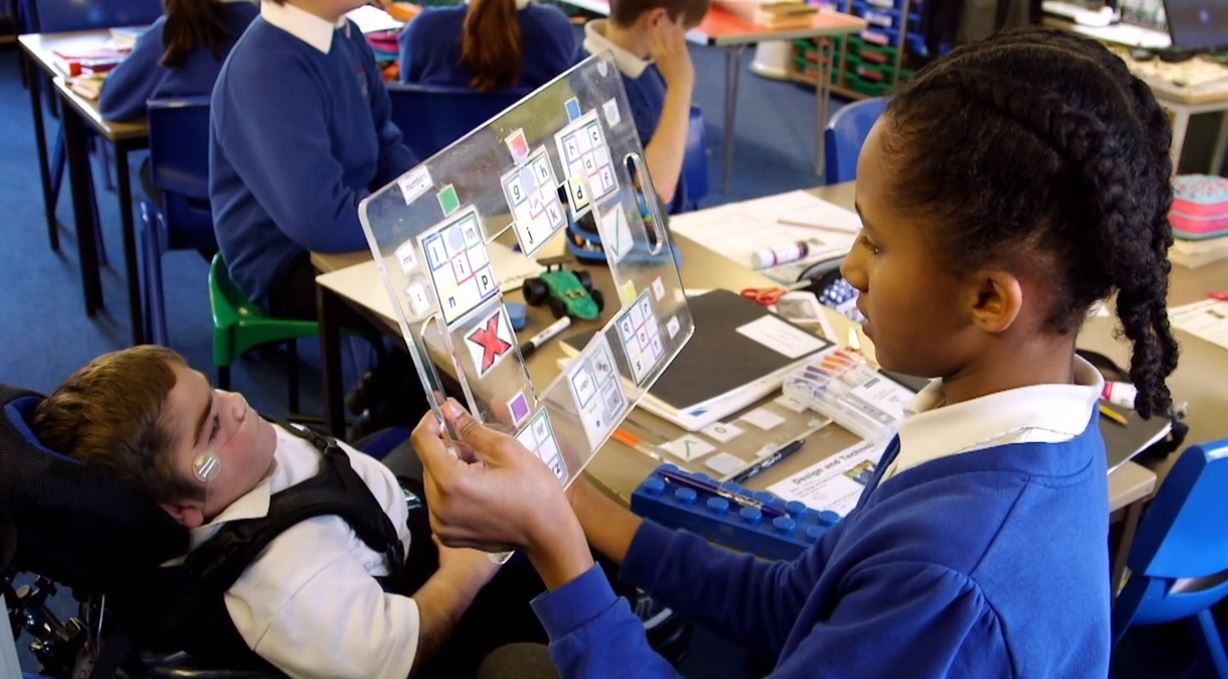
“When I tried an eye gaze computer it didn’t work for me and I found it very frustrating, but my personal assistants stood behind the machine could see where I was looking; so we started using a Perspex e-tran frame with my learning resources stuck to it and my carers and mother pointing at where I was looking.

At special school I was not taught to read or write, so my mother took me out of school to teach me at home for a couple of hours a day. After a year and a half, I had learnt enough to spell out everything I wanted to write and say, using the alphabet divided into colour coded groups and stuck to the e-tran frame. Each letter is two looks on the board. I have a separate board with numbers stuck to it for maths.”

Explain the feelings and perceptions you had from no longer being ‘locked in’?

“Throughout my life I have been able to use non-verbal communication, but there is nothing like being able to communicate my thoughts and feelings using words. Life is richer, life is deeper, life is fulfilled. Like a bird released from a cage, I am free to fly in the open fields.”

Tell us about going to your local primary school? How did your peers and teachers learn to support you?

“My local village primary school went out of their way to include me, both in the classroom and out of it, by for example, joining my class on school trips and residential. Where possible the teachers sent lesson plans and resources in advance so my carers could adapt them to make it easier for me to join in. In the class, I was often asked a question and then the teacher came back to me a few minutes later for an answer. My table had table raisers so my wheelchair fitted under the table, and my class partner sat on a stool. The layout of the classroom was adapted so I could access the parts of the room I needed to. For our music lesson I took in Soundbeam so that I could join in. In games my peers took it in turns pushing me, as far as I was concerned the faster the better (my carers didn’t always agree with this philosophy). Sometimes I would take my walker in and my friends would whoop and clap when I managed to move it. All my peers could use my spelling board for yes and no, and one of my friends learnt to use my board for all my communication, she was so quick my personal assistants became redundant as communication partners.”

Jonathan Bryan and his class-mate pictured during a school lesson, using a spelling board to communicate.

How did you feel being included and do you think all Disabled children should have the chance to be included?

“Being included as part of the class and school is great and makes you feel valued in the community. Before I could spell, I attended my local primary school for one afternoon a week, which was always fun and I made some good friends.”

What do you think will need to change to make inclusion a reality?

“If everyone valued inclusion, it would be more of a reality. It takes belief in the importance of inclusion and a can-do mindset to enable it to happen.”

Based on your experience you started a charity and campaignTeach Us Too’. Tell us why you set this up and some of the main impacts it has had to change things for children with complex communication needs?

“Tragically, there are many children with academic labels like PMLD (Profound and Multiple Learning Difficulties) who are not taught to read or write at school. Expectations founded on labels often leads to a lack of educational aspiration. For non-verbal children like me, literacy is not just a life skill, literacy gives us a voice. Even at its most basic, being able to write simple words gives us the ability to say what we want in our own way.

With my charity ‘Teach Us Too’, I have sought to raise awareness of this issue, I’ve done interviews, spoken to thousands of trainee teachers and heads of schools. We challenge attitudes and assumptions based on labels, influence educational practice and encourage ambition, and share good practice for practitioners and parents alike. Until all children are taught to read and write, I will continue to be the voice for the voiceless.”

Tell us about your transfer to secondary school? What worked well and what could have been better?

“When I transferred to secondary school, I made a small pamphlet explaining who I was, why I needed a wheelchair, and crucially, how I communicate. It was folded A5 and I tried to think of the questions people at school would like to know about me, and then answer them. The pamphlet was given to everyone in the school the summer before I joined, including the new year 7s on their taster day. As a result, everyone at secondary has always talked to me in a normal voice, knowing I understand. Early on, my tutor group had a session on other ways of communicating including having a go at my spelling board. After the first half term, my care team and I had a meeting with the teachers on how best to support my learning in the classroom. Ideally this happens every new academic year, as close to the start of term as possible, as I have new teachers every year.”

Tell us about your writing?

“Writing is my joy and passion. In 2018 my first book, ‘Eye Can Write’, was published, in which I shared my story. I regularly write blogs on my website, eyecantalk.net, and write articles and poems when my school work allows.”

Lockdown for Covid-19 has been difficult for everyone, but you have been out of school for 10 months because of your high risk of infection. How have you coped and what thoughts have you had about coping?

“From an educational point of view, lockdown has been really difficult. Like many secondary schools, during the first lockdown my school produced sheets of work for us, to be self-marked. I felt this didn’t further my academic progress like one would have hoped, or anticipated; and, as I’m sure my peers found, worksheet after worksheet was very boring and demotivating. This time lockdown has been brilliant, and I have had my first online lesson from my school since March last year.
During the first lockdown, I started tweeting everyday using the hashtag of my own making, #ThankfulNotFearful, because being thankful and finding and celebrating things every day is a way to help us appreciate all that we’ve been given. In September, I added #GratefulNotResentful, in a bid to match the mood as restrictions started up again. Living life in all its fullness means making the most of the situation we are in. New opportunities have opened up for me because of the lockdown, rather than in spite of the lockdown. For example, I have had conversations with people it would have been logistically difficult to meet, and the more accepted universal use of platforms like Zoom has opened a new world for me.”

How do you think we can get more equality for Disabled children and Young people now and in the future?

“Disabled people need to be valued as people so that society can’t imagine life without us. If the mind-set changed from ‘how can we accommodate disability’ to ‘how can we make sure everyone is included’, we could make amazing progress.”

Jonathan’s UK Disability History Month film
Jonathan Bryan The Boy Who Speaks with His Eyes

Jonathan’s poem for Disability History Month 2020

PMLD

We are not capable of learning
So do not tell me
There’s something going on behind the disability.
Treated as useless handicaps
Minds with nothing in there, tragically
Stuck in a wheelchair,
Disabilities visibly crippling –
Just incontinent and dribbling,
We are not
Academically able.
You should make our minds
Stagnate in special education!
We cannot
Learn to read,
Learn to spell,
Learn to write,
Instead let us
Be constrained by a sensory curriculum.
It is not acceptable to say
We have the capacity to learn.
School should occupy us, entertain us; but never teach us
You are deluded to believe that
Our education can be looked at another way!
Now read it again from the bottom line up.

Supported by

ALLFIE’s campaign for Inclusive Education as a human right is backed by funders and donors who reject the systemic segregation of Disabled people from society.