Please ensure Javascript is enabled for purposes of website accessibility Skip to main content

May 2019 Briefing: March, Court Case and Day of Action

There are lots of opportunities coming up for you to get involved in our work as we prepare for the National SEND Crisis March on 30th May, a court case on 26th & 27th June (Disabled Children v Secretary of State for Education) and the National Day of Action against Disability Discrimination in Education on 4th December.

Dear friends,

The Alliance for Inclusive Education (ALLFIE) is gearing up to combat the government’s attacks on inclusive education. Whilst this government continues to be hostile towards the upholding of disabled people’s human rights to education as set out in UNCRPD Article 24, we are witnessing an upsurge of support from different organisations and campaigning groups who, like us, are campaigning against the funding crisis in the education system that is making it harder for schools to retain and develop their inclusive education practice. This briefing covers:

  1. National SEND Crisis March
  2. Disabled Children v Secretary of State for Education court case
  3. National Day of Action for Equality in Education

We very much want to use the National Day of Action for Disability Equality in Education on December 4th as a big opportunity to organise ALLFIE-led activities. We would welcome any ideas from you by end of June.

In Solidarity

Simone Aspis (Policy and Campaigns Coordinator)

 1. SEND National Crisis March

March Date: Thursday 30th May 2019

11.30 ALLFIE staff, members and supporters meet at the Boots Shop next to Westminster Station (map).

12.00 A petition is being handed into 10 Downing Street. 10 minute accessible walk/wheel from Downing St to Parliament Square

13.00 Rally

Further information and access details about local marches.

ALLFIE is supporting the SEND National Crisis March which has been organised by many parents struggling with securing SEND provision for their disabled children. Three main demands are:

We have all experienced the shortfalls of the SEND legal framework when requests for an EHC assessment and plan, including appropriate SEND provision within mainstream education settings, are made by disabled young people and their families. Without a universal SEND process underpinned by the UNCRPD Article 24 principles, disabled people’s rights to inclusive education will continue to be a struggle.

What we want you to do

Banner Making Event

Date: Mon, May 27, 2019

Time: 11:00 AM – 1:00 PM

Venue: Blackhorse Lane Studios, 114a Blackhorse Lane Walthamstow E17 6AA

A family banner making workshop will be held to prepare for the march. The SEN National Crisis will have some materials but bring some old cardboard and anything else you want to use.

This venue has ground floor level access with no steps and there is some space for parking inside the gates at the front of the building. Nearest station is Blackhorse Road.

More information from the organisers.

You are welcome to attend the banner making event or bring your own banners and placards that highlight the crisis in our mainstream education system.

2. Disabled Children v Secretary of State for Education

Court Hearing Dates: Wednesday 26th and Thursday 27th June 2019

Time: From 9.00 am

Court hearing times: 10:00am – 4:00pm (include 1 hour for lunch)

Location: Royal Court of Justice, Strand, London WC2A 2LL

Nico and Lorraine Heugh, Benedict and Kirsty McFinnigan, and Dakota and Mary Riddell are three families seeking a declaration that the government’s SEND funding cuts are unlawful.

The judge is being asked whether the government’s special education needs funding policies are compatible with the promotion of disabled people’s rights to mainstream education under the Equality Act and Human Rights Act provisions. More information.

What we want you to do

We want a high turnout of supporters both in and outside the court for the three families who are taking on the government. The three sets of parents have chosen mainstream education and have faced struggles in securing appropriate SEND provision for their disabled children because of existing budget cuts.

This is an opportunity for you to join ALLFIE and speak out against the injustice that the government’s funding cuts are creating for disabled pupils in our education system. Feel free to bring your experiences, poems, songs and your voice alongside any placards while wearing an ALLFIE t-shirt if you have one.

3. Second National Day of Action for Disability Equality in Education

Date: Wednesday 4th December

Venue: More information to follow

The University and College Union (UCU) and other organisations including ALLFIE are joining forces to run the second National Day of Action for Disability Equality in Education after the success of last year’s parliamentary and local university events. Read the report.

A second parliamentary event is being held with the aim of raising politicians’ awareness of inclusive education.

The Day of Action is planned during disability history month, and therefore we expect a range of events to be held locally. If you are thinking of holding an event in a school, college or university, do let us know.

What we want you to do

If you are looking at holding an event, we can provide you with some suggested ideas on what you may like to do, perhaps in a school assembly, school lesson, a students’ union activity or extra-curricular activity.

ALLFIE would also like to hear from you on what activities you may like to do locally or nationally.


Easy read version of this page.

What does this court case concern?

As many of us know, the deficit in funding is having a dramatic impact on disabled pupils’ well-being and experiences within our generally underfunded education system. Disabled children need high-quality teaching, support, facilities and other SEND provisions to thrive in education. Local councils estimate that there could be a national deficit in high-needs spending of between £1.2 billion and £1.6 billion by 2021 unless the Government plugs the gap. This Government needs to know that high-quality inclusive education practices do not come cheap.

Families are saying enough is enough – these cuts cannot continue if their children are being denied access to education. Three families are taking the Secretary of State for Education and the Chancellor of the Exchequer to court. For more information about the struggle of Nico and Lorraine Heugh, Benedict and Kirsty McFinnigan and Dakota and Mary Riddell, see Irwin Mitchell for more details.

The judge is being asked whether the Government’s special education needs funding allocation – which does not cover the true costs of arranging the provisions disabled pupils require within their school settings – is lawful and adheres to their civil and human rights.

Why is the court case important?

The Government has signed up to the European Convention on Human Rights and the UN Convention on the Rights of Persons with Disabilities. These international human rights treaties place duties upon the state, local authorities and state-funded schools to develop inclusive education practices. We all know that the lack of financial resources can mean that local authorities and schools are failing to do so.

Why is ALLFIE supporting this case?

ALLFIE has decided to support this SEND action case because the court has been asked to consider whether the Government’s SEND funding policy is lawful in terms of having regard for:

What has ALLFIE’s contribution been?

We are delighted that SEND Family Action and Irwin Mitchell have succeeded in securing a judicial review case involving key civil and human rights arguments that ALLFIE uses within our day-to-day work with families, disabled students and our allies and when lobbying for changes in education and equality law and policy.

What outcome would ALLFIE like to see from the court case?

We want the court to make an explicit declaration that the Government’s inadequate SEND funding allocation policy is unlawful because there is a shortfall in securing the SEND provisions that disabled pupils require to flourish within mainstream education on a par with their non-disabled peers.

We want the court to issue guidance making it very clear that the Government must ensure that there is sufficient funding for schools and local authorities to allow them to fulfil their legal duties to promote the presumption of mainstream education free from disability-related discrimination under the Equality Act, ECHR Article 14 and its UNCRPD Article 24 duties and obligations.

How can you support the court case?

ALLFIE will be attending the court case on Wednesday 26th and Thursday 27th June. We would like you to come and join us from 9am onwards and show your support for Nico and Lorraine Heugh, Benedict and Kirsty McFinnigan and Dakota and Mary Riddell.

Address: Royal Court of Justice, Strand, London WC2A 2LL (map)

After 13 years of tireless campaigning to bring about a shift towards inclusive education, Tara Flood, ALLFIE’s Director, is leaving to pursue a new strategic lead role in the public sector.  ALLFIE knows that for Tara the decision to leave has been an extremely difficult one. Over these years, we have developed an important friendship, and she will be missed, but that friendship will firmly remain.

With ALLFIE, a dedicated team, trustees, members and allies, Tara has had a significant impact, crossing all educational sectors, that has resulted in generations of Disabled young people having completely different educational experiences, rather than those of segregation. 

ALLFIE’s trustees, staff and supporters wish Tara all the very best in her next adventure and we have no doubt that she will make a significant impact in her new role. 

Navin Kikabhai, Chairperson of ALLFIE

Contact: chairperson@allfie.org.uk

In 2017, the UK government were found to be violating Disabled pupils’ human right to mainstream education under the UN Convention for Persons with Disabilities (UNCRPD) Article 24, which obliges governments to promote the human right to inclusive education. The UNCRPD’s monitoring committee accepted evidence that Disabled pupils attending special schools had poorer outcomes than their mainstream educated peers as one of the reasons for rejecting the government’s rationale for increasing special school provision.

The government’s latest destinations data, focusing on pupils finishing their GCSEs in 2012/13, shows that nearly half (45%) of young people leaving PRUs were not in education, employment, or training six months after the end of their compulsory schooling; and this was also the case for 11 per cent leaving special schools, as compared to 6 per cent of students leaving mainstream schools.

Simone Aspis, Policy and Campaigns Co-ordinator, says:

“This is no longer about austerity and cuts – this government’s ideological drive is towards the dogma of investing in more segregated provision despite its association with poorer educational, employment and emotional outcomes.  The government continues to ignore the evidence that good mainstream education provision is more likely to produce better outcomes for Disabled pupils and that mainstream schools are the first preference of parents.  The establishment of special schools with poorer outcomes for Disabled children is in breach of  the government’s obligation to promote Disabled children’s human right to inclusive education under UNCRPD article 24, which requires the development of a fully inclusive education system for all.”

Mike LambertYou can listen to the piece online at 11 minutes 30 seconds into the programme, or read the text below:
When I was 16, I lost my sight in an accident. Back in 1972, the idea that, with support, I could continue at my local school wasn’t even considered. Part of the problem was I already attended a segregated school: where all the pupils were non-disabled. None of us had a clue about disability or what it might take to include someone with sight loss. My teachers and parents were relieved and grateful to receive the glossy brochure from the special school. Thank god, such centres of expertise even existed where I could carry on my education. And so, without further ado, I was dispatched to a school for the blind, far from my home in London.

But what happened over the next 3 years set me wondering about the desirability of educating disabled and non-disabled children in separate institutions. Admittedly, my special school gave me the grades I needed for university. But it was academic success at a very high price in terms of my social and emotional well-being. For one thing, losing my sight then immediately being sent away to a boarding school created a painful sense of isolation. Just when I needed them most I was separated from my family and community and slowly but surely lost touch with my old friends.

Meanwhile, what I was finding out about my new school did nothing to help me adjust to the social and emotional consequences of sight loss. Back then, the level of institutionalisation was alarming. Many of its 90 boys had attended the same special schools since kindergarten. No wonder they’d developed a shared culture, which I found impenetrable and cut off from teenage life as I knew it. When my parents came to visit, I hoped they wouldn’t notice the boys aimlessly rocking from side to side, or the shocking standards of hygiene demonstrated by some of my new classmates. And, at a time when I was struggling to work out what it meant to be blind in a sighted world, these were some of the role models that surrounded me.

Following university, I trained as a teacher and spent most of my career coordinating support for disabled youngsters studying at their local mainstream college. I saw how, given the right resources, visually impaired students can succeed on vocational and academic courses across the curriculum. So I know there’s no overwhelming, practical reason why blind and partially-sighted children need to attend special schools.

Hardly a day goes by when I’m not confronted by strangers made anxious or uncomfortable by my disability. It’s nobody’s fault. Most likely, I’m the first blind person they’ve ever had dealings with.

Almost as surprising are those people I encounter who aren’t the least bit phased by my situation. And often this turns out to be because they had some early, positive experience of disability or difference: either within their family or a school that had an inclusive ethos.

How could it be otherwise? You can’t separate people throughout their formative years, then expect them to just get along and negotiate their differences as adults.

And, if I’m right, then mustn’t there be a connection between the special school system and our society’s failure to adequately include disabled people in the workplace and other adult settings?

Inclusive education is a human right. That’s the view of the United Nations, in its Convention on the Rights of People with Disabilities. Unfortunately, although the UK’s a signatory of this UN convention, our government maintains a legal reservation on inclusive education. The best we have is a “presumption of mainstream”. And, in practice, this “presumption” is so shot through with caveats and legal loopholes that parents find it extremely difficult to insist on a mainstream placement.

The Scottish Parliament has approved Liz Smith’s motion and there’ll now be an official review into how this “presumption” is being implemented. Hopefully, those conducting this review will see the advantages of a system where disabled and non-disabled children learn about the world and one another in the same, properly resourced classrooms.

Mike Lambert


Part 1 of 3: Backward Services are not working for children with autism.

Why are children with autism and their families increasingly fearful of engaging with the very services that have been created to serve them? Services are increasingly dysfunctional and failing to give support or understanding to children with autism. Children with autism are being presented as ‘problematic’ to mask poor services. Ill-equipped professionals blame children rather than acknowledge service failings. We know these services have had billions of pounds cut from their budgets for over a decade. What is unforgivable is that managers and politicians have generated a myth that these cuts would not have a negative impact upon the service to children. This is clearly not correct.

Living can be a struggle when you are a child seen as different and having to manage being the ‘round peg in a square school’. It requires guts and resilience to cope with ordinary living in such circumstances.

Some children with autism may have a ‘meltdown’ or adverse sensory reaction; these can be triggered by inappropriate lighting, sounds, temperature, smells or tensions in school when appropriate support is not available. Such experiences are very difficult for children with autism to manage, but it is made much worse when the event is ‘catastrophised’ by the professionals in charge. This reaction can lead to a chain of events resulting in unlawful exclusions and for some children, removal into closed systems where they ‘disappear’.

Families, understandably, are fearful of such a possibility so may not seek advice or support from services, preferring to keep their children off ‘the professional radar’.

This is such a regressive situation which undermines the progress made, over many years, in our understanding of autism and the significant contributions made by people living with autism to their schools, communities and society in general.

Statutory services are losing integrity. It is also disturbing that allied services, including charities, academics and advocates are suspected of colluding or standing by as children with autism are further devalued and put at risk of disappearing into closed systems.

This is what happened to Philip (not his real name). After several assessments from various professionals, Philip was directed to different special schools; he was eventually diagnosed with autism. It became clear to his parents that ‘the schools did nothing to educate Philip’. When he was 10 years old and after a major struggle with schooling authorities, the family researched and critically questioned another ‘specialist’ school before securing funding for Philip to attend. Philip ‘made great progress’, particularly in relation to physical abilities and developed greater independence. Philip is non-verbal and his parents explored different ways of supporting his communication, they believed that Philip, with the right support, could express his thoughts. They discovered an approach where Philip was able to spell meaningful words on a keyboard and express his thinking in a way that was understood by others. This was a transformation for Philip and his family. However, this change was not acknowledged by the professionals. It was frustrating to find they were unwilling to build on Philip’s new skills and his ability to communicate. They were not prepared to listen to him or his family.

Philip’s parents had more struggles to secure funding to support his independent living; they did manage to get some, which had to be managed by a charity, allocated by the local authority. During this period Philip’s family organised support for him to develop a healthy lifestyle with a good diet and plenty of rigorous exercise, where he could also develop his communication.

Philip was now living in his own rented accommodation with support from personal assistants. More importantly for Philip he was regularly attending classes at university, an opportunity to study which Philip had wanted for so long. He was free to be a member of his own community, which is a basic human right for every disabled person.

Philip and his family still had issues to manage such as staffing issues, and managing budgets, not helped by inadequate funding from the local authority. He was however able to develop friendships where his communication was actively valued and used; this progressed for almost ten years.

Part 2 of 3: It’s a shock for parents when some professionals deliberately lie to them.

When Philip was in his mid twenties, the local authority, without any consultation with Philip or his parents, handed over Philip’s funding to be managed by another agency. The agency was inexperienced and unable to support Philip’s independent living; it lasted a short time. To bring an end to managing Philip’s independent living, Philip was deliberately made homeless when the agency decided not to renew the rental agreement on his home.

The professionals from the local authority persuaded Philip and his parents, that a ‘short three month assessment’ in a residential ‘care facility’, was the most appropriate way forward, when detailed planning could be completed to arrange Philip’s future and independent lifestyle once again.

Within a few days of being institutionalised Philip, who had been drug free since birth, was given antipsychotic medication; his parents immediately protested and met with the clinical psychologist in charge, but their voice was ignored.

A few days later, Philip was admitted as an emergency patient to the local hospital, having had multiple seizures. Philip had never experienced a seizure prior to his admission to the institution and the medication he was forced to take. After his stay in hospital he was returned to the ‘care facility’. The institution remained silent and refused to make any comment about Philip’s hospitalisation.

The medication continued and Philip’s communication was stopped. At the end of the 3 month ‘assessment’ a case conference was convened. Philip was not allowed to attend: his parents were told by the psychiatrist and other members of the team ‘it would be too distressing for Philip’.

The parents refused to attend the case conference without Philip’s participation. It was again made clear Philip could not attend. The family refused to leave without seeing Phillip. The psychiatrist called the police to have the family removed from the premises.

The following day Philip was discharged to another private residential facility hastily, arranged by the local authority, 40 miles from his family’s home.

Part 3 of 3: ‘Closed Settings’ are a fertile ground for the abuse, in silence, of children with autism.

For the first few months Philip was treated well in the new centre by support staff, he was medication-free and his healthy diet was adhered to. He had plenty of exercise and was relieved to be away from the other ‘care facility’. Philip’s parents visited every weekend and Philip was relaxed and beginning to regain his self-confidence.

However when Philip’s communication device was broken the manager refused to replace it – having staff communicate with Philip was not part of the culture of the institution.

Philip was returned to anti -psychotic medication prescribed by the psychiatrist. Yet again, Philip had seizures and was admitted to another general hospital as an emergency patient.

Again the silence of the management continued and no formal acknowledgement or explanation was given to the parents or Philip. This was now a ‘private closed institution’, who were not open to questioning from families or friends.

The family made formal complaints to the statutory service, to the governors of the centre, to local and national politicians and the ombudsman service. These complaints and calls for help resulted incredibly slowly in neutral responses, thus supporting Philip’s continued incarceration in the closed centre. The senior professionals maintained a powerful silence with little or no meaningful engagement with Philip or his family.

Philip’s current independent lifestyle – a bright future?

It was years of ongoing advocacy by his family and friends, with a commitment to hearing Philip’s voice for independent living, that maintained the motivation for his release. Eventually, two new professionals in the statutory service, who were honest and prepared to listen to Philip – and more importantly willing to challenge the decisions of their colleagues – worked with the family to enable Philip to return to independent living.

Philip currently lives in rented accommodation with his own support staff, takes holidays and visits his friends in Europe. Philip also advocates at international conferences for independent living for all disabled people who require the funding to do so.

Philip has left behind the horrors of a closed setting, where he was systematically abused by the professionals in charge. His family have to remain continually vigilant to ensure he always has independent living. It is clear what happened to Philip five years ago is happening today up and down the UK and it could happen to any disabled person who requires support and funding to live an independent lifestyle.

Why is such a horrible prospect still happening?

Because:

It is important however, to know what is in Philip’s life now that will militate against a repeat of the injustice he has already endured:

Philip, alongside many other disabled people and their allies, continues this vital campaign to uphold the human rights of all disabled people at a national and international level.

We must resist and expose, through our friendships and networks, the services that fail in their obligations to disabled people. We must speak out against professionals who allow themselves to be seen as ‘experts’ on disabled people, which is as ridiculous as being an expert on people who wear blue jumpers.

A way forward

Many families who have a child with autism can feel very alone and isolated, thinking that they are the only family struggling. They may feel the only choice they have is to turn to professionals for help. Families can benefit by forming groups and being in an environment where they feel safe to share thoughts and experiences with other families where they increase their power to speak out and work together to bring about the necessary changes.

Joe Whittaker

February 2019

Since May 2018, ALLFIE has been investigating how effective Accessibility Plans are as a tool for inclusive education. This DRILL-funded project focuses on secondary schools in England, and we aim to find out about any gaps that may exist between legislation, practice, and real-life experiences. We have been talking with Disabled young people, their parents, and education professionals across the country, as well as asking people for their views via an online questionnaire. This questionnaire closes at the end of February, and we’re keen to hear as many people’s stories as we can.

Although the people we’ve spoken to are from very different geographic locations in England, many of them are telling us about similar experiences. Disabled young people have spoken about being bullied in their secondary schools and the effects the bullying had on their personal and educational journey. Most parents have had a lot to say about the practicalities of Education, Health and Care Plans (EHCP) for their children. Many education professionals have expressed dismay about cuts in funding and how this has resulted in teachers being unprepared to teach Disabled pupils.

We created online questionnaires to help allow more people to participate in the project, because we know how busy parents and education workers can be. The responses we have had so far have been very valuable and insightful. We are keen to gather even more perspectives before the questionnaires close at the end of February.

We’re hoping for as many responses as possible before February 28th. Each different viewpoint helps us build the most realistic and representative picture we can of people’s diverse experiences of access and inclusion in schools. We intend to use our research findings to increase Accessibility Plans’ potential to create more inclusive school environments – and contribute to a future where Disabled people are fully included in their community without fear of being discriminated against or bullied.

If you have not already filled in our questionnaire, please support us to create a better future for all children by completing it now, and sharing it with your friends and colleagues.

Click here to complete the parents’ survey (or copy this link into your browser: https://www.surveymonkey.co.uk/r/ALLFIEparentsquestionnaire).

Click here to complete the educators’ and professionals’ survey (or copy this link into your browser: https://www.surveymonkey.co.uk/r/ALLFIEeducatorsprofessionalsquestionnaire).

Thank you! Your insight and support is invaluable.

logos for the DRILL project and National Lottery community Fund

You can listen online below, or if you want to download the audio files, right click each article and choose “Save Link As”.

In this issue, we cover inclusion from many angles and the articles reaffirm our support and energy in the struggle for our human right to inclusive education. The long hand of segregation of disabled children continues to subvert inclusion, as ably demonstrated in contradictory policy initiatives and their impact in England.

Despite these barriers, we show renewed efforts in mainstreaming and inclusion; the article on Jayne Grant and her work with West Harrow Primary; Lesley Gearing’s hopeful yet sad account of her daughter Ava’s inclusion in Nottinghamshire and her short life; the commitment and many layered good practices at Seven Sisters Primary which create the conditions for learning for all and through therapeutic and cognitive interventions compensate for multiple deprivations which prevent a readiness to learn.

Further afield, Tara Flood reports her initial findings from Finland and New Brunswick (NB), Canada. In Finland, staff are trusted, highly trained and do not require punitive OFSTED inspections to achieve consistently high results and schools suffused with the joy of learning, although this can be held back by complacency and negative attitudes. In NB, after 30 years of inclusion much good practice is in place; whilst not perfect, the view remains that it is the right thing to do and that whole school approaches need developing to normalise inclusion.

The disgraceful saga of Pat’s off-rolling and unlawful practice in Manchester shows the need for eternal vigilance to give disabled young people their right to inclusion in the current obstacle-laden environment.

Richard Rieser

World of Inclusion

Seven Sisters Primary – where the emotional needs of children come first

Richard Rieser meets staff and pupils at the South Tottenham Primary School in London.

“At Seven Sisters Primary School and Centre, we provide child-centred learning within a stable, consistent and inspiring environment. Our children become independent, creative, innovative and reflective members of society. We nurture and support all abilities. As an inclusive school, we recognise the uniqueness and aspirations of all members of our school family. Through an inspirational curriculum, our children are empowered to exceed all expectations and become lifelong achievers with a love of learning. Every member of our school community is valued, listened to, supported and given skills and opportunities to develop and be the very best they can be. We make a difference to the lives of our community and prepare our children to be part of an ever-changing world.” Emma Murray, Headteacher.

I visited Seven Sisters Primary School because I had heard they were doing innovative things to include pupils, especially those from severely socially disadvantaged backgrounds and those with social, emotional and mental health issues. The school is located down a quiet back street near Seven Sisters Road in South Tottenham, a very deprived part of Haringey in North London.

OFSTED (2016) describes the school as larger than most primary schools with currently 482 pupils aged 3 to 11 years (two forms of entry with a nursery and a children’s centre, mainly in a 1912 building). The majority of pupils are from minority ethnic groups. They are mainly from Turkish, Caribbean and Black African heritages. The proportion speaking English as an additional language is above average (81% E2L with 35 languages spoken at the school). Mobility is also above average (32%): 36 pupils were new to the school in the autumn term, over and above their regular intake. There is much temporary housing in the area and the catchment is on the edge of a major regeneration scheme. Secondly, families are suffering from the changes in benefits, they cannot afford to pay their rent. In the last year the number eligible for free school meals has come down from 60% to 38% (National Average 14%) but 61% count towards the funding as they were on free school meals in the last six years. This affects the amount of Pupil Premium the school gets, which it has carefully used to address the impact of disadvantage on pupils and families. Violence, drugs and abuse are part of many children’s experience. So Emma Murray, Headteacher, when she came to the school in 2015 was determined to prioritise with her initiatives and staff development to focus on emotional development.

I heard from Emma and Tara Welch (Assistant Head, Inclusion) that the school is developing an approach focused on the pastoral, reasoning that children who do not feel safe or lack emotional attachment are not in a position to learn or often even to stay in the classroom. The priority has been to build up the capacity of the school with innovative approaches using any funding available from different sources.

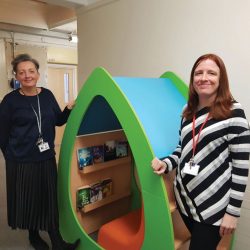
Emma Murray and Tara Welch with oval reading booth containing a comfy seat and bookshelf
Emma Murray (left) and Tara Welch (right) with reading booth

The pastoral team includes Tara Welch, Sam the SENCO, and a health mentor, Philippe, bought in five days per week from the Evolve Project Hero (www.evolvesi.com/project-hero/) and paid for out of sports premium money. This is the third year of Evolve’s involvement in the school and it has led to a shift to viewing the development of emotional intelligence and wellbeing as crucial. The pastoral team meet every week, pick up on referrals from class teachers and oversee the direction of travel. Also part of this team are Donna, leading on child and family intervention, who has been at the school over 20 years and knows the families and the area very well, having previously led on drugs education; Kate who is the designated safeguard lead dealing with child protection issues; Claire who was outreach worker from the children’s centre which has been de-designated – she is now reaching into the community for Early Years extended services for the under 5s and families, and running Stay and Play and parent workshops; and Billy who is the therapeutic /wellbeing practitioner and mainly works with a range of younger children to understand themselves with different therapies. There is also Alkan, a TA, an art specialist who works on drawing/talking stories for individuals for twelve weekly sessions addressing trauma and attachment. There are two counsellors (from the Tavistock and Hope for Tottenham) who each work with five children for one day a week; Reion is a sports instructor specialising in developing social skills through sport, working on self-esteem issues with a group of boys from Black African/Caribbean backgrounds. The school also has access to a speech and language therapist.

The school use the Adverse Childhood Experience (ACE) tracking tool based on trauma and disadvantage, developed by Emma. Years 1-6 are tracked against the 44 possible characteristics by true or false answers, eg child in care system, child has SEND, child is homeless, child abused, child in family with substance abuse, child speaks little or no English. Four or more true answers puts the child at risk. In the autumn of 2018, 88 children (25% of the roll) scored four or more and were judged at risk. This is then used to channel children into the different supports and therapies mentioned above.

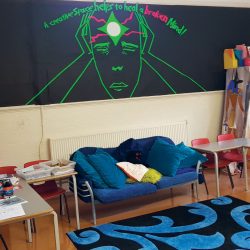
The school is concerned about children’s cognitive development, now measuring this with an app – My Cognition. The school is using programmes they have developed over 40 hours per pupil to repair cognitive development impaired by trauma. Latest theories on neuroplasticity show this can be effective. From January 2019 the school are working on a cutting edge project funded by the NHS and linked to ‘Stronger Brains’ based in Australia, aimed at developing mental wellbeing. Twelve children will work for twelve weeks in a room identified as the Engine Room on mindfulness, meditation, brain training, yoga and other interventions. The aim is that this group of children will understand how their brain works and their anger and get back on track.

The room known as the Engine Room, containing a blue comfy sofa and rug, colouring things, and a board saying "a creative space helps to heal a broken mind"
The Engine Room

Going round the school it was clear there was a lot of space with old classrooms turned into intervention rooms for Years 5 & 6, Years 3 & 4 and Years 1 & 2, staffed by Higher Level TAs and an extra intervention teacher bought out of Pupil Premium; there was a therapeutic suite, the Engine Room, a sensory/quiet room, library and music room, as well as a separate room for lunchtime and after school clubs. In the corridors were reading booths where children could go in twos or threes to read.

Overall there are 40 staff working directly with children as well as another 20 clerical, meals, cleaning and site staff. These interventions are bearing fruit in the very low exclusions and the great progress the children make from when they first come to school on attainment and meeting expectations for a ‘Good’ school. The aim is to increase outcomes once a firm emotional stability has been created amongst the children.

The imaginative way the Pupil Premium has been used was interesting. Of the £270,600 for 2018/19 the following were bought in to enhance inclusion in the school, £38,376 for Child and Family Mentor, £86,636 for two specialist teachers in Year 2 and 6, £34,829 for targeted interventions (therapies), £40,829 for Early Years Extended Lead, £12,000 to allow all children to go on residential and day trips, £12,000 for music tuition for all Year 4 and targeted Year 5, £45,000 for Counselling, £11,466 for a free breakfast club and £12,000 for Ipads.

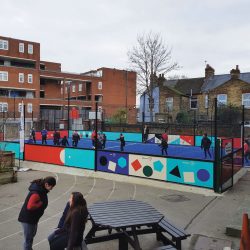
The school playground containing the new astroturf pitch, with girls and boys playing football on it
The astroturf pitch

The school in recent years has changed its Behaviour Policy to a Positive Relations Policy based on the idea that behaviour is always communication and therefore adults must build positive relations with children, not shout or shame or make them feel worthless. The children deserve to be happy. There are lots of positive rewards and if necessary negative sanctions, but always in the context of trying to get the children to understand their behaviour. There is also room for reasonable adjustments for those children that don’t respond to the standard rewards and sanctions with an emphasis on de-escalation rather than confrontation.

Children with identified SEND include 49 on SEN Support, 8 with EHC Plans and 3 more in the pipeline. In recent years, the excellent Early Years facilities and staff have been getting a reputation for working with non-verbal children on the autistic spectrum. The school also strongly supports staff training and development.

The school mobilises resources in the community to improve the school environment. I saw girls and boys playing football together on the new mini astroturf pitch in the playground for which they fundraised last summer. See ‘Follow our Dreams’ a music video used in the campaign:

I came away from my visit impressed and humbled that despite tight budgets and a difficult intake here was a school imbued with an inclusive and child friendly ethos making a real difference to the lives of children and their families (who also get some parenting and language classes at the school) and living up to the school values and motto: “Empowering Learners; Unlocking the Future”. The school values are clearly understood and shared by every member of the school community and are at the heart of everything the school does. I saw ample evidence of this on my visit to the school on 11th December 2018.

Richard Rieser

World of Inclusion

Strong Leaders, Strong Relationships

Jayne Grant retired from her post as deputy head for inclusion at a North West London Primary School last year feeling exhausted – but not yet demoralised – by the unprecedented challenges facing inclusive education. Belinda Shaw met Jayne and heard about how schools have become difficult places to work in and why it is even more important for teachers not to give up the struggle for inclusion.

Jayne has worked for 40 years in primary education, the last twelve years at West Lodge Primary School in Harrow. The school has a reputation for a strong ethos of inclusion and since 2015 has developed an additionally resourced mainstream provision for children with a diagnosis of autism. Up to a quarter of the children in every class at West Lodge have additional needs.

West Lodge Headteacher, Jim Dees, said:

‘I had the privilege to work with Jayne Grant for 6 years at West Lodge and found her an inspirational colleague. Her commitment to supporting each and every child was instrumental in ensuring that an inclusive ethos, with understanding and acceptance at its heart, pervaded all aspects of life at West Lodge. She continually gave her time, energy and emotions to support pupils, staff and parents/carers – I consider myself extremely fortunate to have worked with such an incredible educator.’

Jayne came to focus on inclusion in education from a commitment to equal opportunities and human rights, including as a feminist and anti-apartheid and union campaigner, inspired by people rather than books or policies. Working for inclusive education was the natural consequence of a strong sense of justice, a belief in equality and a growing conviction that disability and special needs is not someone else’s responsibility: that every teacher is a teacher of pupils with special educational needs.

“I remember early in my career having children in my class who I knew needed additional support and colleagues telling me they should be somewhere else. But I remember thinking what’s that about? Why can’t we educate all children together?”

Jayne says at that time, when the former Inner London Education Authority managed inner London schools, resources were pooled and directed efficiently and money never seemed to be an issue. ILEA was abolished in 1990. Jayne paints a very different picture of education now.

She says “brutal” cuts and increasing numbers of children experiencing difficulties are significantly affecting schools’ ability to be “as inclusive as they want to be and as they should be”. Schools with a strong ethos of inclusion are “really struggling” to provide the best and most appropriate learning environment for an increasing number of disabled children and those with special educational needs. Even if extra funds can be secured through what too often has become a legal battle for an Education Health and Care Plan, they do not cover the salary for an additional adult.

Lack of disability training, over-emphasis on testing, publication of league tables, fragmentation of education including loss of local authority control, competition between schools and dismantling of support services add to the pressures, as does a gloomy atmosphere in the wider community due to a range of social problems and a search for scapegoats.

Against this background of a funding crisis and pressures in and outside schools Jayne, who is not lacking in resilience or a stranger to campaigning, has felt the strain in the work she loves. She is concerned children are being let down and that her energy and best efforts to be inclusive, including many hours of voluntary work at holidays and weekends, are being depleted. She describes being emotionally drained and realising she couldn’t carry on, even though she might like to: “I have to give 100% or more and if I can’t, I feel I am not doing my job properly.”

Jayne is proud of the inclusive practice she and her colleagues built up over the years at West Lodge. No pupil has been turned away, no pupil has ever been permanently excluded and detentions no longer exist. She is sad that relationships with families and authorities which have taken years to build are being put under pressure – even broken down – by the need to battle for funds and provision.

None of this has diminished Jayne’s passion for inclusive education. In fact she feels it has become even more important in these dark, difficult and uncertain times for schools and society.

“It’s a way of understanding and living in the real world and how we all participate in society. Inclusive education values diversity. This is crucial in times like these when there is less understanding and celebration of diversity and uniqueness”.

Jayne is inspired by the way West Lodge children “understand and support, acknowledge and celebrate’’ difference rather than being wary and mistrustful as can be a problem for many adults. She sees inclusive education as helping all children become “really decent human beings”.

“Imagine the kind of adults the children I have worked with are going to turn out to be. They are going to be amazing. They are still going to come up against situations where they are going to have to question and challenge themselves about how they feel but they have benefited so much from the start they have had in an inclusive school”.

Jayne believes teachers have a moral obligation to be inclusive. That involves discovering the unique “spark” in each child which lights up them and the world around them – and ensuring all children have equal opportunity to achieve without discrimination, intolerance and other barriers to learning. She is in no doubt about the challenges teachers face and that burnout is real, but is still asking them not to give up their chosen paths.

“There is always a solution for any challenge and there are always wonderful moments to celebrate every day”. Jayne says that to keep teachers going they need to be reminded of these moments, how far children have come and the valuable part they have played in making it happen in difficult circumstances. A commitment to inclusion does not mean teachers getting it right all the time but a need for reflecting on practice and ongoing professional development and improvement.

According to Jayne a key component of making inclusion work is the leadership role of promoting an inclusive ethos in school and fostering positive relationships at every level, no matter how challenging the situation. “I’m talking particularly about relationships between disabled children and those with special educational needs and their families, teachers, support staff and members of the leadership team including the headteacher. In many schools where I have worked the head is a somewhat remote figure, only called upon by teachers to reward or reprimand. Inclusion works best when the head and leadership team build positive relationships with all children particularly those with more challenging and complex needs.”

She says the leadership team need to be visible, available and flexible: eg “meeting and greeting” families when they arrive and leave school or taking responsibility for a class in situations of challenging behaviour while the teacher perhaps has a break or the teacher and pupil concerned take time out together to repair any potential breakdown in relationships.

Another key element for being a fully inclusive school, says Jayne, is commitment to a holistic and creative curriculum all children can access. In many schools the curriculum has narrowed due to pressure to achieve specific standards in core subjects. It is also important to recognise that children experiencing social and communication difficulties may struggle with the social demands of the classroom. “Creating a safe and supportive learning environment is crucial for these children. This is not only about having individual workstations with reduced distractions inside the classroom, but enhancing outdoor provision for learning and having other areas around the school where children and staff feel safe and supported. It’s more than making reasonable adjustments and differentiating learning tasks. It is about modification of the entire learning environment”.

Jayne is not sure where she will place her efforts for inclusion in the future and sees herself as probably needing to finish what feels like a convalescence period or maybe a gap year before she can decide.

Inclusion Now wishes Jayne good luck finding her way. I asked if we could interview her in a year’s time to check on progress. She did not say no.

Illegal Off-Rolling – a Call to Action

Recent press stories have covered the issue of off-rolling, where schools move pupils off the register. Joe Whittaker tells us about what happened to Manchester pupil Pat.

Ofsted, the schools inspection service, have been concerned in recent months at data suggesting some pupils have been moved off the school register and removed from their school. Disabled pupils and those described as having special educational needs, are more likely to be subject to this practice, called “off-rolling”.

This happened to one young person Pat (not their real name) who was recently off-rolled from a state funded secondary school in Greater Manchester. Pat is 14, has a diagnosis of Autism, and also has the protection of an EHCP.

Pat had three years of 100% attendance at the school and although Pat did not find the school met all their support needs, Pat accepted responsibility and gave a commitment to hard work. This was reflected in Pat’s academic achievements and test results clearly indicated progress year on year.

An incident occurred when Pat was allocated a new support worker. The support person had been in post for five days and had no formal training to work with neuro-diverse pupils. The support worker did not know Pat; it was the lack of a meaningful relationship with Pat that triggered Pat’s “meltdown”.

Pat will not be the first neuro-diverse person to have a meltdown in school and will almost certainly not be the last person to have a meltdown. A meltdown is likely when the school does not anticipate the triggers for a particular pupil and has not put appropriate support in place.

This resulted in Pat being suspended from school for two days. Pat was utterly devastated, uncertain what had happened. Pat’s mother attended the school to discuss what had happened, she was confronted by the headteacher and the head of SEN services from the local authority.

There was no discussion: Pat’s mother was told to remove Pat to an “autism school” 35 miles from their home or have Pat “home schooled”. This “choice” was imposed upon Pat’s mother by the head of SEN, supported by the headteacher without any consultation.

This illegal action from two senior professionals is now being challenged. It is however, expected that both professionals will deny their actions and represent their arguments as “considered advice” in the “best interests” of the young person.

What is disturbing is that if the two senior professionals were confident their judgments were in Pat’s best interest – why did they not follow the appropriate procedures and engage in the formal process of an EHCP review, with representatives from health and social care?

Why did the SEN local authority lead professional not take into consideration Pat’s views? In fact he has never met Pat. Why have Pat’s teachers, health and care professionals not taken action to protect Pat from this abuse of Pat’s rights and a total disregard of the EHCP?

What is unforgivable is that the “professionals” surrounding Pat allowed Pat to be presented as “the problem” and for Pat to take responsibility for the abuse of the professionals.

Pat is not the only young person being subject to this despicable and systematic professional abuse, but is one of a growing number identified by Ofsted. This practice is a consequence of a wider concerted devaluation of disabled people in the UK by this government, which has given licence to such malpractice against disabled people.

What disabled child is safe from the malpractice of such senior professionals in schools and colleges? What parent can say with confidence their child is safe from being off-rolled by their school? As a starting point we should encourage every such incident to be reported to Ofsted and the Governors of the school.

Joe Whittaker

Supported by

ALLFIE’s campaign for Inclusive Education as a human right is backed by funders and donors who reject the systemic segregation of Disabled people from society.