Please ensure Javascript is enabled for purposes of website accessibility Skip to main content

The Alliance for Inclusive Education (ALLFIE) campaigns nationally for the inclusive education human right of all Disabled people in mainstream educational settings as set out in Article 24 of The United Nations Convention on the Rights of Persons with Disabilities. ALLFIE does not provide one-to-one advocacy or representation for individuals and other organisations. However, we recognise that Disabled people, parents of Disabled children and young people and other stakeholders may need signposting to useful contacts that might meet their requirements. 

This page has been put together to signpost our community to organisations that could support them with their enquiries. Please note this information is only for signposting purposes only, ALLFIE does not take any responsibility for the services or information provided by the organisations listed on the page.

On Wednesday, 30 October 2024, Rachel Reeves delivered her first budget as chancellor. The budget did not provide for any specific funding to help local authorities or schools improve Disabled people’s participation in mainstream settings, despite improving inclusivity in mainstream settings being one of the Labour party’s main goals for the education sector.   

During her budget statement, Reeves announced that there would be a £1 billion increase to Special Educational Needs and Disabilities (SEND) and Alternative Provision (AP) funding. However, most of this funding (£865m) will go towards covering local authorities’ SEND deficits as illustrated in the table below. 

Tariffs & Technical Tax Changes


Head
2024-25
2025-26
2026-27
2027-28
61
Tariff Changes since Spring Budget 2024
Tax
-55m
-105m
-35m
+0m
62
Special Education Needs and Disabilities: Reduction in Local Authority SEND deficits as result of additional DEL funding 
Spend
+0m
+865m
+0m
+0m


Local authorities have “discretion” on how they will spend the remaining £135m. It is not known if any of this amount will be used to improve Disabled people’s participation in mainstream settings. 

The budget shows that the Government is aware that mainstream settings are not suitable for all Disabled children and young people. The Chancellor announced that the Government will “support pupils with special educational needs that can only be met in a private school” by providing compensation to local authorities for VAT on these pupils’ fees. This is because the government is introducing a 20% VAT on education and boarding services fees charged by private schools from 1 January 2025. 

The Chancellor also announced that “[t]he government will also remove business rates charitable rate relief from private schools in England from April 2025.” However, “[p]rivate schools which are “wholly or mainly” concerned with providing full time education to pupils with an Education, Health and Care Plan will remain eligible for business rates charitable relief.” 

The above two measures imply that the government expects Disabled children and young people who are not being catered for in mainstream schools to be catered for in private schools.  This is an expensive option as the funding required is £61,500 per pupil in private schools, compared to £19,100 for pupils with EHC plans in mainstream secondary schools.  

Where the child or young person has an EHC plan, this amount is paid by their local authority, meaning that it pays three times more for a child in a private school than for a child in a mainstream secondary school.  As many local authorities are experiencing financial constraints and are expected to be reducing their budget deficits under the DfE’s Delivering Better Value programme, this raises some critical questions: How many pupils with EHC plans can local authorities afford to send to private schools and what happens to the rest?   

Where the child or young person does not have an EHC plan, parents are expected to pay this amount. This marginalises Disabled children and young people from under resourced backgrounds or marginalised communities who do not have EHC plans and failed to get the support that they require in mainstream schools. Some of these children and young people may not have or have been refused EHC plans due to local authorities’ aiming to achieve their goals of limiting the number of EHC plans assessments and issues under the DfE’s Safety Valve programme.  

Inclusive Education is a human rights and social justice issue that is protected under Article 24 of the UN Convention on the Rights of Persons with Disabilities (UNCRPD). As it was Labour that signed the UNCRPD, we expect them to be intentional about fulfilling their obligation to implement Inclusive Education.  

Labour has repeatedly stated that its ambition is to improve inclusivity in mainstream education. However, the budget has failed to match this ambition. The lack of any specific funding to help local authorities or schools improve Disabled people’s participation in mainstream settings, compounded by continuing spending on private school fees are a signal that things are going to remain unchanged. It is clear that the government has sufficient funding for inclusive education but choose to spend it on segregated education. This does not uphold the presumption to mainstream education as stated in the Children and Families Act 2014. 

To achieve its ambition of improving inclusivity in mainstream education, ALLFIE argues that the government should channel more financial resources to local authorities and schools so that they are able to properly resource and support every child and young person in mainstream educational settings. This includes providing funding to ensure that all infrastructure, workforce and services in mainstream educational settings are inclusive and accessible.  

At the same time, the Government should develop plans to phase out all forms of segregated educational provisions, such as special schools, colleges, alternative provisions, units or private schools, and redirect the financial resources channelled to these segregated educational provisions towards ensuring that mainstream educational settings are able to support every child and young person. 

The Government wants the country to believe that they are committed to supporting Disabled children and young people, but this budget tells a different story. This budget creates barriers to inclusive education and full participation in society, showing that Labour is continuing to let Disabled people down. 


By Dr Edmore Masendeke, Policy and Research Lead 


The recent National Audit Office (NAO) inquiry into the planning, support, provisions and spending framework for children and young people labelled with Special Educational Needs and Disabilities (SEND) in England shone a spotlight into DfE and the urgent need for systemic change for Disabled children and young people. The Alliance for Inclusive Education (ALLFIE), a key stakeholder in this inquiry, argues that the Department for Education (DfE) must make progress towards inclusive education and stop prioritising segregated settings that reinforce societal inequities and limit opportunities for connection, belonging, and achievement.  

Inclusive Education: A Promise Unrealised 

Despite the intention of the Children and Families Act 2014, inclusive education remains unmet goal. Policies continue to favour segregated provisions over inclusive education in mainstream setting (p.5, p.28).  NAO report reinforces this, highlighting the lack of a clear commitment by the DfE to define “inclusive education” or to mandate specific, measurable outcomes for mainstream settings to support Disabled pupils effectively (pp. 5, 28, 31). This implies that DfE lacks a definition for ‘inclusive education’ and therefore promotes inclusive mainstream education alongside segregated education provisions. The DfE’s approach relies on public trust, but without a clear and binding framework such as Article 24 of the UNCRPD – the current system continues to fail Disabled children and young people, perpetuating social and educational inequalities. 

NAO suggests that DfE’s approach is to integrating Disabled children and young people in mainstream schools through the creation of segregated units within these settings. We strongly oppose any policy recommendations that endorse this model, as it reinforces societal inequalities – including ableism and perpetuates discriminatory practices that lead to exclusion and division rather than cultivating connection and understanding. 

Funding and Accountability: A System of Inequity 

The outdated 2009 funding formula of £6,000 per child is applied uniformly nationwide, fails to reflect local diversity and inequalities in under-resourced areas (p.16). NAO laid out the facts that the resourcing of Disabled children and young people should not be financially unstainable, and it is not reforms that are required (p.8). Analysis emphasises how the Government choose to allocate its finance into segregated provisions at huge costs and at the same time withdrawing financial support to mainstream schools. The evidence is shown in how the stark inequalities exist in LA spending per pupil: 

Resulting in resource scarcity in mainstream schools leaves many parents to “have less confidence in mainstream schools’ ability to support their children.” (p.29). NAO further highlight that 86% of parents of children labelled with SEN at state special schools agreed their child got the support they needed, compared with 71% at mainstream primary and 56% in mainstream secondary schools. (p.29).  

One of the NAO recommendations for DfE is to consider opportunities to “adapt funding and accountability arrangements to encourage inclusivity, building an evidence base for where mainstream settings can best support children with SEN; and how to improve parents’ confidence” (p.11).  Additionally, ALLFIE recommend that the DfE draw on Australia’s approach to inclusive education, which phases out segregated units by reallocating funds and resources to mainstream provisions. 

Inspections and Enforcement: Beyond Superficial Tools 

ALLFIE welcomes models, policies, and practices that genuinely uphold every child and young person’s right to inclusive education in mainstream settings. However, tools like the National Inclusion Dashboard or similar tracking mechanisms are not what Disabled children and young people require.  Without a clear strategy to end segregated systems, the DfE’s measures continue to remain superficial and ineffective in realising Disabled children and young people’s rights to an inclusive education.  

Furthermore, non-compliance with statutory timelines for Education, Health, and Care (EHC) plans and insufficient authority with local authorities having “no powers to require academies to enrol Disabled pupils unless specified in EHC plans, resulting in unequal access” (p.28).  These are the exact issues that ALLFIE argues against, campaigning for a system where inclusive education is the practice, with enforcement measures to hold schools accountable for meeting the requirement of every pupil. 

Addressing Systemic Discrimination  

The NAO report highlights a troubling narrative that blames Disabled children and young people for high SEN budgets and lower school performance standards rather than addressing the systemic inequities within the education system (p. 38).  This scapegoating diverts attention from the real issue. The systemic failings within the SEN system, as well as the ableism and disablism in assessment systems that hinder Disabled pupils’ academic progress by age 19 (p.10). 

In addition, the lack of adequate provisions for Young Disabled people labelled with ‘complex needs’ often remain in education system until 25, even when it may not be the most appropriate provision (p.45) 

Conclusion 

The NAO inquiry did not shy away from the broken state of the SEN system and the urgent need for change. It highlights that the “DfE has not made clear what inclusivity could look like and there are limited incentives for schools to be inclusive.” (p.9) Without a significant policy shift and strategic reallocation of resources, the inequalities and barriers experienced by Disabled children and young people, particularly in under-resourced areas and for families of Disabled children from marginalised communities, will continue to deepen, perpetuating cycles of injustice. 

The DfE must move beyond signalling an interest in inclusive education, it must take concrete action to build public confidence in a system that truly serves all children and young people. This includes phasing out funding for segregated provisions and establishing a clear, sustainable, and long-term goals for inclusive education in mainstream settings. Following the framework set by the United Nations Convention on the Rights of Persons with Disabilities (UNCRPD) and investing in inclusive practices is essential for making inclusive education a reality.   


By: Michelle Daley, Director and Policy and Research Lead, Dr Edmore Masendeke 

We're hiring now! Social Media Co-Lead: We are hiring a social media producer to ensure smooth delivery of our online and social media content, and increase understanding of, and engagement with, our inclusive education campaign work. Join our teamJob Vacancy: Social Media Co-Lead

£31,364 per annum pro rata, 14 hours per week

We are hiring a social media producer to ensure smooth delivery of ALLFIE’s online and social media content, and increase understanding of, and engagement with, our inclusive education campaign work.

Deadline has now passed and the recruitment panel are now in the process of shortlisting.


We're hiring now! Events and Administration Co-Lead: We are hiring an Events and Administration Co-Lead to manage our events, provide administrative support, and support delivery of ALLFIE’s infrastructure programme on inclusive education campaign work. Join our teamJob Vacancy: Events and Administration Co-Lead
£31,364 per annum pro rata, 14 hours per week

We are hiring an Events and Administration Co-Lead to manage our events, provide administrative support across the organisation, and support delivery of ALLFIE’s infrastructure programme on inclusive education campaign work.
Deadline has now passed and the recruitment panel are now in the process of shortlisting.


Further Evidence of Violent Abuse in Specialist Settings

Blog by Amelia McLoughlan, Policy & Research Officer and Michelle Daley, Director.

ALLFIE is appalled, and yet unsurprised to see yet another investigation into the injustice of a ‘specialist’ setting, that found systematic and sustained abuse and denial of rights to Young Disabled people.

ALLFIE is appalled, and yet unsurprised to see yet another investigation into the injustice of a ‘specialist’ setting, that found systematic and sustained abuse and denial of rights to Young Disabled people, with Chairperson, Navin Kikabhai stating that, “It is shocking that once again we learn about the horrendous violence and abuse being experienced by Disabled people in segregated institutional settings, so-called homes.” Reporting by the BBC, documented hundreds of cases of abuse from 2010 through to 2021 at sites run by the Hesley Group, based in Doncaster.

The group describe themselves as providing “specialist care, support and education for people with complex care needs, including behaviours that challenge and a learning disability, often in association with autism”. Whilst Disabled Young people in their “care” were being locked outside in freezing temperatures while naked, and having vinegar poured on wounds, with further horrific violent harm reported. Yet again, this spotlights the systematic failings that allow for bad practice and inhumane treatment under the terminology of “care”. Kikabhai reflects from scenes in history:

This story broke just as I was reflecting on the Holocaust Remembrance Day and the horrendous abuse and murder of Disabled children and adults that was already taking shape in the early 1930s. Have we learnt nothing about subjecting Disabled people to segregated institutions and to dehumanising experiences? In the coming weeks we will read about empty platitudes, and responses such as “we will learn lessons” and “never again” etc.

According to one parent’s testimony, their child’s placement in this setting cost the Local Authority around £300,000 a year. This clearly demonstrates that funding is being funnelled into specialist provision and yet this is not indicative of the quality of support or a guarantee that the Young Disabled person will be treated humanely. ALLFIE has repeatedly spoken about the continuing financing of segregated provision by increasing specialist places and disincentivising mainstream inclusive education, under the misinterpretation that these specialist settings offer superior or better provisions.

While the regulator did intervene in and closed all three children’s homes in March 2021, an earlier 2010 Council report that detailed that Young Disabled people were being violently harmed. Despite this, Local Authorities continued to place Young Disabled people into these settings and fund the group’s profits with known safeguarding and abuse concerns. These included two residential special schools that held a “good” Ofsted rating throughout. Inspection regimes are useless and are part of the problem because Hesley continues to run a school and placements for adults labelled with complex needs.

One staff member also admitting to ordering a taser device from abroad with the intention to use it within the home for “protection”. Luckily, the electronic stun device was seized by Customs and Excise meaning that it never reached its intended destination. However, this disclosure clearly demonstrates that the Young Disabled people within these specialist places were not regarded as human beings but were instead viewed as threats. Furthermore, staff members within these specialist settings, accused of assault were able to leave Hesley and work for different companies after the homes closed.

As of writing this post, Education Secretary, Gillian Keegan, has repeatedly declined to be interviewed despite the responsibility and accountability for education and children’s social care falling within her remit, no individual statement has been issued in regard to this matter. In fact, the SEND AP Improvement Plan has pledged to open further specialist schools and placements, despite the numerous evidence of violent abuse and harm in these settings as reported by the BBC and the Disability News Service.

While these reports fail to document the quality of education Young Disabled people can receive within these specialist settings, there are clear and significant concerns about institutionalisation and the definition of “care“ being used to enable violent abuse and harm. Kikabhai points out the seriousness of these findings, “These are criminal and cruel acts of violence and torture, degrading, dehumanising, inhuman treatment. It is scandalous that millions of pounds of public money is being used to abuse and harm Disabled people”.

In light of this continuing reporting, ALLFIE again demands that the government moves away from specialist provision and fully implement Article 24 and relating articles on freedom from violence, abuse and harm of the United Nations Convention on the Rights of Persons with Disabilities (UNCRPD). The solution to end all forms of segregated education, violence, abuse and harm towards Disabled people is to have a change in law and an education system that is based on the rights and justice for ALL people in the UK.

ALLFIE is marking International Day Against Racial Discrimination with this discussion on how to achieve equity and justice for Black and Global Majority Disabled people in the mainstream education system. In 1966 the United Nations proclaimed March 21 International Day for the Elimination of Racial Discrimination, urging the world to join hands to eliminate all forms of racism.

Includes guest speakers and Q&A

Please come and share your opinions and experiences

This event is part of our Stronger Voices program to build the capacity of Disabled People’s Organisations and to end all segregated education, including at the intersect of poverty, ableism and racism. We’re asking:

  1. What can we do to achieve equity for Black and Global Majority Disabled people in the mainstream education system?
  2. How do we move forward towards embracing inclusion?
  3. What is the reality of trying to achieve mainstream inclusive education?

The event will be recorded, edited and posted here and on our YouTube channel

Agenda

  1. What can we do to achieve equity for Black and Global Majority Disabled people in the mainstream education system?
  2. How do we move forward towards embracing inclusion?
  3. What’s the reality of trying achieve mainstream inclusive education?

Register your place now

How are gender issues shaped in society and how do these affect Disabled women?

On March 8th, 2023 ALLFIE made International Women’s Day, a global annual focal point in the women and girls rights movement, with an online zoom event to celebrate the theme #EmbraceEquality.  This is part of our Stronger Voices program to build capacity in the Disabled people’s movement and challenge structural oppression at the intersect of segregated education, poverty, ableism and racism.

Event included guest speakers and a Q&A session.

ALLFIE’s Stronger Voices project is asking:

  1. What can we do to achieve equity for Disabled women and girls in the mainstream education system?
  2. How do we move forwards towards embracing inclusion?
  3. What is the reality of trying to achieve mainstream inclusive education?

The event was recorded, will be edited and shared here and on our YouTube channel

Inclusion Champions Project report

‘Inclusive Education, Disabled People’s Organisations and Capacity Building for Change’. This report provides some reflections from an Inclusion Champions Project funded by the City Bridge Trust.

Inclusive Education, Disabled People’s Organisations and Capacity Building for Change.

Download the (pdf) Inclusion Champions Project report

Overview

This report provides some reflections from an Inclusion Champions project funded by the City Bridge Trust. This supported ALLFIE to successfully host the Inclusion Champions Network (ICN) made up of 18 London-based Disabled People’s Organisations (DPOs), working with young people and their families, Local Authorities and other young people’s services.

The focus was to facilitate work around inclusive education and to capacity build DPOs to better engage with young Disabled people. Based on our work, this document will offer here some suggestions to other DPOs considering shared capacity building and campaign work that is about inclusive education and involvement of young Disabled people as assets. This includes both a structure for planning social change activities, along with links to learning resources produced as part of this project. At the end of this document, we also note some ideas for future work that we feel will help us work together with DPOs and young Disabled people to achieve inclusive education.

Contents:

  1. Introduction
  2. Disabled People’s Organisations
  3. Inclusive Education
  4. Capacity building and building capacity for change
  5. Recommendations
  6. Summary

Introduction

Disabled People’s Organisations (DPOs) are unique collectives that provide both peer support services and collective action. We demonstrate solidarity in our drive for inclusion, and connect communities to bring together different experiences and individuals within the Disabled People’s Movement. They represent, both at the same time, a social change movement and a vibrant community sector. While in recent years some progress has been made in inclusive education, there is still a way to go.

Inclusive education is a human right, as set out in Article 24 of the UN Convention on the Rights of Persons with Disabilities (UNCRPD). Being included in society is the key to Disabled people being embraced as equal citizens. Non-Disabled people need to grow up, to learn, play and work with Disabled people as friends, classmates and family members. Though Disabled young people and children have some protections and rights to inclusive education, these do not currently work as they should.

The Alliance for Inclusive Education (ALLFIE) want Disabled People’s Organisations to be part of the campaign for the right of all Disabled people to be fully included in mainstream education, not segregated from our peers, our friends, our families, our communities. ALLFIE’s vision is a fully inclusive education system that welcomes all, with the ultimate goal of ending all forms of segregated education for Disabled pupils and students. ALLFIE believes that DPOs can play an important role in achieving inclusive education by increasing involvement with young Disabled people and children in the movement.

Based on the learning and reflections of the City Bridge Trust project this document presents some information about Disabled People’s Organisations, inclusive education and capacity building for change. This includes an approach to planning and organising for change, as well as a number of links to materials produced as part of this project. It sets out how to involve the right people, how to plan actions and campaigns, and links to wider issues by recognising the intersect of ableism, racism, sexism and classism. A number of ideas for future work are also recommended.

Disabled People’s Organisations (DPOs)

Disabled People’s Organisations (DPOs) are run and controlled by Disabled people, focused on equality and human rights. They work to support Disabled people to achieve inclusion.

A DPO can be defined as an organisation whose constitution requires it to have a membership and managing board with a majority of Disabled people. Its objectives will be the rights and equality of Disabled people. DPOs subscribe to the Social Model of Disability and are committed to the human rights of Disabled people. DPOs work for the empowerment of Disabled people either implicitly or explicitly.

DPOs, have grown and developed since the 1970s. They are unique social change organisations focused on issues relevant to Disabled people through the use of a range of activities. In the 1980s the first UK Centres for Independent Living (CILs) were established in Hampshire, Derbyshire and Greenwich. Run and controlled by Disabled people, CILs are based on a number of principles that if available to Disabled people enable self-determination and personal autonomy, so as to be able to participate equally.

These include, having access to accessible information, advocacy, adequate housing, PA support, equipment, transport etc. The key point is that unless Disabled people are involved in decisions and policies about their lives, nothing changes.

The UK has an ever-increasing number of voluntary sector organisations, ranging from small community groups to international charities with bases in many countries. DPOs represent an important movement within this sector. The impact of DPOs has been huge, furthering a radical social policy agenda and redefining meanings of social care, health, independent living and inclusion.

The added value of DPOs comes through the leadership that emerges from Disabled people coming together, sharing experiences and developing practices of inclusion. This facilitates a unique organisational culture that embraces and values the voices and experiences of Disabled people from the perspective of equality and dignity, rather than that of personal and medical tragedy.

For a recent view on DPOs see the report ‘Understanding the needs of DDPOs in England’. This provides information from 100+ DPOs about current issues and what is needed to strengthen the capacity to tackle the deepening structural inequalities faced by Disabled people in a post Covid world.

Inclusive Education

The right to inclusive education is set out in Article 24 of the UN Convention on the Rights of Persons with Disabilities and Sustainable Development Goals, Target 4. The inclusion of young Disabled people and children is key to them being embraced as equal citizens as they become adults. There are a number of concerns about UK education and equality legislation not following the rules on the international agendas, and how segregated education occurs in practice today.

ALFFIE’s current campaigning work is focused on the government’s anti-inclusive education reforms, which are proving to be disastrous and harmful for Disabled pupils’ and students’ right to inclusive education in mainstream education settings. Local authorities are taking funds from mainstream schools to promote, create and pay for expensive segregated education placements, reducing the capacity of mainstream schools to welcome a wide range of pupils and students from different backgrounds.

An increasing focus on academic attainment in public exams through league performance tables, puts considerable pressure on schools, colleges, and universities to standardise learning and assessment practice. For Disabled people with diverse learning styles, the accessibility of education settings is a concern, as there is now greater segregation and exclusion of Disabled pupils and students from mainstream education.

The Alliance for Inclusive Education (ALLFIE) is keen to support Disabled People’s Organisations to be part of the campaign for the right of all Disabled people to be fully included in mainstream educational settings and learning. It supports educational and learning settings that do not segregate us from our peers, our friends, our families and our communities. DPOs in local communities are well placed to support young Disabled people and children.

Capacity building and building capacity for change

Capacity building and building capacity for change are development activities, sets of resources, or forms of assistance provided to organisations in order to help them improve their effectiveness and boost performance. This usually focuses on management, leadership and governance, and organisational systems, but equally can be about developing campaigns, setting goals and working to achieve those, as we have seen in the #MeToo and Extinction Rebellion movements. Based on our work on the Inclusion Champions Project, below we set out some ideas about how we think DPOs can engage with young Disabled people on the issue of inclusive education. The ICN involved exploring how to involve the right people, planning for action, connecting to wider networks, creating resources and ideas, and being influencers for change.

Involving the right people –

It is important to remember also that it is people that make change happen. To organise and bring about the change you want it is useful to involve different types of insights and experiences. This includes centring people with lived experience of intersectionality, people with ideas, and people with power and influence. Sometimes you may find people hold these experiences and insights at the same time, sometimes only one or two. Additionally, people may not be able to be open with their experiences or may not recognise how valid their expertise is.

The following illustrates how this might be applied to the campaign for Inclusive Education.

Planning for action

Understanding what the problem is, being clear about how and why it can be different and knowing what needs to be done in order for it to happen, is key to achieving change. The following maps out some steps, poses some key questions, and gives some useful links for DPOs to consider when planning and organising actions about inclusive education.

What is the impact on people? What harm does it do? Why is it wrong?

Here is a guide to the UNCRPD

Here is an introduction to the Social Model of Disability in the context of inclusive education

What is wrong? What needs to change? How can it be different?

Here is an overview of inclusive education and an account of how inclusion can be achieved in a school

What are we asking for? What exactly do we want? Who needs to hear what we are saying? How do we make them act?

See here for the ‘Educate Don’t Segregate’ and other campaigns by ALLFIE

Recommendations.

Based on our work, and the feedback of those we engaged with, we present the following as ideas for future work. This, we believe, will assist DPOs to engage with young Disabled people, to ensure their voice is embedded within their work. In turn this will help further the campaign for inclusive education, and bring an end to the circumstances that continue to exclude many young Disabled people and children from experiencing inclusive education.

Summary.

This report summarises some key reflections and points of learning from the Inclusion Champions Project funded by the City Bridge Trust. Through this we were able to work with Disabled People’s Organisations (DPOs) and young Disabled people.

This enabled us to better understand some of the issues preventing them from engaging more actively on work about inclusive education. Many DPOs want to work with young people, but often are not able to create the opportunities to do so. ALLFIE’s Inclusion Champions work has shown how this is possible, and what benefits it can offer to social change work in this area.

Based on this work we offer here some suggestions to DPOs when considering capacity building and campaign work that is about inclusive education and looks to involve young Disabled people. These include both structure for planning social change activities and links to learning resources produced as part of this project.

Resources.

Here are some resources created by young people:

  1. Our Voice
    https://pedantic-shannon.91-238-163-161.plesk.page/about-us/who-we-work-with/our-voice-project/
  2. Online University Empowers Disabled Students
    https://pedantic-shannon.91-238-163-161.plesk.page/news/inclusion-now/inclusion-now-58/online-university-empowers-disabled-students/
  3. 50 years since Handicapped Children Act
    https://youtu.be/3c4IAt-PNcA
  4. The CripTales and Inclusive Education
    https://pedantic-shannon.91-238-163-161.plesk.page/news/inclusion-now/inclusion-now-58/the-criptales-and-inclusive-education/
  5. ‘Our Voice’ Project Participants interview Baroness Tanni Grey-Thompson
    https://pedantic-shannon.91-238-163-161.plesk.page/inclusion-now-60/our-voice-project-participants-interview%e2%80%afbaroness-tanni-grey-thompson/
  6. Judy Heumann: ‘The battle is so much bigger than we thought it was’
    https://pedantic-shannon.91-238-163-161.plesk.page/inclusion-now-60/judy-heumann-the-battle-is-so-much-bigger-than-we-thought-it-was-unless-all-disabled-people-are-liberated-none-of-us-can-be-liberated/
  7. Returning to School After Lockdown
    https://pedantic-shannon.91-238-163-161.plesk.page/news/inclusion-now/inclusion-now-59/learning-in-lockdown/
  8. Learning in Lockdown
    https://pedantic-shannon.91-238-163-161.plesk.page/news/inclusion-now/inclusion-now-59/learning-in-lockdown/
  9. ‘Like a bird released from a cage, I am free to fly in the open fields’
    https://pedantic-shannon.91-238-163-161.plesk.page/news/inclusion-now/inclusion-now-58/like-a-bird-released-from-a-cage-i-am-free-to-fly-in-the-open-fields/

Turns out, being a disabled young person in lockdown isn’t great

Remmington is 16 and lives in Cheshire England. They are an ambulatory wheelchair user and are autistic. They play the flute saxophone and piano, and are passionate about music, advocacy for human rights, and analysis of film, TV and literature.

My name is Remmington, I’m 16, I live in Cheshire England, and I have just finished my GCSEs. The Our Voice project has been an amazing way for Disabled Young people to be able to come together and discuss how COVID has impacted our lives. It has also given me, and I’m sure everyone who took part, the chance to speak out and help improve our confidence.

One of the Our Voice meetings we discussed how COVID had affected our wellbeing as Disabled Young people as well as what we would like to have been done differently if another pandemic would happen again during our lifetime, for example wanting the food boxes that were sent out to be more accessible to people with dietary needs, and to be more nutritious.

A multitude of things were brought up including how lockdown had affected us differently as Disabled Young people, and the presumptions that were made by the government regarding us and not listening to our voices and perspectives. This included, Disabled people not continuing with education over the age of 18, not living alone (with or without support), or not having friends and a social life. All of which are false if you were wondering. All these assumptions and stereotypes made it a lot harder if people were shielding, who I think the government thought were mostly older people, as even when things opened up, life wasn’t “normal” for us still as we were still acting as if we were still in lockdown.

Regarding shielding, when it was brought up in the discussion, I mentioned how confusing I found it. Due to my auto immune conditions and my age, it wasn’t clear whether I should be shielding or not. I decided to act as if I was shielding for the most part. But when things started to open up in the recent winter term, I decided to go to the in-person rehearsals some of my bands were running.

During the meeting when we were talking about how lockdown had affected us, I mentioned how my mental health had plummeted at the beginning of the first lockdown due to my music groups stopping due to COVID. These have helped me immensely through the past few years. they also didn’t change to online rehearsals until months into COVID.

I really enjoyed this meeting, as it was great to hear other people’s perspectives on how being Disabled has differently affected our experiences of COVID and lockdown. It also gave me the opportunity to really think about what things I would change or things that the government should do differently, including having a BSL interpreter at press conferences, having much more concise and less confusing rules and regulations, as well as the food packages being much more inclusive to people with dietary needs and for them to be nutritious. I also got to hear other people’s perspectives and people’s ideas that I wouldn’t have necessarily thought of given my experiences.

The OV meetings have been really enjoyable and although I haven’t been able to attend every session due to the saxophone ensemble, I am in, all of the meetings I have managed to attend have been a great opportunity and I have learned new skills and met some amazing people. I have learned so much from the meetings, from the impact of intersectionality on people’s lives, to being able to speak out. The meetings have helped improve my confidence and have made me much more enthusiastic about being involved in social justice and other advocacy work in the future. I would love to be able to do more things like this as it has been such an amazing opportunity and I have loved all the meetings I have been to.

Our voice on intersectionality

ALLFIE promotes the inclusion of Young Disabled people in all discussions that relate to their lives. During the Covid-19 pandemic ALLFIE recognised that young disabled voices were being missed, so the ‘Our Voice’ project was created to encourage young people to feel safe and speak up. I have been a part of the ‘Our Voice’ project since its start and have found the sessions incredibly useful and supportive during quite stressful times.

Hi, my name is Melody, I am 22 and a queer wheelchair user. I love coffee, gaming and fighting for inclusion and diversity. My pronouns are She/Her.

Overview of ‘Our Voice’

When joining the zoom call, you are greeted with a warm and welcoming atmosphere, where everything (within reason) is kept confidential. The sessions are full of non-judgemental friendly people, which really helps create a sense of belonging and safety. Within each session we often cover a variety of topics, all of which are very educational and eye-opening. There is a great mixture of informative presentations and open group discussions.

The group discussions really help you to feel less alone and a part of a community. Knowing that there is a safe place to be heard helps you to release built up emotions and discuss solutions you may never have thought of otherwise. By surrounding ourselves with Disabled people from a variety of backgrounds we also learn about the struggles other Disabled people face.

When sharing our personal experiences, we build upon our individual knowledge and strengthen our collective understanding of the inequalities Disabled people face. This better equips us to fight for change for all Disabled people.

Intersectionality

In order to fully understand a person’s needs, you must recognise all of their identities, this is known as intersectionality. Intersectionality looks at the whole person, all the different identities and characteristics that make up who we are. For example, I am not just Disabled, I am also many other things such as a Young, Woman and part of the LGBTQ+ community. All of my identities impact my life and the barriers imposed on me, so it is extremely important to understand and recognise intersectionality as well as the social model of disability when considering our experiences.

Within our discussions about intersectionality, we looked into the privilege race analogy. This analogy depicts all of us in a race at different starting points, depending on our identities and inherent privileges. Identities such as having a middle-class background would put you farther ahead than someone who couldn’t access any mainstream education. We then reflected on our own lives and not only identified any disadvantages but we each discovered ways that we are privileged too. I realised that I may have a disadvantage due to having a physical impairment and requiring assistance to access things, however my impairment is easily seen so I am also privileged that my impairment is not constantly questioned. Hearing everyone’s unique perspectives really exemplified the importance of looking at people as whole and not just their most obvious characteristic or identity.

Intersectionality is something that is very important to me as throughout most of my life I have been forced into a singular box which caused me to feel like I didn’t belong. Having a place to openly discuss ways of improving inclusion and helping to ensure the next generation of Young Disabled People feel valued for who they are in every aspect of their life is wonderful.

I have found the sessions within the ‘Our Voice’ project to be extremely insightful and supportive these last few months. I am very excited to see how we, as Young Disabled people, use this new knowledge and understanding to use our voice to campaign and improve the world around us.


Melody Powell (She/Her)

Watch the webinar highlights.

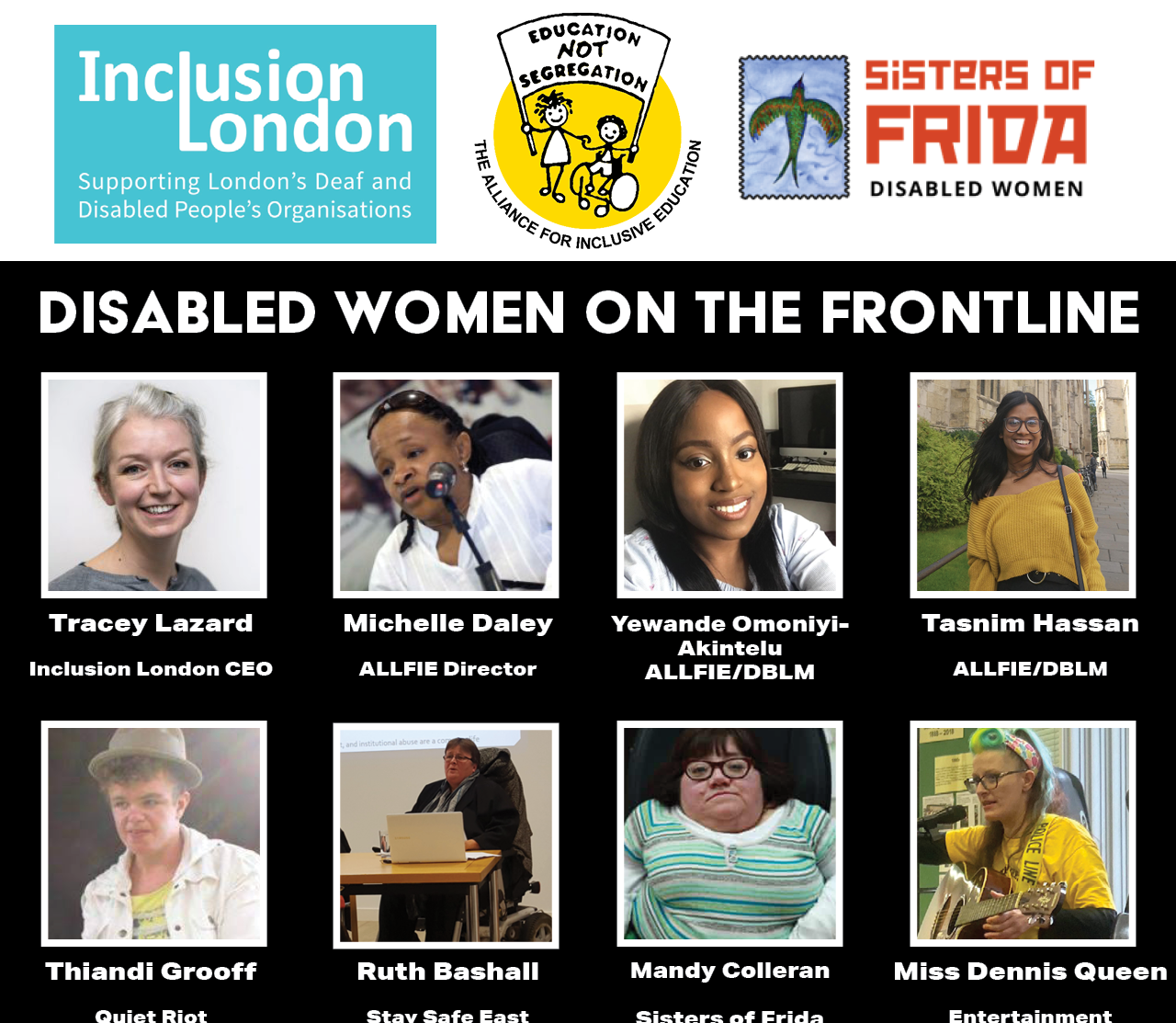
Panellists included:

Disabled Women on the Frontline event flyer listing panelists: Tracey Lazard; Michelle Daley; Yewande Omoniyi-Akintelu; Tasnim Hassan; Thiandi Groof; Ruth Bashall; Mandy Colleran; Miss Dennis Queen. Includes logos for Inclusion London, ALLFIE and Sisters of Frida.

Disability and Happiness

This Is Not a Contradiction in Terms says Matt Smith, London School of Economics & Political Science.

Though my upbringing was based in Liverpool, I have resided (almost continuously),since the age of 18, in London. In the years following this southward journey, my awareness of disability politics grew as I struggled to access many physical spaces (and consequently, areas of life) as an adult.

My current research predominantly concerns the link between portrayals of disabled people in the media and their position in society. Outside the ‘political realm’, I enjoy learning Japanese, collecting vinyl records and visiting new restaurants (as and when lockdown rules permit).

Happiness. Sadly, it is a subject mainstream society seems to have ostracised from conversations with disabled people. In my view, the rationale for this embargo is multifaceted. An available line of reasoning is that generally nondisabled people judge the lives of their disabled counterparts to be much bleaker than the life satisfaction actually reported by disabled individuals themselves (see Longmore, 2016). By this mainstream logic, then, it may seem merciful to avoid taunting a supposedly miserable band of people by delving into the idea of happiness with them. A second, more sinister possibility, is that nondisabled people, to some degree (how ever minor), recognise the risk of being informed about what would actually cause disabled people to be happier, if any related questions are asked. Responses may urge additional public spending on personal assistance services or accessible housing, for example. Fear of facing such demands may incline society to believe ignorance is bliss and to conjecture that misery is simply indissociable from impairment so that expenditure conducive to the equality of disabled people can be overlooked with an air of innocence.

If mainstream society is uncomfortable bringing disabled people’s happiness to the fore, then the Our Voice session on Tuesday 20th April 2021 bulldozed this inhibition by pondering what enables disabled people to enjoy life? Instinctual suggestions from group members revolved around activities such as socialising with friends. The corresponding barriers were then explored. For example, there are numerous obstacles to disabled people forming deep and voluntary friendships – some of these are physical. At present, multiple disabled friends who are wheelchair users could not ride the same bus together in London due to a lack of designated spaces. At the other end of the spectrum, disabled people with little in common are sometimes lumped together in housing blocks or units that are segregated from the rest of society to propel home-building efficiency. Other obstacles are attitudinal; it was agreed at the Our Voice meeting that many disabled children are raised to strive for normalisation. Regrettably, this process can mandate masking the appearance or effects of impairment and dissociating oneself from the disabled community.

As the discussion developed, four elements basic to happiness as a disabled person surfaced: community, empowerment, choice and control. As I perceive it, this constellation of concepts can be connected like so: a sense of community begets empowerment through the acquisition of strength in numbers. Having undergone empowerment, a disabled person then possesses the courage to insist upon choice and independence from the configuration of their living arrangements. By gaining access to choice, a disabled person is then in a position to exercise control over their own lives.

It is worth flagging here there is no guarantee that a sense of community will eventuate in a disabled person having control over their life; a crucial mediating factor is the assiduity of disabled campaigners to champion the introduction of legislation which promotes the autonomy of disabled people. Warriors in the disability movement such as Jane Campbell and John Evans have laboured tenaciously to drive into law the right of disabled people to experience independent living.  In 2008, the UN’s Convention on the Rights of Persons with disabilities was effectuated. However, the UK government is yet to fully embed Article 19 (which affirms the rights of disabled persons to participate within the general community with the same freedom of choice accorded to others) within a domestic legal framework.

During the COVID era, as Lockdown rules were imposed, backlash erupted in the form of furious protests decrying the curtailment of personal freedom. From where I am sitting, these reactions were a vivid illustration of what happens when nondisabled people are temporarily required to endure restrictions of the sort that disabled people are expected to tolerate on a permanent basis (in the absence of sufficient assistance-oriented services). The restoration of normality hinted by the relaxation of lockdown will hopefully ease society’s angst and anguish over the general population’s short-term loss of liberty. That said, will society remember long into the future, the feeling induced by a mass deprivation of independence and accordingly, will society act to enhance the happiness of disabled people by pressing for legislated expansions to provisions and services supporting their personal autonomy? Only time will tell.

On a surer note, Allfie’s Our Voice project has bolstered the happiness of young disabled people during the pandemic. This much can be gleaned from the visible enjoyment each contributor displayed during the meetings. My own affection for the sessions has stemmed, inter alia, from the opportunity to challenge and analyse the labels affixed to disabled people during the pandemic. For example, it was immensely reassuring to discover that I am not the only person irked by being termed ‘vulnerable’ or by being treated as likely to be extraordinarily infectious. My suspicion is that every other member of the group appreciates the same sense of reassurance. This affinity, kindled by the Our Voice project, has been truly precious, especially because the COVID-19 pandemic has threatened disabled people’s wellbeing by inflicting turbulence upon their sense of community (aside from the medical impacts). Recall from earlier that a sense of community is precursory to empowerment. Therefore, what Allfie has safeguarded by convoking disabled people to canvass their views is the openness of a pathway to empowerment. This is such a laudable triumph and a sincere message of thanks is owed to all the project facilitators and funders who have endorsed Our Voice.   


Blog by M P Smith, London School of Economics & Political Science

For The Alliance for Inclusive Education

2021


Supported by

ALLFIE’s campaign for Inclusive Education as a human right is backed by funders and donors who reject the systemic segregation of Disabled people from society.