I am from the Alliance for Inclusive Education recently employed in a new role as Youth Parliamentary Officer. The Alliance for Inclusive Education, has over 30 years of experience, working as the only national Disabled People’s Organisation (DPO), committed to addressing educational issues with the belief that all Disabled people should receive education together with the support they need in mainstream educational settings. This approach promotes inclusion in society by building friendships, and alliances and the understanding of the richness of diversity.
We are writing to express our concerns regarding the national drive to improve school attendance. We are concerned that Disabled children are often driven away from their local mainstream schools. The introduction of the ‘Attendance hubs’ run by schools with excellent attendance records will make some schools less welcoming to Disabled children. Current schools that welcome Disabled children, will become more reluctant to continue doing so, as it will be another factor that will impact their school ratings.
The sharing of ‘daily school registers’ will further encourage discrimination and segregation. Resulting in schools becoming more reluctant to enrol and support pupils who are more likely to have their attendance interrupted due to long-term medical conditions or a lack of support for pupils physical or learning needs.
The present drive around ‘pupil engagement’ to increase school attendance with learning mentors, breakfast clubs and extracurricular activities is not addressing the systemic injustice of the lack of welcome and resources for Disabled children within mainstream schools. Many Disabled children cannot access school meals because of their dietary requirements and extracurricular activities do not include many Disabled children especially those requiring support and assistance. It is crucial to recognise that a child cannot increase their attendance in school if their well-being, physical and learning needs are not being met.
Furthermore, the SEND and AP Improvement Plan, as outlined, aims to reduce individualised support, through Education and Health Care Plans (EHCP’s). This will make attendance at school for a lot of Disabled children more difficult. This approach will drive many Disabled children out of mainstream education.
Considering these concerns, we respectfully demand that this initiative not be implemented, as it will further increase school segregation between Disabled and non-Disabled pupils, poverty, marginalisation and social inequalities. Instead, we request that all mainstream schools receive the training and resources to accommodate the physical, learning and emotional needs of all children.
We propose that the £15 million currently allocated to the school attendance programme be diverted into resourcing mainstream schools to supporting Disabled children.
Under the remit of my work as the Youth Parliamentary Officer, we would welcome the opportunity to speak to you and collaborate on realising a sustainable and successful plan for inclusive education within this agenda. We would appreciate if you or a member of your team could reply with some suggested dates for a meeting.
Thank you for your attention to these critical matters, and we look forward to the possibility of working together to create a more inclusive education for all.
Your sincerely,
Maresa MacKeith
Youth Parliamentary Officer
ALLFIE commemorates International Women’s Day 2024
As we commemorate the recent International Woman’s Day Yewande Akintelu-Omoniyi and Maresa MacKeith reflect on education and employment for Disabled women, based their own lived experience and work at ALLFIE.
As ALLFIE commemorates International Woman’s Day, a global annual focal point in the women and girls’ rights movement, Yewande Akintelu-Omoniyi (ALLFIE’s Our Voice Project Youth Officer), and Maresa MacKeith (ALLFIE’s Youth Parliamentary Officer), take a look at employment for Disabled women. This includes from their own lived experience and journey through education and into the world of work, having both recently come into their first paid roles at ALLFIE. Yewande introduces the systemic issues that prevent Disabled women from entering the workplace and how, for society to have inclusive workplaces, we must keep campaigning for a fully inclusive education system.Maresa then discusses expectations in the education system and the skills Disabled women and people develop because of their impairment.
You can also check out Maresa and Yewande‘s contributions to our International Women’s Day 2023 event on how gender issues, shaped by society, affect Disabled women and how we can challenge structural oppression at intersects of segregated education, poverty, ableism and racism.
Yewande says:
When I got to the post 16 stage in education, I knew that I wanted to work to do something to change things for Disabled Young people. I didn’t want them to experience the same barriers in life and education that I did. However, I was not sure exactly what I wanted to do. My journey in education had been up and down, with some successes and some challenges. During my time studying a BA in education at university in 2010, I stumbled upon the Disabled People’s Movement, and it changed my life. I decided that I wanted to work in this field.
However, the search to find a job was not simple. After volunteering at ALLFIE for some time, I worried I wouldn’t be able to find a job that I could manage because of my impairments. I also didn’t know how to turn the volunteering I’d done for so many years into a paid job. Often, Disabled women are not valued for the paid and unpaid work that they do. I felt that, although I was volunteering backed up by my years of lived experience, this was not recognised by employers, most of who are non-Disabled people. Statistics show that “compared to men without disabilities, women with disabilities are two times less likely to be employed”. (UN Women)
Additionally, I felt limited by not having certain qualifications such as GCSE Maths grade C, and not being strong in numeracy or in aspects such as budgeting which many jobs require.
I also had a very fixed view of what work was and what it involved. I definitely think this comes from the education system because we are told by teachers what work is and it is usually a very narrow definition. For example, I always had the idea that it was sitting behind a desk alone and having to work tasks out on your own, without any or minimal support from your bosses or management, in which I would be punished harshly for any mistakes. All these fears and apprehensions led me to not apply for jobs.
What sets many Disabled women back in taking steps into the world of work is the oppression and barriers we face in our education system before we even start working. An example of this is Disabled women not having the same opportunities in Saturday jobs, internships, and voluntary opportunities that a non-Disabled woman would probably have access to in her late teens or early 20s. These environments are also where young women learn about the world of work. It is also not discussed enough how a lot of Disabled women aren’t able to gain the qualifications needed for paid employment due to lack of inclusivity in the education system. This leaves Disabled women in an even more disadvantaged position when trying to build a career.
The absence of intersectional practices in several careers and jobs is also worrying. As a Black Disabled woman, I was concerned about finding an employer that would understand the different oppressions I face. I also wanted an employer to support and celebrate my multiple identities.
After coming into my first ever paid job last year with ALLFIE, at the age of 31, I have learnt so many important lessons. Working for a Disabled People’s Organisation (DPO), I have had the chance to learn how to work collectively, something ALLFIE prides itself on. We all support each other and work as a team, leaning on each other for knowledge and expertise. My previous lived and voluntary experience is also valued and seen as a part of my work history. Working flexibly and part time means I can take part in work whilst managing my impairment. I can make mistakes and still be encouraged and uplifted by my colleagues, knowing it is all part of finding my way in the world of work. Intersectionality is a core value and principle of ALLFIE, so I feel safe, celebrated and heard as a Black Disabled woman.
My main wishes for this year’s International Women’s Day are that every Disabled woman can feel valued at work and have a career they enjoy, like I have had have over the past 14 months. However, this can only happen when we start to discuss and work to break down the systemic issues that prevent Disabled women from entering the workplace. For society to have inclusive workplaces, we absolutely need to keep campaigning for a fully inclusive education system.
Maresa says:
The education system never expected me to earn a living. I was expected to be a receiver of the care system with maybe a little entertainment, but nothing else.From being very young I wanted to be able to give and be seen as a contributor to the world around me.When I was still at school I started writing. I wrote about my experience of segregation and my experience of coming into mainstream education.
When I was in further education college, two friends and I started running workshops in schools and training sessions on how to include Disabled children in mainstream classes. I then continued on, doing work with young people on friendship.Local poetry groups also gave me confidence as a Disabled writer. Together with other Disabled writers, I sometimes performed in public which gave me confidence as a Disabled person. Although some of this was paid, it still wasn’t seen as a way that I might earn a living.
As we are writing this article, Yewande and I are thinking of International Women’s Day and the work that women do. So much of it unrecognised as work. Women have skills to co-ordinate, to enable things to happen which is often unseen and not considered as their work. Women are good at looking out for people, of noticing what they need and gathering the support to make that happen. All of this can go unrecognised.
Yewande and I are both Disabled women, coming to the workplace much later than most non-disabled women. The skills we have as Disabled women need to be recognised to give us the confidence to assume we can work and be seen to contribute to the society around us.
Some of us Disabled people have impairments which have led us to develop particular skills. For example, I need assistance to communicate and have developed specific and valuable communications skills. I use an alternative communication system which requires assistance, I cannot use it on my own. I spell out what I want to say which takes a lot of time. I have to choose my words carefully. I also watch and listen a lot as the right assistance isn’t always there or the conversation moves too quickly for me to interrupt. These are useful skills, but the impairment is often seen as the reason I can’t participate. Sometimes my communication system is not even believed.
As Disabled people we have strengths we can bring to the workplace. We know how to organise and work with others as we are often dependent on help from a network of other people.The unusualness of Disabled people in the workplace, especially those of us who need a lot of assistance, makes us appear exceptional. We are not. We have either been lucky enough or persistent enough to get what we need with people prepared to accept what we have to offer. This could be a normal part of life.
I feel privileged to be working with ALLFIE. The acceptance of who we are and what we can bring to the job, with the support we need, enables us to be part of the workforce and so be seen to contribute to the wider society. On this International Women’s Day, my wish is that all women be recognised for the work they do, visible or not, and for the generosity of spirit most of them bring.
It is widely acknowledged that education is a social justice issue, and it is clear that this includes inclusive education. To mark World Social Justice Day and our Capacity Development Officer’s return to work after maternity leave, she reflects on ALLFIE’s capacity building work by looking back at the impactful event held last year on this day and looking forward to the year ahead.
Lani says:
As I come back to work after a year of getting to know the amazing new human I have the privilege of parenting, I reflect on how the Stronger Voices project and ALLFIE’s work are underpinned by principles of social justice and human rights. The principles of World Social Justice Day are human rights, access, participation and equity. Our capacity-building work – which focuses on Disabled People’s Organisations (DPOs) being able to campaign and advocate for inclusive education as it connects to poverty and other intersecting oppressions – clearly relies on the principles. But I would go further to say that to have truly inclusive education, education systems must prioritise not only access equity and participation, but also safety, dignity and belonging.
I am filled with gratitude for Iyiola, Michelle and the rest of the team for the way they have taken the Stronger Voices project forward whilst I’ve been away. ALLFIE ran a series of events giving us a chance to discuss important issues related to inclusive education, poverty and intersectionality, going back to what we believe and why, and hearing the voices of those most impacted at the event to mark World Social Justice Day 2023. Discussions were broad and wide ranging. When we think about education and social justice, it cannot be separated from other issues such as housing and lack of good support. These are structural barriers that we must change in order to achieve social justice.
Lucy Bartlett pointed out:
“Poverty of opportunity leads to poverty of outcome: Segregated education, poor housing, lack of good support, lack of time, barriers that prevent access and participation, lack of supportive networks/relationships, medical model thinking, misappropriated resources i.e. resources that are invested in the wrong things.”
We have our work cut out as always: more special schools are being built and Education Health and Care plans (EHCPs) are being cut, which will make it more difficult to get support in mainstream schools. The tightening up of exam standards pushes many young people further out of the education system. Even what could be seen as progressive policy suggestions, such as the rolling out of childcare, will have a negative impact on the poorest families, according to the Women’s Budget Group, and many nurseries will not take Disabled children, increasing segregation further. But this is exactly why getting together, putting forward visions, and discussing the why and how, is so critical.
Andy Greene (DPAC) pointed out at the same meeting:
“Our gains were most when we were aspirational and when we were vision building, and I think we have to regain the initiative in that and really grab hold of that going forward, and us as Disabled people have to kind of step forward and be brave enough to step into these spaces, and really go for it, and talk about ourselves as workers again and neighbours and contributors to this society rather than people who are passive recipients and life goes on over our heads. So, I think we have to start reclaiming that and stepping into that space confidently.”
The Stronger Voices project hopes to support DPOs to do this, by strengthening the work they’re already doing. Many DPOs are building the confidence of Young Disabled people, and Disabled people are changing perceptions, working against segregation, as well as sharing these experiences and making our collective voice louder. We need to be bold and bring forward the much-needed work of supporting young people and families at this time, as we know many families are facing deeper poverty and young people are being stripped of voice and opportunity. Disabled People’s Organisations, through the fight for inclusive education and through building stronger movements, need to make it a priority to support and lift up young people and build the strength of parents and other adults to support them.
As Yewande Akintelu-Omoniyi, ALLFIE’s Our Voice Project Youth Officerstated so clearly:
“When we come back to World Social Justice Day, we need to start listening to Disabled Young people and giving them the platform to get into leadership positions. If we can treat inclusive education, and the lack of it, as a human rights issue then things such as independent living and employment will follow and then I hope we can be a few steps closer to social justice for Disabled Young people.”
This year, I hope that I can build on the amazing work already done towards social justice in the project, particularly strengthening our collective visions and actions to support young people and families, and to challenge poverty and other intersectional oppressions at the roots. The project will be responsive to what people want and need. To start with, we will be hosting a series of action-orientated meetings to share skills to strengthen Disabled People’s Organisations’ abilities to advocate for families against poverty and other injustices. Sign up for updates.
I look forward to connecting with you and working with you.
The Alliance for Inclusive Education (ALLFIE) had a very eventful and productive 2023, starting with our well attended webinar marking UN international Education Day. As an organization that approaches our campaigns from an intersectional and social justice perspective, we often frame some of our capacity building webinars and campaigns around internationally recognized days.
At last year’s webinar, our panel of speakers and participants reflected on the significance of a day dedicated to education. However, education without the full, equitable and equal participation of all Disabled people is an injustice and blatant violation of our human rights, as codified in the UN Convention on the Rights of Disabled People (Article 24 on Education).
As our beloved and late, trustee, Joe Whittaker said at the event:
“One thing that ALLFIE can say very clearly, and very loudly, and very proudly, is that we know at ALLFIE that inclusion works. It’s not an idea. Inclusion works. When we create systems and opportunities where people are supported in meaningful ways that work for them, people can show who they are, make their contribution and participate as fully as anyone else. We know that. We don’t need permission for inclusion. Inclusion is a right”
The people, activists, lawyers, educationists and other professionals who crafted Article 24 agree with us. The question is whether policy makers and other stakeholders believe this, or whether they even understand the intersectional dimensions of segregation in education. Michelle Daley, ALLFIE’s Director, at the same webinar, quoted UNESCO:
“Without inclusive and equitable quality education and a lifelong opportunity for all, countries will not succeed in achieving gender equality and breaking the cycle of poverty that is leaving millions of children, young and adults behind.”
Adding:
“This is a good example to demonstrate the point I’ve been asked to speak on, and that is intersectionality and why it matters and is necessary”.
“Intersection also matters because it forces us to question how policies and practices cause intersectional discrimination. Helps us to identify deep structural barriers. Stops homogenizing Disabled people and other groups and helps to improve campaigning. And lastly, helps identify links and connections of social injustices, as we saw in the pandemic, such as class, housing and education.”
These quotes capture the essence of what we do today at ALLFIE, they define us and set us on the path of campaigning, advocating and convincing society that inclusion does work, and segregating us is a human rights issue.
As another panelist stated:
“Really the aim of education should be giving every child this opportunity to flourish and, you know, develop personally, and to develop professionally, and to go out into the world and be content and be happy and know who they are and what they can give back to their community and their society. And it’s just our elitist system that we have is just not fulfilling that.”
Elitist and based on value system, juxtaposed against intersecting identities and experiences of so many Disabled people, the barriers and attitudes continue to deprive us equal and equitable access to education.
International days are often themed by the UN or other organisations, at ALLFIE we sometimes try and align with those themes. The theme this year is learning for peace:
“In the face of escalating climate change, democratic erosion, persistent inequalities, growing discrimination, hate speech, violence, and conflict on a global scale, education emerges as a powerful tool to both address and prevent these challenges in the future. Moreover, when effectively shaped and implemented, education becomes a long-term investment with increasing returns”. (United Nations Education Day homepage)
ALLFIE demands that all Disabled people must be given the opportunity, like non-disabled people, to be part of the solution to these problems and challenges quoted above. Education can only truly emerge as a powerful tool to both address and prevent these challenges if it includes all Disabled people. Since there is likely going to be general election in the UK this year, we are mobilizing the inclusive education community to make fresh demands on the main political parties. We are therefore refreshing our manifesto and calling our members and allies to action.
We have started the process and are using today, 24th January, International Day of Education to announce that ALLFIE’s manifesto will be changing,and will involve contributions from our members, our communities, our allies, our supporters and everyone who wants to see the injustice of segregation in education stopped in this country.
We will notify you about the methods we will use to engage and solicit your input.Sign up for updates.
In solidarity!
By Iyiola Olafimihan, ALLFIE’s Justice and Campaigns Officer
You can listen online below, or if you want to download the audio files, right click each article and choose “Save Link As”.
Welcome to Inclusion Now 67, with autumn 2023 inclusive education news.
Welcome to Inclusion Now 67, with inclusive education news for autumn 2023. Opening this edition, ALLFIE’s Policy and Research Officer, Edmore Masendeke, brings important news on UK government policy. In the first of two articles (Page 3), he addresses Prime Minister Rishi Sunak’s announcement of a new Advanced British Standard to replace A-levels, emerging from the Conservative Party Conference. On page 22, Edmore looks at proposed cuts of 20% in new Education, Health and Care Plans (EHCPs) and addresses the potential impact on Disabled children and Young people. In other policy news, on page 24, Richard Rieser asks “Is the SEND Change Programme is an opportunity to develop Inclusive Practice?”
On page 16, parent Tom McDonough’s hard-hitting account documents his family’s experience of navigating inclusive education. Tom offers many suggestions for improvement and concludes: “Stories like this shouldn’t be getting told in Britain in 2023. The fact that they are shows there needs to be a fundamental shift in attitudes in many quarters before disabled people can hope for meaningful improvements.”
Our Voice project is amplifying voices of Young Disabled people in the UK. On page 5, project participants interview Dr Miro Griffiths on disability academia, activism, and youth inclusion. On page 10, Our Voice project looks at the 1900s Eugenics movement, with ALLFIE’s Michelle Daley and Yewande Akintelu-Omoniyi’s commentary on the legacy of eugenics in education and its effects on society.
Young people are also the focus of ALLFIE’s Iyiola Olafimihan’s article (Page 14) on building the capacity of the Disability Movement to campaign on ending poverty for Disabled children, Young people and their families.
ALLFIE’s Youth Parliamentary Officer, Maresa MacKeith, discusses getting the best outcomes for Young Disabled people. Following her previous Inclusion Now writing on the importance of relationships, Maresa looks at inclusive practice and accessing effective Personal Assistant (PA) support for Young Disabled people (Page 21).
On page 20, Blake Williamson’s article on non-verbal communication asks us to ‘Hear My Voice’ and includes Blakes original poem, ‘Anything But Silent’. Finally, we close this autumn 2023 magazine with the Legal Question, on moving to a preferred secondary school, including those named in an EHCP (Page 27).
Will introducing the Advanced British Standard ensure that no child is left behind?
By Edmore Masendeke, ALLFIE’s Policy and Research Officer
During this year’s Conservative Party conference, Prime Minister Rishi Sunak announced that A levels and T levels will be replaced by a new qualification called the Advanced British Standard in England. This qualification will combine A levels and T levels into a new, single qualification, including compulsory study of English and maths to age 18. Students will also be required to study five subjects instead of the usual three and have more teaching hours in the classroom.
Mr Sunak ended the announcement with the promise that, “… no child should be left behind.”
For Disabled children, Young people and their parents, this promise is ironic, because Disabled children and Young people have been left behind in the current education system, including at GCSE and A level. And the new Advanced British Standard will most likely leave more Disabled children and Young people behind, especially those from under resourced families who are already pushed to the margins within the education system.
There are Disabled students who cannot access all the support and reasonable accommodations they require to effectively participate in education and learning activities due to the perennial underfunding of the SEND (Special Education Needs and Disabilities) system. This includes hiring Teaching Assistants for additional support where it is required. The proposed Advanced British Standard will require students to study more subject and have additional teaching hours. This will exclude Disabled students if the government fails to reform the SEND system, including providing funding to ensure that schools are able to provide support and reasonable accommodation for all Disabled students.
Beyond the problem of no or inadequate access support and reasonable adjustments for education and learning activities, some students cannot access the support and reasonable adjustments that they need during exams, especially those without EHCPs. In addition, the current GCSE and A level exams are not designed to cater for Disabled students, including the compulsory GCSE maths and English exams. As a result, Disabled children and Young people usually have lower pass rates in GCSE exams than non-disabled children and Young people.
According to a recent report by the Department for Education, 37.1% of pupils identified with SEN (Special Education Needs) in year 11 achieved Level 2 (equivalent to 5+ A*- C/9-4 at GCSE) including English and mathematics (GCSEs) by age 19 in 2021/22, compared to 79.3% of pupils with no identified SEN. The same report shows that 22.5% of Disabled pupils with SEN support and 7.0% of those with an Education Health and Care Plan (EHCP) in 2021/22 achieved grades 5 or above in English and mathematics GCSEs, compared to 55.8% of pupils with no identified SEN.
In maths exams, students are assessed on their ability to memorise formulas, while English assesses spelling, punctuation, and grammar skills, which are barriers for some Disabled students, especially those with neurodiversity. Therefore, introducing the proposed British Advanced Standards without reforming the principles of providing support and adjustments, as well as curriculum design and exams, will continue the legacy of a discriminatory education system.
Under the proposed Advanced British Standard, “All students will study some form of English and maths to 18, with extra help for those who struggle most,” Mr Sunak said. The prospects of such support being available are very slim, given the current shortage of teachers and teaching assistants in schools, including maths specialist teachers. These shortages need to be addressed regardless of whether the Advanced British Standard is implemented or not. In fact, these shortages may be barriers to the implementation of the Advanced British Standard.
The proposed Advanced British Standard is also inaccessible to the current GCSE system, according to Sir Chris Husbands, a leading education expert. This means that the transition from GCSE to the proposed Advanced British Standard is unlikely to be seamless. This is likely to be a challenge for all students, but more so for Disabled students, who may already have extra support needs which are not being addressed by the education system.
A-levels are currently being used for progression into university or higher education (HE). The current progression rate of Disabled Young people is much lower than that of non-disabled young people. In 2020/21, 8.7% of pupils with an EHC plan progressed to HE by age 19, compared to 22.5% of pupils with SEN support and 48.6% for pupils with no identified SEN. Disabled students are also less likely to continue their degrees, graduate with a good degree, and progress onto a highly skilled job or further study, according to the Office for Students.
The Prime Minister’s vision of creating the “best education system in the western world” in which “no child should be left behind” also needs to address the systemic and structural barriers and injustices that impact the participation and progression of Disabled children and Young people in the education system.
Miro Griffiths: “Young people’s voices matter and should be recognised with authority and with influence”
ALLFIE’s ‘Our Voice’ project members interviewed Dr Miro Griffiths on youth involvement in Disabled People’s Organisations, and the intersection of academia and disability activism.
Dr Miro Griffiths is a Disabled person and identifies as a Disabled activist. He is involved in disability activism through both academic research and policy advocacy, with a particular interest in empowering Disabled young people in their activism journeys. As a group of young Disabled people, we spoke to Miro about how disability academics and activists can help us amplify Our Voice.
Background: A journey into disability politics
Miro’s interest in disability politics began in his early teens when he came across ideas around personal assistance and self-directed support. These introduced him to the social model of disability, which sees Disabled people as being Disabled by inaccessible environments and not by their impairments or differences. Before then, Miro’s experiences of loneliness and isolation led him to think of disabilities very differently: “I assumed that it was my fault and my responsibility that I couldn’t do things in society.”
This was despite his parents being “quite passionate about rights and justice” and acting in ways reflective of “aspects of the social model”. For example, they insisted on sending him to mainstream education, against the “advice” of local authorities. Their progressive ideas would become one of the important sources of support Miro had going into disability activism as a Young person:
“[My involvement in activism] came down to my parents a lot. They aren’t Disabled people. They were never exposed to disability until I was born, and experiencing disablement as a family was quite new to them. As soon as I got my diagnosis, my family was trapped in journeys of doctors telling them it’s ‘tragedy,’ ‘suffering,’ ‘medical,’ and all these things. They had very low expectations of me because medical professionals told them so. But credit to them, they always encouraged me to pursue [what I want]. It was my parents who suggested I apply for the things I did to be linked with other Disabled people and civil activists.”
These external connections to Disabled people and activists turned out to be crucial in Miro’s entrance into disability politics:
“When I was about 17, I replied to a call for Disabled people to be advisors to the UK government. [Back then,] a lot of my experience was deeply personal, and I couldn’t talk about disability broadly – as in what was happening to us as a community. Bizarrely, I was accepted onto this network. I can still remember talking to great activists, campaigners, and civil society organisers using the language I assumed we needed to use – referring to myself as the problem and talking about my life in medical ways.”
“But people like Michelle Daley, Clinton Farquharson, and Tara Flood would help me start using language more rooted in our politics of justice and liberation. They started to talk to me in much more accessible ways and explained the social model in a way I could understand. That was the starting point of my evolution as a Disabled person, where I progressively recognised disability as a political and social justice issue requiring radical changes in how society is organised.”
Miro said these links to other Disabled activists are essential to all Young Disabled people seeking to begin advocacy, as they provide support, inspiration, and influence:
“[Networks] were key for me because growing up as a Young Disabled person from a family that’s not fully aware of disability politics, it’s quite easy to be trapped within the traditional charities. They tend to have a tragedy-based or medical narrative, deeply toxic to our liberation. It was imperative that I got the exposure [to networks of Disability activists] and started to be understood as a political individual. By talking about disabilities as a social justice issue, I could then begin to pull away from these traditional charities that had been talking about my life in terms of suffering and tragedy.”
Disability in academia
Whilst his activism career began with policy advocacy in the UK and across Europe, Miro realised that he “quite enjoyed working in academia” when he started doing a Masters degree in Disability Studies. He then continued to pursue a PhD in the field and is now a research fellow at the University of Leeds’ Centre for Disability Studies. We asked Miro to define the discipline:
“Disability Studies is a field of study focusing on the social position of Disabled people in society. It was started by Disabled people who started to recognise the need to think differently about disability. It’s a response to how much of the research and the public assume disability is a medical issue and a problem of the individual – which is why lots of research focuses on correcting Disabled bodies through cures and rehabilitation.”
“As a disability scholar, I focus on what Disabled people are experiencing. I want to look at the political, economic, cultural, social, technological, and all the arrangements around us that form our world. Because the individual is not the problem. It’s the way we’ve organised society that causes these experiences, which are often quite negative, hostile, and discriminatory for Disabled people.”
The discipline is also quite diverse, as it must explore how disablement is experienced and created in all facets of society. Miro explains you can be a Disability Studies scholar whilst also being in another field of study:
“You’re trying to bring together [different disciplines] to make sense of your work and what you’re doing around disability. That’s why at the University of Leeds’ Centre for Disability Studies, we have a collection of researchers based in the same university but not all in the School of Sociology and Social Policy like me. We have engineering scholars who focus on understanding and developing assistive technology [and] colleagues who are inclusive educationalists. Ultimately, they’re all committed to thinking about the barriers that Disabled people face through the environment that hasn’t been adapted to meet their needs.”
But an issue Miro sees in Disability Studies is that scholars are sometimes very disconnected from Disabled communities and believe in a separation between activism and academia:
“I’ve been told by fellow activists and people I thought were friends that I ‘sold out’ and was leaving activism, as soon as I became an academic. [But] I still class myself as an activist because I think activism is a broad concept and needs to be recognised as such. We’ve all got different roles in this journey. Some of us are radical activists causing disobedience and disruption and demanding change immediately. That is needed, but at the same time, we need people who are creating the evidence to back up claims made by radical activists. We also need policymakers who make tweaks to prepare the ground for the broad divisions we’ll have in the future. We’re all connected in trying to push forward.
“An internal reflection for academics is asking yourself how your research is meaningful and useful for people in society. How do you evidence that what you’re working on has led to some change in the lives of Disabled people – whether through organisation or legislation and policy that supports Disabled people? I made a decision very early on that any research project I work on must have relevance to DPOs (Disable People’s Organisations) and Disabled activists. I’ve got many colleagues working on theories and concepts about disability that shape our way of thinking, but their work has to become accessible to activists and communities who’ll use their research and ideas to make change.”
Closer connection and collaboration between disability scholars and Disabled people is also mutually beneficial. Not only does the disability community benefit from research in their advocacy, as a Disability Studies academic Miro also sees the constant opportunity to meet new people and learn about their ideas and what matters to them in inclusion and accessibility as one of his favourite parts of his job:
“I’ve spoken to individuals ranging from Young Disabled activists in Russia, who are resisting and getting out of institutions, to people in Ireland who are setting up independent living networks and campaigning to ensure Disabled peoples’ rights to personal budgets. Activism is like an explosion – it’s just sparking everywhere. It’s repeatedly exploding and going off in different directions because you’ve got all these new voices coming through with new ideas and reactions to things happening in the world. I’m so keen on capturing our history and documenting the different ideas and voices coming through our activists’ networks.”
Nurturing new Disabled voices through inclusive education and activism
Another of Miro’s favourite parts of his job is having the opportunity to teach, hearing what people want to do and where they go on to:
“A lot of people who study disability tend to be Disabled themselves. They’re trying to make sense of their experiences and use research to broaden their arguments and justify their claims. When talking to students, it’s lovely to hear their passion for why they want to engage in this topic. They talk about what they want to do with their studies – working with or setting up DPOs, becoming a policymaker, campaigning to be in their countries’ governments, and so on. It’s also great to see the link and history of people’s and activists’ ideas and their studies. I’ve taught somebody who emailed me five years later to tell me they began working for access to self-directed support for Disabled people in the South Korean government after finishing the course.”
But Miro knows education isn’t accessible to many Disabled people, and has been committed to inclusive education since he identified as a Disabled activist:
“I’ve been very fortunate to have opportunities to talk about the importance of inclusive education through my teaching. At the moment, we’re just launching a new Masters in Disability Rights in Inclusive Education, which will have dedicated modules to look at concepts and strategies people have used to improve inclusivity in education.”
“I’ve also had the opportunity to be a board member of the Alliance for Inclusive Education (ALLFIE). In fact, one of my favourite projects was with ALLFIE, where I visited different schools in different countries – such as France, Italy, and Iceland – to explore different ways inclusive education was articulated. When discussing inclusive education, my starting point is not to justify the inclusion of Disabled people in the world as it currently is. Because that’s not inclusion – it’s integration at best.”
“As activists, we must continuously push the fact that you can’t justify segregated education – just like how you can’t justify segregated housing, living, etc. The tolerance to segregation has to be questioned until we have enough people there to move us towards a different approach. The endpoint should not be just about making schools accessible. We must rethink how education is understood, practised, and purposed. Our role as activists is to change how society is organised to accommodate all forms of participation. That’s what we’re doing with inclusive education – or at least that’s what I’m doing.”
Just like he cares deeply about connecting and supporting his students and making education inclusive, Miro is also invested in empowering Disabled Young people as activists and making disability politics more accessible. He recognised three main issues hindering youth participation in disability activism. The first is the inadequate support Young people have in accessing political platforms and activities:
“It’s really hard to be an activist if you don’t have the necessary support. [We need to] ensure that Young Disabled people have the support required to participate and have access needs met, whether that means personal assistance or various forms of attending and engaging in organisations. For example, many Young people would tell me their local DPOs only meet during office opening hours when they have to study. So, it’s about flexibility and having alternative forms of participation that reflect the different ways we all live our lives, communicate, and participate.”
“Opportunities for Young people to have a visible presence within organisations are also key here. I see lots of opportunities with exclusionary parameters, like requiring 15 years of experience. Many people do not have that experience but have great ideas and need opportunities to share them.”
Even with Young people already involved in DPOs and other activism channels, Miro said their views are often discounted in various ways:
“An issue Young people mentioned during my research was that when they bring up an idea, older and more established activists would say, ‘No, you can’t have that view. This is my vision, and you need to align with it.’ That’s upsetting and harmful for Young activists trying to find themselves in their activism and say what’s important to them. They may be new to disability activism, but they aren’t necessarily new to the ideas they’ve been working on or their existence as Disabled people.
In addition to having their views disregarded altogether, Miro also noticed that Young people often cannot express opinions on issues other than those strictly about Disabled youths.
“When I was doing my PhD research across Europe, a similar issue always came up [where] Young people are telling me they were fed up with only being invited when it’s to give a Young person’s perspective. For example, they can have views about inclusion and accessibility that aren’t necessarily just from a Young person’s perspective. Their views are relevant to different conversations going on in different spaces.
“This is why you need to have a twin track. Whilst you have opportunities for young people to self-organise and be visible as a young people’s network, you need mechanisms where young people can inform and influence broader organisations. The ALLFIE model is quite important here, [as it’s a system of] having a dedicated voice on youth that informs and influences other activity and work of the broader organisation. There can be people dedicated to youth projects or have a youth focus, but no one should be trapped in a youth-related role if they don’t want to be. Young people should be allowed to be involved in all aspects of the organisation – management, strategy, campaigns, mobilisation, etc. They’re not there because they’re young. They’re there because they have great ideas. Young people’s voices matter and should be recognised with authority and influence – as much as everyone else’s voice.”
Young people and the future of disability activism
When asked how DPOs and the disability activism community can do better in empowering Young people, Miro made two recommendations:
“It starts with organisations recognising that they can’t be tokenistic with their engagement with young people. We need to hold them accountable and ask, ‘Are you doing enough to give young people opportunities to take part in the organisation?’
“Another important point is that our projects must become more intersectional. The key thing for me regarding intersectionality is that you can’t compartmentalise or separate a ‘youth issue’ from a ‘Disabled person’s issue.’ You’re looking at the entanglement between the two and the unique experiences born from that. It’s the messiness that creates the experiences we want to focus on and talk about. Intersectionality is extremely important in social justice and inclusion. We have to recognise that within the already marginalised Disabled people’s community, we have further marginalised communities whose voices are ignored and silenced.”
But also, many Young activists are talking about intersectionality within their activism. A lot of the Young Disabled people I’ve spoken to across Europe say that whilst they focus on disability, it isn’t their only focus in terms of creating social change. They may also be interested in climate issues or issues of sexuality and gender, and they’re combining the two.
“I think we’re now at a point where we need to talk about an accessible and inclusive society for everyone. ALLFIE is a prime example of that. It’s talking about inclusive education and using disability as an example to show injustices in the system, but it’s also articulating that the alternative isn’t just for Disabled people. It’s to say, ‘We can rethink education so everybody is welcomed.’ That’s where we need to move the rest of disability activism towards – thinking about our work as producing a world accessible to everybody.”
In terms of the future of disability activism in general, Miro thinks it all comes down to continued resistance from the Disabled people’s community:
“The future has to be open to resistance. As a Disability Studies scholar, I follow the approach of philosopher Michel Foucault. One of the arguments in the Foucauldian approach is that you don’t start with power – you start with resistance. Because resistance is the first thing you’ll experience before you get to power, it is always possible. What that means for us is that there’s always an opportunity to fight for things to be done differently, present an alternative plan, and come up with an alternative justification because we can’t tolerate exclusion and exploitation of Disabled people.
Eugenics in education and its effects on society
The legacy of eugenics in education. By Michelle Daley, ALLFIE Director, and Yewande Akintelu-Omoniyi, Our Voice Project Youth Officer
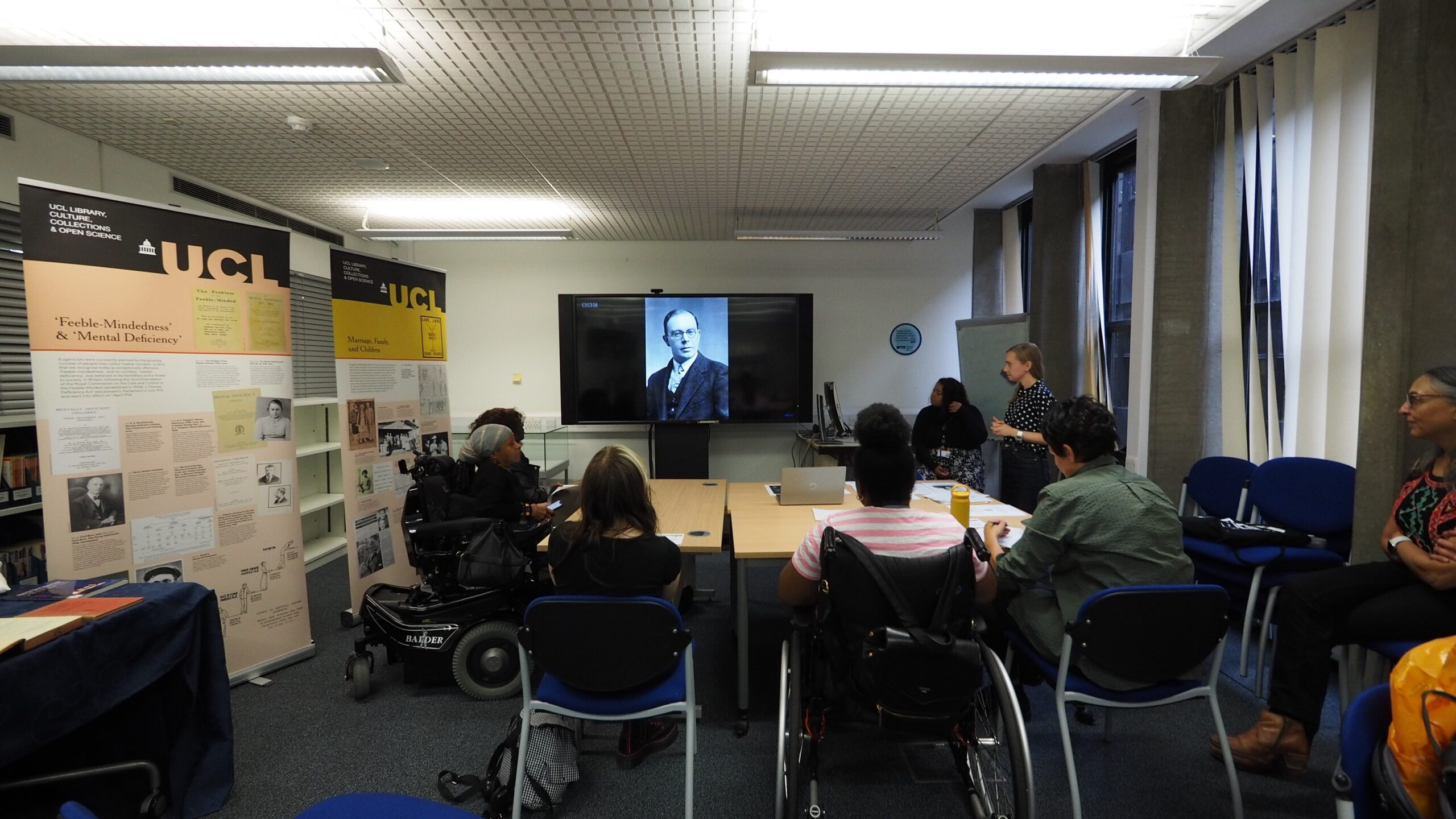
On 20th September 2023, a group of ALLFIE staff and ‘Our Voice’ youth project members attended an exhibition at University College London (UCL) on Education, Disability and Eugenics, led by a Disabled consultant, Jessica Starns. The workshop is part of a wider project called Prejudice in Power: Contesting the pseudoscience of superiority, “a programme of cultural activism for change against structural discrimination. It explores how eugenics has marginalised voices and shaped society” and how “eugenic thinking is present in the racism, ableism, homophobia and reproductive controls we see today.”
The workshop consisted of a lecture and an exhibition on the legacy of eugenics in education, and its relation to people perceived as ‘deviant’ and ‘feeble-minded’ in society. ALLFIE’s Michelle Daley and Yewande Akintelu-Omoniyi report back on what we learned.
Engineering human thinking
The work of Disabled People’s Organisations (DPO) remains significant in our campaigns on the legacy of eugenics in education and other areas impacting on Disabled people’s lives, including independent living to end segregation in all its forms. A collective of over 200 representatives from DPOs came together in a hybrid conference on 21st September 2023 at Manchester’s People’s History Museum. The conference called to increase the funding, resourcing and sustainability of DPOs, as well as cross-movement working on capacity building campaigns to dismantle deep rooted systemic injustices and inequalities. It focused on challenges in four strategic areas of The Disabled People’s Organisation Manifesto:
Representation and Voice
Rights
Independence
Inclusion
The outcome of the conference saw the adoption of the Disabled People’s Organisation Manifesto (DPO Forum, 2023) which included different asks such as “all resources going to segregated settings and programmes diverted to inclusive programmes and support”. It made clear the need to bring “a right for every Disabled learner to get appropriate support in a mainstream education setting”.
The 1900’s eugenics movement engineered a set of beliefs and practices, providing rationales to shape global thinking about the quality of the human population. Eugenicists in education were fundamental in encouraging disconnection and segregation between groups and communities. Historian, Nazlin Bhimani, from the University College London, said that eugenicist’s work was engineered in a “scientific way”, which gave acclaim to their thinking as extraordinary and had significant influence in policy and the treatment of Disabled children, and other communities considered ‘deviant’ or ‘misfits of society’. The eugenics’ movement introduced categorisation, and streaming of individuals based on ability and age to determine a child’s future potential. Eugenicists created reasonings that would result in the design of separate nurseries, schools, colleges, and university buildings to cater for children and young people, categorised by their impairments. Such reasoning led to the segregation of other groups based on characteristics such as race and socioeconomic background.
Law, policy and practice
In less than 100 years, there is enough evidence to track the tools of the Eugenics Movement in educational law, policy and practice. For example:
1944 Education Act introduced labelling and categorising Disabled children by their impairments. The act also placed a duty on Local Education Authorities to create separate educational places based on impairments’ groups.
1978 Warnock Report carried out an inquiry into the education of Disabled children. While it resulted in the ending of the 1944 educational categories of impairments and introduced the term SEN, the recommendations retained the notion of who is deserving and undeserving of mainstream education.
1981 Education Act and further amendments retain Local Authority power to remove Disabled children from mainstream educational settings.
In 1992, Ofsted introduced a grading scale to inspect nurseries, schools and colleges to determine their performance and other information used from the Ofsted reporting. A setting is judged based on their grade.
In 2009, the UK government signed and ratified the international treaty UN Convention on the Rights of Persons with Disabilities (UN CRPD) and adopted Article 24 (on Inclusive Education) as a human right. However, the government placed two reservations: on parental choice and to retain special educational settings, showing the legacy of eugenics in education.
2014 Children and Families Act introduced a presumption to mainstream education, and extended EHC plans between the ages of 16 and 25. The government has failed to effectively resolve these provisions of the Act.
2023 SEND and AP Improvement Plan published recommendations, which included an investment of “£2.6 billion between 2022 and 2025 to fund new places and improve existing provision for children and young people with SEND or who require alternative provision.” (DfE, 2023).
Other examples can be found in the number of Disabled children labelled with ‘complex needs’ placed in segregated residential settings that operate as both care homes and schools. There is a current campaign led by a collective of Disabled People’s Organisations, including ALLFIE, against the Hesley Group which was found to be inflicting torture and violence on Disabled children and Young people.
Influences of superiority
The above examples show how the legacy of eugenics inform current laws, policy and practice within the education system that reinforce societal divides and inequalities. The eugenics movement ideology in education continues in practices of measuring and grouping children and young people based on characteristics and socioeconomic backgrounds, by placing them into categories that influence superiority over the types of education students receive. A lot of these practices are based on assumptions about communities and groups of people in society that continues to render human difference and uniqueness as awful. The harm retained by this legacy is evident in the Timpson Review of School Exclusion but also shines a spotlight on the structural and systemic oppression in education. This particularly impacts communities and individuals who are pushed to the margins of society because of a person’s characteristics and socioeconomic background. An exploratory research conducted by Dr Ashlee Cristoffersen (2021) titled “Intersectionality in practice: Research Findings for Practitioners and Policymakers” found that “…intersectionality is widely thought to be a challenging theory to apply, and it represents a puzzle to policy makers and practitioners who work in both issue area and ‘equality strand’ silos (of e.g. race, gender, and disability)” (p.6).
It is necessary to recognise the intersectional barriers and injustices that impacts different communities and groups of people living at the margins of society. There is no doubt that the following factors are consistent with eugenicist’s ideology:
Retaining of elite grammar schools
Continued measuring and testing of primary school children which consists of Standard Assessment Tasks (SATs)
Ofsted ratings on nurseries, school and college performances
Assumptions made based on student’s personal characteristics and socioeconomic background
All are consistent with the legacies of the eugenicist’s works that we looked at during the workshop. This includes:
Cyril Burt: An influential British psychologist who developed factor analysis in psychological testing. He believed that intelligence was hereditary, but he also believed that the environment and social background played a role in intelligence. He developed a “Backward Map of London Boroughs”, which showed the difference in intelligence across London. He was the first educational psychologist to be appointed by government, and he had a radio show on the BBC which had a lot of influence on the general population. He was also a professor of psychology at UCL from 1931- 1950. His book “Factors of the Mind” was published in 1940. After his death it emerged that his research and data had been falsified and fabricated.
Alfred Binet: A French psychologist who introduced the first practical IQ test. The IQ test included processes such as reasoning, with techniques using, pencil, paper and different objects. He opened a laboratory in Paris for child study and experimental teaching.
Henry H Goddard: An American eugenicist, segregationist and psychologist. His research was on intelligence and mental deficiency at the “Vineland School for Feeble Minded” in New Jersey. He brought Alfred Binet’s intelligence tests to the US. He advocated for sterilisation of people with Learning Difficulties. He manipulated the photographs of the Disabled people he photographed.
Karl Pearson: An English mathematician and biostatistician. He was the first chair of eugenics at UCL. He promoted the idea of an “immigration IQ”. He thought that immigrants had a low IQ and he held racist views against Jewish and Black people.
George Shuttleworth: A British psychiatrist and asylum superintendent at the Royal Albert Asylum. He introduced vocabulary and words for mental health conditions that are now part of our everyday vocabulary. Words include: ‘idiot’, ‘imbecile’, and ‘lunacy’.
Mary Dendy: Promoted segregated education for individuals labelled as ‘mentally handicapped’ people. She established a colony for people deemed ‘feeble minded’. The aim of this colony was to keep Disabled people separated from the rest of society.
Former Prime Minister, Winston Churchill, also believed in eugenics and judged inferior and promoted superior of human population as a way to retain a divided society. He was vice president of the first eugenics conference in 1912, which took place in London.
Arguments made by historian Nazlin Bhimani in a website article for the Wellcome Collection (2022) titled “Intelligence testing, race and eugenics” shine a light on how the history of eugenics informs contemporary society. Attention was drawn to her reference:
“The legacies of eugenics in education are most obvious in the way we continually assess our children. These methods are often based on standardised measures that result in the labelling, ranking and grouping of children”.
Nazlin Bhimani’s argument is necessary in providing an understanding of how reasons and tools were used for identifying ‘superior’ and ‘inferior’ students, which would determine the child’s educational destiny and future opportunities. Across the UK today the legacy of eugenics in education remains, with nurseries, schools, colleges, and universities competing against each other, affecting the distribution of resources and opportunities for students. As already mentioned, Timpson Review of School Exclusion (2019) highlighted the educational inequalities and intersectional injustices. Also, a recent Guardian (2023) article titled “School suspensions rise sharply among disadvantaged children in England” reported that Disabled children “were four times more likely to lose learning through being suspended”. Other literature such as 2023 SEND and AP Improvement Plan and ALLFIE’s research on School Accessibility Plans reveals the nuances of the legacy of eugenics and demonstrates its use in practice predominantly used to shut Disabled children labelled with ‘complex needs’ out of mainstream educational settings.
Inclusive education without discrimination
There are real issues with the legacy of eugenics in education and school segregation. The Council for Europe states that:
“School segregation is one of the worst forms of discrimination and a serious violation of the rights of the children concerned, as their learning opportunities are seriously harmed by isolation and lack of inclusion in mainstream schools” (2017, p.5).
Despite the UK Government being a signatory to the UNCRPD, Article 24 on Inclusive Education (House of Commons) as a human right for all Disabled people without discrimination. Yet, the education system remains committed to school segregation, further fuelled by investment to build 141 of new special schools over the next 3 years (DfE, 2023). What we are experiencing is the education system not making the efforts to ensure inclusive education for all Disabled people in nurseries, schools, colleges, and universities. The legacy of eugenics in education remains; it influences policy, parents, students, and teachers to buy into thinking that fuels marginalisation and injustices in society.
Building the capacity of the Disability Movement to campaign on ending poverty for Disabled children, Young people and their families
By Iyiola Olafimihan, ALLFIE’s Capacity Building Development Officer
Our dearly beloved departed trustee and former chair, Joe Whittaker, often said, the debate about inclusive education as a right is already won. We believe this, despite the system and opponents of inclusive education doing all they can to keep the special provision industry thriving, thereby leading to continual institutionalisation and segregation of Disabled children and Young people.
What is also not in dispute is the causal link between segregation in education and the outcome of poverty for Disabled children and Young people, which was confirmed by a Joseph Rowntree research report in 2016. But we also know that poverty intersects with a range of other issues and affects the most marginalised people with different identities and experiences.
Accessing free meals for children of families in schools have often helped many throughout the cost-of-living crisis. Although the free meals scheme is one of the indicators of poverty, it can also allow families to put aside retain some income that can be spent in other areas.
Unfortunately, the free meal scheme does marginalise some Disabled children and their families because of systemic barriers embedded in its delivery model.
Research conducted by the national family support charity, ‘Contact’, shows that a third of eligible Disabled children are missing out on their free school meal, losing almost £600 a year of financial help.
Of this 33% of eligible families:
60% can’t eat school meals due to dietary requirements or sensory processing difficulties.
22% are off school due to a long-term illness or medical condition.
18% have EOTAS (Education Otherwise than at School), similar to home education, or are off school waiting for a suitable school place.
They surveyed 1,500 families with Disabled children eligible for free school meals. Almost half (49%) are paying £20 a week providing meals or packed lunches to replace the meals their child is entitled to. 85% of families said that missing out on school meals have increased pressure on their weekly budgets.
This data demonstrates that Disabled children and their families, even when accessing free school meals, experience greater discrimination than their non-disabled peers.
At our Stronger Voices Steering Group meeting in September, DPOs at the meeting discussed similar issues, highlighting in a report that Disabled people they engage with are experiencing disadvantage in schools.
For example, some after school clubs and activities are not inclusive and provisions by external partners are often not affordable. Discussions also touched on school uniforms that are not adapted and the extra cost that families pay to make them adaptable. There was acknowledgement that some high street brands now offer adapted school uniforms, Kingston Centre for Independent living (Steering group member) is currently working with a group on school uniform vouchers so that parents of Disabled children have access to school uniform vouchers.
Often, parents receiving benefits cannot afford summer activities and DPOs have had to fundraise to organise these activities.
The Stronger Voices Steering Group (SG) members, however, recognised that these issues are better tackled collectively. ALLFIE and DPOs on the Stronger Voices Steering group must mobilise the movement with one voice to represent families of Disabled children and Young people. Campaigns must be developed, and the fight must be taken to Parliament.
SG members also agreed to explore tools that will help to reach the most marginalised Disabled people address and challenge poverty, understand what we are doing that is working well and design strategies that we can incorporate into our intersectional practice.
ALLFIE, as part of our capacity building, will collate all the information, and ALLFIE’s Policy and Research Officer will put it into a document to become a research tool. People will then be able to add to the resource.
To reduce poverty amongst Disabled people, the Disability Movement needs to campaign and influence Local Authorities to acknowledge that educational segregation is a major contributor to poverty for Disabled people, and they should design local strategies to promote inclusive education, to ultimately ensure Disabled children’s right to inclusive education is unequivocally incorporated into UK education law, as per article 24 of the UNCRPD.
Before I had my daughter, who is autistic, I thought I’d already experienced or witnessed the worst disability discrimination that British society had to offer.
I’d grown up listening to people using the term ‘spastic’ as an insult and doing unkind impressions of Joey Deacon, a man with cerebral palsy who appeared on the children’s programme Blue Peter in the early 1980s. Many years later, I worked alongside people with a learning disability who’d experienced hate crimes, bullying and horrendous oppression in long-stay institutions.
And as someone who had lived with anxiety and Obsessive Compulsive Disorder (OCD), as well as chronic pain, I’d also personally felt the sting of unempathetic and inflexible attitudes towards me at work; an experience that is probably not uncommon among people with invisible impairments.
By mid-life, I considered myself a battle-scarred veteran of disability discrimination. I’d seen or experienced the worst of it and, in any case I thought, society had evolved and become kinder and more progressive.
Sadly, when my daughter Suki reached two years of age, I embarked on an unpleasant voyage of discovery that showed me how wrong I’d been.
When Suki was about 15 months old my partner and I began to suspect that she was developing differently. She wasn’t talking and nor was she responding to her name, even if we yelled it at her. We monitored Suki and had her assessed and tested by different professionals and by the time she was two years old we were certain she was autistic and had a preliminary diagnosis that said as much.
We drafted in as much support as we could and had her assessed by a local authority educational psychologist (EP) at her private nursery in Wimbledon. The EP agreed that Suki needed tailored support at her nursery and Merton council released the funds to pay for it.”
This ushered in the beginning of a series of disappointments.
No matter what we said to the nursery they never implemented the programme laid out for Suki. They claimed they just didn’t have enough staff available to put it into practice even despite the extra funding they’d received. I would add to that that their staff also didn’t have enough training to be able to support a child with different needs, despite the enormous profits earned by its bosses.
For one and a half years the private nursery failed to deliver Suki’s tailored programme, causing Suki to lose precious developmental opportunities. While this was frustrating and painful for me and costly for Suki, I didn’t find it shocking.
What did shock me, however, was the nursery staffs’ decision to provide Suki with a range of dog toys obtained from a Wimbledon pet shop. The symbolism of this was devastating – my daughter was being treated, quite literally, like an animal. I raced down to the nursery to complain and received an apology from a subdued manager. I was nonetheless left with the sneaking suspicion that they didn’t really see what the problem was.
None of this was as bad as what was about to happen though.
When Suki was three years old, we moved her into the nursery at St Anne’s Catholic primary school in Vauxhall, Lambeth. By the time it came to applying to St Anne’s we had collected a raft of paperwork about Suki’s needs and had in place an Education Health and Care Plan (EHCP) along with a funding package for a one-to-one teaching assistant.
The school’s Headteacher, who had autistic children of her own, knew all about Suki’s impairment and warmly accepted her, both in person and in writing, saying she was welcome to the ‘St Anne’s family.’
But just five weeks after Suki started there, St Anne’s new Headteacher wrote a letter to Lambeth council saying she wanted Suki to be removed from the school by the following year because of her needs, which, we all knew, were directly linked to her autism. She claimed her presence at St Anne’s was ‘incompatible with the efficient education of the other children’.
It took me some time to absorb the meaning of what had happened. Suki was just three years old – my God, to me it felt like she’d only just been born – and yet she was already being shunned, not by a fellow three year old, but by a school, an institution considered by most to be a pillar of society.
Not just any school either, but a religious one with the strapline: ‘the light of Christ shines through every child’. It also claimed in its blurbs to have an excellent track record of supporting children with EHCPs.
What made matters even worse was that during the first term, St Anne’s had also failed completely to implement Suki’s EHCP, had not responded to most of our emails or requests for meetings and had not taken up our offer of private training support until close to the Christmas break.
When we finally did manage to arrange a meeting, on the last day of term, we asked the new Headteacher why Suki’s presence in the school was ‘incompatible with the efficient education of other children’ (this is one of three stock phrases, outlined in the Children and Families Act, that schools can use when rejecting Disabled children).
Suki always had a one-to-one teaching assistant with her, and she is a sweet natured and loving child, so how, we asked, was she disrupting the play of the other nursery children?
The Headteacher said the problem was that Suki mouthed objects due to her sensory needs, meaning staff had had to ‘put their health and safety on the line’ by plucking the items out of her mouth. It had also compelled them on occasions to put some toys away, which had meant other children hadn’t been able to access those particular toys for brief periods.
So, she was being expelled, in effect, because of a sensory need arising directly from her autism.
I won’t go into the details of how I responded to this, but I will say that I spent some time after that meeting reading up on the law on educating Disabled children. To my relief, I found much in the Children and Families Act, the Equality Act and UN Convention the Rights of Disabled Peoples that defended the right of disabled children to enjoy a primary and secondary education, including a mainstream education.
Once I had my guns lined up, I penned a 20-page complaint about St Anne’s sloppy performance and their discriminatory treatment of Suki, a three year old child with autism.
To be sure that Suki would have a place the following year, we applied to twelve other schools while waiting for St Anne’s response.
Little did we know that another horror show lay in wait for us.
We first of all visited another religious school called Archbishops Sumner and were left speechless when the Head and SENCO told us flatly that they would not use Suki’s budget to hire a one-to-one teacher. As our jaws dangled slack and our eyes widened, they explained they would disperse the money around the school to pay for ‘training in general’ and ‘you know, just staff’.
The Head then sent a letter to Lambeth saying Suki’s presence in the school would be ‘incompatible with the efficient education of other children’ (yes, that tired old line again) and that there was no point in Suki attending the school without one-to-one support – the very support they had just refused to give despite there being a budget for it!
And then things got worse.
A school called Oasis in Waterloo also turned Suki down, saying she was a child of violence who’d pose a serious risk to children and adults alike. This was because of Suki’s previous habit of gently cupping people’s cheeks in her hands to say hello, a gesture so gentle it could make a grown adult cry.
Schools with autism units inside them also turned Suki down as did one specialist autism school called TreeHouse in Highgate, one of only two out-of-borough schools we applied to. TreeHouse said they couldn’t admit Suki because she had occasionally felt fear in the past (due to her autism) and we lived too far away.
Being rejected by TreeHouse was a little like being turned away from a fish and chips shop for having the temerity to ask for fish and chips.
In all, 12 out of 13 schools rejected Suki, including, initially, St Anne’s.
As school after school turned us down, it seemed like society, as a whole, was shutting us out. I felt then that I could imagine what it must be like to be a member of a leper colony, reviled and banished from mainstream society. No other protected characteristic group would face this level of exclusion. If they ever did, it would surely make the headlines in the national papers.
I didn’t have the resources of energy or time to challenge all the schools so I just put in a complaint to Oasis, the school that had made Suki out to be Charles Bronson in nappies.
Oasis backed down and so, after three months of deliberations, did St Anne’s. In their letter, St Anne’s said they would accept Suki because it was religious establishment and as such it believed in a quote from the Old Testament that says: ‘how we treat the very least of our brothers is how we treat ourselves.’
It made their stance clear. Suki, to them, was of little value – the least among us.
Those schools’ arguments for rejecting Suki were morally and legally weak and they’d probably have lost if we’d taken them to court. They were trying, I suspect, to protect themselves from having to make any adaptations that would cost them time, energy and resources and they didn’t much care about the impact of their decisions on us.
Just one school said they’d be happy to accept Suki, a mainstream primary school called Heathbrook.
The Headteacher there was warm and welcoming from the start and called me on my mobile phone a few times to talk about transitioning Suki to his school and the ways they could support her to develop to her full potential.
Their upbeat and welcoming letter came after we’d received ten icy rejection letters and by the time we got it, we were deeply distressed. Reading the Headteacher’s kind words almost caused me to break down in tears of relief. His offer restored some of our faith in society and humanity and brought us solace and comfort when we were feeling like social outcasts.
Heathbrook is significantly further away from us than St Anne’s and we didn’t want Suki to go through a change of location, setting and staff; however, we eventually decided to move her there because, in the end, attitude overrides all other considerations.
The stance of Heathbrook’s Headteacher makes a mockery of the positions adopted by the other 12 schools, showing they most certainly could have taken Suki on if only they’d been willing to accommodate her differences.
Reasonable adjustments are not always about ramps, lifts, widened doorways and different forms of reading material – sometimes they are mainly about attitudes.
Heathbrook will not go up in smoke when Suki joins this September. Nor will its children have their educations and futures ruined because Suki is there. Instead, they will have their social educations enriched by having someone among them who is neurodiverse. They will also, I suspect, adore Suki for her infectious smile and laugh and her sheer difference, just like the children at St Anne’s did.
Stories like this shouldn’t be getting told in Britain in 2023. The fact that they are shows there needs to be a fundamental shift in attitudes in many quarters before Disabled people can hope for meaningful improvements.
Hear my voice
By Blake Williamson
Life as a nonverbal communicator has given me some extraordinary experiences especially, ironically, around communication. The notion of communication being one dimensional i.e verbal, is still the default for most people, with any anomaly eyed as suspicious.
The possibility that we may all at some time during our life be nonverbal, even if only for a while, is a very real probability; weakness from illness or injury, a stroke, pneumonia, anxiety, Parkinsons or simply laryngitis. Given these odds it feels incongruous that my facilitated communication is received the way it is. Those who are unfamiliar with me find this concept difficult to comprehend and are often quite vocal with their opinion.
Facilitated communication is used when a person’s physical abilities affect accuracy when pointing at letters on a board to spell out words and sentences. The facilitator reads what has been written and speaks those words. My Personal Assistants (PA’s) take great care when reading and then expressing my words to accurately convey my meaning. I have used this method from childhood, from family, classroom assistants, college support, university mentors to PA’s. Many have acknowledged my communication within educational settings, some have challenged it. These challenges always came from a power dynamic which had to be picked apart to illicit understanding, which I worry is now the default approach in many schools and classrooms.
I have always hoped that the visibility of a nonverbal communicator within education, communities, work, and leisure environments shape the understanding of educators and influence the learners of communication in all its forms.
Anything but silent
A poem by Blake Williamson
We understand others far beyond just speech
There is so much underlying that words alone cannot teach
We are anything but silent if you take the time to know
Friendships can be richer if we sow patience and watch it grow
My opinions are just as valid and I have plenty to convey
The rewards are simply richer if we all get a say
Supported by
ALLFIE’s campaign for Inclusive Education as a human right is backed by funders and donors who reject the systemic segregation of Disabled people from society.
![ALLFIE [logo]](https://pedantic-shannon.91-238-163-161.plesk.page/wp-content/themes/allfie-2025/assets/img/allfie-logo-original.svg)