Please ensure Javascript is enabled for purposes of website accessibility Skip to main content

Q: Tell us something about you and your family, particularly you and Honey?

A: My daughter Honey and I have , I guess, an average mother and daughter relationship. We enjoy spending time together and have lots in common. However we have something else in common that maybe other mothers and daughters do not; we are both Autistic.
In fact Honey was the first Autistic female I had met: my own daughter.
So little was known about Autistic women and girls when I was growing up that I wasn’t diagnosed until I was 32; my daughter and her younger sister were diagnosed as Autistic at 2 and 6 years old.

Q: Tell us something about autism, how it affects you and people’s reactions?

A: The way our Autism affects us is actually a great deal more than people may assume from the outside looking in. Outwardly we may seem to be “mild” in our Autism presentation but a mild diagnosis does not mean a mild life experience – in many cases it means the non-autistic person’s experience of us is milder perhaps?
For Honey it means a great deal of anxiety and being misunderstood – it meant having to choose at 13 to have the human right to an education or her human right to health – not both, as both for an Autistic female is near impossible in the current educational system.
For me it means anxiety, a need to second guess every action and for a predictable outcome, all the while being not so capable at predicting an outcome at all? It means a great deal of social isolation and loneliness, but it also means concentrated interests and intelligence (without any exams to prove it as I couldn’t cope at school either!).

Q: Why do you think it is important for Honey to be included in mainstream education?

A: It is so vital that Honey and indeed her sister and other girls like her have the access to participate in mainstream education; there is a whole wealth of subjects taught at secondary school level that have very little to do with academia; friendships, routine, time management, health education, sex education, conflict resolution, all of which Autistic females and males can go without when school isn’t equipped, trained and experienced in how autism looks and how to support, understand and most importantly RESPECT the wonderful asset Autism is.

Q: What have been the challenges?
A: The challenges Honey had at school were totally avoidable – sadly her mistreatment was not in full by other students, who would be perhaps too young to understand Autism, but by those who should have known better and protected her; a handful of educational staff. On one occasion in 2008 a teacher made a dunce hat out of red cardboard, wrote in black marker “I will be polite to everyone I meet”, and forced her, then only six, to wear it for a full school day.

Q: What were the high and low points of Honey’s inclusion?

A: I moved Honey to a local school with an autism unit attached to it. This was a perfect situation as although Honey did not require the unit full time she could dip in and out of the unit’s support, and the whole school had an autism ethos as all staff were trained and had hands-on experience of autism – rather than read a book once! Unfortunately my daughter aged out of that ideal school situation and moved to secondary school which was just awful – it ended up with a very anxious child unable to learn – and some teachers being told some home truths after months of them proclaiming they knew all about autism only for one staff member to severely punish my daughter for “not looking at him when he was talking”.

Q: What needs to change?

A: There needs to be more research, understanding and action to bring our educational systems into the future and to ensure inclusion really does mean all. No child should have to choose between their health and education. Home education has helped my daughter, but it isn’t the answer. It is elected exclusion, as inclusion was not an option open to her. Autism training by autistic adults in schools is a must. In fact it should be done yearly for both students and staff as a legal requirement.

A stop gap is the Olley Edwards academy, set up in Jan 2015 for home educated Aspergers /Autistic/ PDA children who did not flourish emotionally in school and are therefore home educated. The academy’s aim is to prevent isolation and seek inspiration and friendship in activities and small meet ups for those unable to attend larger events.

Carly and Honey run a website to help other families with autistic members.

Intelligence testing began in earnest when in 1904 the French government commissioned psychologist Alfred Binet to find a method of differentiating between children who were ‘intellectually normal and those who were inferior’, in order to put the latter into special schools where they would receive more individual attention. In this way the disruption they caused in the education of intellectually normal children could be avoided. Sound familiar?

This was a natural development from Darwinism and the Eugenics movement that dates back to 1869. Sir Francis Galton promoted the idea that for society to prosper the ‘weakest’ should not be allowed to have babies, as this would affect the genetic stock of future generations. He and his many followers were contemptuous of any impact education might have on raising the achievement of the ‘least able’ (Thomas and Loxley, 2007).

Binet’s work led to the development of the Binet Scale, a new approach to assessing mental ability. However, Binet himself cautioned against its misuse or misunderstanding. According to Binet, it was designed only to identify children requiring special education, not as “a general device for ranking all pupils according to mental worth.” Binet noted that “the scale, properly speaking, does not permit the measure of intelligence.”

Since, according to Binet, intelligence could not be described as a single score, the use of the Intelligence Quotient (IQ) (a notion coined by Terman in 1916) as a definite statement of a child’s intellectual capability would be a serious mistake. Binet feared that IQ measurement would be used to condemn a child to a permanent “condition” of stupidity, damaging his or her life chances:

‘Some recent thinkers…[affirm] that an individual’s intelligence is a fixed quantity, a quantity that cannot be increased. We must protest and react against this brutal pessimism; we must try to demonstrate that it is founded on nothing.’ (Binet)

Binet’s scale had a profound impact on educational development. However, the educators and psychologists who championed the scale and its revisions failed to heed Binet’s caveats.
Cyril Burt, the first educational psychologist for London in 1913, was less cautious than Binet. A Social Darwinist, he was convinced of the inherited basis of intelligence and fond of psychometrics. This gave great impetus to segregated education based on categorisation of children. Burt’s reputation is now linked to his fraudulent invention of data about inherited intelligence based on non-existent twin studies but at the time his influence was enormous.

When medical officers were largely responsible for selecting pupils for UK special schools the most important item in the selection process was the Stanford-Binet Intelligence Scale. Although such decisions are now a result of a Full Statutory Assessment in which parents’ wishes are significant, substantial numbers of educational psychologists across the UK still use psychometric tools. Despite being modernised to include tests such as the WISC-R and the BAS (British Ability Scales) their core constructs remain unaltered.

This is surprising as the shortcomings of such tools have been long known and debated among educational psychologists. Yet scores are still demanded particularly around those for whom measurement is the most difficult. There is a wealth of literature critical of the role and negative impact of IQ testing (Leyden, 1978, Lokke et. al, 1997; Leadbetter, 2005, Farrell and Venables, 2008) and yet educational psychologists still spend much of their time undertaking formal special education evaluations using psychometric assessment including IQ tests (Shapiro et al., 2004 and Farrell and Venables, 2009).

Test scores are appealing, offering the immediate and seductive appeal of a spuriously precise, defined result in a complex educational world.

Why are such tests so problematic?

The tests were primarily designed for white, middle-class children and are unfair and invalid when used on children from different backgrounds. Attempts to create culturally neutral tests have proved unsuccessful; no test has been found that does not reward some cultural groups over others. Intelligence may be as great in different groups, but questions may need to be approached differently due to differences in cultural background. The tests have been challenged in court for racial and cultural bias, but there have been no definitive rulings on them.

So much caution has to be applied when administering and interpreting such assessment processes with different cultural groups that major validity questions are raised on every occasion. It has been shown that test outcomes can depend on familiarity with the test materials, the procedure and the examiner.

“No one would believe until I demonstrated it with controls that the IQ scores of pupils from an open air school could be lifted 10 points or so by thawing them out on the hot water pipes for half an hour before testing.” (Head of Special School-quoted in Galloway and Goodwin, 1979)

In one US experiment, asking 99 school psychologists to independently score an IQ test from identical records resulted in IQs ranging from 63 (mild learning difficulties) to 117 (gifted) for the same individual. In addition, differences in the interpretation of test scores for entire groups have been documented (Ropers and Menzel, 2007).Anxiety is also known to affect test scores. If being tested makes you anxious you will score lower.

IQ tests only capture a few aspects of many different ‘intelligences’ or ‘systems of abilities’ omitting, for example, creative and practical intelligence, social, emotional and moral intelligence, and lateral and radiant thinking. Wisdom is not considered. IQ tests are ‘static’ (‘What has the child learned?’) rather than ‘dynamic’ (‘What does the child achieve when given guided feedback?) – they measure not intelligence but a child’s attainments in arbitrarily selected skills. They only measure a sample of situations in which so-called intelligent behaviour is revealed and do not capture the complexity of real-life situations. Intelligence tests have been criticized for their limited ability to predict non-test or nonacademic intellectual abilities.

Critics assert that potential is gauged by simply adding up correct answers, ignoring how a child has arrived at them; but research has demonstrated that the child who answers wrongly may understand as much about a problem as the one who answers correctly, perhaps by guessing.

A central criticism of IQ tests is that they are used to distribute limited resources and provide rewards: special classes for gifted students, admission to college, employment or the opposite with special education placement. Those who do not qualify for resources based on test scores may feel thwarted and resentful. Negative assumptions have been initiated, aspirations lowered and self-fulfilling prophecies created. Unfortunately, intelligence test scores have become associated with self-worth.

At worst such assessments have been used to wrongly place pupils from ethnic minorities in special schools and units. The PLASC and School Level Annual School Census (2002) revealed Black Caribbean pupils were over represented in Pupil Referral Units (5.8% compared with 1.5% in mainstream schools). Even more relevant was that 3.6% of Pakistani pupils were in special schools. Would this have anything to do with factors such as poverty? Or are some pupils still being assessed and doing badly on culturally biased tests?

Dyson and Gallannaugh (2008) have also considered the disproportionate presence of students from different social groups in the UK special needs system and argue that it reflects broad educational and social inequalities.

Many intelligence tests produce a single score. This is inadequate in explaining the multidimensional aspects of intelligences. Two people can have identical scores, yet one may have obtained the score due to strong verbal skills while the other may have obtained it due to strong skills in perceiving and organising various tasks.

Linda S. Siegel (1992) proposes we abandon the IQ test in the analysis of the disabled child. According to most definitions intelligence consists of logical reasoning, problem solving, critical thinking, and adaptation. However, examining the content of IQ tests, they test virtually none of these skills.

Siegel gives a detailed analysis of the subtests of the Wechsler Intelligence Scale for Children-Revised (WISC-R), often used in diagnosing learning difficulties. In each subtest of the Verbal scale, performance is in varying degrees dependent on specific knowledge, vocabulary, expressive language and memory skills, while in the Performance scale, visual-spatial abilities, fine motor coordination, perceptual skills, and in some subtests speed, are essential for scoring.

According to Siegel it is a paradox that IQ scores are required of disabled people, many of whom have difficulty in one or more of these skills. They may end up with a lower IQ score than a non-disabled person, even if they have identical reasoning and problem-solving skills.

Most tests are carried out against the clock. If you are slow because of movement differences or learning style you will do worse. If doing things is hard for you because of any kind of physical impairment or difference then you will score less well against a ‘typical ‘population.

Another assumption is that an IQ score should predict reading ability. However, many individuals have low IQ scores and are very good readers, making a nonsense of this way of thinking.
IQ scores and psychometric test results are clinically focused on the child or young person’s deficits especially if they have additional support needs. They provide one answer to the vexing question ‘What is wrong with you?’

“I scored relatively high in an IQ test when I was a child. Since then I have done many many many very very very stupid things in my life. I still wonder what that test has to do with intelligence or understanding at all.” (Alex Wien, Austria, 2009)

Many people assume intelligence tests measure inborn intelligence that will never change, when in reality they are based on an individual’s interaction with the environment and can never exclusively measure inborn intelligence – if such an entity even exists. People continue to learn throughout their lives and no-one has proved the existence of fixed potential, a ceiling that lasts a lifetime.

Anne Donnellan (1994), recommended adoption of the “Least Dangerous Assumption.” When faced with a disabled child who does not appear to be learning, educators can either assume that she is incapable of learning and segregate her from her peers, or keep on exposing her to learning. Whether the child in fact learns nothing, or simply cannot communicate what she learns, the latter is by far the least dangerous assumption.

Intelligence testing is still widely relied on in allocating scarce resources in the special educational needs system in the UK and SEN tribunals are over-fixated on the percentiles scored in the WISC Test. An inclusive approach which respects disability equality is based not on labelling and attachment of scores but on the needs of the child in a mainstream inclusive environment, identifying supports and reasonable adjustments to help them be involved and progress in their learning at a challenging pace that suits them.

With the Government drawing up legislation for selective education this will again be based on IQ type testing to select the most able. In the 50s and 60s educationalists learned to their cost that selection by ability was grossly unfair as children developed in different ways and at different rates. By the age of 18 often those who had failed the 11+ exam outperformed those who had passed, and the test results had little relation to life success. Let us not make the same mistakes again.

Colin Newton, with concluding paragraphs by Richard Rieser

References:


With a gathering of like-minded individuals, we were immersed in fascinating discussions, invited to listen to an amazing variety of insights into how education, housing, employment, independent living could work in the interest of everyone, and this included the struggles people had about getting out of institutions and living their lives independently. A common theme throughout this weekend was the crucial role of good and effective personal support. It was reassuring to witness many examples of personal support working in mutually respectful relationships.

It was necessary to remind all participants that despite the failings of State Governments the United Nations Convention of the Rights of Persons with Disabilities (UNCRPD) 2006 Article 4, clearly states that governments should “ensure and promote the full realisation of all human rights and fundamental freedoms”.

And yet, ten years on, we continue to hear how many disabled people are denied fundamental freedoms that so many non-disabled people take for granted. Those attending the Freedom Fighters Festival were a group of individuals fighting for a society in which justice and freedom are part of a collective struggle.

The festival was organised by Thiandi Gooff and her two mothers, Trix and Jose, women from Inclusion Netherlands, who involved many different groups, communities and individuals into the Freedom Fighters Festival, recognising the value of creating inclusive communities for all people in those communities.

Thiandi is a member of the group Quiet Riot, a group of young people who do not use speech and yet have so much to communicate. As part of the festival, the group launched ‘Quiet Riot Collected: Facilitated Fables’, a collection of their poems and prose, with challenging, triumphant, celebratory sub-texts and revelations of discrimination. The book was orchestrated by a founder member of the group Maresa McKeith who collected contributions from Quiet Riot members. In total 11 contributors participated, sharing some 43 poems.

Members of Quiet Riot were able to present their poems with the support of their PAs. One such poem was ‘Walls of Families: Auschwitz’ by Maresa, which recounts the experience of ‘a boy looking at the wall of pictures’, and ‘the invisible thousands’. Maresa takes the reader on a journey being “unborn, looking forward to life but tested as ‘not required”’, asking a fundamental question about choice and concluding with the haunting passage that “there are still too many poems that will not fit on a memorial wall”.

Of interest is also the number of challenging comments which appear on the back cover, one of which is by Blake Williamson who shares his experience of a “lifetime of effort” making reference to “one disability phobic act” which “makes you defensive and defenceless”. Blake makes reference to a “disabling world” yet with his PAs is committed to challenging a “world made by non-disabled people” for a “more just society”. As the Freedom Fighters Festival gathered pace, there was an opportunity to meet with Amsterdam’s local politicians and ask questions about access, education, employment and living independently. The discussion was lively, informative and raised a number of acknowledged concerns as to how disabled people were often excluded from political participation.

Social events included visiting community centres, sharing meals, and attending an Opera concert in the park which was attended by hundreds of enthusiasts.

During the festival weekend, there was an organised march, accompanied by a brass band, consisting of like-minded individuals which mobilised residents from local communities to participate on a common theme relating to ending the segregation of disabled people, to human rights and social justice. In asking individuals for their recollections of attending the Freedom Fighters Festival Maresa responded that she was surrounded by “a focus to believe in each other” and being amongst people “who I identify with and don’t have to explain myself to” in a “wonderful atmosphere of welcome and solidarity”. Anthony Kletzander replied “it meant a really good opportunity to discuss the issues that affect people like myself and those like me”. Raphael who contributed an untitled poem which uses the line of “freedom on hold”, recounts his lasting memory of participating in the “poetry gig”. For Paul-Thomas there were “lots of moments of light and music”, consisting of “freedom and acceptance” and the “value of an active movement”. For Thiandi there was a gratitude of having visiting friends and loving “the tolerance and respect and the music and the inspiration” and wanting to “organise it again”.

The Freedom Fighters Festival was an important reminder of the way disabled people continue to fight for freedoms which have yet to be actively realised. The festival was embodied with a celebratory tone celebrating difference, pursuing change, acknowledging diversity and fundamentally about our reciprocal interdependence. As we return to the UK, awaiting political and social fragmentation, what a week to remember and remind us of our struggle for human rights and social justice!

Navin Kikabhai

You can purchase the book here.


Q: I am a parent of two children. My 13 year old non-disabled son has passed the 11 plus exam and is attending the local school, which happens to be a grammar school. I would like my 10 year old daughter, who has learning difficulties, to attend the same school. We believe my daughter will be disadvantaged by the 11 plus test to such an extent that she will fail the assessments. Can we challenge the use of the 11 plus test’s content and marking arrangements (rather than arrangements made around administering them ie making papers available in large print on different coloured paper etc)? Can I challenge the use of the 11 plus test in the admissions process under the Equality Act 2010 on the grounds that it is biased towards non-disabled pupils?

A: The use of selection tests arguably cannot be said to amount to discrimination against disabled students, unless there is evidence that a particular disabled child is put at a disadvantage due to:

If there is evidence that the tests are biased against disabled candidates, that may give rise to a claim for indirect discrimination on the ground that it puts disabled candidates at a particular disadvantage. It is important to remember however that any discrimination challenge will need to show that a particular individual has suffered a disadvantage as a result of a discriminatory act or practice. It is not enough to claim that disabled individuals are likely to suffer a disadvantage as a result of it.

If a school had taken reasonable adjustments to remedy any disadvantage suffered by disabled candidates in being required to take the test, it may make it harder to argue indirect discrimination.

The duty to take reasonable adjustments means that schools should take pro-active steps to remedy any disadvantage before it is suffered by any disabled pupils.

Once made aware of a disadvantage that may be experienced by a disabled individual, the school would be expected to take reasonable steps to avoid this disadvantage which is likely to vary for each disabled candidate. Reasonable adjustments would normally be made in administering and/or sitting the test rather than its content or marking arrangements. This may include giving the disabled candidate more time to complete the test, providing them with a note taker, or other similar adjustments. It would be more difficult to identify reasonable adjustments that should be made to the content and marking criteria.

If it was clear that there were reasonable adjustments that the school should have made and did not, this may point to its failure to make reasonable adjustments. Where a candidate has dyslexia, it is reasonable that they should not lose marks due to this.

Ultimately, schools are not required to make any adjustments that they do not have the financial resources to make, only what is ‘reasonable’ in the circumstances.

If your child is disabled and you are concerned that they will struggle in future admission tests, you should tell the admissions administrator of your child’s disability in advance, ask that reasonable adjustments be made for your child and explain what those should be. Evidence of your child’s disability will be required to support your request, for example medical reports or any evidence from her current school. If you are concerned that reasonable adjustments have not been made, you should report this immediately to the school and admissions authority. You can also bring a challenge via the admissions appeals process based on discrimination principles.

If you are concerned that your child may have been subject to discrimination by a school, please contact education law specialists Simpson Millar LLP on 0808 129 3320 or online.

Serena Fassò

Serena is a Solicitor with Simpson Millar and specialises in Education, Community Care and Public Law.


Alliance for Inclusive Education (ALLFIE) Submission to the Residential Special Schools Review

The Alliance for Inclusive Education campaigns for disabled students’ and pupils’ rights to inclusive education. We are led by disabled people but our membership also comes from allies, parents, SEND professionals and educational institutions.

Over the past century little has changed; parents want their disabled children to live at home and be part of the family, to be in mainstream education in their local community with necessary support, rather than in residential special schools and colleges.

Disabled Children & Young People and Human Rights

The UK Government ratified the UN Convention on the Rights of Persons with Disabilities (UNCRPD) in 2009 and UN Convention on the Rights of the Child (UNCRC) in 1990. Both highlight the importance of access to family life and of ending the institutionalisation of children. UNCRC Articles 23 and 18 make it clear governments must provide parents with the support required to raise disabled children within their local communities. Article 7 of the UNCRPD requires the ‘best interests of the child to be a primary consideration’. The Lenehan report [1] highlights that current arrangements for some disabled children and young people do not meet this criterion.

Article 24 of the UNCRPD clearly states governments must develop an inclusive education system. ALLFIE believes that despite the Government’s Reservation and Interpretative Declaration, which includes a commitment to building the capacity of mainstream schools, current decision-making violates disabled students’ human rights under both treaties and would be unacceptable if applied to nondisabled children and young people.

“A senior manager reflected on a panel which had been pleased to agree a solution for an 11 year old which involved him living full time in a residential school a long way from home. ‘It can’t be right, can it?’ he said and the answer is no, it can’t. We wouldn’t make that decision for a child without these needs; it would not be seen as acceptable.” (Lenehan 2017)

Residential special education – a lesson from history

ALLFIE’s 2015 “How Was School?” project[2] captured 100 years of disabled peoples’ educational experiences, mostly in residential provision. It demonstrated that whilst the environment and the nature of SEND provision in residential special schools and colleges may have evolved, the impact of segregation and institutionalisation on disabled children and young people remains the same. The experience of institutionalisation cannot be improved because it is founded on the mindset that disabled people are not full members of society. Many of the participants in “How Was School?” have experienced lifelong effects from childhood segregation.

Lenehan (2017) reports systematic failings of residential provision, including residential special schools and colleges, to provide meaningful education and safe care. ALLFIE believes residential special schools and colleges should not be viewed separately from other residential institutionalised settings such as Winterbourne View and St Andrews Special Hospital with the same deficit approach to disabled children and young people. Disabled children and young people in these settings are inevitably, harmfully, disconnected from their families, communities, peer group and positive identity around disability.

How and why these children and young people come to be placed in residential special schools and colleges

Parents do not actively choose residential special schools and colleges. On the contrary research[3] [4] indicates many parents (up to 84%5) want their child to be educated with appropriate support in a local school whilst living at home. NASS research in 2012[5] highlighted that in fact:

Placements are generally made when the placing Local Authority has been unable to meet the needs of the child or young person through their own (local) provision

This experience is supported by Scope[6]:

Families were often forced to make difficult choices, in some instances be apart so that they could receive all the support they needed.”

The threat of institutionalisation is as real today as fifty years ago. Ian, now 69, was sent to a residential special school when very young, whilst Jane’s 11 year old son was threatened with residential special school placement in 2016, despite being successfully included in a mainstream primary:

I had to go to boarding school. I had no say in what was going to happen. Parents do not have a choice. Their rights are dictated by professionals.” (Ian, How Was School 2014)

“We were told that, for children like our son, with severe learning disabilities and non-verbal, inclusion was not “meaningful”, that there were no options and that he would have to go to a special school, even if we didn’t want it. How could a little boy go from living at home with his loving family and attending his local primary school to being sent away to a residential school?” (Jane (not real name), evidence to ALLFIE 2017)

Jane and her family had to go to tribunal to prevent her son’s removal to a residential special school.

Since 2014 the number of residential special school enrolled pupils has increased from 13,059[7] to 17,066[8] (30%) and boarding pupils have increased from 3,185 to 5,195 (63%). More shockingly the Lenehan report highlights that 1129 disabled children and young people are currently in 52 week placements with little chance of returning home.

When the state is paying £120,901[9] to £250,000 (parent, evidence to ALLFIE 2017) per residential special school placement, clearly decisions are not based on cost effectiveness. The Department for Education and local authorities are withholding resources from local services whilst spending vast sums on residential special schools and college placements. Services for disabled children are often planned and commissioned separately from other services and miss strategic opportunities to provide coordinated education, health and care services locally. ALLFIE believes this is also still about the government’s commitment in 2010 to ‘reverse the bias towards inclusion’ under the guise of parental choice – yet families have no choice:

“Miles was settled into a good mainstream school with a well-resourced impaired hearing unit. After the school’s unit closed down as a result of cuts, the parents had to move him three more times from one school to another before settling for a residential special school for deaf children.” (Garner 2013[10])

The local mainstream college is now stating that they have no experience in working with a young person like my daughter and therefore they cannot accommodate her.” [11]

Improving experiences and outcomes

Residential special schools and colleges still exist because they provide a solution to LAs struggling with the disabled children and young people least able to fit into a society which resists inclusion; sending these children out of area makes the ‘problem’ disappear. Residential special schools and colleges claim they can meet these children’s needs because they provide safe and appropriate environments. ALLFIE’s How Was School? Project tells a very different story.

Educational professionals with concerns about an education system focussed on a deficit model of disability talk about the indiscriminate lumping together by diagnosis of disabled children and young people:

I sat on a panel where the young person had been diagnosed by the local CAMHS team as having ‘bipolar disorder’. The panel’s problem-solving dialogue amounted to little more than: ‘Where do we know that takes bipolars?!” (educational psychologist, evidence to ALLFIE 2017)

And there is no guarantee that pupils will actually receive education and support that meets their needs.

My parents were told things would be better at the Deaf school. I wasn’t allowed to sign and found it impossible to lip read the teacher. My education really suffered.” (evidence to ALLFIE, 2014)

“How Was School?” is full of accounts from disabled adults who were institutionalised in residential special schools and colleges, often when very young and for most of their childhood. Usually the experience was negative with little focus on education whilst significant attention was given to normalisation. Everyone talked about the separation from family and community and the cruelty of methods supposed to make disabled children and young people independent.

“this one poor girl, they wanted her to pick up the cup and drink without a straw… she’d get it half-way to her mouth and then for some reason, she’d go into spasm so obviously it went all over her… and obviously they’d shout at her… Instead of changing her, she’d have to stay in it all. Gradually she stopped drinking and what do you think happened?” (Angela, How Was School? 2014)

ALLFIE has worked with many describing themselves as special school survivors whose accounts of segregation and often abuse and mistreatment on the same scale as Winterbourne View have been ignored by government and the providers and commissioners of these services. However the police, CQC and the media are beginning to investigate a number of cases, some historic and some not[12]. Claims that abuse and mistreatment in residential special schools and colleges would not happen now because of improved safeguarding are naive at best.

Destinations

Residential special schools and colleges commonly promote themselves to parents/commissioners on their ability to prepare young people for adult independent living[13]. Abbott4 and Heslop16 found that most former residential special schools and college students with learning difficulties moved into other residential college or care provision, not back into their own communities. Claims that residential special schools and colleges prepare disabled young people for independence and work are not substantiated.

Residential special school places are scrutinised closely – evidence here is that children return to family homes ill-prepared for life within their local community and knowing few people – as you will anticipate.” (Anne Matthews, Principal Educational Psychologist (personal capacity), evidence to ALLFIE 2017)

This reflects evidence from up to 50 years ago.

I had a huge culture shock! When I entered the hearing world, I felt so isolated and invisible amongst all the hustle and bustle of the outside world – no one prepared me for it.” (Phillip, How Was School? 2014)

“Cast out into a real world where you’d had no experience at all in handling any of it.” (Sue, How Was School? 2014)

Once back in the community, feelings of exclusion resulting from institutionalisation have substantially affected disabled people’s emotional wellbeing. Lenehan (2017) found many disabled young people’s admissions into psychiatric inpatient care often came directly from previous residential placements including those from residential special schools and colleges.

I came home, [my family] couldn’t fit back in around me and I felt ashamed and two summers in a row I had overdosed and I ended up in hospital…” (Angela, How Was School 2014)

Children learn about inclusion and segregation from school. The effects of segregation cannot be underestimated, as highlighted by the Equality and Human Rights Commission inquiry into disability hate crime:

The Commission believes that setting may also be important and that separating disabled children from their peers at an early stage may have a long-term impact.” (EHRC 2012)

In conclusion

ALLFIE sees no role for residential special schools and colleges today, a vision shared by the global community through the UNCRPD, as well as General Comment No.4[14].

“Inclusive education is central to achieving high quality education for all learners, including those with disabilities, and for the development of inclusive, peaceful and fair societies.” (Gen Comm No.4 2016)

Residential special schools and colleges cannot be part of a truly inclusive education system because of their premise that some children are too difficult/complex/profound/multiply-impaired to be part of the mainstream world, a myth mainstream providers also propound.

ALLFIE believes their existence violates disabled children and young people’s human rights to inclusive education and to fulfil their potential and that the segregation of children and young people who don’t fit in should be consigned to the last century. We need to create the alternative – a fully inclusive education system as set out in the UNCRPD. Courage is needed to find a new vision for what is possible and make it happen.

Tara Flood, Director                         Simone Aspis, Campaigns & Policy Co-ordinator

Tara.flood@allfie.org.uk                 simone/aspis@allfie.org.uk

Alliance for Inclusive Education, 336 Brixton Road, London, SW9 7AA
Tel: 020 7737 6030, Website: www.allfie.org.uk


[1] Lenehan, Christine (2017), “These Are Our Children”. (CDC/DOH)

[2] www.howwasschool.org.uk 2015

[3] Abbott, D, Morris, J and Ward, L (2001), Residential schools and disabled children: decision making and experiences. Joseph Rowntree Foundation

[4] Office of the Children’s Commissioner (2014), The views and experiences of children in residential special schools: overview report.

[5] NASS (2012), Education Committee – Pre-legislative scrutiny: Special Educational Needs. Written evidence

[6] Brawn, E and Rogers, C (2012), Keep us close: Ensuring good, inclusive and accessible local services for disabled children and their families. Scope


[7] Children’s Rights Alliance for England (2014), State Of Children’s Rights In England; Review of Government action on United Nations’ recommendations for strengthening children’s rights in the UK

[8] DFE FOI response Feb 2017

[9] Baker Tilly (2012), Summary of Findings: Extension of the 2011 Cost Comparison Methodology to A Wider Sample. NASS http://www.nasschools.org.uk/wp-content/uploads/sites/9/2014/08/NASS-Cost-Comparison-Report-October-2012.pdf

[10] Garner, R (2013), Deaf children ‘are forced to move house due to budget cuts’ Baker Tilly (2012), Summary of Findings: Extension of the 2011 Cost Comparison Methodology to A Wider Sample. NASS http://www.nasschools.org.uk/wp-content/uploads/sites/9/2014/08/NASS-Cost-Comparison-Report-October-2012.pdf

[11]Melanie, ALLFIE blog 2013 https://pedantic-shannon.91-238-163-161.plesk.page/blog/blackburn-college-further-education-and-inclusion/

[12] http://www.bbc.co.uk/news/uk-england-32904796; http://www.bbc.co.uk/news/uk-england-leeds-23768362; http://www.bbc.co.uk/news/uk-england-manchester-38532852; http://www.bbc.co.uk/news/uk-england-kent-35966220;

[13] Heslop P (2008) Where Next? Transition Pathways for Young People with Learning Difficulties in U.K. Residential Schools and Colleges

[14] http://www.ohchr.org/EN/HRBodies/CRPD/Pages/CRPDIndex.aspx


Dear friends

We are expecting a busy year with more SEN reforms on the horizon. On Jan 28th an independent review of residential special school provision was announced. This comes three days after publication of the Department of Health’s report “These Are Our Children”, a critical review of education, care and treatment of young people with complex needs placed in mental health inpatient care.

The report, by Christine Lenehan of the Council for Disabled Children (CDC), is critical of the education, health and social care system which fails many young people with learning difficulties and autism trapped and warehoused in NHS mental health provision. It also criticised residential special school provision, which has been welcomed by ALLFIE, and as a result the Department of Education has now commissioned Christine Lenehan to lead this further review of residential special education.

Despite the criticism of segregated services, both the report and current review stop short of asking whether residential special school settings are needed in the first place and whether they can ever promote disabled children’s rights to inclusive education and family life. The “Lenehan review of experiences and outcomes in residential special schools and colleges” is calling for evidence about the role rather than the continuation of residential special school provision. So ALLFIE will be putting forward an argument as to why residential special school settings are part of the problem rather than the solution in preventing the warehousing of disabled adults into long term institutional care.

The deadline for submitting a response to the review is the 17th March 2017 and, with your help, we will be gathering evidence to present a watertight case for the phasing out of such schools. You can read the full document here.

Please do support us! We are not alone…

In solidarity

Simone Aspis

(Policy and Campaigns Coordinator)


Background to the Independent Review of Residential Special Schools

CDC’s “These Are Our Children” – key findings

These Are Our Children”, Christine Lenehan’s review of hospital and residential school provision for children with complex needs, followed highly critical cases of young people being abused and mistreated within assessment & treatment units.

Its major findings are:

Contrary to the belief that residential school was a positive parental choice, the report found that pupil placement was often a means of diverting a crisis.

“A number of our group of children end up in residential special schools as a last resort and there are real concerns about the level of professional health support available from psychiatrists, psychologists etc in that setting….The concerns arose from placements of children made at crisis point, into services which were not adequately skilled or staffed to effectively meet the level of need. Additionally, concerns were raised around the challenge of admissions from schools into both inpatient children’s units and to adult inpatient settings, possibly accounting for the bulge in placements between 18 and 25.”

The report also cites the following story and comments:

“A senior manager reflected on a panel which had been pleased to agree a solution for an 11 year old which involved him living full time in a residential school a long way from home. ‘It can’t be right, can it?’ he said and the answer is no, it can’t. We wouldn’t make that decision for a child without these needs; it would not be seen as acceptable.”

The Department for Education has now commissioned Christine Lenehan to undertake an independent review of residential special school settings as a result of the critical feedback on such provision.

ALLFIE’s view

ALLFIE welcomes Lenehan’s conclusion that young people’s time in residential special school and mental health inpatient services can be harmful and lead onto long stay institutional care. We were very disappointed that all the recommendations are focused on improving the alignment and coordination of education, care and treatment services within segregated settings for young people through better working relationships between multi-agency professionals and families, and are based on the assumption of a continued role for residential special school placements despite such settings being part of the problem rather than the solution. We would have expected recommendations to be focused on preventing young people from being admitted to these institutions in the first place by providing great local services and support that enable disabled children and young people to experience inclusion throughout their childhood.

Take action

As part of our Educate Don’t Segregate campaign we need you to take action against the Government’s assumption that residential special schools still have a place in promoting equality and inclusion of disabled pupils and students.

There are two suggested ways you can help:

1. Responding to the Lenehan review of experiences and outcomes in residential special schools and colleges

Whilst ALLFIE will be giving its own submission to the independent review, it is crucial that the Government receive lots of responses that put the case for triggering the end of segregated education by stopping the funding of residential special school placements to the tune of £100k per pupil.

The web link is: https://consult.education.gov.uk/special-educational-needs-and-disability-division/lenehan-review/

Whilst the review includes specific questions for parents, children and young people on page 5, they are based on the assumption of improving residential special school provision.

The main part of the review covers eight questions around pupils’ characteristics and what good quality support would look like provided by different agencies in and outside the residential special school setting, alongside current commissioned provision. In addition, the review wants to know why young people are admitted to such schools and what their outcomes are.

Here are some tips that will help you to put forward a convincing argument. We suggest that you respond to the following questions asked by the review:

TIP: highlight NO choice of mainstream education and family support services, including the struggle for and lack of forthcoming support services such as early intervention, children and young people’s mental health services and SEN provision needed to support you or your child to live at home.

TIP: LA policy on funding residential special school placements for children with complex needs and impact upon the availability of local inclusive education provision and wrap around support (if known).

TIP: this is your opportunity to share a story about your own or your child’s experience of being placed in a residential special school setting.

Highlight the impact that segregation has had upon developing a strong self-identity and preparation for participating within mainstream education, training and employment opportunities;

relationships with family, local community and existing friendships, your or the child’s mental health and general wellbeing, your or the child’s experience of mistreatment and abuse that took place.

TIP: When talking about improvement to young people’s experience and outcomes, highlight the need to focus on developing great local inclusive education provision and the support services and opportunities that should be made available locally.

Tip: how did life turn out for you or your child after leaving residential special education, and how did the experience of residential special education affect this?

Please email simone.aspis@allfie.org.uk by March 1st if you want your story to be included in our submission.

Or respond by email directly to the review

Please send your responses by the deadline of 17th March 2017 to

Lenehan.Review@education.gov.uk

If you need any help with responding to the review please do not hesitate to contact us. 

2. Media Campaign Work

ALLFIE has begun to receive national media coverage since the publication of the review. View articles and letters published by Disability News Service and the Times Education Supplement and listen to our interview on Radio 5 Drive. ALLFIE has asked the Department for Education to release the numbers of disabled pupils and students with special educational needs attending residential special schools for the past three years under freedom of information requests. We want to know whether there is an upward trend of placing disabled children into residential special school provision.

We need you to write a letter to your local authority

We would like to know whether there are any local trends in local authority commissioning of residential special school provision.

You can write the following suggested letter addressed to the local authority’s department dealing with freedom of information requests. Please either email or post us any reply from the local authority.

[Postal Date]

[Your address]

To Whom It May Concern

I am making a freedom of information request for the following information about disabled and special educational needs pupils from the local authority area placed by the local authority in residential special schools.

Total number of pupils placed by the local authority at a residential special school for Jan 2014, Jan 2015, Jan 2016 and Jan 2017.

Total number of these pupils who are boarders at residential special school for Jan 2014, Jan 2015, Jan 2016 and Jan 2017.

This information is not captured in the SEN annual statistics published by the Department for Education.

I look forward to receiving an answer within 20 working days.

Yours sincerely

[name]


Update on the Government’s proposals on selective education in “Schools That Work for Everyone”

ALLFIE is amongst hundreds of organisations and individuals who responded to the Government consultation on “Schools That Work for Everyone”.

See ALLFIE’s response at http://allfie.org.uk/docs/schools-that-work-for-everyone-consultationresponse121216.docx

On the final day of submission ALLFIE had a letter published in the Daily Telegraph followed by a BBC Kent News radio interview on how selective school proposals will discriminate against disabled children and young people.

We are expecting a Government formal response sometime during spring! So watch this space for our continued campaign activity.

We want to say a big thank you to everyone who has helped us with our successful Education not Segregation social media campaign. It has not only raised our social media profile, but we have been gaining momentum and support from politicians. Angela Rayner (Shadow Secretary of State for Education), John Pugh (Liberal Democrat Education Lead) and Jonathan Bartley (Green Party co-leader) have lent their full support for ALLFIE’s campaign. Watch their videos on our Facebook page.

We are keen for cross-party support – if you know of a Conservative MP who wants to speak out about their concerns on selective education and the impact on disabled children and young people please do let us know as soon as possible. 

Update on Apprenticeships

Since the Enterprise Act became law, the Government has established the Institute for Apprenticeships (IfA) which will support and regulate the quality of employer-led apprenticeships. Additionally the Government has now set targets – all public sector organisations will be required to make sure that 2.3% of their workforce are apprentices at any one time.

https://www.gov.uk/government/uploads/system/uploads/attachment_data/file/503151/bis-16-138-enterprise-bill-apprenticeships-institute.pdf

During the passage of the Bill ALLFIE gained cross-party support for making apprenticeships more inclusive of disabled individuals (see briefing no. 51) by reviewing the apprenticeship occupational standards for disability equality issues. One of the standards required all apprentices to pass a level 1 or 2 literacy and numeracy qualification to successfully complete their apprenticeship. Since then ALLFIE has been invited onto the Department for BIS’s steering committee which is reviewing the literacy and numeracy exemption. At the moment the Government is considering the recommendation from Maynard’s taskforce that learners with learning difficulties should be able to undertake a literacy and numeracy assessment at a lower level than GCSE standard.                                                                         

Department for Education Consultations

Schools National Funding Formula, Government Consultation Stage 2

The Government is currently consulting on the fine-tuning and implementation of their schools national funding formula, covering the different factors used to calculate the dedicated schools grant including a school’s pupil intake, additional needs, building overheads and location. The Dedicated Schools Grant (DSG) does not include any additional costs involved that schools may incur when enrolling disabled (including SEN) pupils as there is a separate funding formula.

Launch Date: 14th December 2016

Respond Date: 22nd March 2017

https://consult.education.gov.uk/funding-policy-unit/schools-national-funding-formula2/supporting_documents/NFF_Stage2_executive_summary.pdf

High needs national funding formula and other reforms Stage 2

The Government is currently consulting on their refined formulae used to calculate funding that local authorities will receive for children and young people (aged between 0-25) with special educational needs. The refined SEN High Needs formula used to calculate the high needs grant consists of various factors covering children with SEN in the population, health and disability, low attainment, deprivation, historic spend and hospital education. This grant is in addition to the DSG.

ALLFIE will be responding to the second stage consultation.

Launch Date: 14th December 2016

Response Date: 22nd March 2017

https://consult.education.gov.uk/funding-policy-unit/high-needs-funding-reform-2/supporting_documents/High%20needs%20funding%20reform%20%20government%20response%20and%20stage%202%20proposals.pdf

Residential special schools have no place in a society that values the lifelong equality of disabled people, says disability charity.

Immediate Press Release

The Government yesterday (23/1/17) launched an independent review of residential special school and college provision. ALLFIE (a leading disability education charity) is asking the review to consider whether such schools should exist at all, and calling on the Government to instead fully fund local inclusive education and support services for disabled children as a matter of urgency, and fulfil their obligation to promote disabled children’s rights to inclusive education and to family life under the UN Convention for Persons with Disabilities and the European Convention on Human Rights.

13,059 pupils or 6% population of pupils with statements of special educational needs or Education Health and Care Plans are placed in residential special schools, the vast majority of them against their own and their parents’ wishes. Research over the past decade has consistently reported that disabled children and their parents do not actively choose a residential special school placement.

“We know of parents being forced into accepting a residential school placement because of the local authority’s systematic failure to provide good quality local support and inclusive education provision. We want the review to highlight the real and negative impact that residential special school provision has upon disabled children’s and adults’ life opportunities as a result of their being taken out of their local communities and placed in residential special school institutions often hundreds of miles away from home, and how it undermines family life and social cohesion. Austerity cannot be an excuse when the Government allows local authorities to pay hundreds of thousands of pounds per residential special school placement which could be used to fund an excellent local inclusive education placement. Continuing to fund residential special school provision is a breach of disabled children’s human rights to inclusive education and family life.

“Residential special schools typify the outdated view that disabled children should be hidden away from society, a mentality that is the foundation of prejudice, ignorance and discrimination, and we know that institutional settings leave disabled children vulnerable to abuse. These schools have no place in a society that values the lifelong equality of disabled people.” says Simone Aspis (Policy and Campaigns Coordinator)

Editor’s Note

Contact Simone Aspis 0207 737 6030 mobile number: 07464 797 453

Email simone.aspis@allfie.org.uk

Children’s Rights Alliance for England (2014) DFE’s FOIs statistics in 2014’s Review of Government action on United Nation’s recommendations for strengthening children’s rights in the UK (Numbers of pupils with SEN in residential special schools)

Department for Education (2014) Statistical First Release Special Educational needs in England

NFER (2012) Views of young people with SEN and their parents on residential education

NSPCC (2014) We have the right to be safe – Protecting disabled children from abuse.

Office of the Children’s Commission (2014) The Views and Experiences of children in residential special schools

UNCODP Article 24 disabled children’s rights to mainstream education

ECHR A(8) disabled children’s right to family life


Inclusion Now 45 Autumn 2016

Plans for more grammar schools, a visit to Eastlea Community School in Newham, Article 24, accessing exams and more…

Welcome to Inclusion Now 45. Audio and plain text versions are in the articles below.

To receive three issues of Inclusion Now a year on publication date, you can subscribe here. Subscribing supports our work and helps us plan for the future.

Inclusion Now is produced in collaboration with World of Inclusion and Inclusive Solutions

What is inclusive education? Why is it of benefit to all learners? How can we transform the current education system?  This downloadable pdf (or text only version) explains in a nutshell. Print it out and pass it on.

Case for Inclusive Education

Case for Inclusive Education text only

We have written this guide because many people we’ve spoken to including voluntary sector organisations, local authorities and health bodies said they wanted to learn how to involve young Disabled people in decision making, and that they wanted to learn about what works directly from young Disabled people themselves. This guide is based on our own experiences from the VIPER project and on the evidence we gathered through our national research project.

We think there should be more opportunities for young Disabled people to be involved in decision making about services. All young Disabled people can be included and participate if we change attitudes. We hope people will use this guide to make that happen.

Download the guide

We suggest you also look at our “Knowledge is Power” toolkit for Disabled People’s Organisations involving young people in their work.

Past issues of Inclusion Now

Access all our past issues online.

We haven’t yet uploaded all back issues of Inclusion Now to our new website. In the meantime, you can find these on Issuu, or if this is not accessible to you, contact us to request an issue.


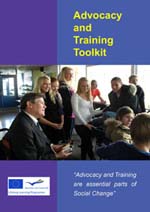
Cover of the Advocacy Toolkit

The toolkit was developed in 2011 by Disabled people from France, Italy, Iceland and the UK and is based on learning and evidence from visits to each of these countries. The toolkit offers information and advice to Disabled people across Europe to encourage their participation and leadership in the implementation of inclusive education for Disabled children and young people. The Advocacy & Training toolkit was funded by Grundtvig.

Download the toolkit

Supported by

ALLFIE’s campaign for Inclusive Education as a human right is backed by funders and donors who reject the systemic segregation of Disabled people from society.