Please ensure Javascript is enabled for purposes of website accessibility Skip to main content

Dear friends.

This year begins with some very good news about an important judgement in the European Court of Human Rights (ECtHR), which sets out very clearly that the right for Disabled students to be included in mainstream education falls under the human rights provisions. On 30th January 2018 the court upheld the complaint of Enver Şahin, a Disabled student, that the failure of a Turkish university to make reasonable adjustments to buildings was a violation of his human right to mainstream education. We’ll also be looking at two other ECtHR cases, including one about support for Disabled children in mainstream education.

We wish you a very happy Easter and Passover.

In solidarity,

Simone Aspis

ALLFIE’s Campaigns & Policy Coordinator

Contents

  1. European Convention on Human Rights
  2. Explanation of articles used around Disabled pupils’ and students’ human rights to mainstream education
  3. Enver Şahin v Turkey 2018
  4. Ceyda Evrim Çam v Turkey 2016
  5. Implications of these two cases
  6. Ştefan-Moshe and Luminiţa Stoian v Romania court hearing
  7. Brexit

1. European Convention on Human Rights

The European Convention on Human Rights (ECHR) is a set of human rights standards that European countries have signed up to. It was made part of UK law by the Human Rights Act 1998. The ECHR covers all areas of our lives including access to mainstream education. For easy read information about the ECHR see https://www.echr.coe.int/Documents/Simplified_Conv_ENG.pdf Cases under the ECHR are heard by the European Court of Human Rights (ECtHR).

This briefing focuses on some very important cases:

Enver Şahin v Turkey case. The European Court of Human Rights said that Disabled students have a human right to mainstream education. Disabled students can expect that universities, colleges and schools will be accessible to wheelchair users. We will also look at the case of Ceyda Evrim Çam v Turkey 2016 which concerns the refusal of a music school to admit a blind student.

Ştefan-Moshe Stoian and Luminiţa Stoian v Romania. We are waiting for a date for the hearing. The case involves two Disabled children in mainstream schools. The court are being asked if Romania is breaking human rights law by not providing the support Disabled pupils need to be educated in mainstream school. It is not enough for the school to allow Disabled children through the front door of their building.

These cases are important because we want UK education law to be based on Disabled pupils’ and students’ human rights to mainstream education. Judgements in ECtHR cases against other countries cannot be ignored in the UK. Judges interpreting UK legislation must take into account rulings by the ECtHR when deciding if an individual’s human rights have been violated.

Before the case is heard by the ECtHR, individuals must have gone through all legal remedies in their own country including Supreme Court appeals.

2. What are Disabled people’s human rights to mainstream education?

Four different rights are considered when deciding if Disabled pupils’ and students’ human rights to education have been violated by the state. The right to family and private life, not to be tortured and not to be discriminated against are in the original ECHR document. The right to education has also been added under Article 2 of the Protocol to the Convention for the Protection of Human Rights and Fundamental Freedoms.

Whilst there is no explicit mention of inclusive education, nevertheless ECtHR judges have ruled that Disabled pupils’ and students’ rights to mainstream education fall under Articles 2 and 14.

Article 2, the right to education, states that: “No person shall be denied the right to education. In the exercise of any functions which it assumes in relation to education and to teaching, the State shall respect the right of parents to ensure such education and teaching in conformity with their own religious and philosophical convictions.”

Article 14 prohibits discrimination on any ground or status for anyone securing their human rights under the convention.

The ECtHR have considered and continue to consider whether failure of state and state-funded mainstream educational institutions to implement reasonable accommodations for Disabled pupils and students falls under the remit of ECHR Articles 3 and 8.

Article 3 prohibits state-sponsored torture, and “inhuman or degrading treatment or punishment” without exceptions or limitations on this right.

Article 8 confers the right to respect for private and family life; this includes an individual’s right to wellbeing and dignity. “There shall be no interference by a public authority with the exercise of this right except such as is in accordance with the law and is necessary.”

3. Enver Şahin v Turkey 2018

In 2007, Enver, a Mechanics student, wanted to resume his studies after becoming a wheelchair user due to a serious injury. Enver requested that the technical faculty of Firat University adapt their premises so that he could return to university and complete his studies. The faculty refused, citing financial constraints. Without any formal assessment of his needs, the university suggested as an alternative form of reasonable accommodation that they appoint a Personal Assistant to enable him to move around the three-storey building.

On the 30th January the ECtHR held that the state, the national courts and the university did not sufficiently weigh up competing interests whilst considering solutions that would allow the student to complete his studies under conditions as close as possible to those provided to his non-disabled peer group. The university requested exemption from anti-discrimination provisions because their campus had been constructed in 1988, but the ECtHR decided that the student’s access to the university’s facilities could not be left unresolved pending the full amount needed to complete all the major adjustment works. The judges found in Enver’s favour that this was a breach of his Article 2 and 14 rights when read together.

The university’s alternative solution that they provide a personal assistant would not promote Enver’s privacy and personal dignity under ECHR Article 8 and Article 14 when read together since it disregards the student’s need to live as autonomous a life as possible. Furthermore, without a formal assessment of the student’s needs there was no reason given by the university as to why appointing a PA, which would have interfered with his privacy, was justified and necessary. In other words, Disabled and non-disabled students should enjoy the same experience of independence.

4. Ceyda Evrim Çam v Turkey 2016

In 2004 blind student Ceyda Evrim Çam applied to the Turkish National Music Academy, attached to Istanbul Technical University, and passed the entrance exams. As part of the enrolment procedure, the university commissioned a hospital to assess Ms Çam and affirm her physical fitness for the music course. The medical report concluded that Ms Çam “could attend lessons in the sections of the music academy where eyesight was not required”. The University asked the hospital to clarify whether Ms Çam was physically fit to attend lessons, on the grounds that the whole academy required eyesight. Unfortunately the hospital amended the report stating that she was unfit to attend lessons without considering any reasonable accommodations that the university could make. The lower and higher courts upheld the university’s refusal to admit Ms Çam.

The court upheld disability discrimination under ECtHR Articles 2 and 14 on the following grounds:

5. Why are the Enver Şahin and Ceyda Evrim Çam cases important for ALLFIE and Disabled students?

The ECtHR upheld that education institutions that fail to make reasonable accommodations for Disabled students without objective and reasonable justification are violating Disabled students’ human rights. UK courts are required to take the judgement into account, making it clear that the UK government has a duty to ensure universities uphold Disabled students’ rights to mainstream education in accessible premises or to make accommodations to the learning environment (including curriculum). However, the rulings do not compel all education providers to make reasonable accommodations such as making their buildings fully accessible as decisions are determined on a case-by-case basis.

There is a separate human rights case concerning Disabled pupils’ rights to mainstream education, which will be heard by the ECtHR some time during 2018:

6. Ştefan-Moshe Stoian and Luminiţa Stoian v Romania

Parents Ştefan-Moshe and Luminiţa Stoian brought a case on behalf of their Disabled children regarding their right to mainstream education. Complaints centred around the following failures of the school/education authority:

Legal issues under Articles 2 and 14

Legal issues under Articles 3 and 8

What are the implications of this case?

If the court upholds the Stoians’ complaints then it becomes clear that parents’ right for their child to be educated in mainstream school will be upheld as a human right, and that state failure to provide effective legislation and implement reasonable accommodations with the aim of promoting inclusive education practice will be a violation of children’s human rights.

7. Brexit

ALLFIE has spent some time researching the possible implications for UK compliance with the ECHR after the UK departs from the European Union. ALLFIE believes that it will not be affected by Brexit. The Council of Europe oversees our compliance with the European Convention on Human Rights, not the European Union.

-ends-
Embargoed 22/03/2018

Disabled children (including those with SEN) in mainstream schools are facing the biggest attack on their human rights to participate in mainstream education in a generation. Despite the government promoting greater parental choice for SEND provision in announcing their SEN Grant scheme, less money is following disabled children into mainstream schools. Up and down the country mainstream schools are being forced into cutting teaching staff including SEND support and resource provision, which is having a negative impact upon disabled pupils’ access to mainstream education whilst SEN funding is being shifted into special school provision. Increasingly cash-strapped local authorities are being forced to shell out up to £250,000 per pupil if his or her needs cannot be met within any local provision.

Such pressures on SEND budgets are undermining local authorities’ and government’s obligations to champion inclusive education practice. Only last year the Local Government Association warned government that local authorities would be failing in their duties to promote the presumption of mainstream education for disabled children if the cuts continued as planned.

Also in 2017 the UN Disability committee found that the government’s education funding policies of not investing in mainstream education are a breach of disabled pupils’ and students’ rights to mainstream education under Article 24.

ALLFIE’s campaigns co-ordinator, Simone Aspis said “We want government to adopt SEND funding policies that will develop an inclusive education system and build the capacity of mainstream schools to become inclusive of all pupils and students regardless of ability.”

Contact ALLFIE on 0207 737 6030 email simone.aspis@allfie.org.uk tara.flood@allfie.org.uk

https://www.local.gov.uk/sites/default/files/documents/Stage%202%20LGA%20High%20Needs%20repsonse%20FINAL.pdf

You can listen online below, or if you want to download the audio files, right click each article and choose “Save Link As”.

You can listen online below, or if you want to download the audio files, right click each article and choose “Save Link As”.

One of the themes emerging for me from this issue of Inclusion Now is transitions. I’ve found from talking to parents, teachers and young people that many people experience difficulties with transitions. You get everything working – more or less – and then it’s all change again. The Head of Emersons Green Primary School alludes to this in our first article when he talks about his disappointment that many children in his school don’t manage to go on to a mainstream secondary place, and Catherine McLeod talks about the issues of moving both into and out of early years settings.

I recently found myself explaining the forces that lead to children and young people leaving the mainstream as “it’s more about the school’s failure to deal with the child than it is about the child’s failure to deal with the school” and there’s ample evidence for this in the Lenehan review’s findings. And our CEO, Tara Flood, rounds up more voices from around the education sector, including higher and further education, about some of the forces acting against inclusion.

Whether in the UK, in Ukraine or Malaysia, Disabled children and young people shouldn’t just be expected to go somewhere else when the system doesn’t meet their needs.

So it’s good to see a commitment to inclusion from up and coming politicians like Marsha de Cordova, and from teachers and staff like those at Emersons Green. Such examples demonstrate that inclusion works, and that it can happen.

Jess Cahill (ALLFIE’s Communications Officer)

Emersons Green school visit

“We’re trying to create ripples of change, socially. It’s the same experience for everyone, as much as possible.” Belinda Shaw and Navin Kikabhai visited Emersons Green Primary School near Bristol and found a bustling school with inclusion at its heart.

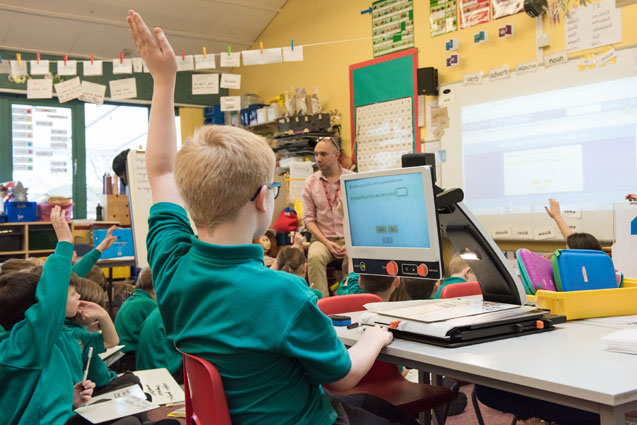
Child in classroom using adaptive technology putting his hand up

Emersons Green Primary School in South Gloucestershire was purpose built in 2000 to include disabled young people, and perhaps this is the main factor in the development of its inclusive approach. It seems significant that because no disability-designated, separate learning areas were set up at the school when it opened, no disabled pupils are required to go to them today.

Although originally designed to accommodate physically and visually impaired students, it is evident that a broader range of impairment groups are now attending. Built for around 210 children but now with 270 attending, there is plenty of natural light and there are window blinds, contrasting colours, Braille signs and acoustic panels to mute noise for students who are neurodiverse (autistic) or have a hearing impairment. There are 53 children on the SEN/EHC register of whom 20 have Statements/EHC plans, and 12 are Resource Base pupils.

Inclusion is seen as a civil and human rights issue at Emersons Green; the school tries to embed an inclusive ethos through everyday relationships and by example as well as through assemblies and other organised activities. School outings and residential visits are carefully researched to ensure everyone can take part. The school’s British Values statement includes the following: “The pupils know and understand that it is expected and imperative that respect is shown to everyone, whatever differences we may have, and to everything however big or small.”

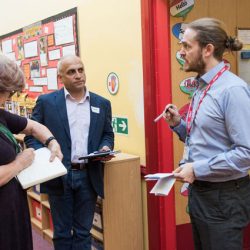
We visited the school for some hours during the middle of the day. We joined the children at work and play, and spoke with staff and pupils. We were welcomed by the school receptionist who introduced us to Head Teacher Karl Hemmings. He had previously been a teacher at the school, left for a while and then returned in 2016 to become Head. Karl showed us round the school during the student session. The school is easy to get around because it is on one level, doors are invariably open, and hoists, power chairs and other impairment related equipment are readily available. Facilities are available for physiotherapy and bathrooms are accessible.

Headteacher Karl Hemmings talking in a corridor to Belinda and Navin
L to R: Belinda, Navin, Karl Hemmings

Karl shared his frustrations with reduced SEN funding, having to cut teaching assistance hours, and having to argue with the local authority about the need for lunch break supervisors, currently 27 in total. As we were observing one of the classes, Karl explained the buddy system which operates in the school, and how friendships are as easily made through personal interest in a football team as in anything else. As Karl pointed out, “Well we do have a City/Rovers thing going on in this school,” and commented:

“What we find is that pupils are buddies because they’re their friends. They don’t see them as disabled because that’s all they’ve ever known in their class, what they’ve only known, disabled or not.”

Cohorts of children had been and were learning and growing up together. During this teaching session we were introduced to a Blind student who was practicing his Braille skills on a Braille typewriter. As we talked to him it was clear that this student was pleased with the progress he was making. Another student stopped us in the corridor and began signing in Makaton to us, asking how many children and siblings we had.

This was a busy school with multiple organised learning activities simultaneously taking place in classrooms, students being assisted with TAs, buddies assisting students, and students using assistive devices. School space is used flexibly, including for occasional therapy or one-to-one teaching outside the classrooms. The so-called Resource Base in the school is not an actual place or unit but refers to funding arrangements associated with the teaching/learning support of the students (Braille, signing, readers, wheelchairs, physio-equipment, assistive technology, etc.). In a sense the Resource Base is everywhere.

As our conversations delved deeper Karl talked about the frustrations of the students once they were to leave Emersons Green. There was a sense of unfairness about the students’ experiences of progression and Karl had this to say about their determination to be part of mainstream education:

“There is no secondary school out there that provides the model we provide, that’s no disrespect to them, it just doesn’t exist. … So, a high proportion of them just go to a special school … I want them to be not angry that’s not the right word but I want this young lady, and this young lady, and that young man to say ‘I deserve the same as everyone else because what my school has taught me is that I should expect that’, and they should have a voice … true pupil voice. I do feel that at the systemic level, at the local authority level, it never really comes across.”

Moving on to another class, we were introduced to Matt who was working with a Year 2 class, in which there was a team of teaching assistants (TAs). It is not unusual to see three or more adults in a classroom at Emersons Green including two TAs – one might be assigned to support generally in the class while another gives more focused attention to a pupil. One of the students was using a magnifier which enabled him to access visual materials and comments on the class board without feeling excluded from spontaneous learning opportunities. For this learner this piece of equipment was “life-changing”.

Matt shared his experience of having worked at the school for sixteen years and commented on how the school was built for inclusion. He made a point of mentioning the use of technology and assistive devices in supporting the diverse range of students within the classroom, and said:

“What we don’t want is anything holding him back, and this bit of kit makes learning easier, and that they can access the curriculum. … From the very beginning the philosophy has always been about inclusion, it is about children working together… and that the children are in the classroom as much as possible. Some instances they are not but most of the time they are in here.”

It is now almost lunchtime and we meet a student having a one-to-one with a teacher specialising in Braille. This student had previously been working on his maths, English and touch-typing, and was looking forward to leaving early due to his brother’s birthday. Learning Braille is hard work and they made a point of saying that he does lots of fun things at the weekend and doesn’t take his Brailler home, although he does have a smart Brailler.

We finished conversations and made our way to the school playground, where Karl remarked:

“We’re trying to create ripples of change, socially. … It’s the same experience for everyone, as much as possible.”

The school playground was a buzz of activity. One pupil, Alice, who had recently started at the school, recalled that there were no disabled students in her previous school, and said:

“When I came here it was a very unique school. It’s really good … we always help everybody no matter if they have a disability. We treat everyone the same.”

Sadly, Alice’s comment reflects the wider reality that inclusive education is still a long way from becoming the norm everywhere and the struggle to realise the human right to inclusion for every child and young person is still very much ongoing.

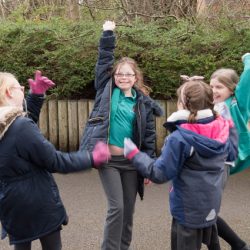
Four girls, disabled and non-disabled, playing in playgroundFor me (Belinda) the playground was the main area where the school’s inclusive ethos came alive in a personal way. Young people’s movement inside the school building itself is not overly restricted or ordered and this was also the case outside in the playground. Young people freely engaged – or not – in energetic games and other active recreation as they wished. Despite the energy, the playground felt calm and pupils used the space with awareness, avoiding getting in each other’s way. Walking slowly, as I do, I felt a great deal safer in the playground than when negotiating a main London railway station for the journey to the school. It was reassuring to find a wooden chair and other seats in the playground where pupils (or myself) could rest or take time out. The high-backed chair was appropriately engraved and dedicated to the founding head teacher of Emersons Green, Mrs Jan Isaac, and her pivotal contribution to inclusion at the school.

The general atmosphere at Emersons Green is of busy organised informality. We saw a community at ease with itself – friendly and yet purposeful, focused whilst appearing chaotic in its day-to-day happenings. Challenged, engaged, respectful, confident and aware were other words which came to mind as we observed pupils at their lessons. Importantly this learning was being achieved without segregating any pupil. Flexible approaches to the curriculum, buddy systems, teaching, and pupil groupings within classrooms, as well as appropriate assistive technology and devices enabled pupils to learn together.

At Emersons Green support is based on access and participation – not separation – and on a can-do attitude that prioritises changing and developing practice as necessary and making individual adaptations and accommodations in order to find ways to include all. As Karl confidently stated: “Anybody can do it”, and added “We want to make learning work for everybody”.

Belinda Shaw and Navin Kikabhai

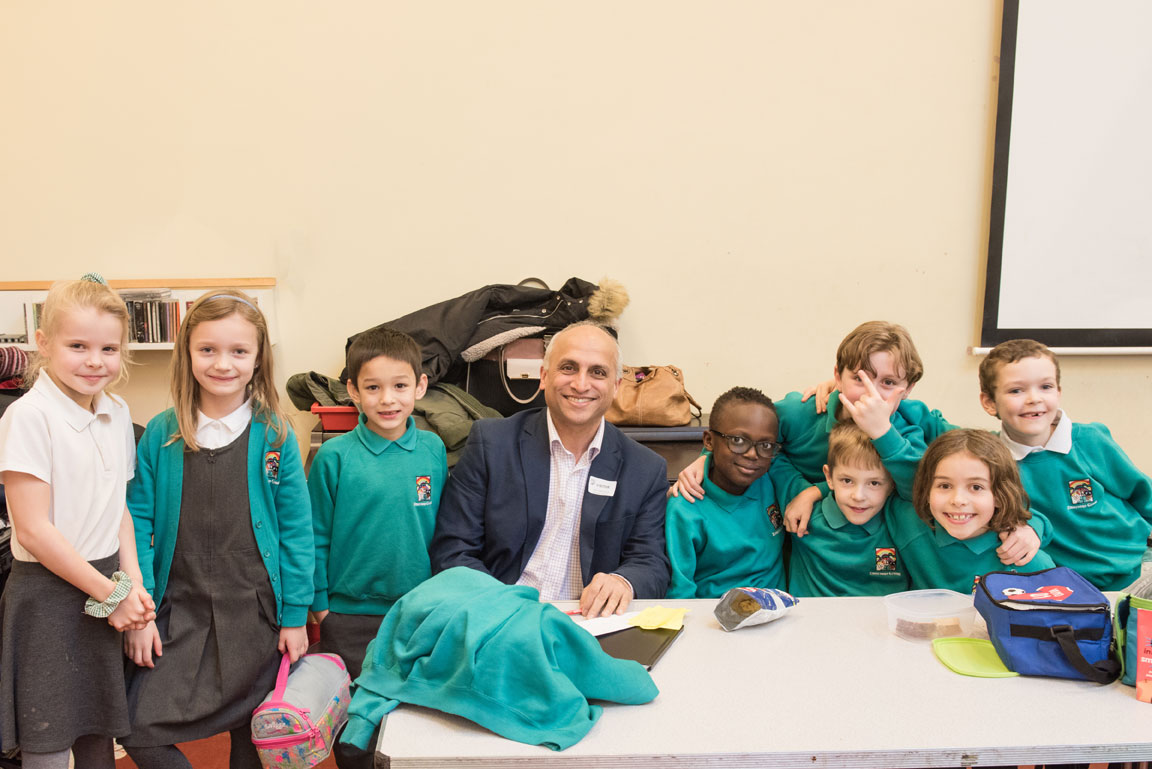
Navin, seated, surrounded by 8 children
Navin with some of the children

I am a young person with autism; my autism is a part of me but it does not define me. I know what it is like to have labels put on me. Like: “the naughty child”, “attention seeker”, “the disruptive one”.

People label us because they do not know how to react or what to say. It is not right; it makes people feel upset and ashamed to have those labels put on them.

But that is not the case. If people took a little bit of time to get to know me, they would realise that when I get the support I need and when people treat me with dignity, I am really a caring person. I would learn much quicker if people just took a little while to realise that I want to try hard and be successful in life, but I need some help to accomplish the goals that I set myself.

Not having the right support throughout education can give children and young people the labels of ‘the attention seeker’ or ‘the naughty child’ because they will not be able to excel in learning and get bored so they will try and get the attention of the teacher for the teacher to help them to understand what they need to do.

Some children and young people need to play with fidget toys (like fidget spinners or fidget cubes) in order to be able to concentrate for long periods of time. Also some children and young people need to be able to walk around because they can’t sit still for a long time: this can cause disruption in the classroom and be seen as the person just walking out of the situation when they are really self-regulating.

I feel that having the resources around me like fidget spinners, fidget cubes, blue tak and paper and coloured pencils can keep me focussed on the task that I need to do because if I am doing something with my hands I can concentrate better.

Don’t put the labels like “the naughty child”, “the disruptive one” or “attention seeker” on all children with autism or any other disability or impairment because we are not all the same; we are all unique and our own person.

Everyone is their own individual person so they should be treated as an individual. Life is about doing your best and if one person can accomplish more than another then don’t try and put them down because of that. Try to help us to succeed in what we are doing by encouraging us to try our best and telling us what we are doing well and not always what we are doing wrong or need improving.

Instead of labelling children and young people with autism try to understand that they have their own individual needs.

Just because a child or a young person does not have the diagnosis of autism or ADHD does not mean that they don’t have autism or ADHD it may just mean that they are good at hiding their issues and it has not been recognised.

I think that adults need to be trained in disability awareness and not just physical disabilities but hidden disabilities like autism, ADHD and dyslexia so that they can understand children and young people.

I think that schools and other environments should be more autism friendly because it will allow people with autism to access more environments in the community without getting stressed or anxious which could lead to challenging behaviours which could be hard to manage in a community space.

Alisha Adams

Video: lessons from Eastlea

You may remember Eastlea Community School from Inclusion Now 45. A new 20 minute film about inclusion work at Eastlea has been produced by Richard Rieser of World of Inclusion together with the school. Directed and edited by Becky Bell it is an excellent contribution to the argument for more inclusive practice. With the voice of managers, teachers, teaching assistants and young people it is a powerful testament to what can be achieved when a school has a long term commitment to inclusive education. The film has recently had subtitles added.

Watch the video

Training: person-centred planning

Inclusive Solutions are now offering training aimed at developing Person Centred Planning for staff of Local Authority or Multi Academy Trusts.

Person Centred Planning is a way of expressing a set of inclusive values through a unique range of tools and techniques. The Children and Families Act and guidance require participation of children, young people and their parents/carers in decision making at both individual and strategic levels. The use of Person Centred Approaches provides the opportunity to fulfil those principles.

Find out more

Young people and DPOs

ALLFIE’s recently produced toolkit, “Knowledge is Power” is designed for use by Disabled People’s Organisations with Disabled young people, and has session plans for understanding identity, developing skills & building confidence.

It is a chance to step into the future and educate Disabled young people about the power they have and their rights!

Download the toolkit

Nottingham Community Circles

The purpose of community circles is to bring people from a local community together to share their skills, talents, gifts and resources. We believe that everyone needs community. They will be on the second Wednesday of the month at 7.45pm.

New venue! St Judes Church Hall, Woodborough Road, Mapperley, Nottingham NG3 5HE

Phone: 0845 458 9595 / 0115 960 8254.

Any questions please email Inclusive Solutions

Website

In November ALLFIE and the National Education Union co-hosted an inclusive education workshop at the National Disabled People’s Summit, organised by DPAC, ROFA and the TUC.

We based the discussion on the recent UNCRPD Concluding Observations document and in particular the recommendations for implementation of Article 24: the Right to Inclusive Education.

Because we got such rich information from the workshop participants we decided to include a snapshot of what people said in this edition of Inclusion Now. This is the first of two articles: this article sets out many of the concerns that Disabled people in education and/or working in education have about the implementation of Article 24 and the development of education that is inclusive. In the second article (Summer 2018) we will consider the way forward.

Participants talked about all levels of the education system, but with a particular focus on higher education.

Florence Oulds
Florence Oulds

Florence Oulds is a Disabled student at Cambridge University, who set up the CUSU Disabled Students’ Campaign seven years ago. Florence told us:

“As an organiser in Higher Education, I believe that a large issue we’re facing is a lack of allyship from non-disabled staff and students who don’t understand how important their voices and actions are in support of Disability liberation, but also a huge lack of institutional funding. Disabled students don’t feel like they deserve HE, and then when they get here this is confirmed by a lack of support, which often leads to distress and isolation and ultimately Disabled students dropping out and abandoning their studies.”

Nicola Martin
Nicola Martin

Nicola Martin, Professor and Head of Research, Higher Degrees and Student Experience at London South Bank University, Education Division told us that the 2014 Children & Families Act has a lot to answer for in the worsening situation for Disabled students in higher education:

“The Children & Families Act 2014 did prospective Disabled university students a disservice by failing to acknowledge higher education as a viable progression route. Further education, employment and apprenticeships were flagged but no mention of university. We must also keep a very close eye on how the changes to DSA [Disabled Students’ Allowance] are impacting on Disabled students and their access to university. We need to work together across education from early years to post school, including Higher Education.”

Lynn Wilson
Lynn Wilson

NADP, the professional association for Disability and inclusivity practitioners in further and higher education, was represented at the workshop by Operations Manager Lynn Wilson. Lynn gave her personal perspective on how and why inclusive education is being held back:

“Firstly management tend to view inclusive education as a money-saving opportunity. If they invest in a one-size-fits-all solution then they do not need to make costly adjustments such as employing SENCOs/Disability Advisers and using individual support workers.

“Secondly ‘inclusivity’ has become the current buzz-word. This means that many people from diverse areas are discussing approaches to inclusivity. Senior management are given guidelines and draft policy documents from equalities officers, widening participation officers and disability advisers. A lot of this information is conflicting and pulling together one concerted policy is complex. The best work is being done when there is a senior management champion to oversee and force through the changes needed. Many universities, for example, are leaving the forcing through to a disability manager who is not high enough on the food chain to have much effect.

“Thirdly the role of the SENCO or Disability Adviser needs to change. They will, of course, be needed for advising on complex disability issues but they also need retraining in order to support the development of an inclusive practice and advise other staff members on how to build an inclusive curriculum and assessment process.”

Mandy Hudson
Mandy Hudson

The summit was held at the National Education Union’s office in London, and Mandy Hudson who represents Disabled teachers on the union’s national executive shared her thoughts:

“I think teachers do want to include all pupils but feel overwhelmed and stressed by a heavy workload, an ever changing curriculum and punitive inspection system. We know that including all pupils doesn’t equate to a problem. The problem comes due to schools not having the resources to provide a high quality education. With the right attitude, schools can include all pupils but unfortunately, the current political situation means that more segregation is taking place.

“We do need an investment in disability equality training within initial teacher training (ITT). However, with the increasing fragmentation of ITT into school level training, without a change of approach such training will not happen.”

Roddy Slorach
Roddy Slorach

Roddy Slorach, Senior Disability Advisor at Imperial College London and author of “A Very Capitalist Condition – A History and Politics of Disability”, was at the workshop and talked about the neoliberal ideology driving the attack on inclusive education.

“Successive governments have undermined the principle of education as a right for everyone and turned it into a privilege for those who can afford it. The government argues that universities need to make teaching and learning accessible to all, and shoulder the cost of reasonable adjustments for disabled students. It’s true that the more accessible teaching and learning is, the less reasonable adjustments are needed. But the most successful universities – who can charge the highest fees – are most likely to become more inclusive, while universities with less profit to invest in redesigning courses and curricula risk losing students as well as government funding. Take one example. Some of the wealthiest universities now video record most lectures, posting recordings on the electronic learning environment immediately afterwards so students can use them as a revision tool. Every student gains from the increased accessibility, although those with specific learning difficulties are the most obvious beneficiaries.”

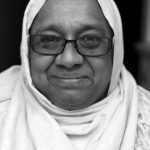
Sarifa Patel
Sarifa Patel

Lastly Sarifa Patel, a Disabled person and parent of a Disabled young person, sums up the broader intersectional barriers that many parents face. Sarifa is also the Vice Chair of ALLFIE.

“I work with parents of Disabled children and young people, many from the BAMER community. It does feel like things are going backwards and we need to campaign to make sure it is at the top of the agenda for all the political parties. Parents and our children and young people are having their basic human rights denied and racism and disablism is forcing our children and young people out of mainstream education and away from our communities. This is having a massive detrimental effect on the learning and well-being of our children. We need to hold the government to account.”

This is just a snapshot. Workshop participants also talked about the growth and speed of academisation, the narrowing of the curriculum, inflexibility of testing and assessment and the worrying rise in the numbers of Disabled pupils being excluded from school or shifted into segregated education and alternative provision.

The second article in this series will take into account much of what people have told us of the current barriers to inclusive education, and will begin to map out what changes to law, policy and practice a transitional framework should include.

Tara Flood

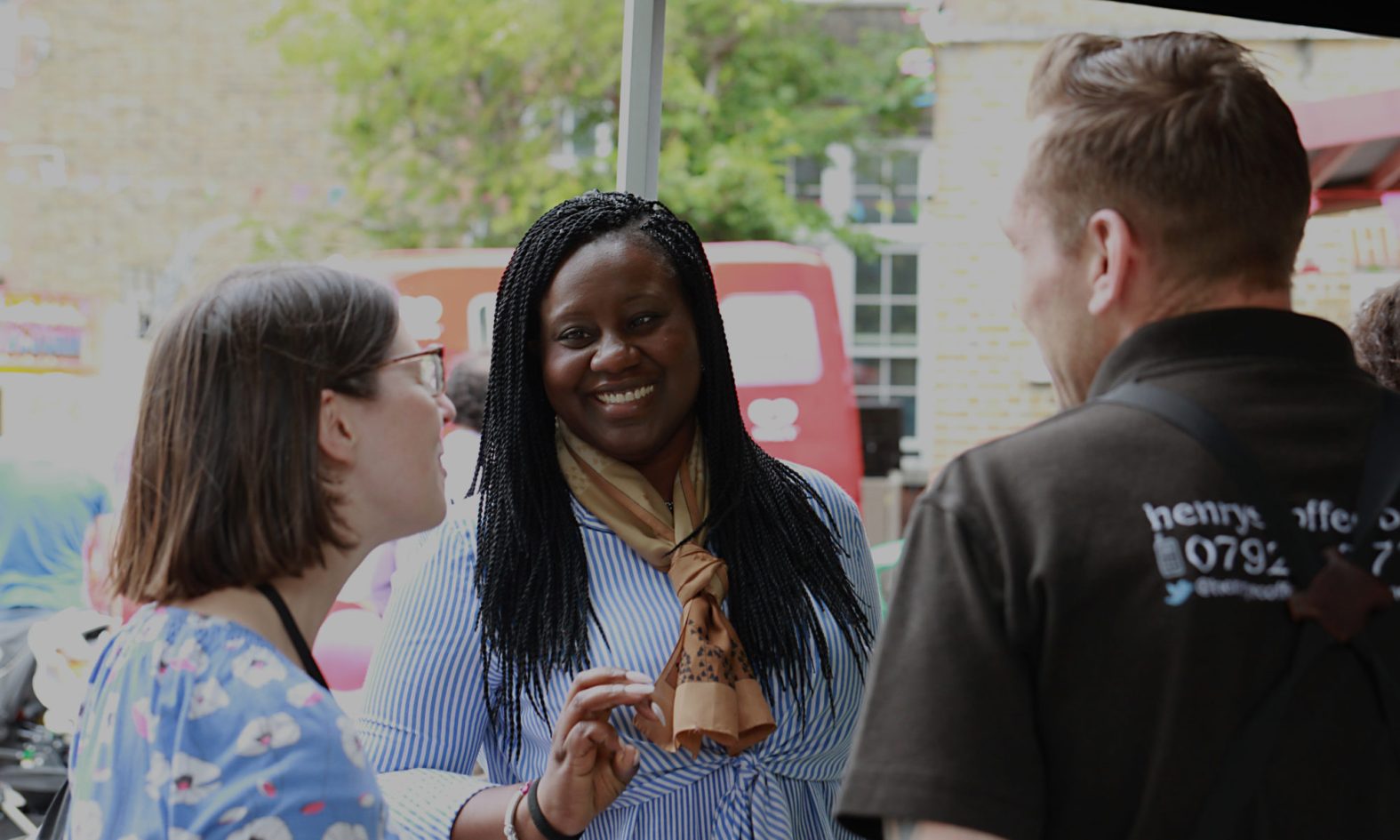
Marsha talking to two constituents outside
Marsha (centre)

In summer 2017 Marsha de Cordova was elected to Parliament: overturning a large Conservative majority to become Labour’s new MP for Battersea, South London. She’s already shown herself a powerful advocate for disability rights and last October was appointed Shadow Minister for Disabled People.

I began by recalling Marsha’s maiden speech to Parliament in which she expressed her opinion that she’d never have been elected an MP if it hadn’t been for her mother, who’d “fought tooth and nail” to keep her in mainstream education.

Mike: “What happened to you at school?”

Marsha: “At my primary school, the headteacher – possibly through lack of knowledge – felt it would be better that I was educated in a special school. But my mother was having none of that. I was externally assessed, and the report back said that, with support, I could remain in my mainstream school.”

Mike: “What additional support did you receive in school and in your higher education?”

Marsha: “At primary school, I started getting some one-to-one help from a support worker. Then, I went to a mainstream comprehensive school that had a unit for disabled children. They enlarged written materials to A3 and for certain subjects – like home economics, technology and the sciences – I had someone with me in those lessons. And later, South Bank University was fantastic. They provided all the reasonable adjustments I needed and, when I had exams, I had additional time, a separate room and use of a computer.”

Mike: “How important was it for you and your development that you were able to live at home amongst a supportive family?”

Marsha: “I was grateful that my Mum didn’t want me to go to a special school because, as I said in my maiden speech, if I had, then I don’t think I’d be the person I am today. I think that children who go to special schools often face even greater barriers, like institutionalisation.

“I grew up in quite a close family, where I was the only disabled person. So I was the clumsy one, who was always falling down and walking into things. My Mum didn’t try to shelter me or keep me away from playing or riding a bike – or doing the things my sister and cousins were doing. She tried to make sure I had the most normal upbringing possible; whilst recognising that I did sometimes need additional help and support – which she’d provide.

“One of the lessons she drummed into my head from an early age was that I was always going to have to work much harder than everybody else. So that, even now, today, as a member of Parliament, I just have to prepare more and work harder. Sometimes I don’t want to – but it’s just the nature of my life that I’ve got to do it.”

Mike: “What are your views on inclusive education?”

Marsha: “First of all, I’d say there’s no rational reason why a visually impaired person should be sent to a special school. I have very strong views on education and believe in inclusive education for everybody. The default should always be mainstream and only if circumstances are such that mainstream absolutely isn’t viable should any alternative form of education be considered. But, the default should always be mainstream.

“If you have schools that are just for disabled children, then that’s all those children will see and know. So, their experience in the real world will be very limited.

“And actually, non-disabled children benefit from being educated with disabled children. It opens up their minds, teaches them about difference and how to be caring and compassionate.”

Mike: “It sounds like you went to a good comprehensive school, with an inclusive ethos. I wonder what you think about recent changes to our education system that have made it harder for such schools to be inclusive?”

Marsha: “The academisation of our schools hasn’t been the most positive approach to education. I think the model of having a proper comprehensive school, with the right support services as an integral part of that, is essential. Every school, college and university should be able to offer support for disabled students – and we should be able to fund that. Children should never be assessed and then the outcome of that assessment is, ‘well, you don’t have any support needs’ or ‘we can’t afford to meet all your needs’. That should never be an option: because every child deserves a good education.”

Mike: “Do you think performance targets and league tables have worked against the inclusion of disabled children?”

Marsha: “That’s the absolute problem with the current system. Because targets and so forth shouldn’t be the driving force for the kind of educational system you become. If the actual starting point is that every child deserves a good education – then, actually, if you want to set targets, then a good target will be, has every child received the support they require to enable them to have a good education. Unfortunately, our education system has failed so many young people, because it’s all driven by a tick-box set of standard targets and outcomes: and I would hope that a Labour government would seek to redress that.

Mike: “Following this summer’s UN report, which was so critical of the UK’s record on disability rights, what do you think we should be doing to maintain the pressure?”

Marsha: “We know that the last seven years of austerity has disproportionately hit disabled people. We’ve experienced over £28bn of cuts since 2013 because the government have targeted disabled people as the ones they believe will make the least noise. So, it’s down to us as politicians, DPOs, charities and disabled people to keep the pressure on this government: constantly lobbying and raising issues in Parliament. I think the government’s pretty much trying to ignore it, but it’s important that people aren’t afraid to keep fighting, because together we’ll be victorious – we’ll win!”

Mike: “My final question has to do with Labour’s manifesto, which promised to embrace the principles of inclusive education. I wonder how this commitment can be turned into a reality? And also, would you consider working with ALLFIE to pursue this goal – especially given that one of ALLFIE’s aims for 2018 is to develop a private member’s bill in support of inclusive education?”

Marsha: “My belief is that inclusive education is the only way forward. It’s fundamental that – whatever policies the Labour party develops and wants to introduce – they have to support that. In my capacity as Shadow Minister for Disabled People, I’d be more than happy to work with ALLFIE, and I think this idea of a private member’s bill sounds like a very good one.”

Mike Lambert

I recently attended conferences to develop inclusive education in both Malaysia and Ukraine. Although the history and culture of the two countries are very different there are similar misunderstandings of what inclusive education means in terms of pedagogy (methods of teaching) in both countries.

Ukraine has a complex history with many different cultural groups. It was part of the Tsarist empire in the 18th Century and then, after its own revolution, part of Soviet Russia until 1991 when it seceded and moved closer to the European Union. Ukraine did maintain some independence in the Soviet years, but as far as education was concerned the Soviet system of segregation and defectology (an extreme version of medical model thinking developed under Stalin) dominated. Families were encouraged to give their disabled children to the state to go to either special schools, internats (orphanages for those children and adults deemed ineducable with learning difficulties, which were more like hospitals than schools) or left at home with their parents. As a result mainstream teachers had little or no experience of teaching disabled children, and schools, curricula and assessment systems were designed for non-disabled children and students. Work by NGOs such as the Step by Step Association over the last 16 years has opened up Ukrainian society, especially encouraging parents to support inclusion. Ukraine has a population of 44 million, 16,700 general academic schools (of which only a fifth are private), with 3.8 million schoolchildren and 445,000 teachers. Only 154,000 pupils are identified with SEN; the majority must be at home and in institutions.

Since 2000 there have been many legislative attempts to become more inclusive. These have largely foundered on negative attitudes and teachers claiming not to be trained. Now, President Poroshenko in September 2017 introduced a new law – Features of Access of Persons with Special Educational Needs to Educational Services. This sets forth the right to education of people with special educational needs and gives them the opportunity to receive education in all educational institutions, including free of charge in state and municipal educational institutions, regardless of the “determination of disability”. The changes provide for remote and individual forms of education, and the creation of inclusive and special groups for such individuals in general education schools. The law also provides direct funding to schools with teachers deciding what it will be spent on to avoid corruption and provide freedom for schools to determine what they teach along Ministry guidelines.

I visited School 41 in Central Kiev, a multi- storey 6-15 year old school with no access. Since last April they have had a ‘correctional teacher’ and unit with 11 children identified with speech and language, autism and learning needs. This is in a school with 470 students and 67 teachers. The needs of the children struck me as very low level. They spend some time in unit and most with their age appropriate class supported by teaching assistants. Mainstream staff seemed considerably resistant to increasing the number of disabled students or their degree of impairment. Eleven schools in central Kiev had such classes and a programme of teacher training was under way.

The Malaysian Federation of sixteen states was formed from British colonially ruled Malaya and North Borneo when the country was given independence in 1963. Many Chinese and Indian people were settled alongside Malays by the British to work on plantations and build up an infra-structure. Since these times Malaysia has concentrated on developing its people with a strong and successful education system to match its transformation from an agricultural to an industrialised and prosperous country. The current population is 31 million people with 7,772 primary and 2,407 secondary schools providing twelve years in free state education.

For a long time, apart from a special blind school and one for deaf children, disabled children went to school only if they could fit in. The British medical model of special education was slowly adopted with first segregated special school and later School Special Education Integration classes. These dated from 1996 following the Salamanca Declaration, but were based on a medical assessment of educability. More recently all children are entitled to go to school and, under the influence of the UN Convention on the Rights of Persons with Disabilities, the Malaysian Government is developing an Inclusive Education Programme (IEP). In 2016 30.3% of identified children with SEN were in mainstream classes and more than two thirds of schools were involved with training of teachers. However, before a student can move into a mainstream class they have to satisfy a team of professionals that they grasp the 3 Rs: reading, writing and arithmetic. In 2016 all pre-school children will be screened for special needs and then directed to special school, special class or IEP mainstream classes. The Malaysian Education System is highly competitive with weekly tests and an overburdened curriculum with only 14% of students making it to upper secondary. Most drop out and earlier those not academically inclined are enrolled in sports and co-working courses. Guidance has been produced called Inclusive Pedagogy Implementation Guidance.

School Chouskat Laurt, Taiping,Parat, has five special classes with six teachers and four teaching assistants. Most disabled students at the school have learning difficulties and had not mastered the 3Rs. Students screened from the special ed classes who achieve the appropriate skill level join the inclusive education programme.

The UNCRPD Committee General Comment No 4 on Article 24 has some useful advice about adaptability to help address the pedagogic shortcomings found in Ukraine and Malaysia.

“26. The Committee encourages States parties to adopt the universal design for learning approach, which consists of a set of principles providing teachers and other staff with a structure for creating adaptable learning environments and developing instruction to meet the diverse needs of all learners. It recognizes that each student learns in a unique manner and involves: developing flexible ways to learn, creating an engaging classroom environment; maintaining high expectations for all students while allowing for multiple ways to meet expectations; empowering teachers to think differently about their own teaching; and focusing on educational outcomes for all, including persons with disabilities. Curricula must be conceived, designed and implemented in such a way as to meet and adjust to the requirements of every student, and provide appropriate educational responses. Standardized assessments must be replaced with flexible and multiple forms of assessments and the recognition of individual progress towards broad goals that provide alternative routes for learning.”

Worryingly both Malaysia and Ukraine have ratified the Convention where inclusion is a principle, and have framed legislation to implement it, but they interpret that only those students deemed suitable for the mainstream can be included, in both cases leaving the majority of disabled children out of inclusive mainstream settings. The whole point of the ‘paradigm shift’ at the heart of the UNCRPD is to shift from viewing the problem as with the person to viewing the problem as changing the barriers of curriculum, teaching methods, assessment and environment. On top of this there is an immediate duty on both school systems to put in place reasonable accommodations. Much advocacy is needed more than ever for real inclusive education based on Social Model thinking.

Richard Rieser

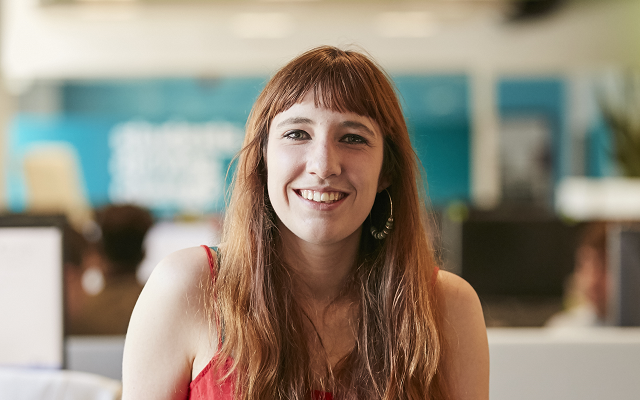
Rachel smiling
Rachel O’Brian

In the past few years, we have seen inclusive education and disabled students’ access to mainstream education at all levels attacked from all angles – from cuts to Disabled Students’ Allowance (DSA) for students in Higher Education, to massive funding cuts to Education Health and Care Plans that shut disabled students out of schools and colleges. The appointment of Toby Young at the start of the year to the Office for Students just added insult to injury after years of cuts and privatisation, with his comments disparaging inclusive education and in favour of “progressive” eugenics.

Unfortunately, Toby Young’s views, whilst more explicit than most, are not unusual. In the Disabled Student’s Campaign, we hear story after story of disabled students forced from their courses because their university or college do not make the adjustments needed for disabled students to complete their courses, or twist the concept of independent living beyond recognition in order to subject students to disabilist Fit to Study procedures. The Disabled Students’ Campaign exists within the National Union of Students in order to extend, defend and promote the rights of disabled students, and to ensure that our post-16 education system is inclusive of all students, at all levels, regardless of a student’s impairments.

This year in the Campaign, we have been working to launch a legal challenge to scrap the DSA £200 surcharge, as this is an unfair charge placed on disabled students to participate in higher education on an equal basis to their non-disabled peers. In practice, it has led to thousands of DSA laptops being left unclaimed, meaning that disabled students are unable to complete their courses with the assistive technology they need to do so. We are still looking for named clients to take this case forward – so if you have been told, in the last three months, that you have to pay the £200, and you have not yet paid, please get in touch!

We have also been doing some work around Universal Credit, which full time students in practice cannot receive, and for part time students will lead to financial hardship as has been already documented – leading to claimants in rent arrears and using food banks. We are also doing a large campaign opposing cuts and privatisation in the NHS, particularly focusing on mental health services, as we believe that all service users should have rights in their treatment – from the right to determine what that treatment looks like and receive it consistently, to the right to confidentiality if they make a complaint. For people in mental distress, receiving good treatment to help them manage their conditions is essential for them to be able to access and stay in education.

Anti-austerity campaigns and political education are the key campaigns for DSC this year – with disabled students’ political education days being planned to take place regionally across the UK. It is essential that disabled students have at least a basic understanding of liberatory theories such as the social model of disability, and know some of the disability rights movements that preceded them and the radical forms of action that they have used. We aim to equip disabled students with the tools and knowledge they need to run anti-austerity campaigns – the ideology behind the cuts which are stopping us from being able to access education, and makes our education systems less inclusive.

Rachel O’Brian, NUS Disabled Students’ Officer

Supported by

ALLFIE’s campaign for Inclusive Education as a human right is backed by funders and donors who reject the systemic segregation of Disabled people from society.