Please ensure Javascript is enabled for purposes of website accessibility Skip to main content

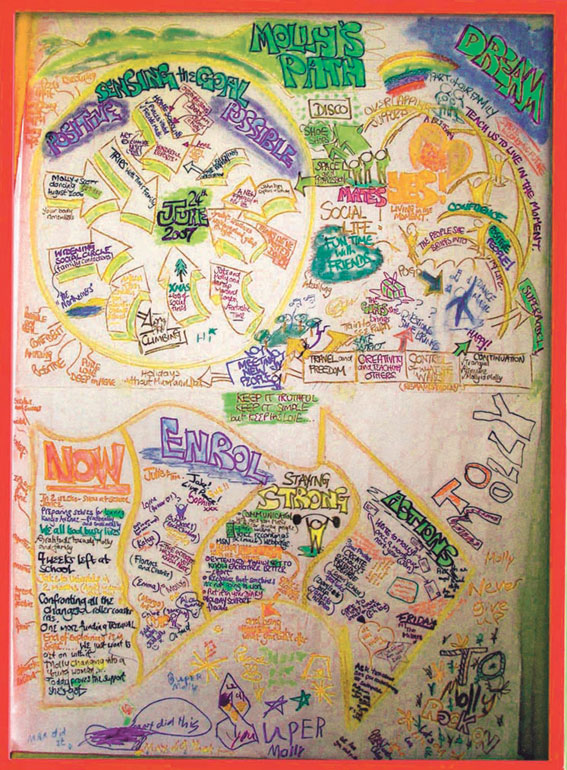
The graphic used to map out Molly's learning pathBack in 2005 Molly was 11 years old at her secondary school transfer stage. She had had an additional year in nursery class at her local mainstream primary school. Initially we had been of the view that Molly would transfer to our local mainstream secondary school along with the majority of her class mates and friends.

We were fortunate that the SENCO at the primary school was a great ally and advocate. We had planning meetings with her to put together our ‘strategy’ and ‘presentation’ for the impending interview with the SENCO at secondary school. We felt confident, having seen how beneficial inclusion was, not only for Molly but for the whole school.

The interview did not go well. The secondary school SENCO was not inclusive, she was unimpressed with Molly’s achievements, with the tools and strategies the primary school had implemented, unimpressed that behaviour in her class had improved because she was a calming influence, unmoved by the fact that her friends were transferring to the school and that continuity would be hugely supportive to her. In fact the first question she asked us when we had presented our views was “Can Molly line up?”

We had to reconsider what next for Molly. Special school was not an option. The local Steiner school to my surprise was also not inclusive. So what next!?

I happened to bump into a parent I had previously supported some years ago when she was battling to get her son into her local primary school. We exchanged our stories of how things were working out or not and she asked me if I had considered Home Education. I had not. I hadn’t heard of it.

I went straight home and began my research. I looked into the aspects of the law and parent rights. I looked into what support was available for a child with a Statement – none as it happens. I then looked at the Education Otherwise website and I was thrilled. The stories from parents of children with ‘special educational needs’ were inspiring.

By then the secondary school had made Molly an offer to attend for just one hour per day. Needless to say, we said “no thanks”. And laughed all the way home to begin planning how we would provide an education for Molly that would support her growth as an individual and as part of her community.

Our first step was to ask Colin and Derek from Inclusive Solutions to do a PATH for Molly. And so, the summer in which she left primary school we gathered together, friends, family and allies and together created a beautiful PATH for her and a great support mechanism for us. Looking back now we can clearly see how seeds for the future were planted. It was not only beneficial for those first tentative steps away from the ‘system’ but also as a reference point in moments of being stuck or bewildered and a validation of the choices we made to ensure Molly continued inclusion.

It took time for us all to adapt. There was grief of the loss of the familiarity of her routine and regular contact with friends. There was no support, there was monitoring– which we were able to handle because I knew the system and the people doing the monitoring. It took time to trust other parents in the home ed community. Largely, parents did seem to be inclusive. But I felt isolated without the network of support I had created while Molly was in school. Molly adapted better and quicker than me and my husband! Over time she and I made some good friends which led us to going to a Home Education Summer Camp in West Wales. A few years later we moved there.

This really is an inclusive community. Molly has an awesome social life. She has freedom of movement and self-expression in abundance. We know that when she goes out with her friends she is safe, people look out for her, they care about her, they love her company. Our lives are abundant now and full of hope for her future beyond us.

It is strange that a simple idea – disabled children growing up and learning together with their brothers and sisters – should have sent shock waves through the education system. The world would end, chaos would reign, and no child would get a good education ever again. This was the attitude many experienced when Parents for Inclusion (PI) started. Margaret Gault, Joe Cameron, Diana Simpson and other parents came together to build a campaign for ‘integrated’ education as it was then known. The Warnock Report (1981) had enabled local authorities to put physical support in the form of learning support assistants, teaching and curriculum support into mainstream schools to allow children with SEN to be included.

For 30 years PI brought together parents struggling to keep their children away from segregated services and disabled adults who felt they had been damaged by segregation. Disabled people brought to the parents an analysis of the real problem they were facing, an oppression, not a personal problem.

Parents and disabled people wrote and delivered unique training courses for parents and potential allies, always starting from the viewpoint that the child was not the problem, built a peer support helpline and developed innovative school-based support groups. In encounters with PI many parents were asked to say what they loved about their child for the first time. It was revolutionary.
Children whose parents founded and found PI grew up with parents as allies in their struggle against ‘disablism’ and with role models of disabled adults taking the platform, living good, meaningful lives.

Many schools began to open their doors to children they had previously felt unable to teach. Teachers learnt on the job what inclusion really means, mainly from the children themselves. The most common comment was that the school benefited more than the child because all they had been taught and the changes required made school life better for all.

PI was not able to raise enough financial support and in 2014 we had to close our office and lay off all staff. But we are needed more than ever. The adult children of the first PI parents are proof that inclusion from early on leads to better, richer, more connected lives – not perfect, not even happy all the time, but more meaningful and influential lives.

We who are still connected to PI cannot allow this door of opportunity to close behind young people. It is time to transform ourselves from a small charity to a voluntary network of parents, disabled people of all ages, professionals and the ‘army’ of retired people who have a wealth of experience to share.

At this event ‘our’ grown children will speak about their current lives, parents will report on their current struggles and ways of dealing with them, visitors from Germany will be describing how a PI inspired project operates in another country.

There will be opportunities for people to network and link in with one another on themes and projects of current interest and urgency.

There will be a celebration of people connected to PI in the past and the present, food, music, poetry and fun.

By the time you read this the event will have happened. If you are curious to find out more of what did happen and how you can link into this network of disabled people, parents and allies join the Facebook group Parents for Inclusion. The Facebook group is the most immediate place where we come together virtually to continue the work. You are welcome to join!

United Together for Inclusion

Richard Rieser interviews Mary Bousted and Kevin Courtney, joint General Secretaries of the new National Education Union (NEU) about their interest in inclusion.

Q: Since 1996, the NUT has supported inclusive education. With a rising number and proportion of children with EHC plans attending special schools, what are the current threats to this policy?

Kevin: ‘The NUT takes into the NEU a serious intention to make the experiences of children and young people with SEND a significant policy and campaign focus. There are serious threats to the ability of schools to develop inclusive practice, and this is directly because of government policy, so it’s high on the list of what we want to work on.’’

Q: Tell us about ATL’s commitment to equality and how that includes inclusive education?

Mary: ‘’The ATL has a longstanding policy focus on children with SEND and their rights. I share Kevin’s desire to make sure the NEU shapes the future of education. We want success and respect for every child; we want barriers to access taken away; we want a curriculum that enables every child to reach their potential and to reform the accountability system which currently undermines inclusion.’’

Q: Many disabled children and young people stand to be negatively affected by school funding changes (eg AWPU and the removal of ring-fencing). What can the NEU do to challenge and change this?

The NEU is proud to be concentrating on an urgent funding campaign, started by the NUT and the ATL before amalgamation, which has brought parents, communities, MPs, and unions together to call the government out on its damaging cuts. We put education funding on the map in the general election and we’ve kept the issue high on the agenda ever since, securing an extra £1.3 billion for education from the DfE budget. But the cuts continue, and the huge under-funding for SEND is becoming apparent. We’re making the SEND cuts a major focus of our campaign, as too often SEND provision is the first thing to be cut. We urge all your readers to get involved at SchoolCuts.org.uk.

Q: 91% of schools will experience a budget cut this year. Many heads will be in a difficult position: not wanting to lose courses or teachers. Too often choices made have a disproportionately negative impact on support for disabled pupils. What can be done to counter this trend?

You’re right that head teachers are being put in an impossible position – to cut staff, courses, outings, clubs or enjoyable music and sport activities. Heads have been speaking out in growing numbers within our Funding Campaign. The risk for children and young people with SEND is immediate, and terrifying. Without the funding needed, children with SEND won’t access the curriculum; they won’t get what they should be entitled to; they will get a narrower range of experiences, and they will lose the chance to reach their potential. It’s not fair; which is why parents of children with SEND are joining teachers, heads and governors to speak out. We want to build an even bigger campaign.

Q: Exclusions have been rising, including a disproportionately high number of disabled children. The government has announced an inquiry into exclusions. What recommendations can NEU make to address this problem?

If teachers aren’t given professional freedom to make the curriculum interesting and engaging; if schools aren’t given budgets for pastoral support and mental health counselling; if schools are forced to teach to the test and drill students for numerical targets, then schools simply won’t be accessible for many students. Disaffection, exclusion, school phobia, self-harm, child poverty are all on the rise. The government is proud of its over-testing; in denial over its funding cuts and ignorant of the link between high stakes accountability and rising exclusions. Exposing the impact of cuts to SEND provision on individuals and families is a priority for the NEU – we released figures about the 4,000 children with SEND with no education because of the cuts imposed on LAs and have been highlighting the stories of “invisible children” lost in the system.

Q: There appears to be a structural conflict between the “presumption” that disabled children will enter mainstream education and the perception of some heads that this may adversely affect their targets and results. How should targets and school success be recalibrated to improve the rates of SEND?

The way we hold schools to account undermines inclusion. Schools should be accountable to children and their parents/carers but we need to value, and capture, all the ways schools contribute to children’s lives and development. The high stakes system turns children into numbers. The huge pressure to get every child to fit a standardised system means schools are driven to focus on the demands of the tests rather than the individual needs of the child. Children with SEND, summer born children, children with EAL – all lose out disproportionately in the exam factory culture conjured up by Government policy. The inquiry recently launched by the Education Committee into SEND gives us an opportunity to push for investment in children with SEND, professional development for staff and a collaborative system based on schools working together, not in competition. Children must not be denied the education they are entitled to due to institutional self-interest.

Q: We know disabled children and young people are a focus of bullying which can contribute to them transferring to special schools. What can teachers, schools and the Union do to address this problem?

There’s no magic bullet. Schools need clear policy, real commitment to support every child and space to develop strategies like restorative justice and cross curricular projects. Relationships between staff and pupils are so important. If we value welfare and inclusion we should reduce class size, and invest in counselling and pastoral systems. These are all casualties of funding cuts. Many schools have developed effective approaches but it gets much harder to share this practice if you fragment the education system. The plans for a National Education Service could be the way forward on reversing this.

Q: The government is far from meeting its human rights commitment under Article 24 of the United Nations Convention on the Rights of Persons with Disabilities. How can the NEU be part of making them implement their commitments in this area?

The UN Convention on the rights of disabled people gives life to some deeply important principles. It places expectations on national governments that can be very effective lobbying tools. They remind us that the goal must be independent living and respect for the human rights of disabled citizens. Trade unions must promote the social model. We must negotiate with government and employers to take away the barriers to disabled people’s full participation in work, in society and in trade unions.

Q: My final question has to do with disabled staff, many of whom are experiencing increased pressure. Very often, when they approach the union for support, the outcome is that they leave the profession with some sort of financial settlement. What could the NEU do to support staff in ways that will help them remain within the profession.

The current situation for NEU members is serious. Funding cuts, targets, testing and excessive workload are making too many question whether they can stay in education. Workload levels are directly jeopardising teachers’ mental health. It is getting harder to develop a diverse profession or to retain disabled teachers. Teachers with pyhsical or mental health conditions pay penalties because of discrimination; many don’t progress fairly in terms of pay and promotion. The NEU will continue to work hard to represent disabled workers. In order to challenge harassment and discrimination, the NEU needs a representative in every school and members working together collectively. That is our vision – to bring members together, collectively, to make change happen in their school, but also, to connect them together to make change happen nationally. The National Education Union is well placed to reclaim the promise of education: that working in education should be, and can be, the best job in the world.

Inclusion Now 50 Summer 2018

Bumper 50th edition! inclusion snakes and ladders, interview with Kevin Courtney and Mary Bousted of the NEU, school visit to Tollgate Primary, young people’s research into EHCPs and more…

Welcome to the 50th edition of Inclusion Now 50. Audio and text versions are in the articles below.

To receive three issues of Inclusion Now a year on publication date, you can subscribe here. Subscribing supports our work and helps us plan for the future.

Inclusion Now is produced in collaboration with World of Inclusion and Inclusive Solutions

Question:

“As a parent of a 10 year old disabled child I am concerned about local authority proposals to remove the SEN unit from one mainstream school and reduce the number of SEN pupils in other mainstream schools. There are proposals to increase special school placements by establishing two free special secondary schools and increasing special secondary maintained and academy school placements. I am worried what this will mean for my disabled child who will be making the transition to secondary school. What can I do to legally challenge this direction of policy where disabled pupils will find it harder to access mainstream education?”

Answer:

What does the law say?

There are two relevant legal duties on the local authority that you should be aware of. The first is known as the mainstream school presumption. What this means is that even if a child has a Statement of SEN or EHCP, they must be educated in a mainstream school unless an exemption applies to this. The exemptions are that it is incompatible with the wishes of the parent, or the provision of education of other children.

The second duty is that local authorities have to make sure there are ‘sufficient schools’ in the area of the local authority. In order to comply with this duty, they have to make sure that school places available offer all pupils ‘the opportunity of appropriate education’. This means that the places need to vary for different pupils’ ages, abilities and aptitudes.

How do these duties help in this situation?

These duties mean that if a parent wants their child to be educated in a mainstream school, the local authority has to facilitate this unless the local authority can demonstrate that to do so would be incompatible with the education of other children. This, therefore, means the local authority should ensure that there are enough mainstream school places available for children with Statements of SEN or EHCPs.

Local authorities can reduce the number of school places available if for example, they have a surplus of places which are never filled. However, if they are doing this because they are increasing the number of special school places available, and expecting SEN pupils to attend them instead, they could find that they are in breach of their duties to ensure sufficient school places are available in the area as well as complying with the mainstream presumption.

What can I do if the LA is trying to make my child move from mainstream to special school?

If your child has a Statement of SEN or an EHCP, the local authority should not try and change their school placement without formally amending this. Once they have taken the steps to formally amend this, you will have a right of appeal to the First-tier Tribunal (Special Educational Needs and Disability). If you are not happy with the placement named we recommend you use this right of appeal. If this is an issue which is impacting on a number of parents or has the potential to, you might also want to consider seeking legal action to see if anything can be done to prevent these changes to how the local authority ensures it has sufficient school places for children within its area, and particularly those with SEN.

Samantha Hale

Samantha is an Associate Solicitor with Simpson Millar and specialises in education, community care and public law.


The Alliance for Inclusive Education (a leading charity that promotes inclusive education) condemns the government’s announcement of £50 million funding to expand selective school provision that will further reduce the choice of mainstream school for Disabled children.

The government’s own statistics show that children with SEN statements or Education, Health and Care plans (EHCPs) already represent a mere 0.1% of grammar school pupils, despite making up 1.8% of the whole secondary school population. Disabled children without statements or EHCPs make up only 4.2% of grammar school pupils, but 12.4% of all secondary school pupils. This constitutes an enormous underrepresentation rate of between 3 and 18 times.

With substantial cuts to education budgets having a harmful impact upon local authorities and mainstream schools having insufficient funding to properly arrange SEN provision for their Disabled pupils, the government’s grammar school expansion programme is nothing more than another ideological attack on good schools that welcome all pupils regardless of ability.

Simone Aspis (Policy and Campaigns Coordinator) said: “The UN Convention Monitoring Committee concluded that the government’s education policies violate Disabled pupils’ human rights to inclusive education. The expansion of grammar school provision is another government attack on comprehensive and inclusive education and Disabled pupils’ rights to a good and well-resourced mainstream school placement as set out in Article 24 of the UN Convention for the Rights of Persons with Disabilities.”

The option for Disabled children and their parents to choose a good mainstream school placement has been in steady decline as a result of the government’s existing education policy, as indicated by the Department for Education’s own statistics, which show that the number of pupils on the roll of special schools has increased steadily over the past five years. Now with the introduction of greater selection by ability in our education system through the expansion of grammar school provision, choice for SEND pupils and their parents is in danger of becoming non-existent, warns ALLFIE.


Press notes

For more information please contact Simone Aspis on 07464 797453 /0207 737 6030 or by email.

References

Bolton P (2015); Grammar School Statistics House of Commons Library Briefing Paper No 1398

Department for Education (January 2015); Special Educational Needs in England

Andrews J, Hutchinson J and Johnes R (2016);  Grammar Schools and Social Mobility Education Policy Institute


Dear friends,

It is that time of year when local authorities (LAs) are setting or have set their budgets, which will, of course, include an allocation of funding for schools and SEN support services for Disabled pupils and students. Over the past few weeks we have been asked to support a number of parent-led campaigning groups who are challenging local authorities’ decisions to cut spending on school and SEND support services. It’s not only the cuts we are concerned about, but how existing budgets are increasingly being used to support segregated education.

It is great to see local communities coming together to challenge the cuts to education and support services, including inclusive education support for Disabled pupils and students attending mainstream schools.

Many of these decisions can still be challenged, so in this briefing the focus will be on what action ALLFIE’s members and supporters can take to promote Disabled pupils’ and students’ rights to mainstream education and how you can get involved.

In solidarity,

Simone Aspis

(Policy and Campaigns Coordinator)

Summary

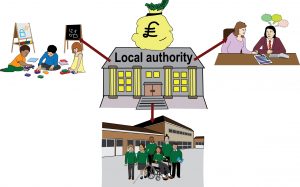
Local authorities are cutting money for schools /and for the support that Disabled children need in school.

Graphic illustrating local authority making decisions on education spending


School and college heads are concerned that the funding cuts will affect Disabled children in mainstream schools. Mainstream schools have less money to help their Disabled pupils. This is because some of the money is being used to pay for special school services and for support for Disabled children with Education, Health and Care Plans (EHCPs).

sad emoticon

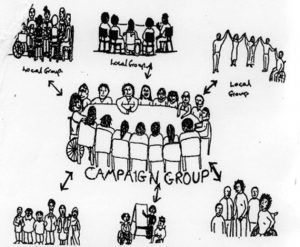
There are lots of campaign groups being set up by parents to fight the school funding cuts.

graphic showing local campaign groups connected to a central group


This is a real opportunity for Disabled people to work with families to fight the cuts.

Information about school funding

Last year the government introduced a new funding formula for how funding should be allocated to different schools. The Dedicated Schools Grant covers funding for schools, early years settings and Disabled pupils and students (including those with SEN) with high needs. More information about funding formulae.

New funding formula – impact on schools & local authorities

During the high needs funding consultation in 2017 the Local Government Association warned the Department for Education that school budgets were not enough to cover the real costs of meeting Disabled children’s needs and fulfil their legal obligations under the 2014 Children and Families Act. Just twelve months later, the Association of School and College Leaders (ASCL – a professional body representing school and college leaders across the UK) reported that “high needs funding is insufficient and is threatening inclusion across the system.”

The ASCL found that 75% of local authorities have had to move funds out of wider schools budgets to fund the increasing demands of SEN support for Disabled pupils and students. Until now the budget for a number of mainstream schools has been subsidising the Education Health & Care Plan provision of most pupils in special schools.

As result, there is less funding in mainstream schools and LA high needs budgets to fund the real cost of supporting Disabled pupils and students in mainstream. The cuts are particularly disadvantaging the 98% of Disabled pupils and students without an Education Health & Care Plan.

Local campaigning against the cuts

National March Against SEN and Education Health & Care Plan Failings

Concerned by the implementation of SEND reforms, a group of parents of Disabled children have started a Facebook group to organise a national march on Thursday 30th May 2019. The group have agreed a list of issues that affect families with Disabled children and young people across the country. Whilst the Facebook group is parent-led, they do welcome people with different experiences of education, including those who are Disabled. ALLFIE is keen to find ways we can work together to plan the march.

Local campaign groups

Alongside the coordinated national campaign, parents and families with Disabled children and young people are coming together to fight cuts to school and SEN budgets in their local areas.

Steve Broach, a barrister specialising in education and child law, has published a blog on how local groups can challenge school funding cuts using legal action, often called a Judicial Review. The law may apply differently in different situations so it is important that families and campaign groups seek legal advice.

Here are a few campaigns being mounted by local groups.

Hackney Special Educational Crisis

Hackney Special Educational Crisis successfully crowdfunded the cost of a legal challenge to Hackney Council plans to make 5% cuts to Education Health & Care Plan provision from 1st April 2018 with further significant cuts in April 2019.

ALLFIE has supported the Hackney campaign by drafting a letter outlining why we believe the proposed SEND cuts are unlawful and are not in the spirit of the local authority’s duty under the 2014 Children and Families Act to promote the presumption of mainstream education.

Reverse Surrey SEN Cuts campaign

The Reverse Surrey SEN Cuts campaign is taking Surrey County Council to court on the lawfulness of the decision to cut funding for SEND services. This includes a £300,000 budget cut to support for inclusion in mainstream schools. The campaign group have asked law firm Irwin Mitchell to investigate:

Bradford Families Against Children’s Services Cuts

We have been contacted by this family-led campaign group because they are very concerned about Bradford council plans to create 190 special school placements funded by changes in how the schools and SEN budgets will be spent on education provision. We too are deeply concerned about Bradford Council’s policy to cut inclusive education support services in order to fund segregated education. Clearly any funding decision that not only has the purpose of increasing the bias towards segregated education, but is being funded by cutting mainstream school resources, must be challenged.

ALLFIE’s call for action

ALLFIE believes that, in theory, the law should be on our side as there are clear duties on government, local authorities and schools to promote the equality and inclusion of Disabled pupils and students in mainstream education settings. The actual duties are as follows:

But this needs testing…

We need to secure some court rulings around local authorities’ obligations to promote inclusive education when considering education funding cuts or other related policies.

We are keen to explore with our members and supporters, local campaign groups and lawyers whether legal action is possible against local authorities who are cutting their inclusive education provision despite having a duty to promote the ‘presumption of mainstream education’.

How can DPOs get involved?

Disabled People’s Organisations could give their support to local parent-led campaign groups focusing on cuts to inclusive education practice in schools and LA services. For example:

What to include in a letter to the local authority challenging cuts to local education & SEND budgets

Whilst local campaign groups will be focused on challenging local authority budget decision making processes, what is considered lawful or unlawful will depend on the facts of each individual case.

Campaign groups are usually sufficiently knowledgeable about the specific issues they want to challenge, however there are three important points which would strengthen your letter:

This is the opportunity to highlight the impact of local budgets cuts on opportunities for Disabled pupils and students to be included in mainstream with all necessary support for learning and participation alongside their non-disabled peers.

And finally…

We really want to hear from you about the negative impact that the SEND funding cuts are having in your local area – so please get in touch!

Read our submission to the inquiry.

Dear friends

The Education Select Committee, in Parliament, has just launched an inquiry into the impact on Disabled children and young people and their access to education of the SEND legal framework established by the Children and Families Act 2014. The inquiry announcement is a response to growing concern about the social injustices that Disabled pupils are experiencing, including increased exclusions and segregation into Alternative Provision.

The inquiry’s remit only covers the day-to-day operation of the SEND legal framework: ALLFIE thinks such a limited remit is no accident. The 2014 Children and Families Act re-affirmed the ‘presumption of mainstream’ principle in law; leaving this clause out of the SEN inquiry is deliberate as the government continue to systematically attack our UNCRPD rights.

We need to act urgently if we are going to influence the direction of the inquiry so that it focuses on the government’s violation of Disabled children’s human rights to inclusive education as set out in Article 24 of the UNCRPD.

This briefing will provide you with ideas on how you can take action to get our voices heard on the government’s systematic failure to uphold Disabled pupils’ and students’ human rights to mainstream education.

If you have any further queries please do not hesitate to contact me at ALLFIE on 020 7737 6030.

In solidarity,

Simone Aspis

(Policy and Campaigns Coordinator)

Summary

The Education Select Committee is a group of MPs, chaired by Robert Halfon MP, which looks at how well the government’s education law and policy is working for all pupils and students.

The Committee are worried about Disabled children and young people being excluded from school or being placed in segregated education.

The Committee wants to know how the Children and Families Act 2014, the law that gives Disabled pupils rights to education-related support and a school or college placement, is working.

The Education Select Committee’s SEN Inquiry was launched on 18th April 2018.

The committee published the following information about the inquiry.

The inquiry

In 2014, the government introduced wide-reaching changes to the SEND system, with the intention of offering simpler, better and consistent help for Disabled children and young people with SEN. The government claimed these changes would give families greater choice in decisions. The new inquiry is intended to review the success of these reforms, how they have been implemented, and their effectiveness in meeting the challenges faced by Disabled children and young people with SEN.

Remit of the inquiry: addressing social injustice in education

Launching the inquiry, Rt Hon Robert Halfon MP, Chair of the Education Select Committee, said:

One of the primary objectives of the Education Committee is to address social injustice in education. Understanding and addressing the challenges faced by children and young people with special educational needs and disabilities is an important part of this work.

It has been four years since major SEND reforms were introduced and so it is timely that there is now the opportunity to examine whether the government’s stated ambitions for simpler, better and consistent help for Disabled children and young people with SEN have been met. For a while now there have been rising concerns about the quality of and access to SEN provision which the committee will want to explore in this inquiry. The committee’s current inquiry looking at Alternative Provision has heard considerable evidence that Disabled children and young people with SEN are disproportionately excluded from school and over-represented in Alternative Provision. An inquiry into the quality of apprenticeships and skills training is also under way, and during the course of this ALLFIE has heard that Disabled young people with SEN have faced significant barriers in accessing apprenticeships.

ALLFIE believes that all children deserve to access good quality education that meets their needs and supports them to learn, to ensure that they are able to thrive. The Children and Families Act 2014 extended SEN provision to Disabled young people up to the age of 25 and the committee is particularly keen to hear evidence about whether there is the right support available to enable young people to access appropriate post-18 opportunities such as studying at FE colleges and apprenticeships. The Children & Families Act also replaced statements and Learning Disability Assessments with Education Health and Care Plans (EHCPs).

Inquiry terms of reference – call for written evidence

The committee is inviting written evidence by 14 June 2018. Topics include:

Closing date for written submissions: Thursday 14 June 2018.

ALLFIE’s view

We very much welcome the opportunity to submit evidence to this inquiry. It will be an opportunity for families, Disabled people and education professionals to set out their concerns about the implementation of the recent SEND reforms. ALLFIE will be focusing on the barriers that existing law, policy and practice create which lead to many of the injustices Disabled children and young people with SEN experience in education.

ALLFIE believes that the SEN framework and EHCP process cannot be fixed without tackling the weaknesses in the Children and Families Act, in particular, the caveats that weaken the right for Disabled children and young people to be in mainstream education.

We are very concerned that the inquiry’s remit is too narrow to really address the government’s attack on inclusive education. We think the remit should also take into account:

What ALLFIE is doing to raise our concerns

However, we need you to help us, as the more of us that echo similar concerns, the less chance that the Education Select Committee can ignore Disabled people’s human rights to inclusive education.

What can you do?

ACTION NUMBER 1: Contribute to the Call for Evidence

We need to hear from you about your recent experiences (over the past four years) around:

Please feel free to contact Simone at the ALLFIE office if you need any help in writing up your story (that will be anonymised) on 020 7737 6030. Alternatively you can email your story and please do not forget to include your telephone number. Email simone.aspis@allfie.org.uk.

DEADLINE: Sunday 20th May 2018

ACTION NUMBER 2: Contact the Education Select Committee

If you want to contact the committee directly we have set out below some information you might want to include.

The aim of the inquiry is to investigate the social injustices that Disabled pupils experience in the education system.

We think the SEN Inquiry needs to investigate further:

Do not forget to send an email copy of your letter to all MPs on the Education Select Committee – https://www.parliament.uk/business/committees/committees-a-z/commons-select/education-committee/membership/

Deadline: As soon as possible

ACTION NUMBER 3: Make a written submission to the inquiry

The Education Select Committee is now accepting written submissions. The deadline is Thursday 14 June 2018.

https://www.parliament.uk/business/committees/committees-a-z/commons-select/education-committee/inquiries/parliament-2017/special-educational-needs-and-disability-inquiry-17-19/commons-written-submission-form/

We have provided you with some suggestions for what you could include in your submission under the previous Action (see above). We suggest you also include:

If you need any further assistance please do not hesitate to contact Simone Aspis Tel No: 020 7737 6030 simone.aspis@allfie.org.uk

DEADLINE: Thursday 14 June 2018.

We look forward to hearing from you and please do let us know any results from the actions you take from this briefing.

See also our press release.


The language of special educational needs can obscure the fact that most children with SEN fall under the protection from discrimination provided by the Equality Act 2010. ALLFIE recently produced this guide for Sec Ed magazine on what schools should be aware of. We will be adding to this information on our website in future so do stay tuned.

If you are interested in the law in this area, we carry a legal question in each edition of Inclusion Now magazine.

Thanks are due to Richard Rieser for contributing to the article. You can also read Richard’s blog post on discrimination and equality for SEN Jungle here.


The Education Select Committee is undertaking an urgent inquiry into the SEN reforms brought in under the Children and Families Act by government just over four years ago. The announcement comes against a backdrop of increasing concern over the growing numbers of Disabled children being failed by the education system and revised SEN and schools funding arrangements.

The failures of the SEN framework that need to be investigated include the social injustices that Disabled pupils experience and the growth in both exclusions and segregation as a result of SEN reforms. The UN Committee on the Rights of Persons with Disabilities, in their scrutiny report on the government’s implementation of Disabled people’s human rights, found that the SEN reforms resulted in the violation of Disabled children’s human rights to mainstream education under Article 24.

“We are deeply concerned, frustrated and angry at the failure to mention inclusive education in the inquiry launch, which is not an accident or ignorance but a deliberate attempt to avoid the issue, that government attacks on inclusive education are a systematic violation of Disabled pupils’ and students’ human rights to inclusive education. The Committee have reported that the SEN reforms do not comply with international standards in promoting Disabled pupils’ rights to participate in mainstream education as set out in UNCRPD Article 24” says Tara Flood, ALLFIE’s Director.

ALLFIE has written to the Chair of the Education Select Committee calling for the inquiry to urgently address the fundamental issue affecting Disabled children, that being the weaknesses of the SEN legal framework to protect and uphold their rights to mainstream education.

For press, campaigning and policy enquiries, please contact our Campaigns & Policy Coordinator Simone Aspis or CEO Tara Flood on 020 7737 6030.

“One of the big things here is that they [Disabled children] get a lot of interaction with people from around the school and that benefits those people as well because they’re becoming more tolerant, they’re understanding the needs of others much more. I just think it’s a much better way to run a school.”

Find out more about Eastlea in Inclusion Now 45read about our visit here.

You can also read an interview with the parents of Finn, a child at Eastlea, about their battle for a mainstream place for him.

Thank you to World of Inclusion for permission to use the video.

18.3% of pupils in London have SEND compared to a national figure of 17.9% [1] and are at significantly higher risk of being excluded and segregated than the general pupil/student population. Over the past few years London schools have faced real cuts to their budgets, disproportionately affecting Disabled children through reductions in SEN support services, pastoral care and specialist teachers [2].

At the same time, London boroughs are spending more than other regions on expensive out of borough placements, due to the lack of suitably funded local mainstream school placements [3]; and so as a result of funding priorities, Disabled pupils’ and students’ human rights to inclusive education have been violated, as families have been forced to opt for out of borough segregated placements.

The UN Disability Committee recommended in its Concluding Observations, published in August 2017, that the UK government should develop a “co-ordinated and comprehensive framework for an inclusive education system”. We believe that local authorities have a fundamental role in promoting an inclusive education system by supporting their local schools to maintain and expand inclusive education practice; in particular by decreasing the funding of expensive out of borough placements and increasing funding for support of Disabled children in mainstream schools.

Local councillors have a real say over the local SEND budget which is an opportunity to steer the council towards making a financial investment into the promotion of Disabled pupils’ and students’ human rights to inclusive education.

We are asking candidates to pledge to:

Please contact ALLFIE if you would like to talk about our asks.

We have also contributed to the Inclusion London local election toolkit, which has more information on this opportunity to get Disabled people’s voices heard.


[1] London Councils (2016) Do The Maths http://www.londoncouncils.gov.uk/our-key-themes/children-and-young-people/education-and-school-places/do-maths-2016

[2] London Councils (2017) The school funding crisis Head Teachers speak out on the impact of insufficient funding for schools https://www.londoncouncils.gov.uk/our-key-themes/children-and-young-people/education-and-school-places/talking-heads/school-funding

[3] National Audit Commission (2007) Out of Authority Placements for Special Educational Needs  http://dera.ioe.ac.uk/6381/7/ooa-sen-nr_Redacted.pdf

Supported by

ALLFIE’s campaign for Inclusive Education as a human right is backed by funders and donors who reject the systemic segregation of Disabled people from society.