Please ensure Javascript is enabled for purposes of website accessibility Skip to main content

Read ALLFIE campaigner Simone’s “barnstorming” speech to the Global Disability Summit

Simone Aspis spoke at the Civil Society Forum, part of the Disabled People’s Summit hosted by the UK government on 23rd July 2018. Her speech, drawing attention to the failures of the UK government recently highlighted by the UN, drew “repeated loud applause”.

You can also read Disability News Service’s report of the event here. There is more information about the summit here and the event is on YouTube, with BSL interpretation here.

“Hello my name is Simone Aspis – I am Policy and Campaigns Coordinator for the Alliance for Inclusive Education, a member of Reclaiming our Futures Alliance, an umbrella organisation consisting of Disabled people-led organisations.

“Today, the UK government is asking other countries to sign up to a charter which talks about the importance of holding governments to account under the CRPD and yet our government stand in breach of it – hypocrisy!

“In 2016, Inclusion London and DPAC submitted a complaint to the UN Monitoring Committee on how government’s austerity plans were fundamentally breaching Disabled people’s human rights to independent living, and a decent standard of living and work. The Independent Living Fund, a fund that allowed Disabled people to live independently in their own homes, was going to be withdrawn. This meant for many Disabled people, they would be prisoners in their own homes or forced into institutionalised care, a campaign we fought against over 30 years ago. This was the first time that the CRPD monitoring committee have been asked to investigate complaints under the optional protocol against a state. Disabled people’s complaint was upheld. The UN disability committee published the findings of an extensive investigation which found evidence of grave and systematic violations of Disabled people’s rights due to welfare reforms. As we expected our arrogant government dismissed these findings.

“In 2017 the routine examination of the UK government’s implementation of the CRPD took place. The UN disability committee made over 80 recommendations and commented that in the history of the committee, members have never been as concerned about a country as they are about the UK today. The Chair described the “human catastrophe” caused by the government’s “social cuts” as there is continued evidence of deliberate, systematic and dramatic retrogression of Disabled people’s human rights.

“The UK government has said for the second time that they do not agree with the findings. The UK government attempted to defend their record, by saying that the state of Disabled people’s human rights is worse in other countries. This is government’s failure in understanding that the CRPD is about the progressive realisation of Disabled people’s human rights.

“UK DPOs [Disabled people’s organisations] absolutely welcome the giving of support and aid to our Disabled brothers and sisters in other countries but we must also not let the UK government get away with its deliberate dismissal of its obligations under the CRPD because if one government can get away with it then others will follow.

“We must all make sure that the charter being introduced at the summit does not become a substitute for proper implementation of the CRPD and a way to water down our rights and our ability to hold our governments to account.

“In the UK, DPOs are campaigning for the enshrinement of the CRPD in domestic legislation.

“We call on our government to implement the inquiry recommendations from the UN disability committee, all of which they have dismissed, including carrying out a full cumulative impact assessment of welfare and tax reforms.

“We are also calling upon our government to reverse welfare reform measures that have been seriously adversely impacting on Disabled people’s standard of living since 2010.

“We are also calling for a national independent living support service independent of local authorities and funded via general taxation to halt and reverse the re-institutionalisation of Disabled people that is happening here and to meet our rights to Article 19.

“We are also calling for the removal of the reservation on Article 24 and full implementation of Disabled people’s human right to inclusive education.”


The Alliance for Inclusive Education (ALLFIE) is looking to recruit a Development Worker

Fixed term contract from September 2018 to March 2020

Salary £32,795 (including inner London weighting) per annum on a pro rata basis for 17.5 hours – £16,937

ALLFIE’s vision is ‘a world where inclusive education is a right not a struggle’. We campaign for the right of all Disabled pupils and students to be fully included in mainstream education, training and apprenticeships with all necessary supports. We also create the resources that people and organisations need to advocate for inclusive education, training and apprenticeships and to develop good inclusive education practice.

ALLFIE is looking to appoint a part time Development Worker to co-ordinate and run our Inclusion Champions project. The project is set out to strengthen the voice, advocacy and representation skills of Disabled Person-led Organisations (DPOs) and enable them to support young disabled people (YDP) and their families who want to be better included in schools/colleges and their communities. The project will support London based DPOs to build relationships between YDP/families to overcome existing barriers and find solutions together, resulting in greater levels of inclusivity. The project has already been set up and is in Phase 2 of its lifecycle.

ALLFIE is committed to equality and diversity of human rights. We welcome applications from applicants who have personal experience of disability, experience of working with Disabled people’s organisations and working knowledge of project development work. ALLFIE has flexible hours and working from home policy.

To apply please download the application pack:

Return your CV, supporting statement, the data consent and recruitment monitoring forms by e-mail to: Michelle.Daley@allfie.org.uk

Closing date for applications: 5pm 31st August 2018.

Applications will be reviewed on a rolling basis.

Under the Equality Act 2010, all education and training institutions must produce Accessibility Plans to focus on an accessible curriculum and ensuring physical access to the learning environment.

ALLFIE has received funding from the Disability Research on Independent Living and Learning (DRILL) grants programme to lead a project on the effectiveness of schools’ Accessibility Plans. In October and November 2018, we will hold focus groups in the North, South, East and West of England for groups of Disabled young people and children, parents of Disabled learners, and educators and professionals. The project looks at any gaps emerging between what the system sets out in law, and what respondents report is happening in practice. Better understanding of this area should:

If you are interested in getting involved in the focus groups, please email the Project Researcher, Armineh Soorenian.

logos for the DRILL project and National Lottery community Fund

You can listen online below, or if you want to download the audio files, right click each article and choose “Save Link As”.

Information about the inquiry.

Who is ALLFIE?

The Alliance for Inclusive Education (ALLFIE) is the only national Disabled person led organisation working on educational issues and particularly working to promote the rights of Disabled pupils and students to be included in mainstream education. We work in partnership with Disabled people, their families, schools, colleges and universities, parents and education professionals (www.allfie.org.uk). Inclusive education benefits everyone. It is only through Disabled and non-disabled people playing, learning, working and growing up together and building relationships with each other that we will achieve an inclusive society that welcomes all regardless of ability and background.

We are pleased that the purpose of the inquiry is to address the social injustices in the education system experienced by Disabled children and young people (DC&YP), including those with special educational needs. We are taking the opportunity to highlight social injustices that Disabled pupils and students experience as a result of failures within the SEND framework. These failures are:

SEND language

Many children with SEN would fall under the disability definition and therefore be considered as a Disabled person under the Equality Act 2010. So ALLFIE uses the term Disabled children to include children with special educational needs.

Implementation of the Children and Families Act and relevance of a human rights agenda

The UK government have signed and ratified the UNCRPD, an international treaty consisting of recognised standards for promoting and safeguarding Disabled people’s human rights. Article 24 guarantees all Disabled pupils and students a right to participate in all forms of mainstream education with appropriate support. Additional text set out in the UK’s interpretative declaration states the government’s commitment to developing an inclusive system that involves building the capacity of mainstream schools to meet the needs of a broader range of Disabled children, including those with significant impairments. Thus, the government has an obligation to promote and build the capacity of the mainstream education system to educate all pupils and students including those with complex and profound learning difficulties.[1]

In August 2017 the UN Disability Committee scrutinised the UK government’s implementation of the UNCRPD. The Committee published its concluding observations, which included the UK’s failure to promote Disabled pupils’ and students’ human rights to inclusive education under Article 24.[2]

Current situation

The UNCRPD monitoring committee censored the UK government on the statistics regarding placements of Disabled pupils in mainstream and special schools. Between 2010 and 2017 the percentage of children in England with an Education, Health and Care Plan (EHCP) attending maintained special schools increased from 38.2% to 43.8% while those attending state-funded secondary schools declined from 28.8% to 22.2%[3]. These figures do not include Disabled pupils and students being home educated, in residential special schools or in specialist psychiatric inpatient units. Further, the numbers do not include Disabled children being placed in segregated provision whilst being on the roll of a mainstream school. Thus, the statistics severely underestimate the true extent of segregated education experienced by Disabled pupils and students within the UK.

Bias towards segregated education

The UNCRPD monitoring committee expressed concern at the increasing numbers of Disabled children being placed in segregated education as a result of government policies on schools admissions and exclusions, education funding and resources. Currently the government’s SEND capital grants are being used to establish new special school placements. During 2017 1,600 new special free school places have been created across England as 19 local authorities (LAs) invite applications to run new special free schools[4] to deal with the predicted growth of Disabled pupils and students within their catchment areas. LAs such as Bradford are not only expanding segregated education, but reducing mainstream provision for Disabled pupils.

“Many pupils with additional needs are currently taught in mainstream schools, but the council has decided that the needs of these children would be better met in specialist provision. Last year, the Bradford Schools Forum decided to move money from mainstream school budgets to make 360 spaces at schools with a specialist provision.”[5]

One of the drivers towards increased segregated education is the government’s deliberate policy of reducing year-on-year real funding of mainstream schools and Disabled pupils with high needs. The Local Government Association and other professional bodies have all expressed their concern over the government’s schools and high needs funding policy which has affected their ability to promote inclusive education practice. The Local Government Association warned the government that:

“We are concerned that if councils do not receive sufficient funding to cover high cost SEND, they will not have the resources to allocate extra funds to highly inclusive schools above the notional SEN budget. The concern is that unless funding reflects needs, mainstream schools may be reluctant to accept or keep pupils with SEND because they cannot afford to subsidise the provision from their own budgets.”[6]

One of the core pressures on the LA’s high needs budget is the increasing number of pupils and students entering segregated education; this can run into hundreds of thousands of pounds per placement when taxpayers money could be used to facilitate mainstream educational placements.

The UNCRPD Monitoring Committee expressed concern that the UK’s dual education system is a source of social injustice, carried out under the pretext of parental choice. Parents do not actively choose special school provision.

“We had a meeting with the Head of Inclusion at W. LA…We were told that, for children like our son, inclusion was not “meaningful”, that there were no options and that he would have to go to a special school, even if we didn’t want it.” (ALLFIE Case study 2017)

All the parents we know who have sent their children to special schools do so because their choice of inclusive education has not been provided by LAs. Too often parents are forced to take up special school placements as a result of government’s systematic failures in supporting a fully funded and resourced inclusive education system.

Presumption of mainstream education is a qualified right

One of the biggest strengths of the C&FA 2014 should have been its presumption of mainstream education for all Disabled pupils and students regardless of ability. For Disabled pupils with SEN but no plan, their right to mainstream education can be precarious as success of the placement is often determined by the consistency and reliability of the support that Disabled children receive. Too often Disabled children are excluded from mainstream schools because SEN provision is not either arranged or consistently in place which often leads parents to request a special school placement; this is exactly what the UNCRPD findings highlighted as the failure of the UK Government.

Disabled pupils and students with an EHCP have a legal entitlement to SEN provision outlined in their plan and it must be arranged by the local authority. However, Disabled pupils and students without an EHCP have no equivalent legal entitlement to SEN provision. Instead they are simply reliant on mainstream schools and FE providers using their best endeavours to secure SEN provision for them.

Ambitious About Autism flag up the case of Alice[7], who is 14 and has autism. Her needs were not understood or met in school, leading to behavioural problems which were again not understood and poorly dealt with. This led to repeated short exclusions from the school. Her family ultimately removed her from the school as no measures were put in place to meet her needs; as they were unable to identify any other local school which could, she has been home educated for five years, with no support.

Disabled pupils and students and their parents can lose their right to mainstream education if requesting an EHCP. Clause 35 of the C&FA states that LAs are not required to place a child in a mainstream school if it is incompatible with (a) the wishes of the child’s parent or the young person, or the efficient education of other pupils. A case worker for Communities Empowerment Network (CEN – www.cenlive.org) explains how having an EHCP would mean that if her son started school today he would be forced down the segregated education route.

“S is an increasingly rare breed – as a young man with an EHCP requiring a flexible and bespoke approach to his education – you would expect now to find him in the special school enclosure as most mainstream schools/academies are shutting their gates either at admission stage or are excluding students with significant needs once they are in school often using unlawful and underhand routes.” (ALLFIE Case Study 2018)

Clause 35 of the C&FA allows local authorities to place Disabled pupils and students with an EHCP in a special school if no reasonable steps can be taken to remove the incompatibility with the efficient education of other pupils. Education caseworkers for various organisations have reported a steady increase of Disabled pupils being rejected by mainstream schools and declining support from LAs. Too often this test is a theoretical one based on prejudice as illustrated by two parents of Disabled children with significant impairments in separate London boroughs.

“The Council are not catering for all children, for example there are currently no options for children with severe learning disabilities in mainstream secondary schools in the borough.” (Waltham Forest Special Education Crisis 2018 website)[8]

Whilst strictly speaking the decision is taken by the local authority, a school’s view that admitting a child will be incompatible with the efficient education of other children in the school is likely to carry significant weight. A parent forced to place her Disabled daughter with severe learning difficulties into a special secondary school after she had been successfully included in primary school says:

“The C&FA 2014 supports parents’ right to choose a mainstream education, but it doesn’t say anything about what to do when mainstream schools show little or no interest in educating our children. When my daughter was in year 4, her big brother’s secondary expanded itself into a smart and spacious new building. There had apparently been room for a resourced provision if there had been an appetite for it. Is it any wonder, then, that the number of children with severe learning disability educated in special school has increased.” (ALLFIE Case Study 2018)

The “inefficient education of other children” caveat allows the same Disabled children to be treated differently by different schools and local authorities, which is informed in ALLFIE’s opinion by prejudice and is clearly a source of social injustice.

A parent of a Disabled son found that inclusion in a mainstream school was possible within the borough the family was living in but not the one that they were moving to. (ALLFIE Case Study 2018)

To illustrate this point we have found that Newham Local Authority schools have a reputation of admitting Disabled children from other boroughs, which consistently refuse to arrange SEN provision within their own local mainstream schools, as experienced by Finn (now being educated in Newham), who has significant physical impairments and learning difficulties.

“Around forty mainstream schools were contacted about a place for Finn and all except one refused. The LA did not support our preference for Finn to attend a mainstream school, claiming it wasn’t suitable and that children like Finn do better in a special school.” (ALLFIE Case Study 2016)

The Joint Committee on Human Rights (JCHR) highlighted the concerns they had when the Inclusive Schooling guidance accompanying the SENDA 2001 and Education Act 1996 was not replaced with any specific guidance under the C&FA 2014 setting out for local authorities and schools the principles of inclusive education and what is expected from them in terms of taking reasonable steps to remove the incompatibility with the efficient education of others[9]. This point supports ALLFIE’s argument that without guidance, it will be for individual LAs, schools and SENDISTs to decide for themselves on a case by case basis whether the child will be allowed to be educated in mainstream schools. JCHR expressed the view that the uncertainty around the implementation of the efficient education clause should be removed to achieve compliance with the UNCRPD Article 24.

The UNCRPD monitoring committee recommends speeding up the process of withdrawing the UK government’s reservation, which allows LAs to send Disabled children to special schools outside their local area often hundreds of miles away from their families. One of the barriers families face in accessing mainstream education for their Disabled children and young people needing various therapies is the location of availability. Many Disabled children / young people requiring education, health and care services are sent to residential or out of borough special schools. This is because Clauses 25 and 26 of the C&FA which place a duty on local authorities to commission integrated education, health and care services do not require such services to be available in parents’ preferred local mainstream schools.

The biggest source of social injustice is that Disabled children do not have an unqualified right to mainstream education. Disabled pupils and students are the only group of people who can be segregated because of their “protected” characteristic (under Equality Act 2010) which the UNCRPD monitoring committee have said is a breach of UNCRPD Article 24 standards.

The presumption of mainstream education can lead to segregated education

A key message from the UNCRPD Monitoring Committee is that inclusion is not simply about the Disabled pupil’s/student’s attendance at a mainstream school or FE college. Their guidance in Comment 4 sets out clearly that segregation occurs when Disabled pupils’/students’ education is provided in separate environments such as SEN units and segregated courses designed or used to respond to a particular or various impairments, in isolation from their non-disabled peers whilst on the roll of a mainstream school or college. Disappointingly, the C&FA 2014 does not comply with Article 24 standards because the presumption of mainstream education only covers a Disabled pupil’s/student’s right to get through the door of a mainstream school or college. Under the C&FA Disabled pupils/students can still face segregated education, as this parent experienced with Steve, her Disabled son with autism.

“Sending a child across the city to a mainstream school with separate unit for autistic kids to go to is not inclusion because it’s not in your local community…. I did not let him go to the unit across town because it would not have met his needs…There was 0 in mainstream class support! Just the unit to go and hide in when you can’t cope…” (ALLFIE Case study 2018)

C&FA 2014 clause 35 sets out the duty for schools to arrange SEN provision in a manner that will promote the child’s engagement in mainstream activities such as lessons and the like. However, schools can rely on clause 35 exemptions to segregate DC&YP as the presumption of mainstream clause does not entitle Disabled pupils and students to anything, as this parent explains:

“The removal of children from subjects is a bespoke package that the school have for children they do not think will pass GCSE. These assessments are all done in the first term of year 7 and are never done again. This option is designed for the SEN children of the school, none of which get any reasonable adjustment support. My son was taken to a classroom that they called learning support…” (ALLFIE case study 2018)

Segregation is endemic in the further education sector as we found the overwhelming majority of Disabled students with learning difficulties are placed on preparation for independent living and employment courses (from FOI requests made to London FE colleges during 2016, two years after the implementation of the Children and Families Act).

“Linda wanted to enrol onto a Level 2 Performing Arts course after several years of performing in plays for a local theatre company. Instead Linda was offered a place on a segregated ‘preparation for independent living’ course in the college’s separate facility for students with learning difficulties.” (ALLFIE case study 2014)

ALLFIE has found that these are not isolated cases; Disabled students’ lack of access to mainstream education was evidenced in 2011 by the NFER and Local Government Group report “Young people with special educational needs/learning difficulties and disabilities: research into planning for adult life and services”[10].

Segregated courses and campuses are forms of segregated education which are at odds with the intention of the C&FA presumption of mainstream and incompatible with Article 24 inclusive education standards as set out in comment 4[11].

Next steps in strengthening inclusive education practice

We want the Education Select Committee to consider the UNCRPD Monitoring Committee’s recommendations. In particular we want the Committee to consider the UNCRPD Monitoring Committee’s recommendation to government of developing a comprehensive and coordinated legislative and policy framework for inclusive education when making suggestions on how they can improve the SEND framework and strengthen Disabled pupils’ and students’ rights to mainstream education under the C&FA 2014:

We know that mainstream education policies, underpinned by market principles, are having a negative impact upon LAs’ and education providers’ ability to implement inclusive education and their duty to promote Disabled pupils’ and students’ rights to mainstream education; these policies include academisation, increased grammar school provision, school performance tables and criteria (ie Progress and Attainment 8 and SATs), admissions, exclusions, funding, OFSTED inspections and qualifications reforms as well as school building regulations.

The UNCRPD Monitoring Committee recognised that an inclusive education system cannot be developed without Disabled people’s voices at the heart of its implementation. It should be co-produced with Disabled people (including children) and organisations led by Disabled people. This can begin by the Education Select Committee inviting us to give oral evidence to the SEND Inquiry.

To conclude, the Education Select Committee cannot begin to investigate injustices that Disabled pupils and students experience in the education system unless the inquiry examines government violations of Disabled pupils’ and students’ human rights to inclusive education, and the failings of the C&FA 2014 presumption of mainstream education. Furthermore the UNCRPD Monitoring Committee made some very reasonable recommendations which we believe are the basis for developing an education system based around supporting Disabled students’ human rights.

For further information contact Simone Aspis (Policy and Campaigns Coordinator)

Telephone: 0207 737 6030

Simone.aspis@allfie.org.uk


[1] UNCRPD Article 24 text https://pedantic-shannon.91-238-163-161.plesk.page/campaigns/article-24/

[2] DFE (2017) National Statistics on SEN

[3] UNCRPD Committee’s Concluding observations on the initial report of the United Kingdom of Great Britain and Northern Ireland (2017)

[4]  DFE (2017) Applications open to create 1,600 new special free school places Press Release

[5]  Telegraph & Argus (Jan 2017) Consultation into creation of 160 extra special educational needs places begins

[6] Local Government Association (March 2017) response to the Department for Education’s stage two consultation on high needs funding formula and other reforms

[7]Ambitious About Autism (2014) Ruled Out

[8] Waltham Forest SEN Cuts Website (2017)

[9] Joint Committee on Human Rights Legislative Scrutiny : Children and Families Bill Third Report of Session 2013-14

[10]Local Government Group & NFER (2011) Young people with special educational needs / learning difficulties and disabilities : research into planning for adult life and services

[11] UNCRPD Article 24 comment 4 text

Editorial

In our 50th edition ALLFIE’s Chair, Navin Kikabhai, looks back – and forwards.

Another first for me! I would never have guessed that being the Chairperson of ALLFIE would also bring this amazing celebratory opportunity to provide the editorial for its 50th edition of Inclusion Now. What an incredible achievement of over 17 years of sustained and focused work targeted at the realisation of inclusive education. Reading the first volume, it set out a series of questions, about the what, why and how of inclusive education. It draws upon personal experiences and reflections, engages with teaching and learning practices, highlights legislative changes, reports on discriminatory practices, and offers international and global perspectives. Today, ALLFIE, can respond to those initial questions with determination because we are able to draw upon the numerous contributions that have highlighted this struggle for change. All of this could not have been achieved without you.

Whilst many of the contributions have had personal elements to them, I have lived through an important shift of emphasis for ALLFIE as an organisation. We have informed, lobbied and campaigned for our rights to inclusive education. Whilst there is serious work yet to be done, we have recognised that this is much more than attitudes. The struggle for inclusive education requires structural change, an openness to address the balance of power, to embed protective rights in our legislative and policy documents. We have strategically formed alliances, extended our reach across the whole of the education sector, adapted to using multiple technologies, engaged in critical debate, completed collaborative work, and more.

Inclusive education is not a choice, but a fundamental vehicle for human dignity, respect and celebration of difference. It requires a paradigm shift from ‘needs’ to entitlements, rights not charity, and nothing about us without us. In this 50th edition, you will read about … well I’ll leave this for you to find out, and only to say enjoy the snakes and ladders!

Happy 50th edition.

From cover to cover

Maresa McKeith appeared on the cover of the very first edition of Inclusion Now in Spring 2001 and is now a writer. We asked her to tell us about her journey.

The weeks in the Spring of 2001 were my last few weeks at school. I had only been at the school for two years but in that time my self-esteem rose dramatically. I had moved into a school in 1999 where, for the first time, school teachers had believed in me. The teachers were excited by what I could do, I had effective assistance and was able to make friends, one of whom I am still close to. So Spring 2001 was the time I was preparing for my GCSEs which was wonderful after the struggles I had to access the learning I had craved.

It is eight years now since I left formal education and seventeen years since I left school. In that time my life has moved on because of my relationships. Relationships with family, friends and assistants. The denial, in the education system, of the importance of relationships is a denial of what is important in life.

When I was at Further Education College, doing ‘A’ levels, two of my friends and I set up a team which we called ‘One For All’. We set ourselves up to help schools understand how important including ALL young people in mainstream education is and how possible it can be.

The three of us are very different from each other but worked well together. I was seen as having ‘high support needs’, Lucy has an impairment and needs help with carrying things etc and Lindsey is seen as not disabled.

When we started ‘One For All’ in 2003 we were asked into schools and did workshops for professionals in education. They seemed to want to hear what we had to say. We felt welcomed in for about five years. More recently I, with some others and the support of ALLFIE, went into a secondary school to deliver some training around the concept of ‘The Inclusion Assistant’. The school staff were enjoying us being there and would have liked us to continue, but we were not asked back again. Something had changed.

Since then I have offered to go into schools to talk about how important it is for all young people to be together in school. Initially there is usually interest but then, even with follow up, there is no response.

After I went to university. In one way I was a success as I had done well in GCSE and A level work and I loved the academic challenge but socially it was very hard.

Everything was speedy and we had to invite ourselves into groups in the canteen and/or social areas so it was hard to make friends. The pace and my communication system did not match up. I did make some friends but they haven’t lasted.

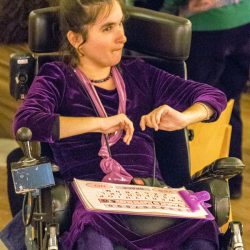
Maresa in her wheelchair at an event

Getting into the writing world

When I left university I knew I wanted to get into the writing world. I had been to two creative writing classes before university but now wanted more. I was lucky enough to be asked to write a chapter for a book from my ‘One For All’ days and I experimented with a few writing groups before I found a poetry group I jelled with. I was accepted as myself and I wrote and we found ways of performing my poetry. At that time one of this group became my assistant, Jim. It has been my partnership with him that has been crucial to my getting into the writing world over the last seven years.

There are always people who want us to be included in life. I have been fortunate to continue to be invited to teach in the education department at the university. We meet students who are studying education and many of them are enthusiastic about including all young people but it is not easy being employed in schools at the moment.

How we are included in the world depends on our relationships. The education students who have had disabled young people in their lives are often the ones who are enthusiastic about including all young people in school.

My friend Brandon is also known to ALLFIE and has been in Inclusion Now. He is twelve years younger than me and encounters the same difficulties as I do. He says, “It isn’t possible to do anything spontaneously because so much needs to be checked out.” He also spends a lot of energy finding assistants, “It’s a lengthy process”, also training “takes ages and it is exhausting.” Brandon was at a mainstream school with mixed experience of making some friends but also of being bullied. Even now he finds a lot of people can be patronising and thoughtless.

At present it is not ordinary to need a high level of support and be part of the mainstream world. It is still seen as extraordinary and unusual. We need our assistants, friends and allies, to enable the extraordinary to become ordinary.

The world is still so unaware. We must grow up together to stop the vicious circle of segregation.
It is about how society sees questioning, about whether wondering is seen as productive or not. For the Earth to preserve itself we need to live differently, we need to be curious about how this can be done. We need to wonder about each other. If we can’t wonder how can we think, how can we find new ways of living, how can we get to know each other? I love to wonder, I love to think about how we can use each other’s talents and how to share without anxiety.

Friends are essential, our survival depends on them.

Tollgate school visit

Tollgate Primary School in Plaistow, East London, has a reputation for being an inclusive school. Richard Rieser and Yvonne Brouwers visited to see how this works in practice. For Yvonne, who lives locally, this was an interesting opportunity to write about an inclusive school in her own community.

Tollgate is a lively primary school with about 450 pupils and 14 classrooms. The site was quite restricted as they are currently building an extension to the 1930s building with a direct government grant to extend access. When completed this Autumn the whole campus will be wheelchair accessible with a lift. There is currently a long waiting list. Despite the ongoing building and crowds, we noticed no overly loud shouting or chaotic running. Katie told us that this is an explicit focus of the Headteacher and the result is a calm and peaceful school environment in which all pupils can feel safe and comfortable.

There is a separate “Family Centre” where parents and families are welcome to do different activities, like a coffee morning for parents of children with SEN. We met Vicky George, one of the family workers at the school. Her two older children are at the school and her 3 year old with ASC has started in the nursery. ”When he started he had no language. Already he has 15-20 words and signs. Putting my child here it’s like a family. Very inclusive and every parent is helped from the beginning.”

Tollgate is a resourced school, with a specialism for children identified with Autistic Spectrum Condition (ASC). The school has 14 resourced places for children with ASC but there are twice as many children with ASC attending. There are a further 25 disabled children, including children with hearing and visual impairment, dyslexia, ADHD and global development delay. Altogether there are 54 disabled pupils, about 12% of the school’s population. They are proud to be the first mainstream school to have gained accreditation from the National Autistic Society.

The nursery has 40 morning and 40 afternoon children. Nursery, Reception to Year 6 and children with ASC are allocated to every class with a key worker. The school and its provision are rated by OFSTED as Outstanding.

Tollgate believes all children have the right to access the same opportunities as their peers and benefit from the modelling that takes place in a mainstream setting. All disabled children are therefore part of their mainstream classes and access the national curriculum, whilst their Individual Education Plan (IEP) addresses their specific areas of difference.

The school is a recognised Initial Teacher Training Centre. The advantage of this teacher training approach is the focus on inclusion, with five days of the taught course and placements in inclusive classes. With more than 40 schools in the Alliance, a job is guaranteed to all completing the course.

We were shown round by Katie Pugh, Assistant Headteacher for Inclusion and Sarah Emir, a Learning Support Teacher. They told us every child was allocated to a class and the aim was for them to spend as much time as possible in the classroom with their own personalised targets, supported by assistants. They have three fulltime learning resource teachers, 26 learning support assistants, two speech and language therapists (one full time equivalent) and three behaviour mentors. Having a full time SALT greatly benefits the development of the children’s language and literacy.

Katie explained that pupils are only taken out of the classroom when the child themselves is distressed and needs some time in a quieter space. Children with SEND spend from 100% to 20/30% of their time in the mainstream classroom.

Katie and Sarah explained the structure of support for the children with autism. The three learning support teachers lead three teams covering Lower (Reception to Year 2) Middle (Year 3 & 4) and Top (Year 5 & 6), monitor their progress and develop Individual Education Plans with three meetings a year with parents. The school does not use any one approach to ASC. Each child has an individual timetable depending on how much time they can manage in their mainstream class. Visual timetables are used for all children with ASC. There are five spaces for withdrawal, small group work, one-to-one or chillout and for a wide range of interventions including messy play, speech and language, PECs, Proloquo2Go, Signalong, Colourful Semantics, Intensive Interaction, Attention Autism, Music Interaction, Sensory Integration, Life Skills and Lego Therapy. This last was particularly popular, with mixed groups taking different roles to collectively build the model. Each of the children has their own task according to their ability and the children also form friendships this way.

The children who are non-verbal learn Signalong (a system of signs derived from British Sign Language) with a new sign to learn every week. I (Yvonne) was especially happy to see this emphasis on teaching signs to all the children as my own daughter uses Signalong to communicate and always has to teach other people signs before they can interact well with her. I feel that the whole community will benefit when the non-disabled children learn signing so they are equipped to communicate with everyone. Signalong have recently developed a syllabus and accredited courses for schools. Perhaps this would be a good opportunity for the whole school to make Signalong a more serious part of the curriculum.

The Green room, where children with ASC can go with a key worker, is a quiet space with stalls that cut out sensory overload. Next door is the Yellow room with tables for small group work, cooking facilities and a place where the class sessions can be broken up with snack time for children with ASC who need it. There is a sensory room and, until the building works, a soft play room. We were also shown a hall with space for mini-trampolines, mats and blocks where physiotherapy and sensory integration therapies take place.

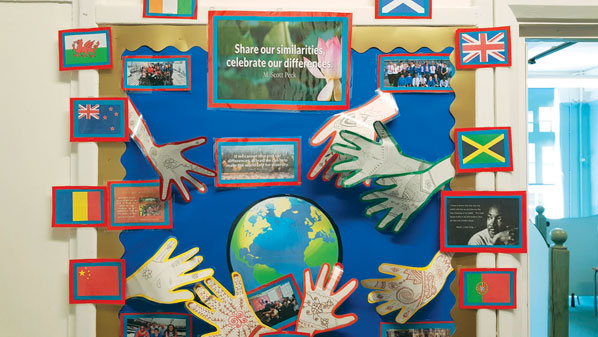
A classroom display with paper hands, paper globe and the words "share our similarities, celebrate our differences"

In every classroom we spotted one or more children supported by teaching assistants, sitting between their peers or alone at a table when that made them feel more comfortable.
We asked how the non-disabled children get on with those with impairments. The Learning Support Teachers felt that because they have all been in the same class since reception the children accepted and got on well with each other. They had assemblies and PSHE lessons on disability and the whole school engages in activities on World Autism Day. All children are together at registration, assembly, lunch and playtime; we thought there was an opportunity for more formal circles of friends and buddying, which would enrich the offer at the school.

There is a buddy system in the playground and Katie says that the pupils who have a disabled sibling are more understanding of disability, make friends more easily with disabled pupils and are their best advocates.

We asked what role the class teacher takes and were told they were responsible for the learning of all children in their class and planned and differentiated the work so it was appropriate for each child. There is staff training every Monday and Katie Pugh has at least a session every half term. The Teaching Assistants all complete the five day ACS training at the Tunmarsh centre with certification. The school has access to a specialist advisory teacher in the Borough’s Language Communication and Interaction Service.

We noted lots of effective teaching and innovative inclusive practice. Staff could not remember the last exclusion. Katie told us proudly about a boy on the autistic spectrum who came to the school non-verbal and on the P levels and now in year six he has progressed so much that he is doing SATS.

Our impression of the school was that it was quiet, well ordered and work in every class was purposeful. The school was full of colourful displays of beautifully made art and craft work. And in the art gallery there was wonderful art by the pupils with higher educational support needs presented amongst all the other artwork. All children take part in school and class performances.
It is expected all children go on out of school trips, which are tested beforehand for accessibility, though sometimes adjustments are made such as only going for the day on residential trips. There are many after school and holiday clubs, but we learnt that unfortunately transport often hinders participation. The only disabled students currently included in after school clubs are the ones whose parents can take them and pick them up.

What were the outcomes for the children with ASC? The school used the p-scales and National Curriculum Levels for the 14 Resource Base pupils to measure academic progress. The progress shown in all but two pupils was expected or above, with which Ofsted were more than satisfied.
Headteacher Tom Canning told us that his passion for inclusion came from his experience at university in the eighties, where he came across a disabled person for the first time and noticed he was afraid because he had never seen a disabled person before and didn’t know how to engage with them. He thought how wrong this was and that disabled people should have the opportunity to go to mainstream schools all the way, just like himself. He says he has been passionate about social justice ever since. Therefore the motto of his school is All Children Are Welcome. They do not reject any disabled children.

The schools in this trust are academies and they are all inclusive, which shows that being an academy is not necessarily bad for inclusion as long as the attitude of the leadership is inclusive. Tom explained that it is an advantage to be an academy, a school led system, as opposed to a local authority (LA) led system, because there is so much instability at the local authority. We could see how it could be empowering in this world with its resistance against inclusion to be one of seven in a trust of like-minded schools.

As we left we were impressed and wondered if Tollgate and the Boleyn Trust were the exceptions that showed inclusion can work in academies if the will is there. Sadly in far too many it is not.
We are grateful to Tom and Katie for all the time they spent with us and to all staff and children who gave us a look in their daily lessons and activities. When we said goodbye Tom surprised Yvonne by saying that, for years, he had enjoyed seeing her and her daughter Sterre cycle past on the tandem to and from Sterre’s secondary school and seeing her growing up. This made her feel that he was really interested in inclusion in the wider community, not just within his school.

Julia Hayes

Julia Hayes, Educational Psychologist (Inclusion Now 33)

Just like parents in the UK, parents in developing countries want their disabled child to be educated, but with many facing barriers like poverty, conflict and lack of access to schools, it is estimated that 90% of disabled children in low- and middle-income countries are out of school (UNICEF, 2014). Despite these challenges, I have worked with lots of committed NGOs and education ministries around the world, trying to support disabled children to gain a quality, inclusive education.

For example, I evaluated a great project in Afghanistan that went door to door to find disabled children in rural areas who were being kept in their homes to keep them safe from conflict. The project worked with the families and children, introduced them to a classroom environment, before supporting them to access their local schools (read more in Issue 33, Autumn 2012). I am always reminded that if people in countries with scarce resources and huge challenges can make inclusive education happen, then so can we. Progress might be slow, but we can make this happen!

www.inclusioncreativa.com

Adele Rose MorganAdele Rose-Morgan, parent of Rhys (IN 48)

I recently re-read the very first edition of Inclusion Now from Spring 2001 and felt downhearted. The words I was reading were so relevant for us today, but I also feel that we are moving away from inclusion at a fast rate. The targets for schools are getting higher and higher and money is getting tighter. My child does not matter to the ratings or the targets and will cost more for a school. So guess what? They don’t want him.

The term ‘inclusion’ gets talked about a lot, especially when a box needs to be ticked. Inclusion for me means so much more than that – it means equality, equity, belonging, value, humanity. To me, it is beautiful and involves, affects and benefits everyone. Do we really need to compartmentalise inclusion? Physical inclusion looks like this, racial inclusion like that? What about admitting there are no excuses for not including any child in their right to education, together with children with and without disabilities. Accept this and work it out. I am sure that this is cheaper, more cost effective and, most importantly, would improve wellbeing and health outcomes for countless children and carers.

Disabled people aren’t just individuals, they have families who are also often disabled by the system due to lack of support for their caring role. I am one of those people. I am affected by a segregated dual system as a carer because I have to fight to ensure that my child has the best possible chance of reaching his full potential. This has a huge impact on my own mental and physical health because it’s an adversarial system. It is also a full-time job, which means I am unable to work in paid employment and contribute to my pension. If our outlook was to ‘include all’ the physical and social barriers would disappear. Would we need so many ‘special services’? Would our future generation grow up to support each other regardless of perceived need or deficit? This is not a minority group – it’s massive!

Putting myself in my son’s position – what is it really like to be seen as a ‘problem’ to be passed around and fobbed off in the hope that I will simply disappear? I am Adele and I have additional needs – in support, understanding and real, practical help. My positive traits (determination, passion, hope!) are perceived as very low value to the general population. How can I climb out of this hole and emerge feeling truly valued? How can I realise my full potential? Answers on a postcard!

Derek WilsonDerek Wilson, Educational Psychologist (IN 36)
No politician ever stood up and said ‘Our policies are exclusionary and privilege only the few’. No Headteacher ever began her parents’ evening welcome by saying ‘We are not an inclusive school’. Each wants their work to serve the interests of all, but this does not mean their practice achieves this. Clearly ‘all’ does not mean ‘all’ in many of our schools and our education policies – ‘all’ means ‘some’.

Fifty issues of Inclusion Now (and counting) have challenged this doublethink and shown us what inclusion means and can look like – anywhere and every day.

ALLFIE and Inclusion Now– they’re here to prove that all (still) means all – that full educational inclusion is a possibility we can live into.

www.inclusive-solutions.com

Gus JohnGus John, educationalist (IN 37)

One sure sign of the duplicity and hubris of government is its apparent inability to consider the impact of one piece of legislation or/and statutory guidance on others that already exist. This is clearly evident in the powers conferred on schools to exclude students, regardless of their rights being denied by whimsical, illegal and inhumane exclusion practices.

Despite evidence of the appalling disproportionality in the number of SEND students who are excluded, the government has made no attempt to prohibit the practice. We must all campaign to demand that no ‘child in need’, or who is the subject of a child protection plan, or education, health and care plan, or is assessed as having social, emotional and mental health needs should be excluded from school.

YewandeYewande Akintelu-Omoniyi, ALLFIE volunteer (IN 38)
Seventeen years ago I was in primary school under the Labour government, getting ready to go to secondary school the following year. The Labour government would be in power for the next eight years until I left school after sixth form. During my time at secondary school, I would say that I experienced integration, not inclusion. We had many Disabled students in my school but I am sure many of them would say that they did not have an inclusive experience. For example, I spent a lot of time in school surrounded by my non-Disabled peers. However they rarely wanted to build friendships with me, which left me feeling isolated. Nevertheless being around non-Disabled students showed me what I could achieve in life, for example going to university, if the barriers I experienced as a Disabled person were removed.

In contrast, under the coalition government it became even harder to get a Disabled child into mainstream and segregation increased as David Cameron said he wanted to “reverse the bias towards inclusion”. Also, Theresa May wanted to increase selective education. However, I do believe that we can still create more positive inclusive experiences in schools and push for proper inclusion in education. Inclusion can do positive things such as raise aspirations. Awareness needs to be raised in schools of issues such as Disability equality, and there needs to be an inclusive ethos in schools. This however, will take time but can be achieved if we work together with allies such as parents and teachers.

Linda JordanLinda Jordan, Governor of Eastlea Community School, Newham (IN 45)
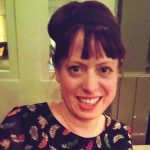
As we celebrate the 50th edition of Inclusion Now I can’t help reflecting on my time as an elected member of Newham Council. Between 1988 and 1994 we closed six special schools and created a culture which expected disabled children and young people to be included in local mainstream nurseries, schools and colleges. It was a good time and all over the country there were debates about inclusion and a genuine will to make changes. Anti-bullying and anti-discrimination policies were being developed and there was an air of excitement that finally we could create an education system where everybody is equally valued and free to be themselves. Sadly over the last fifteen years we have seen an erosion of these values and a return to an elitist model of education where exclusion and bullying is on the increase. The narrowing of the curriculum and a focus on distorted measures of “progress” means that very many schools now think it is ok to say “You do not belong here”. This has led to a perception that more “specialist” schools are needed. Thank goodness we have managed to stave of the worst of this in Newham and still have a very low number of children in special schools.

I want every school to be specialist so that they can welcome, nurture and love every child and young person in the community they serve. There is so much to do but we must remain optimistic in the knowledge that inclusion is the only way for the future. Best wishes for the future – keep highlighting what is positive and possible and how important it is for a healthy society

http://www.eastlea.newham.sch.uk

Louise KingLouise King, Director, Children’s Rights Alliance for England
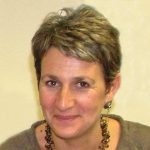
The most significant development since 2001 for The Children’s Rights Alliance for England, is the UN Convention on the Rights of Persons with Disabilities (CRPD) – adopted by the UN in 2006 and ratified by the UK in 2009. The CRPD builds on the rights that all children have under the UN Convention on the Rights of the Child by giving additional important rights to disabled children, including the right to an inclusive education. While we still have a long way to go until the ambition of article 24 is realised, the CRPD is none the less an important tool for holding government to account to ensure disabled children and children with Special Educational Needs can attend a mainstream school.

www.crae.org.uk/

Linda LascellesLinda Lascelles, CEO, Afasic

7% of children are affected by DLD (Developmental Language Disorder) but, shockingly, this is identified in only half of cases. This is the consequence of persistent attitudes within the education system, and society at large, that take language for granted. So teachers are not trained to identify and support children and language is not explicitly included in the curriculum. Instead, too many children are simply labelled as underachievers and not helped to develop the skills that will enable them to reach their potential. A truly inclusive system would actively teach children the language skills they need to access the curriculum, make friends, and achieve a successful transition to adult life.

www.afasic.org.uk

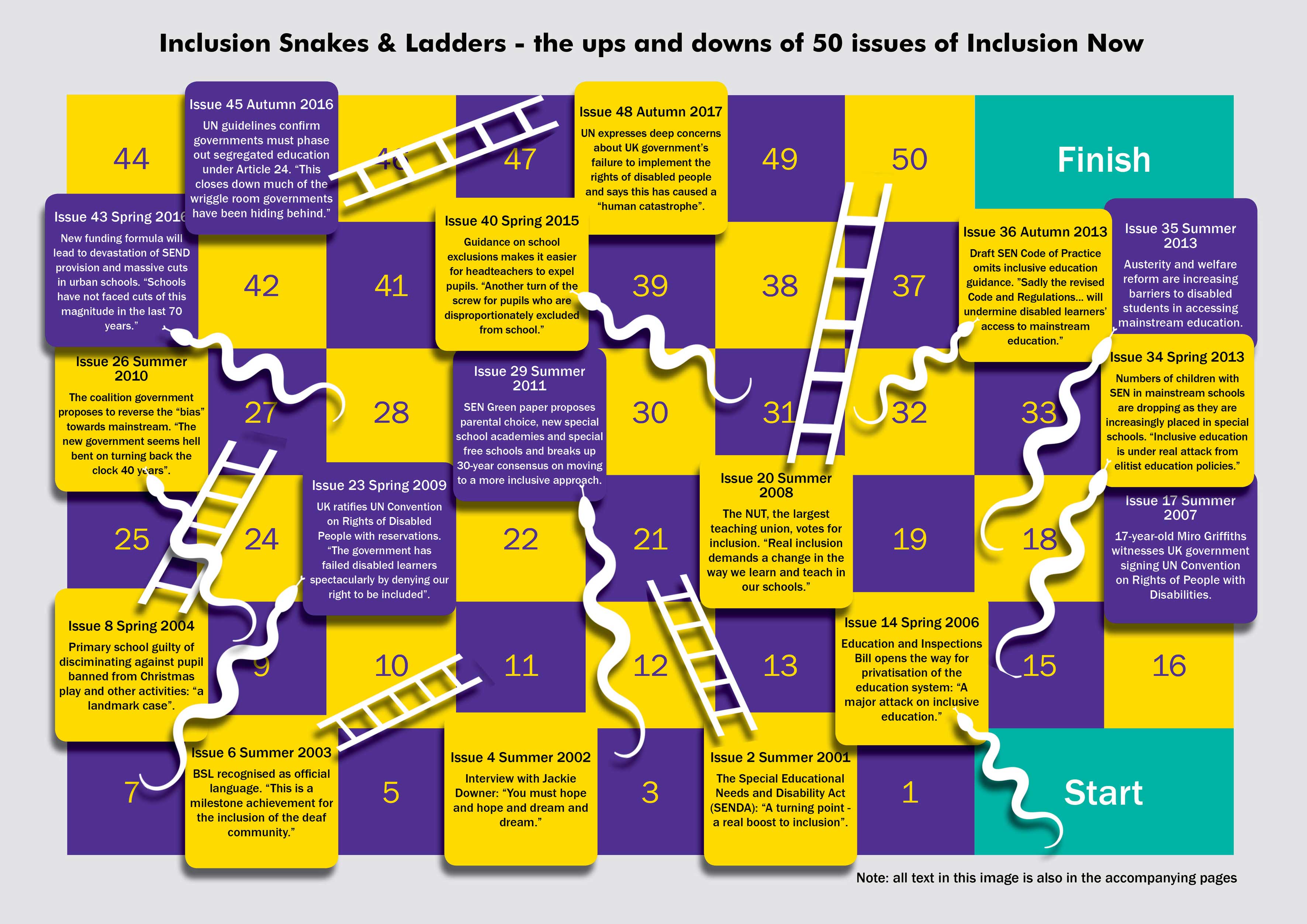
Graphic of a snakes and ladders board with events from past issues of Inclusion Now. All the events listed are also in the timeline below.

Complete timeline

Timeline by Belinda Shaw

“Plans made for us, not by us”

A team of Disabled young people tell us about their research into how well Education, Health and Care Plans are working.

We are a research team called RIP:STARS. This stands for Research into Plans: Skilled Team with Ambition, Rights and Strength. We are all disabled young people aged 16 to 25 and we are from Coventry.

We have been funded by DRILL (Disability Research on Independent Living and Learning)/Big Lottery to research the quality of Education, Health and Care (EHC) plans, and whether they meet disabled children and young people’s rights. We also want to find out whether plans prepare disabled children and young people for independent living and help them achieve their dreams for the future. We are interviewing professionals, parents/carers and disabled young people to see what a good plan should really be. Coventry University are training us in research methods and helping us with the research. We are also working with ALLFIE, Nottinghamshire and Coventry local authorities, Zara Todd and Grapevine Coventry.

Our project is about improving EHC plans and how they are written. It is also about improving access to support within EHC plans and raising awareness of disabled young people’s rights. Often young people and their parents do not know that they have rights as children, and as disabled people. We want to make sure that disabled young people have a real say about what is in their plan.The RIPSTARS logo

This project is also about making our voices heard and becoming empowered as young disabled people. ALLFIE and Zara Todd have given us training sessions where we have learnt about our rights under the United Nations Convention on the Rights of Persons with Disabilities (UNCRPD). Before this project we had little information about our rights as young disabled people, but now we have carried out some research and learnt about rights and EHC plans, this makes us feel empowered.

We have also learned about the Social Model of Disability. This means not seeing young people just as a label such as autism or dyslexia, not treating everybody with that condition in the same way, and always focussing on the negatives of disability rather than the positives. We are now using the Social Model in our research.

However, we now feel angry because through our research we have found out that in reality we cannot make a complaint or change our EHC plan without a legal process. We are also angry because we have found that EHC plans are not always carried through correctly. For example, disabled young people are not always involved in their plans and do not get a real say into what is in them.

By the end of this research we aim to break down the barriers associated with disability and highlight the positives about it. We are using all the information in our research project to help and support young people with their EHC plan to make sure they have a good plan, and they know what it should include. A good plan should include and support a young person’s skills, strengths, ambitions and rights.

We will be publishing our research this autumn and developing resources to help disabled young people and their parents achieve plans which meet their rights. If you would like to come to our launch or hear more about our research please contact Anita Franklin, Coventry University.

Written by Eva, with Jordan, Tom, Heidi, Vandana, Ben & Ryan


Logo of the DRILL research project


There is considerable evidence from research in the UK and around the world that including disabled children and young people with the full range of impairments is successful, particularly where well planned and funded and staff are well trained. I have been observing and filming inclusion working across the UK and beyond for the last 30 years and I have witnessed children with multiple impairments being successfully included. It boils down to attitudes and where there is a ‘can do’ attitude it can happen in all sorts of environments. But even where this does not occur, disabled students do better in all ways compared to those segregated into special schools. This is the case for those with cognitive, social, emotional and mental health impairments, as well as those with physical and sensory impairments.

From 1997 to around 2004-2006 the Labour government had a policy of inclusive education but they did not defend it and allowed it to be undercut. The pressures of the Tories’ Standards Agenda, reduction in central support teams, high stakes testing and the wish of special schools to expand, all undercut the policy and the Labour Party did not know how to develop and defend it. The Coalition and Tory governments had a commitment to end the ‘bias to inclusive education’ and a moratorium on special school closures.

Whilst the Conservatives remain set on turning the clock back on inclusion, Labour in their 2017 manifesto committed to developing a National Education Service based on inclusivity. Considerable work needs to be done both within the Labour Party and with the general public to raise understanding and commitment to inclusive education. The current cuts in school budgets are hitting inclusive practice towards disabled young people particularly hard with cuts in teaching assistants, small groups, reduction in bought-in specialists and growing class sizes.

And yet despite the doom and gloom about the turning back of the clock on inclusion, ALLFIE continues to hear about schools that are developing inclusive education practice and enriching the lives of their pupils and students, such as Eastlea Community school in Newham, Emersons Green school in Bristol and Blatchington Mill secondary school in Brighton are all bucking the trend away from inclusion by continuing to value each and every one of their students.

The UN Convention on the Rights of Persons with Disabilities (UNCRPD), ratified by the government in 2009 must become our roadmap for inclusive education. Article 24 of the UNCRPD and the follow up General Comment No.4 set the tone for the paradigm shift required to get us to a place where inclusive education is not up for discussion, but is a reality for every pupil and student. The General Comment No. 4 sets out the requirements for change which include:

Interestingly these are not dissimilar from ALLFIE’s seven principles for inclusive education.

Last summer the UN Disability Committee scrutinised the UK government’s implementation of the UNCRPD. Their Concluding Observations document highlights that the UK government’s approach to disabled people, including disabled children and young people, is causing a ‘human catastrophe’. The phone calls ALLFIE receives from parents almost everyday confirm this to be true. The committee have set out a number of recommendations that if implemented would deliver a truly inclusive education system – placing the rights and support requirements of all pupils and students at its heart.

The key recommendation for ALLFIE is the committee’s requirement that the government develop a comprehensive and coordinated legislative and policy framework for inclusive education and a timeframe to ensure that mainstream schools foster real inclusion of children with disabilities in the school environment and that teachers and all other professionals and persons in contact with children understand the concept of inclusion and are able to enhance inclusive education.

Such a framework would need to focus on building real aspiration for all our children and move away from sticking with what we know in terms of existing and traditional practice and policy that sees Disabled children & young people as the problem.

We need to reach out to parents, particularly those parents who are gathering together locally across the country to challenge the cuts to vital SEND support services.

Developing a legal, policy and practice plan that takes us from existing education arrangements to a system that is based on human rights and inclusion is the firm foundation to this transformation, and at the heart of that is the work that needs to be done to develop confidence in inclusion among teachers and support staff, parents and young people. That plan should include:

We will need to convince staff and parents that another inclusive way is possible and practicable. We need to convince government and local authorities that running both a special school and mainstream system is not cost effective. It is also wasteful of young people’s potential. As we transition from the current situation to an inclusive system, capacity building will be crucial. Many more resources and expertise can be released to make inclusion work, provided high stakes testing is dismantled and children’s happiness is put at the heart of learning, with a curriculum for all.

We need to move away from schools competing against each other and instead celebrate good inclusive practice and share the learning. We need to learn from the aspiration in other education systems such as Finland where a belief in the value of all children hasn’t damaged their PISA ranking because they value academic and vocational learning equally. Also many areas of Canada which have not had special schools for decades…. there are many other countries that are embracing the possibility of inclusive education. The UK needs to take a deep breath and do the same!

Supported by

ALLFIE’s campaign for Inclusive Education as a human right is backed by funders and donors who reject the systemic segregation of Disabled people from society.