![ALLFIE [logo]](https://pedantic-shannon.91-238-163-161.plesk.page/wp-content/themes/allfie-2025/assets/img/allfie-logo-original.svg)
Dear friends
Save the Date: National Day of Action Against Disability Discrimination in Education: November 21st 2018
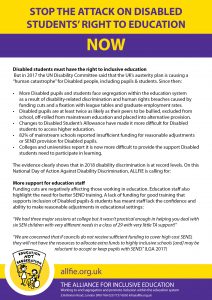
ALLFIE is joining forces with education unions, students and other campaign groups for a national day of action against Disability Discrimination in Education. Our focus is on raising MPs’ awareness of the injustices faced by Disabled students when attempting to access mainstream education.
Since the Conservatives came to power in 2010, we have seen increasing attacks on inclusive education with new legislation and policies that have weakened Disabled students’ right to mainstream education. At the same time, education providers are being financially penalised for promoting inclusive education practices and disincentivised by academic performance measures.
From ALLFIE’s experience, the overwhelming majority of MPs lack any real understanding or appreciation of just how severe the injustices experienced by Disabled students in mainstream education are. This is our chance to put the record straight: disablism and disability-related discrimination is rife in our education system and it needs to end.
This is a call for action:
- We need you to tell your MP about your experiences of the education system – what works and what doesn’t work.
- We need to use the power of social media to get the message out to the general public; we need to highlight the widespread disability discrimination that takes place in education on a daily basis.
In solidarity,
Simone Aspis, ALLFIE’s Campaigns & Policy Coordinator
Educate Don’t Segregate
We know many Disabled students experience discrimination at all levels of the education system, which often leads to segregation and exclusion. For example:
- Schools sending Disabled children with autism home because there isn’t the right support in place.
- Schools placing Disabled pupils into Alternative Provision because they believe those pupils will harm the school’s GCSE results.
- FE colleges only offering Disabled students with learning difficulties segregated life skills courses because college tutors can’t or won’t make mainstream courses fully inclusive to all students.
- Universities refusing to make reasonable adjustments for Disabled students.
- Education providers refusing to follow inclusive design principles when refurbishing their premises.
The Education Select Committee is currently undertaking a SEND inquiry. Whilst the inquiry’s terms of reference focus on the SEND assessment and EHCP processes and operations, ALLFIE decided to put forward a submission highlighting (1) how the government systematically violates Disabled students’ human right to mainstream education and (2) the failure of current education legislation to promote the presumption of mainstream education.
We are pleased that Tara Flood, ALLFIE’s Director, has been asked to provide oral evidence to the Education Select Committee on the 20th November 2018. The Education Select Committee has a Twitter feed, so please tweet your messages of support for the right to mainstream education to @CommonsEd, including @allfieuk and @DamianHinds.
We need you to act and bring the issue of disability-related discrimination to the forefront of the minds of the government, the Department for Education and MPs.
Contact your MP
We are asking you to raise your concerns with your MP about your experience of disability discrimination in education, and please encourage your MP to attend a parliamentary reception event at the House of Commons on 21st November from 17:30-19:00. ALLFIE is asking MPs to pledge their support for the following during the session:
- Disabled students’ right to an inclusive education
- To review education buildings in light of Disabled students’ needs
- To ensure schools implement reasonable adjustments in a timely manner
Please let us know how you get on.
Get Tweeting!
On the 21st November we will be using the power of social media to tell Damian Hinds and the Department for Education about the widespread disability-related discrimination that thousands of Disabled students experience across the country every day.
Please feel free to write your own tweet beginning with “#DisabilityDiscriminationinEducation is…” adding in @DamianHinds @educationgovuk – don’t forget to include us – @allfieuk.
Or you can tweet one or more of the following tweets:
- #DisabilityDiscriminationinEducation is when Disabled pupils are 7 times more likely than their non-Disabled classmates to be excluded from school. @DamianHinds @educationgovuk
- #DisabilityDiscriminationinEducation is when 82% of mainstream schools say they have insufficient funding to make reasonable adjustments for Disabled pupils. @DamianHinds @educationgovuk
- #DisabilityDiscriminationinEducation is when approx 30% of pupils who leave school between years 10 and 11 have SEN despite making up only 13% of the school population. @DamianHinds @educationgovuk
- #DisabilityDiscriminationinEducation is when 52% of Disabled pupils with an EHCP are forced to attend a special rather than mainstream school. @DamianHinds @educationgovuk
- #DisabilityDiscriminationinEducation is when education performance league tables fail to include Disabled students’ learning achievements. @DamianHinds @educationgovuk
- #DisabilityDiscriminationinEducation is when Disabled students have to pay £200 to access IT, a cost not incurred by non-Disabled students. @DamianHinds @educationgovuk
- #DisabilityDiscriminationinEducation is when 79% of students attending segregated Pupil Referral Units have SEN. @DamianHinds @educationgovuk
- #DisabilityDiscriminationinEducation is when, by age 7, 12% of SEND pupils and 11% of EHCP pupils said they were bullied “all of the time” by other pupils, compared to just 6% of their non-disabled peers. @DamianHinds @educationgovuk
- #DisabilityDiscriminationinEducation is when the proportion of Disabled 16-24 year olds who are NEET is significantly higher than those who are non-disabled. @DamianHinds @educationgovuk
If you are planning to hold any activity on the day, let us know and we can promote it on social media.
If we can help you, please let us know.
Simone Aspis: simone.aspis@allfie.org.uk 0207 737 6030
 “[Government] developed an inclusive education strategy. Mainstreaming in every department. We need to do a lot of capacity building with every teacher so that inclusiveness starts at the ground level.”
 In Columbia our government have been developing some measures to promote inclusive education which is adapted to the convention and to guarantee communication for children with disabilities. For example a deaf child can get a sign language interpreter in classes. Inclusive education just started last year but the main goal is to accomplish what has been set in our law within the next five years.”
 “Five years ago we started a policy on inclusive education but it is not finalised. We have a Special Needs Education Department with the Ministry of Education but it is highly under funded. Inclusive education can be achieved if there is financial commitment but it requires money. We have laws and institutional mechanisms but we need enough teachers, resources, technology for this to be achieved.”
 “A policy was adopted in 2013 that has a lot of progressive things within it, that talks about including children within mainstream schools. Some milestones have been achieved for example five schools enrolling deaf children and blind children. There are challenges – due to lack of resources we have not implemented the policy in its entirety. Some children with intellectual disabilities do not attend mainstream classes because there are no resources to support them within the classroom. They have moved from special to resourced schools.”
 “The Philippines are training more teachers for special education so children with disabilities can go to mainstream school without fear of discrimination. The infrastructure is not yet ready because inclusive education is not a priority.”
 “The First Lady of my country, wife of the president, is doing some good stuff to promote the importance of inclusive education but we need a systematic approach and real changes for inclusive education to really work.”
 Father Mike Lake (Canadian Member of Parliament): “When Jaden attended a regular classroom we didn’t realise the amazing positive impact it had on the other kids. Every one of them would say that their lives are better off for having Jaden in them. When you include people like Jaden in schools everybody’s definition changes to include [others].”
 “Inclusive education is very important and all governments should legislate for it. It’s not just about policy, it’s about implementation. Teachers tells us they want to include disabled children but they don’t have skills and resources. Inclusive education should be provided through in-service training and continuous professional development. School infrastructure needs to be accessible and friendly for all learners. Bottom line: government to commit to make it happen.”
 “90 special schools in Kenya, 3,000 special units in mainstream schools but those units have a problem because they lump all disabled children in these units without proper provision. So the units become a dumping ground for disabled children. Budget remains consistent with no increase, making inclusive education difficult to achieve.”
 “What is not working is many children with disabilities are not getting early childhood assessments so that they can get the right kind of support. This is really lacking. There has been sign language introduced. There has been introduction of access and Braille in some schools but it needs to go wider, even into university. We need to do more and need more resources.”
 “For inclusive education to work better we need rapid short training for teachers on technical aspects and to have a sandwich programme. It will have a ripple effect. It would have less wastage and improve inclusive education teachers.”
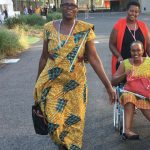 “Northern Uganda talks about inclusive education but not in the context of the disability movement. So it is special needs education that is what Uganda defines as inclusive education. We have a lot of units for example for people with visual impairments, schools for blind children, schools for the deaf, schools for handicapped and schools for deaf & blind. The mainstream education that Uganda is talking about is where a disabled learner can access it without any adjustments made. The disabled student has to access the school based on what they can manage. If they cannot manage they are not welcomed. This is not inclusive education.”
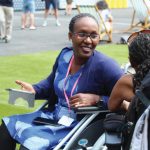 “In Western Uganda I don’t even think inclusive education exists. In Uganda the ministry needs to learn more about what inclusive education means because it is still not a common thing on the norm. We need to sensitise the government to convince them it’s a human rights issue. Also the government needs to learn from other countries.”
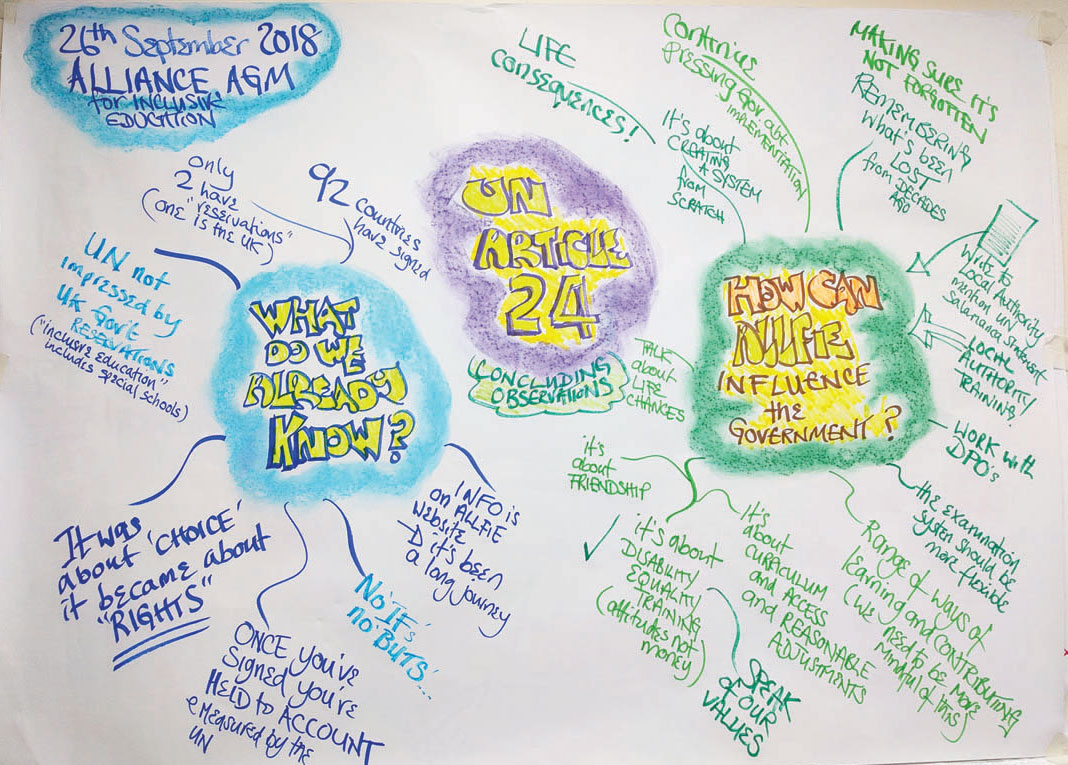
 “We are also calling for the removal of the reservation on Article 24 and full implementation of Disabled people’s human right to inclusive education.”
 In 2014, The Children and Families Act brought in legislation and principles that underpin the current SEND Code of Practice. Yet reports from Local Area SEND inspections and third sector organisations suggest that these principles are not implemented consistently nationally. Let us remind ourselves of the nature of these principles (see table).