Please ensure Javascript is enabled for purposes of website accessibility Skip to main content

The DFE have asked the Council for Disabled Children to organise a small number of workshops across the country. Email senfinancialevents@ncb.org.uk, giving your name, role, organisation and email address.

The call for evidence has no doubt been prompted by growing concerns of families, Disabled people, education providers, local authorities and unions over the negative impact that funding cuts are having upon Disabled children and young people in all forms of education including post 16. The Department for Education is consulting on both how existing funding arrangements are working and whether improvements can be made to support children and young people in different settings.

Whilst the inquiry is mainly geared towards collecting views of schools and post-16 education, nevertheless we are responding anyway.

The call for evidence provides an opportunity to not only say there is insufficient funding in the education system per se, but the funding itself is being spread more thinly across a broader range of SEND provision. Funding policy appears to be moving from resourcing mainstream to segregated education which is clearly incompatible with promoting Disabled pupils’ right to inclusive education. Whilst mainstream education budgets have been slashed, this government is increasing the funding available to establish new free special schools – such as the 37 that were announced in March this year.

We are always on the lookout for examples of both good and poor practice currently happening. So if you are or know anyone directly affected by the cuts to funding please do contact us with your experiences in confidence.

Simone.aspis@allfie.org.uk, tel: 0207 737 6030.

After the first successful day of action for disability equality in education which took place last year, ALLFIE is working with the Universities and Colleges Union to co-ordinate the second day of action, taking place on 4th December.

With a new government in place, we will be planning to use the day to take action around the government’s continued failure to implement the UNCRPD Monitoring Committee’s recommendations.

More information will follow.

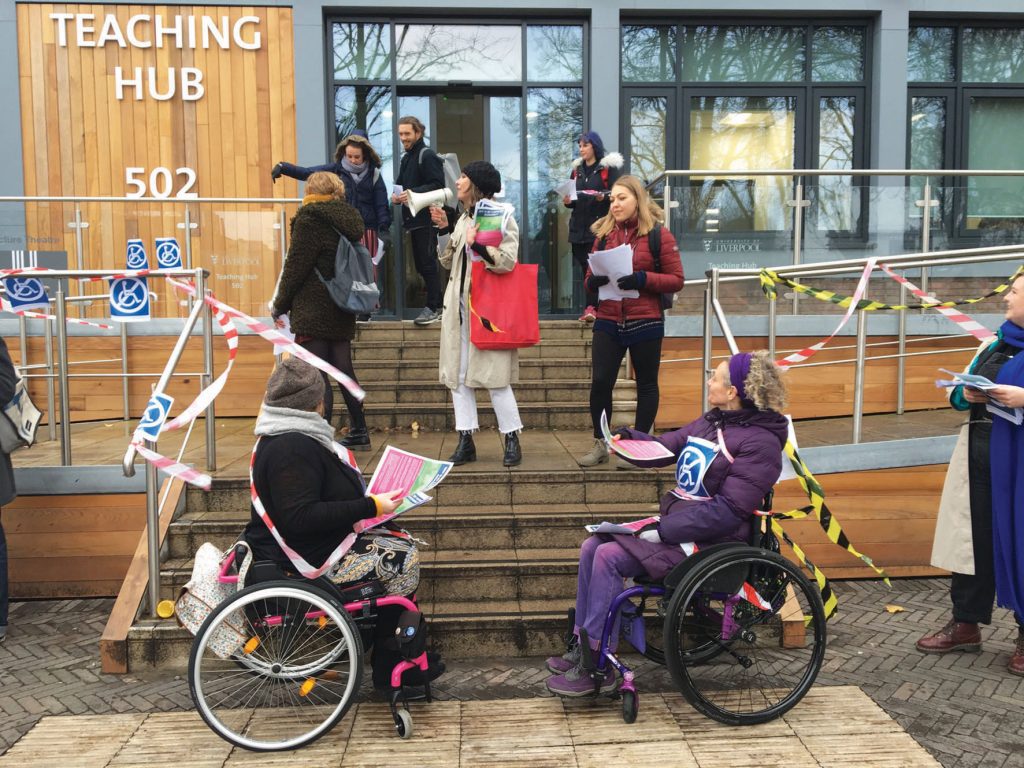
Protestors at Liverpool University with inaccessible entrances taped off

Report on the SEND National Crisis march

On 30th May we went on the SEND National Crisis march along with parents, children and other campaigners. Michelle Daley reports back.

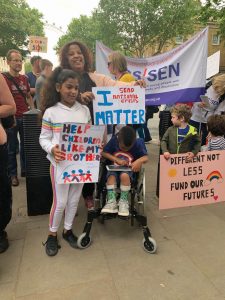
Woman, girl and boy (wheelchair user) - daughter holds placard saying "help children like my brother". Mother holds placard saying "I matter"SEND National Crisis is a network made up of parents and other organisations who came together and organised marches across 28 local authorities on 30th May. The purpose of the march was to draw attention to the crisis in SEND caused by education funding cuts, and get the message across to the Government.
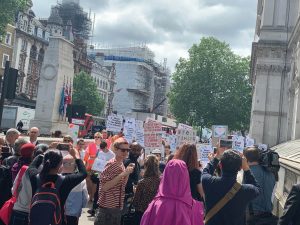
 

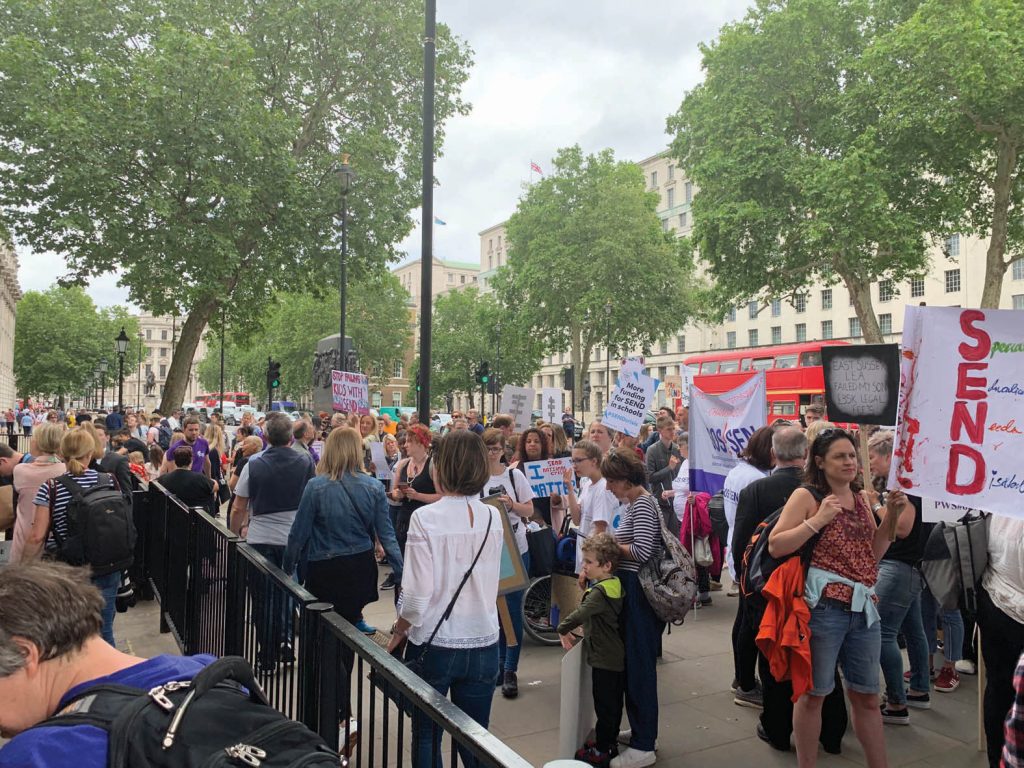
Crowd at march

ALLFIE was present at the London and Leeds marches. We attended the march to show comradeship and solidarity, to shine a spotlight on the failure to meet UNCRPD Article 24 and to demand a fully funded and supported inclusive education system.

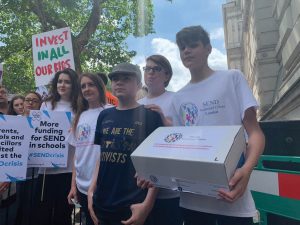
The petition - a large box - being held by a young man and companions


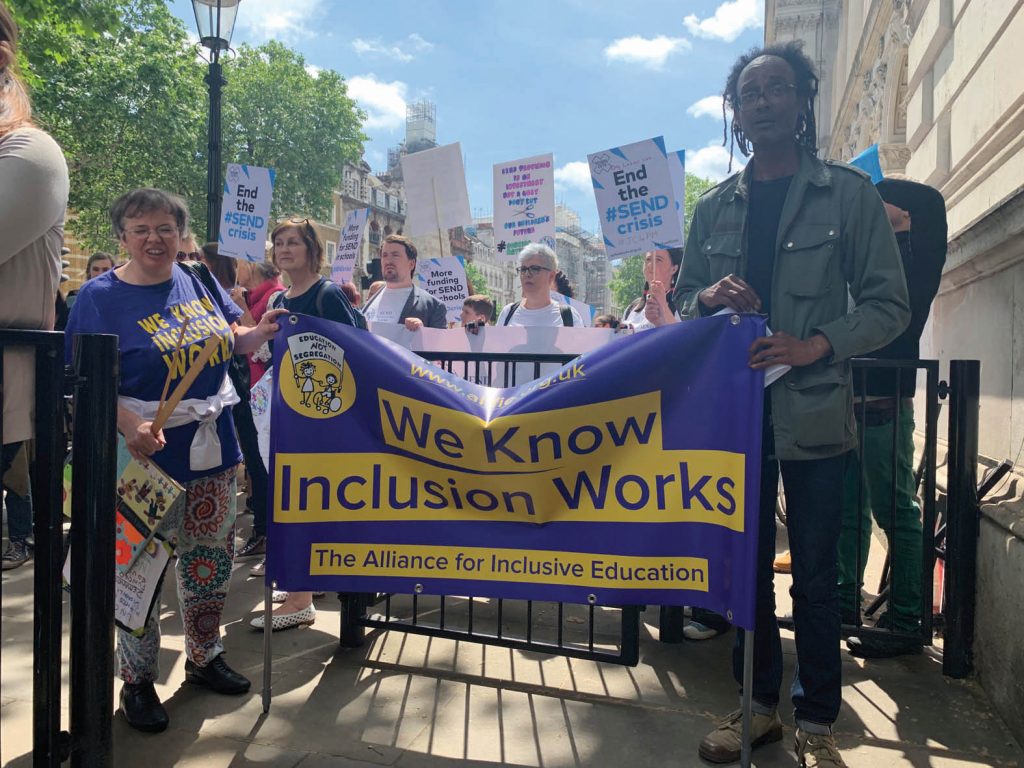
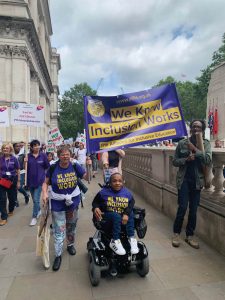
We were impressed with the attendance – it was reported that up to 1,000 people attended the march in London and there was a strong media presence. The march was held over school half term which helped ensure many children and young people attended.Michelle and Simone from ALLFIE holding a banner saying "We know inclusion works"


There were passionate speeches, especially from young people, clearly stating “It’s wrong that people don’t get what they need. And it’s wrong they have to fight for it.” There were also some very disturbing stories shared by parents. One parent said “Every single school has refused my child. He is locked in a seclusion room.” Another parent shared that she had to pay £20,000 to secure a place for her child in a mainstream school.

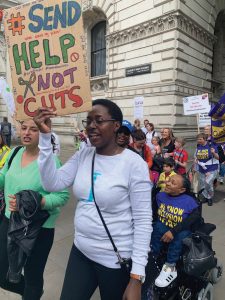
Woman in crowd with placard saying "send help not cuts"


The question is how much notice has the government actually taken of the SEND Crisis March? There is an important case on the 26th & 27th June on the issue of SEND cuts and denial of access to mainstream education. ALLFIE will be supporting this case and we also hope to see you there!

Michelle Daley


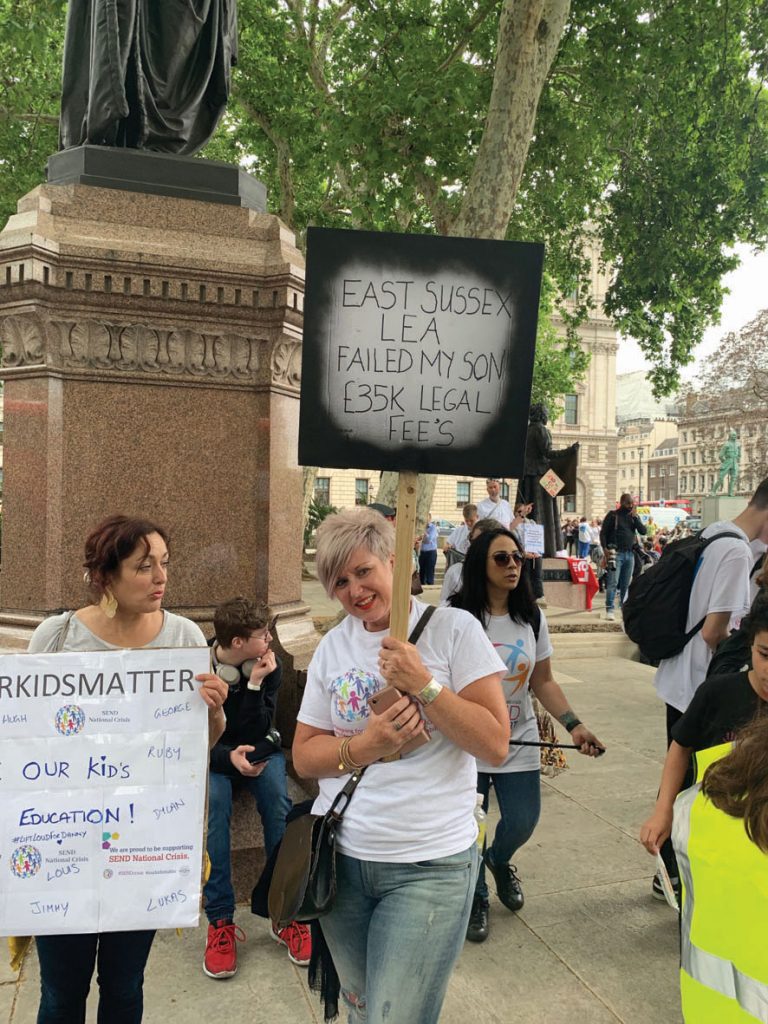
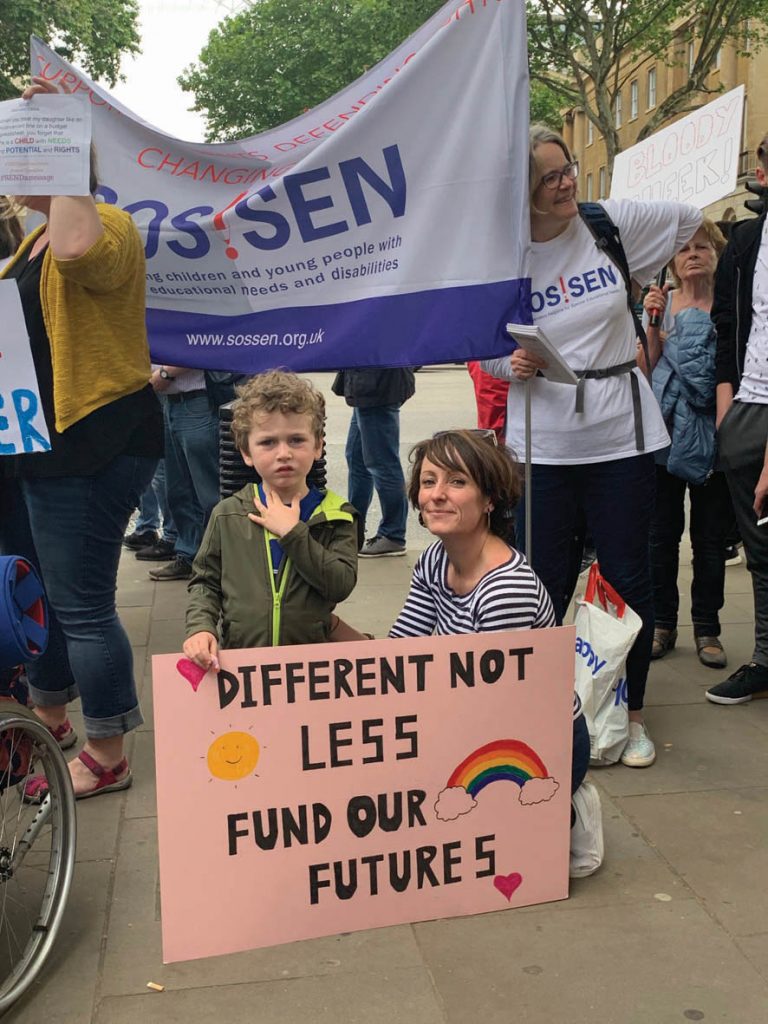
Woman with placard saying "East Sussex LEA failed my son, £35k legal fees"Woman and young child with placard saying "different not less, fund our futures"


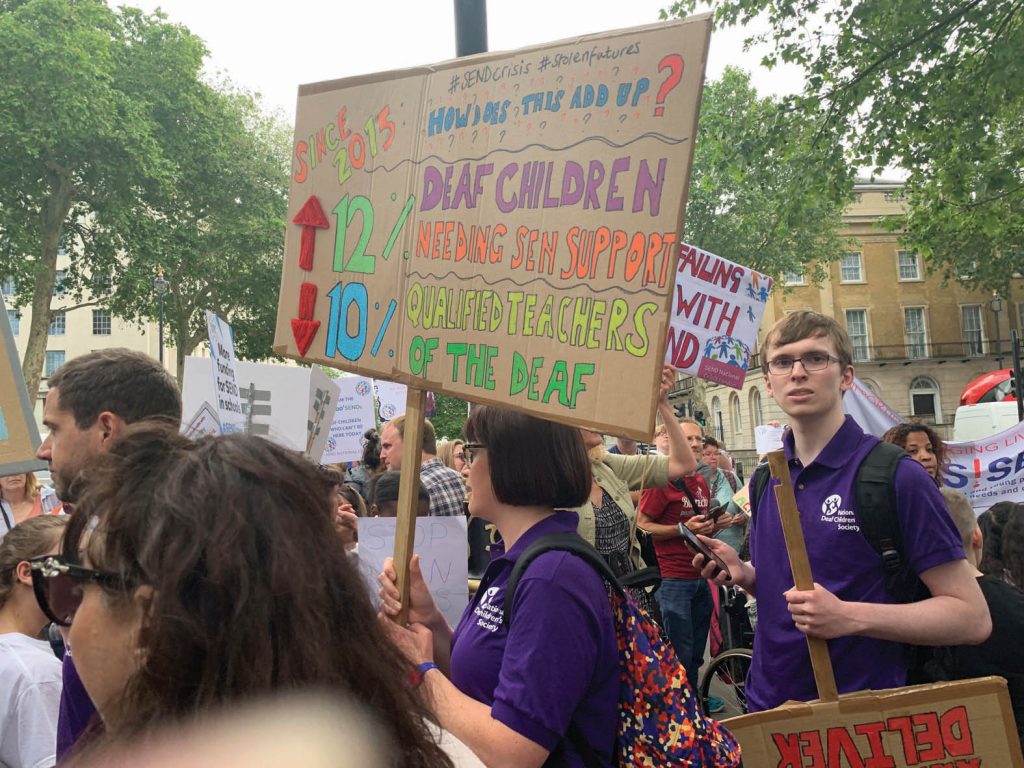
Crowd with woman holding placard saying "How does this add up? Since 2015 12% increase in deaf children needing support, 10% decrease in qualified teachers of the deaf"Crowd at demo
ALLFIE's "We know inclusion works" banner


The Timpson Report on Exclusion

What will it mean for families of disabled children? Richard Rieser reports.

Hannah Phillips lost count of the times her son James was excluded from primary school for disruptive behaviour. There were daily phone calls from staff, often asking her to take him home, and his three older siblings were fed up with being called out of class to deal with him. He was frequently placed in isolation, away from the classroom, and excluded from school trips and activities, says Phillips.

James has Down’s syndrome and moderate learning difficulties. So what his teachers classed as disruptive behaviour was actually “general excitement and joie de vivre”, says his mother. With the right kind of help, she believes he could have progressed well in a mainstream school. But she was disappointed by the support that was offered. “The attitude seemed to be: ‘We don’t really want him here, but we have to take him because the education system says we have to take children with special needs’”.

Julie Sheppard also found herself making frequent trips to her school to collect her son Logan, who has autistic spectrum disorder, because staff said his behaviour was unmanageable. For Sheppard, the multiple trips back and forth to the school became too much. “I remember ringing my mum in tears, saying: ‘I can’t keep doing this’.” (Guardian 18 February 2013)

On 15th March 2018 the Times Educational Supplement reported on a decision of the First Tier Tribunal of the Health, Education and Social Care Chamber (previously known as the SEND tribunal). The tribunal found that an academy trust failed in its duty to make reasonable adjustments by imposing its behaviour policy rigidly to the detriment of the education of a child with special educational needs. The 15 year old pupil (X), who has attention deficit hyperactivity disorder and epilepsy, was given a fixed term exclusion and was also excluded from a work placement. X was later permanently excluded from the school.

The parents of X argued that the academy trust had failed to meet their son’s needs and the exclusions were the result of his disability, which led to challenging behaviour. They went on to claim that X’s education suffered as a result of his treatment by the school.

The tribunal, which heard the evidence in February 2018, reported that “the question of X’s actual education appears to have become secondary to the zero-tolerance policy of the school”. The tribunal noted that the pupil’s education was becoming a series of detentions and exclusions and that the behaviour policy was being imposed rigidly, resulting in X being put at a “substantial disadvantage” compared to non-disabled pupils. The tribunal stated that the school should have made reasonable adjustments to the policy for X rather than continuing with the “inflexible application of its policy”. A spokesperson for Burnt Mill Academy pointed out that it was a high-performing school, with high expectations for its pupils: “The school’s behaviour policy has been instrumental in securing outstanding behaviour”.

More recently the Children’s Commissioner, Anne Longfield, reported excessive use of off-rolling in some schools. Her report ‘Skipping School: Invisible Children’ (4th Feb 2019) showed that while many parents who make a philosophical decision to home educate put a substantial amount of thought and dedication into providing their children with a high quality education; there are many other families who have ended up home educating for other reasons, and are struggling to cope. There needs to be a shift away from pressurised, hot-housing schools, to stem the tide of children entering home education when it is not in the family’s true interests or wishes. There is a pressing need for immediate measures to improve the experiences, safety and wellbeing of children who do end up being home educated and to reduce school pressures on families to withdraw their children from school.

The report shockingly showed that in Hackney, academies saw an increase in children moving into home education of 238% between 2016-17 and 2017-18, compared to an increase of 21% in local authority-run schools over the same period, and that numbers off-rolling for primary schools are fast increasing.

Stories like the above and hundreds more finally prompted the Government last March to appoint Ex-Minister Edward Timpson to report on exclusions, including the over representation of children with SEND in exclusions.

It was meant to be published by Christmas but was held up. One can only speculate what the original report said; although it identifies some of the problems now, it hedges around the issue, making 30 recommendations that Government have accepted but misses the target of changing culture and practice in schools.

Timpson points to the latest England exclusion statistics where those with identified SEN were 46.7% of permanent exclusions and 44.9% of the much larger number of fixed term exclusions, when they only make up 14% of the school population. This is 2.8 times higher for those with an EHC Plan and 3 times higher for those on SEN support. This goes up to students with social, emotional and mental health issues being permanently excluded 3.8 times more than non-disabled students.

The failure to make reasonable adjustments (a duty all schools have towards all disabled students) is not really examined by Timpson, though he suggests it should be more explicit in DFE guidance to schools. Yet it goes to the heart of the issue. This duty under the 2010 Equality Act is anticipatory and therefore applies to policies such as behaviour policies. They must be flexible to allow for behaviour that arises from underlying conditions such as hyperactivity, autism, depression or anxiety. One barrier to the exercise of this duty was removed by the courts last August, when schools who used the get out ‘tendency to violence’ to say the child was not disabled and so the school did not have to consider reasonable adjustments was quashed and the Government did not appeal it. However, the increasing use of rigid behaviour policies leading to exclusion is common and, if consideration has not been given to reasonable adjustments, unlawful.

The report has also been criticised by leading campaigners for racial equality in education, for similarly not tackling the institutional racism that lies behind the disproportionately high rates of exclusion for students with an Afro-Caribbean heritage.

Other recommendations include more focus on behaviour in teacher training, leadership training and the development of more equality and diversity hubs; specific training on attachment and trauma for leaders and SENCOs, the development of a practice improvement fund; developing the role of Alternative Provision as sharers of expertise; schools being made responsible for children they permanently exclude; OFSTED promoting good practice; DFE reviewing recorded categories for exclusion; increased safeguarding responsibilities on LA, schools, social workers and safeguarding boards. These measures tinker with the existing system. Why not get rid of exclusion? Many other countries do not have it.

We need to have an education system that supports the learning and development of all children, committed to inclusion based on collaboration and not competition, so all are valued and cared for. We know that the real problems are worsening funding, loss of support staff with the multiple effects of high stakes testing, league tables, narrowing of the curriculum and the increasing use of punitive behaviour management systems. These factors are leading to more and more mainstream schools being uninhabitable for many disabled children. Only by elevating inclusion to a fundamental principle and practice with sufficient funding, can we tackle this issue of exclusions.

Richard Rieser

World of Inclusion

Katie Matthews: my story

Katie was born with Downs Syndrome, adopted, and supported through mainstream school and college. After a range of voluntary and insecure jobs Katie is now Learning Disability and Autism Network Manager at NHS England.

“I am Katie and I have Down’s Syndrome. I don’t mean to brag, but I feel that I have achieved success in the face of adversity. I have come out of mainstream education with 8 GCSEs, an A-Level and 3 BTEC Diplomas. I have done voluntary work in charities and had casual pay on minimum wage, which means that this is my first real job.

“I spent all my life in mainstream education, which allowed me to be treated just like everyone else, without any special treatment. Well, that’s what I thought! But I didn’t have friends in high school and I was getting teased a lot. My brother soon sorted that out by sticking up for his little sister, but I was still a loner no-one talked to.

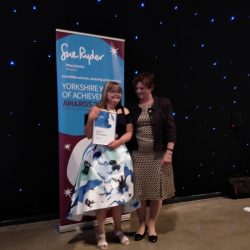
“But still, I managed to survive Beckfoot High School and get 8 GCSEs, an A-Level and a BTEC Diploma at Leeds City College. Which accidentally made my brother jealous because he only got 5 GCSEs. Oops! Sorry! I do love you! When I got to college, I wanted things to be different. So I did things I wasn’t proud of in order to impress them. All that did was get me in trouble. I got through three years at college getting two BTEC Diplomas.Katie collecting her award

“After college I got voluntary work and casual pay. I started working voluntarily at People First Keighley & Craven and at Down’s Syndrome Training & Support Service Ltd. I campaigned against injustice for people with a learning disability such as the Taxi Campaign. This is a campaign to stop taxi drivers making people in wheelchairs pay double because the clamping and seatbelts take up extra time.

“I tackled Disability Hate Crime which included creating awareness, doing presentations and sitting on different boards and panels such as the Hate Crime Scrutiny Panel, Hate Crime Third Advisory Group and the Hate Crime Action Group. I have also worked in crèches for babies and infants with Down’s Syndrome, a Youth Club for teenagers and young adults with Down’s Syndrome, as well as doing front of house, admin work, training courses and so much more. I was paid for this work, but it was casual pay, as and when I was needed.

Why did I want to work for NHS England?

“I have spent most of my life alternating between voluntary work and casual pay on minimum wage. This job has given me not only equal pay but also equal rights and equal responsibility. It has not only given me a purpose in life, but it has also made me see myself in a different perspective. I now have a responsible job as a Network Manager, which means people rely on me to be professional. I want to prove to myself that I can do this. And most importantly, I want to prove everyone who ever doubted me wrong. “This is real. This is me. I am exactly where I am supposed to be.”

“I did make a lot of mistakes in my previous jobs, but I did learn from them, and continue to do so. That did not stop some people from my previous work messing me about and stabbing me in the back. They did not even think about whether I needed any extra support to do my best in my work.

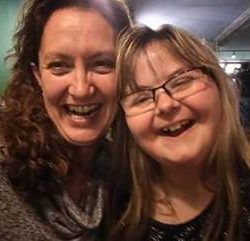
Katie with a colleague“However, I have this extra support in this job to help me to achieve my potential and I seriously don’t know how lucky I am. This is the best thing that has ever happened to me. I am going to do whatever it takes to stay here forever, and I will not let you down. That is a promise. I enjoy organising big events, giving big presentations in front of loads of people and interviewing the big CEOs of NHS England. But the main thing I enjoy about my job is the people I work with. We get on really well and I would like to think I have got friends for life. My department are so open and supportive, that you can get help and advice from everyone in the office.
What I do in my role:

“The Learning Disability and Autism Engagement Team acts as a bridge between NHS England’s decision makers and people with a learning disability, autism, or both, and their families and carers. Our team ensures that people get their voices heard and have their say about the health and care services that they use, and have equal rights too.

“The team is based in Leeds, but, we are a national organisation and we travel all around the country to make sure everywhere in England lets people with a learning disability, autism, or both, and their families and carers, have their say about the health and care services that they use.

“My role in the team is their Social Media Lead, where I find different ways to include people with a learning disability, autism, or both, and their families and carers in a way that is more inclusive to them. As part of being inclusive, our team holds various different events for our national forum, where everyone comes together to give feedback on the work NHS England does. I help organise, plan and facilitate these events, advertise it on our social media and sometimes even speak at them.

“I also have a similar role in the team’s Learning Disability and Autism Advisory Group made up of fifteen experts by experience who link with their various networks to help us engage with more people in inclusive ways.

What do you care most about?

“Honestly, what I care about the most, has to be my family. I have lost my grandma and my brother who I loved deeply, but that has made me stronger than ever. The bond that I have with my mum, and the fact that I have got this amazing job. This has kept me going!
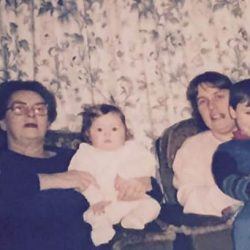
What I would like to do with my life?Katie as a baby

“I would like to have a contract in this job for as permanent as I can possibly get it, so I can have the best job ever with the most amazing people ever. I would like to, one day, get a promotion, if it ever comes up. But I don’t want to leave this company, and I definitely do not want to leave this amazing department. I want to organise more work nights out and socialise more, because I grew up without any friends and without a social life. I want to go on more holidays abroad, see the world and do new things with my mum. I know she’s getting on a bit and can’t do as much. But I can’t imagine doing it with anyone else. I just want the life I never had! I know that sounds selfish. I love my brother and I would do anything to bring him back. But we have finally got some freedom. We finally have a life!

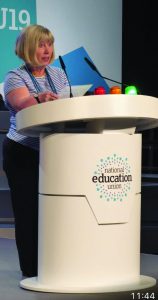
Colleen standing at a lectern delivering a speechIn January this year I took up my position as the new seat-holder for disabled members on the National Executive of the NEU. It was very important to me to build on the dynamism that resulted in me being elected. Thus quite early on I visited Lambeth district to talk about the effects of the funding crisis on our SEND pupils. It is good to see both parents and educators working closely together on this issue to highlight and challenge this dreadful situation. It is shocking to think that in 2019 we have schools saying they are not being given the funds to support SEND pupils and that pupils with SEND are six times more likely to be excluded from school than their peers!


More on SEND issues later – after meeting the new organiser for disabled members, it was decided under the spirit of ‘Nothing About Us Without Us’ to visit the proposed venue for our Disabled Members Conference 2019 and to do a full access audit with a group of disabled members and NEU staff. This felt like a much more inclusive process which should yield better results for members.

Since the beginning of the Spring term I have visited both Somerset and Southern Derbyshire NEU in order to talk to members about self-identifying as disabled to the NEU. It is important too I feel, that people really understand and use the social model of disability and realise that reasonable adjustments can and should be requested to help them at work. Our group needs to grow within the NEU as we must become a force to be reckoned with, not just an afterthought.

I have begun to think about what works for disabled members if we are to have a more diverse workforce. A meeting with both Mary Bousted and Kevin Courtney, Joint General Secretaries, provided lots to think about when armed with questions from members. A meeting with Nick Gibb MP is being sought so that disabled members can talk about being in school and what works or causes barriers for them. What pleases me most is to hear about collective action in relation to a disabled member, like recently at Connaught School for Girls in Waltham Forest where NEU members supported their colleague brilliantly under the direction of the school rep, or when I’m chatting to a district secretary who is very skilled at supporting disabled members so they remain at work and are not managed out of the profession with a settlement agreement.

NEU Annual Conference took place in Liverpool this year and it began almost instantly with a very positive and large disabled members’ reception. It was great to see how our new larger union included more activists who wanted to be out and proud as disabled people. Different officers and officials from the union dropped by to say thank you to the outgoing seat holder Mandy Hudson and to welcome me to the role.

During the conference the motion from the Disabled Teachers Conference was passed despite attempts to weaken it. The motion called for role sharing on the national executive for disabled members, those with caring responsibilities or parents. It also sought the creation of a new publication to welcome disabled members to our profession and to tell them about their rights. Finally, it requested improved training for those representing disabled members. It was a wide ranging, ambitious motion but it passed with a two thirds majority required to get a rule change in this situation.

In the Education SEND Section, Motion 23 Supporting Special Educational Needs and Disabilities passed including both its amendments. It includes setting up a forum so that staff working within special needs can feed back to the union promptly. It highlighted the need for Changing Places facilities and it sought to improve SEND training for new teachers. On several occasions, the motion referred to an inclusive model and an inclusive curriculum – much needed for all our children, I feel.

During the conference breakout time I attended a session about The National Education Service where several people spoke eloquently about the future of education under a Labour administration. As plans are still not laid down in detail Richard Rieser from World of Inclusion noted that there was considerable wiggle room to highlight the importance of inclusion. He believed that there was the possibility of a new curriculum coming along and that in coming years a truly inclusive education system could be developed. This system would be based on added value where the social development of youngsters was key as part of a child-centred approach. Families of schools would work together in order to educate all our children together. As for barriers, there should be an ombudsman to deal with complaints from parents and schools. But schools should be accessible as should the curriculum. It was great to listen to this vision, a world away from our current test-based curriculum that is so damaging to all our children.

Going forwards myself – well there’s lots to do…Disabled Workers TUC, the Northern NEU Equality Conference, improving our training to support our members better and the SEND Conference in Durham to attend. All this as well as being in school with the children, teaching. These are exciting times if we are determined and are clear about what we want to achieve.

ALLFIE is continuing to add resources to our website, and the latest is an article aimed at education students on some of the key issues around inclusive education. In “Current Debates: Part 1, Understanding Disability and the problem with ‘Special’”, Academic and ALLFIE trustee Dr Miro Griffiths MBE begins a three part series.

He introduces the social model of disability, and looks at how the language and practice of “special” needs casts Disabled learners as separate from the mainstream.

We’ll shortly be adding a guide on how to write an Education, Health and Care Plan (EHCP) from an inclusive perspective, so keep an eye on our resources page.

The Local Authority has a legal duty to ‘secure’ the special educational provision in your child’s Education Health and Care Plan (EHCP). In practice this usually means the local authority providing funding to your child’s school and the school using that money to arrange for the provision to be delivered.

If, as a consequence of the local authority’s funding cuts, your child’s provision is reduced or stopped then the legal remedy for addressing this issue is by way of judicial review. If successful, the court could order that such provision is arranged, and consequently, funded.

For a judicial review of this type to be successful the provision in Section F of the EHCP must be properly specified and quantified so that it is clear to the court what provision your child requires, such as how often they are to receive it, for how long and who is to provide it. If provision is vague, such as providing for “access to 1:1 support” rather than, for example, “20 hours of 1:1 support each week to be provided by an experienced Teaching Assistant”, this would make judicial review proceedings highly unlikely to be successful even if the child had received a certain amount of provision historically.

A judicial review would be brought against the local authority that maintains your child’s EHCP and not the school although they may be an interested party. It is important to act quickly as a judicial review must be brought as soon as possible and usually within three months of the act complained of, although when there is a failure to provide provision the timeframe usually continues to run as this is seen as an ongoing failure. The Court will nevertheless still require anyone who brings a claim for judicial review to do so quickly and without delay so it would be important for advice to be sought quickly. Legal aid is available for these types of actions based on the child’s means.

If the local authority wishes to change provision in a plan, the annual review would provide them with the opportunity to do this. Similarly, if you are concerned that your child’s provision is not sufficiently specified and quantified, your child’s annual review is a good opportunity for you to raise this and request amendments be made to the plan. Any amendments suggested (by either the parent, school or local authority) should be based on the child’s needs and not based on budget/financial resources.

Following an annual review, the local authority must issue a decision letter stating whether or not they intend to amend an EHCP and, if they do, what amendments they are making. This letter should set out a right of appeal to the Special Educational Needs and Disability Tribunal which allows a parent to challenge the contents of an EHCP and therefore ensure that the provision in the plan is properly specified and quantified. Any appeal should be lodged within 2 months of the date of this letter so it is important that parents act quickly if they have concerns.

Thomas Mitchell

Thomas is a solicitor with Simpson Millar and specialises in Education and Community Care law
www.simpsonmillar.co.uk

Inclusion Now 53 Summer 2019

Visit to West Lodge School in Harrow, lots of campaigning news including a report from the SEND Crisis march, an update on the Timpson report into school exclusions and much, much more.

Welcome to the 53rd edition of Inclusion Now. Audio and text versions are in the articles below or you can read it in magazine format on Issuu (not screenreader friendly).

To receive three issues of Inclusion Now a year on publication date, you can subscribe here. Subscribing supports our work and helps us plan for the future.

Inclusion Now is produced in collaboration with World of Inclusion and Inclusive Solutions


We’re working with the 38 Degrees campaigns website to increase the pressure. Let’s tell government clearly they must provide the support Disabled children need to thrive in mainstream.

Sign the petition here – and don’t forget to share it with friends and family too.


38 Degrees logo (reads "38 Degrees: people., power, change")


The deeply disturbing scenes witnessed yet again on BBC Panorama are another glimpse into the grotesque consequences  of segregating disabled people from ordinary life.

This relentless and systematic devaluation of disabled people can start at birth, when statutory services often accelerate disabled children (and this can happen in adult life too) into segregated “services” often under the guise of “care”.

Our schooling system continues this process of devaluation by labelling and isolating disabled children into segregated schools. Even when disabled children are located in mainstream schools they are routinely segregated in “special units” or in a “special” room, where apparently they can receive “special” teaching. Many parents know that they have no “choice” and have been left abandoned with limited legal redress. Segregation of disabled children leads to further segregation in adult life. Segregation of disabled people continues in employment, in health, in housing, in all aspects of relationships and living.https://pedantic-shannon.91-238-163-161.plesk.page/uncategorised/the-abuse-of-dis…-it-must-end-now/

By segregating disabled people “outside” of ordinary life, as was seen with the Panorama investigation, their families, their opportunities, their relationships, their aspirations, their contributions are all devalued. By creating segregated environments, irrespective of inspection regimes, disabled people will continue to be abused by the very “services” established to offer support. It is not only one or two individuals who carry out abuse, but the segregated institutional system that is fundamentally flawed. Governments the world over, have known this for decades.

Our schooling system has failed miserably to recognise the talents and skills of disabled children. We know inclusion works, we know disabled children do learn in a myriad of different ways with a wide range of meaningful supports, disabled children do make a rich diversity of contributions enhancing the learning environments of ALL participants.

To end segregation of disabled people now the government must end segregated institutional settings, remove their Reservation on Article 24 of the UNCRPD and assert the rights of all disabled people to be active members of their local, national and global communities.

The Alliance for Inclusive Education

Reclaiming Our Futures Alliance

Greater Manchester Coalition of Disabled People

Inclusion London

Current Debates: Part 1, Understanding Disability and the problem with “Special”

Academic and ALLFIE trustee Dr Miro Griffiths MBE begins a three part series for education students on some of the key issues around inclusive education.

Inclusive education is a complex issue, with considerable resistance emerging from political, economic, cultural, and social structures in society. There is substantial support for inclusive education with activists, scholars, policymakers, and public officials showing their commitment to developing, promoting, and implementing inclusive education practices. It is not possible to capture the entirety of the debate surrounding inclusive education; however, the aim here is to provide an overview of some of the central points. Please use this as an introduction, which, when combined with the list of suggested readings, provides you with substantial literature and points of reference to develop your own thinking on inclusive education.

Understanding Disability

The Disabled People’s Movement, which is closely aligned with the Inclusive Education Movement, challenges the traditional approach to understanding disability as a problem associated with the individual. The individualistic, and overtly medicalised, narrative proposes that a disabled person is marginalised and excluded on the basis of their body, impairment, health condition, and/or medical label. Activists and Disability Studies scholars have challenged this perspective by introducing the social model of disability. According to Barnes and Oliver (2010, p. 548), the social model places emphasis on “how far, and in what ways, society restricts [disabled people’s] opportunities to participate in mainstream economic and social activities rendering them more or less dependent”.

This perspective is important within the context of education, as it challenges the policy making process that promotes disability in medical terms. If such policy is not challenged then it reinforces service provision that is rooted in exclusion and institutionalisation. For this reason, disability becomes an inherently political issue. Concerns about power and politics lead to substantial questions with regard to how disabled people are positioned within society, how disabled people are supported within the community, and how the barriers encountered by the disabled people are addressed?

Barton (1988, p. 5) highlights the significance of politics within education policy, as it “is particularly applicable to those who would seek to raise the question of politics in relation to special education policy or practice. To do so is to raise doubts about the nature of your commitment and whether you have the proper interests of individuals with learning difficulties in view”.

Current education policy fails to engage with the significance of disability politics and, as a result, fails to capture the significance of inclusive education. Continuing with Barton (1998, p. 60), he provides a clear and concise approach to developing inclusive education by insisting “[it] is about the education of all children which necessitates serious changes, both in terms of society and its economic, social conditions and relations and in the schools of which they are part”.

With current policy far removed from implementing this approach within the current education systems, it comes as little surprise that questions remain as to whether disabled learners should be excluded from schools and placed in “special educational schools”. The failure of policy to engage with the politics of disability has led to debates prioritising the location of children labelled as having “special educational needs”. This comes at the expense of those who would rather design an education system that takes account of disabled people’s exclusion on the basis of how society is organised. 

The Problem with Special

The extensive labelling of disabled learners as having “special educational needs” is problematic. By adopting such labels, educational institutions and professionals associated with supporting disabled learners create the conditions in which disabled people are considered separate from those who conform and reflect normative values and practices. This process of othering is referenced extensively within the literature (Kumashiro 2000). There is little to be gained by referring to disabled people’s access requirements as “special”; furthermore, by positioning disabled people as different it reinforces a narrative to suggest there is a normal, expected way to behave, act, and exist within the education system. This means the barriers preventing disabled people from accessing education will lead to strategies and agendas that reinforce segregated initiatives.

Under the guise of “special” there is the potential to identify those that are considered imperfect, unruly, or disruptive to the functioning and operations of mainstream education systems. As Campbell (2009) suggests, disabled people who resist assimilating into normative practices and conformist expectations are subjected to diagnostic tools – typically as a way to justify their exclusion. This justification has led to calls that there is inclusive education bias within the UK (Runswick-Cole 2011), an argument that appears to be upheld by those across the political spectrum considering that little action has been taken to counter the argument. Within disabled people’s activism and Disability Studies, there has been notable resistance to this perspective. Warnock (2005) and Runswick-Cole (2011) draw attention to the persistent exclusionary approaches within the education system. This serves to undermine the argument that there is a bias towards inclusion but also draws attention to how disabled learners are problematised within the education system. If people are deemed “special” then they can also be deemed a problem.

As a final point on this, it is worthwhile considering the work of Beckett (2014) and Beckett and Buckner (2012). In their pursuit of exploring non-disabled children’s ideas about disability, they illustrate how disabled people are viewed as broken, faulty, problematic and undesirable. It also led to claims that disabled people are incompetent. Whilst the research makes no explicit reference to the impact of labelling disabled learners as having “special educational needs”, it is not surprising non-disabled children hold such views. Having an education system that challenges the idea of inclusion, and the provision of a separate system for those unable to conform to the expectations of the mainstream system, will undoubtedly lead to questions over the competency and value of disabled people.

Beckett and Buckner (2012) go on to suggest it is essential that an anti-disablist education is necessary if a fair, accessible, inclusive society is to be realised. Envisaging an anti-disablist education requires scrutiny of how all children are supported to learn and acquire knowledge; this, therefore, means challenging the label that some people are special.


This completes Part One of a three-part series on packing the current debates within inclusive education. Part Two explores support provision for disabled learners and considers the importance of international human rights in addressing barriers to inclusive education.


Barton, L. (1998) Sociology, disability studies and education. In The disability reader: Social science perspectives, ed. T. Shakespeare, 53-65. London: Cassell

Barton, L., ed. (1988) The politics of special educational needs. Lewes: Falmer

Beckett, A. (2014) Non-disabled children’s ideas about disability and disabled people, British Journal of Sociology of Education, 35:6, 856-875

Beckett, A. and Buckner, L. (2012) Promoting positive attitudes towards disabled people: definition of, rationale and prospects for anti-disablist education, British Journal of Sociology of Education, 33:6, 873-891

Campbell, F. K. (2009) Contours of Ableism. Basingstoke: Palgrave Macmillan

Kumashiro, K.K. (2000) Toward a theory of anti-oppressive education, Review of Educational Research, 70:1, 25-53

Oliver, M. and Barnes, C. (2010) Disability studies, disabled people and the struggle for inclusion, British Journal of Sociology of Education, 31:5, 547-560.

Runswick-Cole, K. (2011) Time to end the bias towards inclusive education?, British Journal of Special Education, 38:3, 112-119

Warnock, M. (2005) Special Education: a new look. London: Philosophy of Education Society of Great Britain


Supported by

ALLFIE’s campaign for Inclusive Education as a human right is backed by funders and donors who reject the systemic segregation of Disabled people from society.