Please ensure Javascript is enabled for purposes of website accessibility Skip to main content

What is Section 3?

If someone is detained in accordance with Section 3 of the Mental Health Act, this allows for the detention of the person for treatment in a hospital against their wishes.

Under 16

If the young person is under the age of 16, the Local Authority (LA) continues to have a very clear legal duty to provide suitable full time education. If it is inappropriate for this to be provided in a school then alternative arrangements must be made. This could include the provision of tutors in the ATU (Assessment and Treatment Unit) for example. It should not be the case that education simply ceases because a young person is detained under S3 Mental Health Act. The Mental Health Act Code of Practice states:

“Children and young people admitted to hospital under the Act should have access to education that is on a par with that of mainstream provision, including appropriate support for those with SEN. Practitioners and local authorities should work together to minimise any disruption to education, and in order to ensure that local authorities can meet their duty to provide suitable education, when a child or young person is admitted under the Act, they should be notified as soon as possible, ideally in advance of the placement…”

Over 16

The duty to provide suitable full time education set out above only applies to those below compulsory school age (up to the end of Year 11). This does not mean there are no duties towards those over 16 but these duties do differ and there are stronger protections in place for those over 16 if they have an Education, Health and Care Plan (EHCP). If they do not have an EHCP and are over 16, LAs still have a duty to promote effective participation in education for 16 and 17 year olds including those under section.

EHCP

If a child or young person has an EHCP, the Mental Health Act Code of Practice is clear that:

“the local authority who maintains the plan should be informed, so that they can ensure that educational support continues to be provided. If necessary, the plan may be reviewed and amended to ensure targets and provisions remain appropriate. The local authority should also be involved in creating the discharge plan…”

Summary

It may not be possible for your daughter to continue to attend her mainstream school as it is the decision of the Responsible Clinician as to whether she is allowed supervised leave which may enable her to attend and this would depend on her mental health and the nature and extent of her difficulties. If it is not possible then alternative education must be provided. If she is under 16 then this must be full time as long as this is in her interests. The professionals involved in your daughter’s care should work cooperatively with you and the LA to ensure her needs are met. Your daughter also has the right to challenge her section to the Mental Health Tribunal.

Sarah Woosey

Sarah is a solicitor and partner at Simpson Millar www.simpsonmillar.co.uk

Education Inclusion Toolkit

back up trust logo


Current Debates: Part 2

Exploring support provision for disabled learners and the importance of international human rights in addressing barriers to inclusive education. Academic and ALLFIE trustee Dr Miro Griffiths MBE continues his three part series for education students on some of the key issues around inclusive education.

Inclusive education is a complex issue, with considerable resistance emerging from political, economic, cultural, and social structures in society. There is substantial support for inclusive education with activists, scholars, policymakers, and public officials showing their commitment to developing, promoting, and implementing inclusive education practices. It is not possible to capture the entirety of the debate; however, the aim here is to provide an overview of some of the central points. Please use this as an introduction, which, when combined with the list of suggested readings, provides you with substantial literature and points of reference to develop your own thinking.

Click here for part one of this series.

Support Provision for Disabled Learners

Support for disabled learners must be contextualised within the existing neoliberal agendas that plague the education system. Currently, education systems prioritise economic viability (Hazelkorn 2015), and competition is rife between learners as they attempt to achieve the highest grades (Verhaeghe 2014). This is deeply problematic for disabled people, as their inclusion within the education system (and the extent to which support is provided) is determined by how valuable the disabled learner is to the existing social structures within society. As Ball (2013, p.48) argues, “the school became in many respects an expression of humanity and a demarcation of the limits of humanity – who was and was not educable, of value, worth investing in”.

Slee (2019) provides a comprehensive analysis of how attempts to develop inclusive education are often undermined by an era that prioritises the exclusion of disabled learners. Support that should be available for learners is denied because educational institutions construct a system that holds the individual responsible for their participation within the classroom environment. To get support, the learner has to accept diagnostic tests and professional intervention (Harwood and Allan 2016). Support is provided on the basis that the student is unable to conform to the expectations of the existing education system, and that the purpose of support is to address the “additional” (otherwise understood as physical and cognitive) needs of the individual. This is significant because support is, thus, framed as a response to the student’s failure to conform to the existing practices of the educational institution. The provision of support becomes rooted in individual competency, rather than acknowledging that support forms part of a wider assessment to reorganise education and take account of the diversity within human existence and participation.

The extensive barriers encountered by disabled learners are well documented (Kendall 2016). It is argued that this will be further impacted by the onslaught of continued cuts to (local) government services, including education services (O’Hara 2014). In the assessment of barriers to accessing education, thought should be given to the mechanisms for examining and determining support levels for disabled learners. Literature highlights how the assessment procedures focus on performing specific tasks and an examination of medical conditions (Fuller, Bradley and Healey 2004). Again, this emphasises how the individual’s access to support is to participate in an education system that is designed by non-disabled people, for non-disabled learners. Nussbaum (2006, p.98) articulated it best, “[disabled people] remain an afterthought, after the basic institutions of society are already designed”.

Importance of International Human Rights

Disabled people’s rights to education are well documented under international law (read the United Nations Convention on the Rights of Persons with Disabilities, in particular: Article 24). The United Nations Committee on the Rights of Persons with Disabilities has produced policy documentation for States to implement that would realise inclusive education (United Nations 2016). However, it is not uncommon for States to sign – possibly ratify – the convention but fail to deliver an inclusive education system. This draws attention to the disparity between what is articulated in human rights treaties and declarations, and what is implemented through policy-making. De Beco (2018) argues that it is possible to transition the ideas of inclusive education into practice but to do so requires a critique of political philosophy and the effect this has on key debates emanating from disability studies literature on inclusive education.

Whilst literature on inclusive education, and the sociology of disability more widely, is typically dominated by majority world scholars, literature from the global South draws attention to the persistent ambivalence towards developing inclusive education systems. Ngwena (2017), through his empirical research, illustrates a double discourse surrounding inclusive education. On the one hand, governments will attempt to show domestic commitment towards implementing the inclusive education approach, often through political rhetoric. This, however, leads to no real change because extensive policy practice continues with an exclusionary approach to disabled people accessing education.

Tools have been developed to understand how states are developing policy to realise the obligations outlined in international human rights frameworks. Priestley and Lawson (2015) introduced an online tool to map and analyse existing disability policies across Europe. This provides opportunities to critique and evaluate the progress made to design, develop, and implement inclusive practices throughout different areas of social policy – including education.

For inclusive education to become a reality, there is a need to consider how international human rights frameworks provide a conceptual basis to instigate a change in policy direction. A direction that moves away from exclusionary and isolating practices, and one that positions education as a matter of social justice. Disabled people, most notably children and young people, must be regarded as active voices in the policy-making process and should form part of the networks that influence the delivery and evaluation of education policy. Analysis of human rights legislation to realise inclusive education should not be at the expense of scrutinising social policy.


This completes Part Two of a three-part series on unpacking the current debates within inclusive education. Part Three will explore key arguments surrounding the purpose of education and the ways in which existing, exclusionary education systems can be resisted.


References

Ball, S. J. (2013) Foucault, Power, and Education. New York: Routledge.

de Beco, G. (2018) The right to inclusive education: why is there so much opposition to its implementation?. International Journal of Law in Context. 14(3), 396-415.

Fuller, M., Bradley, A. and Healey, M. (2004) “Incorporating Disabled Students within an Inclusive Higher Education Environment.” Disability and Society. 19(5), 455-468.

Harwood, V. and Allan, J. (2014) Psychopathology at School: Theorizing Mental Disorders in Education. Abingdon: Routledge.

Hazelkorn, E. (2015) Rankings and the Reshaping of Higher Education: The Battle for World-class Excellence. Basingstoke: Palgrave MacMillan.

Kendall, L. (2016) “Higher Education and Disability: Exploring Student Experiences.” Cogent Education. 3(1), 1-12.

Ngwena, C. G. (2013) Human Right to Inclusive Education: Exploring a Double Discourse of Inclusive Education Using South Africa as a Case Study. Netherlands Quarterly of Human Rights. 31(4), 473-504.

Nussbaum, M. C. (2006) Frontiers of Justice: Disability, Nationality, Species Membership. Cambridge: Harvard University Press.

O’Hara, M. (2014) Austerity bites: a journey to the sharp end of cuts in the UK. Bristol: Policy Press.

Priestley, M. and Lawson, A. (2015) Mapping disability policies in Europe: Introducing the disability online tool of the commission (DOTCOM). ALTER – European Journal of Disability Research. 9(1), 75-78.

Slee, R. (2019) Belonging in an age of exclusion. International Journal of inclusive Education. 23(9), 909-922.

United Nations. (2016) General Comment No 4 – Article 24: Right to inclusive education. Geneva: United Nations.

Verhaeghe, P (2014) What About Me? The Struggle for Identity in a Market-Based Society. Translated by J. Headley-Prôle. London: Scribe.


Community Fund logoThe Alliance for Inclusive Education is celebrating after being awarded National Lottery funding to put people with lived experience in the lead in looking at how disabled community leaders can create change for Disabled people and combat discrimiation.
The new grant from the UK’s biggest funder of community activity will bring together the Disabled young people from the RIPSTARS project with a group of disability rights leaders to share intergenerational experiences of what makes a good leader, what the barriers are for Disabled people and what Disabled people have done to challenge disablism and discrimination and create change.

Michelle Daley, ALLFIE’s Chief Executive said:

“We were incredibly impressed with how these young people went about their research on the RIPSTARS project and stated their case for disability rights loudly and clearly. We’re very excited to see what comes out of the Being Seen: Being Heard project, which will bring them together with older people who have been campaigning for years or even decades.”

The grant is part of The National Lottery Community Fund’s £800,000 Lived Experience Leaders Pilot Programme, an initiative which aims to better embed ‘experts by experience’ in all aspects of an organisation’s operations – and enable the Fund and the wider sector to continue testing and learning about how people with first-hand experience can become leaders and how funders can support them.

Joe Ferns, UK Knowledge and Portfolio Director at The National Lottery Community Fund said:

“Thanks to National Lottery players, people with lived experience will use their unique expertise to lead social change and help their communities to thrive. We know that supporting those with first-hand experience to become leaders is a key enabler for civil society to do more, help more people and for our sector to have a greater impact.”

This pilot programme, which was developed through workshops across the UK involving more than 70 lived experience leaders, is a core part of The National Lottery Community Fund’s ‘people in the lead’ strategy.

Today’s announcement is also a key part of The National Lottery Community Fund’s commitment to enabling civil society to be fit for the future – helping organisations and the social sector create opportunities for people with first-hand experience to be at the forefront of decision making.

To find out more visit www.TNLCommunityFund.org.uk

-ends-

For more information please contact us.

Notes to Editors:

About The National Lottery Community Fund

We are the largest funder of community activity in the UK – we’re proud to award money raised by National Lottery players to communities across England, Scotland, Wales and Northern Ireland. Since June 2004, we have made over 200,000 grants and awarded over £9 billion to projects that have benefited millions of people.

We are passionate about funding great ideas that matter to communities and make a difference to people’s lives. At the heart of everything we do is the belief that when people are in the lead, communities thrive. Thanks to the support of National Lottery players, our funding is open to everyone. We’re privileged to be able to work with the smallest of local groups right up to UK-wide charities, enabling people and communities to bring their ambitions to life.

WebsiteTwitterFacebookInstagram

About The Alliance for Inclusive Education

ALLFIE is a unique voice. Formed in 1990, we are the only organisation led by Disabled people focused on campaigning and information-sharing on education, training and apprenticeship issues. We campaign for the right of all Disabled pupils and students to be fully included in mainstream education, training and apprenticeships with all necessary supports. ALLFIE believes that inclusive education is the basis of lifelong equality. Children who learn and play together will grow into adults who can understand and respect each other’s differences.

WebsiteTwitterFacebook

Ofsted logo stating "Ofsted, raising standards, improving lives"Last month, ALLFIE submitted a response to an Ofsted consultation centred around changes to Ofsted’s inspection framework, including the substance and quality of education, the curriculum and pupils’ personal development.
  1. To what extent do you agree or disagree with the proposal to introduce a ‘quality of education’ judgement?

Ofsted proposes to holistically examine the quality of education and explore the substance of the curriculum. ALLFIE immediately noticed that the first question failed to inspect inclusive education. Whilst ALLFIE welcomes Ofsted’s perspective on curriculum flexibility, we were surprised that they failed to mention how they were planning to make the curriculum more accessible and inclusive for Disabled pupils. The question also overly focuses on academic subjects and disregards preparing young people for life in the community, or preparing schools to be inclusive.

ALLFIE also wants the quality of education to mean that Disabled pupils are not on segregated courses in mainstream educational settings; this is integration, not inclusion. The consultation also mentions inspecting leadership; in ALLFIE’s view, if Disabled students are in segregated lessons, judging good leadership should be part of the criteria.

  1. To what extent do you agree or disagree with the proposed separation of inspection judgements about learners’ personal development and learners’ behaviour and attitudes?

Ofsted wants to judge pupils’ personal development separately from their behaviour and attitudes. ALLFIE believes that behaviour policies are used to segregate Disabled pupils within mainstream schools. During the House of Commons Education Select Committee enquiry, the legality of zero-tolerance behaviour policies was questioned. Under the Equality Act 2010, schools must make reasonable adjustments for pupils. ALLFIE states that by judging pupils’ behaviours and attitudes, schools may not want to accommodate pupils with challenging behaviour, fearing that this will discourage Ofsted from giving them a “Good” or “Outstanding” rating. ALLFIE instead wants Ofsted to focus on pupils’ wellbeing.

Seven Sisters Primary School, for example, has a positive relationships policy and not a behaviour policy, and is an excellent example of focusing on pupils’ wellbeing. Art therapy and PE are used to develop cooperation skills among pupils, and quiet rooms are available. Furthermore, pupils can take part in activities such as mindfulness. ALLFIE was pleased to discover that Ofsted wants to include off-rolling and attendance data as part of their grading criteria. However, solicitors have questioned attendance awards; Disabled pupils may need time off due to medical conditions, placing them at a disadvantage, particularly if their attendance is used as part of Ofsted’s grading process.

Similarly, ALLFIE wants Ofsted to clearly define inclusive education and inclusive practices. In ALLFIE’s experience, schools often falsely claim they are inclusive. For example, there are no guidelines for teaching a fully inclusive curriculum. Consequently, ALLFIE recommends that Ofsted use our definition of inclusive education.

  1. To what extent do you agree or disagree that the proposal to reduce the types of provision we grade and specifically report on will make our inspection reports more coherent and inclusive?

Fortunately, Ofsted will now adequately represent SEND provision within their report. Instead of separating 16 plus provision into various categories, they will now have three: education programmes for young people, apprenticeships and adult learning programmes.

ALLFIE is concerned that Disabled pupils in mainstream education are being segregated aged 16 plus. In 2016, ALLFIE found that the majority of 16 plus students in mainstream education with learning difficulties were on segregated courses; this is not inclusive practice, despite it being part of Ofsted’s criteria for judging good leadership. ALLFIE also wants Ofsted to check whether schools use inclusive assessments for Disabled pupils, as well as allowing schools to find ways of capturing the achievements of pupils who cannot participate in formal assessments. We understand that GCSEs, SATs and phonics measure students’ progress, but they may not accurately capture Disabled pupils’ development.

I believe that even though Ofsted says that it wants to inspect the quality of education, to do this when they have not clearly defined inclusion would be difficult. If Ofsted fails to release guidance on inclusion, Disabled pupils will remain disadvantaged.

Similarly, Ofsted needs to understand that many Disabled pupils that exhibit challenging behaviour are doing so because of unmet needs. Ofsted should examine teachers’ response to such pupils and whether this could further exacerbate these behaviours. If Ofsted wants to ensure that such pupils are included, they need to inspect other aspects of behaviour, not just reward and punishment.

Until Ofsted addresses school practices that disadvantage Disabled pupils, it is difficult to know whether the new Ofsted framework will achieve its goal. Ofsted must clearly define inclusive education; making inclusive education the main focus of their inspection criteria will help not only Disabled pupils but all pupils.

Yewande Akintelu-Omoniyi

ALLFIE Volunteer

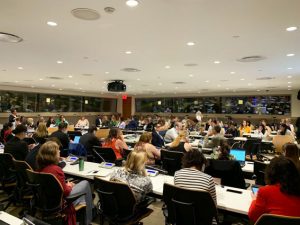
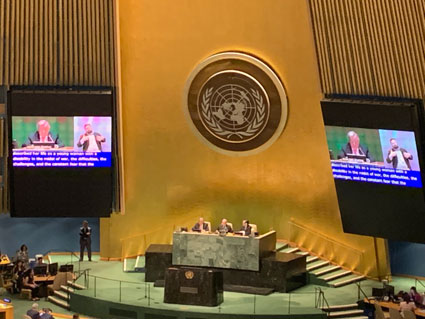
UN conference hall with stage and large television screens

The Conference of States Parties (COSP) was held at the United Nations Headquarters in New York over 10 – 13 June. This was the 12th session and its focus was on the UN Convention on the Rights of Persons with Disabilities (UNCRPD). I attended as part of the Reclaiming Our Futures Alliance (ROFA) delegation, of which ALLFIE is a member. ROFA delegates were fresh from the UK Disability and International Development and Cooperation event, which proved to be an ideal launchpad for this.

The first day of the conference was the Civil Society Forum, hosted by International Disability Alliance (IDA). This provided a platform for DPOs to share and discuss their experiences. The forum felt very positive, with some clear messages about the future of DPOs:

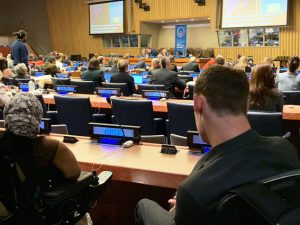
Michelle Daley and ALLFIE trustee Anthony Ford-Shubrook from behind, seated at the conference. Rows of desks and seats are in front of them.

Wheelchair users denied access to the opening of the COSP

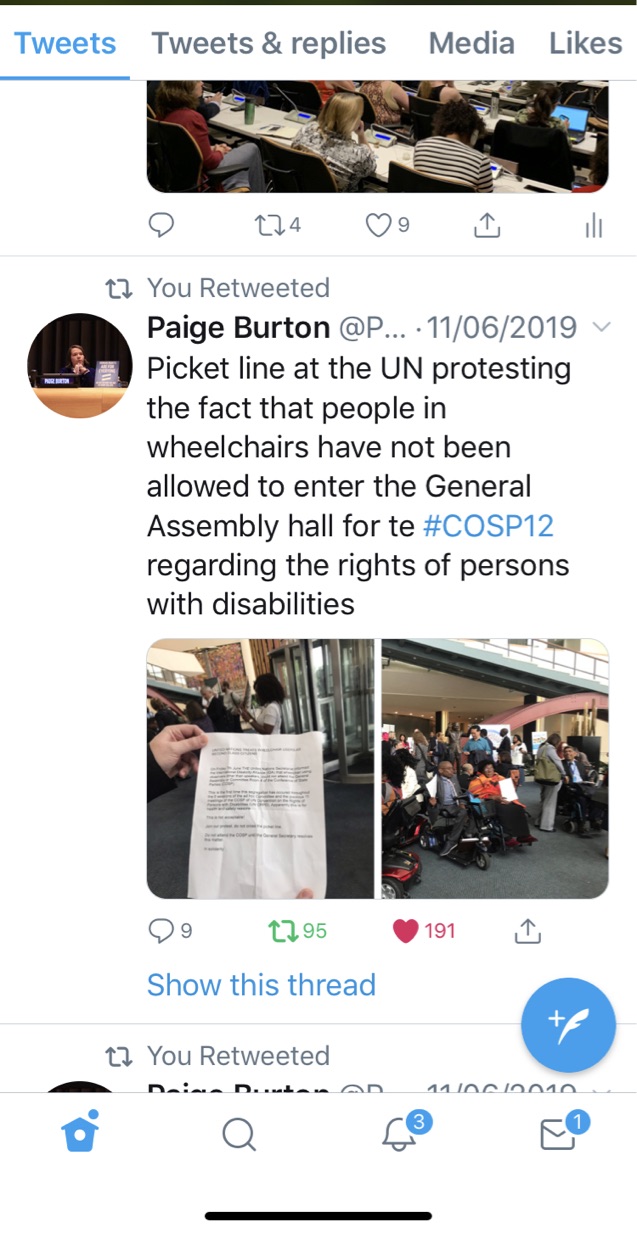
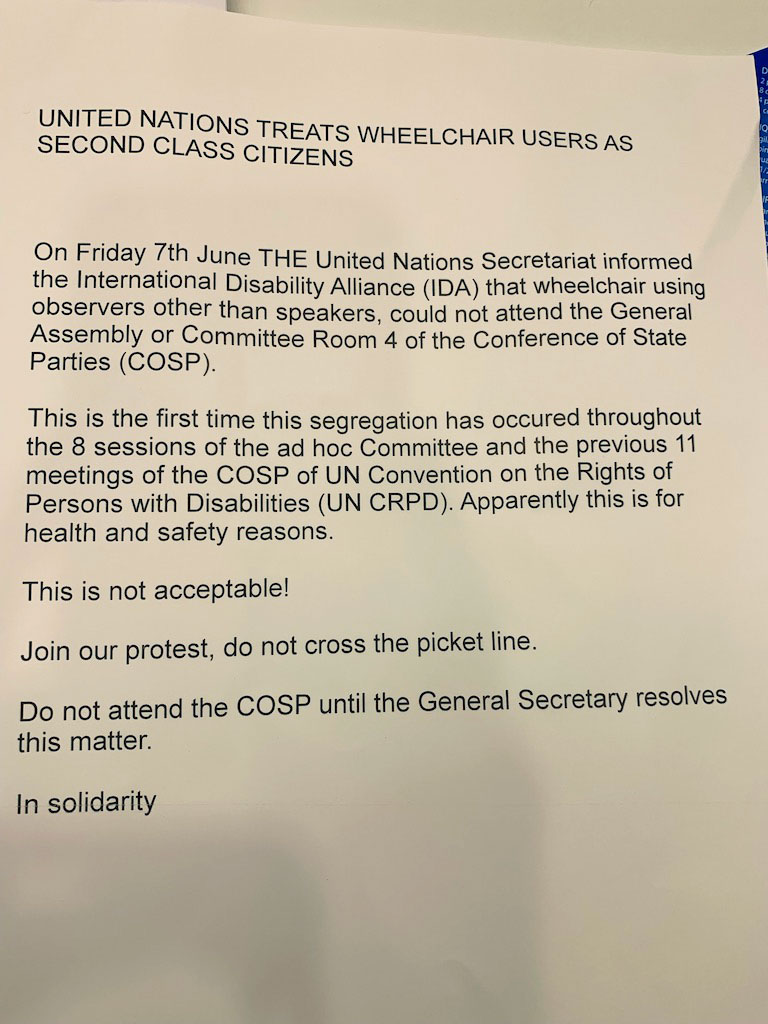
Petition letter. The letter reads: "United Nations TREATS WHEELCHAIR USERS AS SECOND CLASS CITIZENS On Friday 7th June THE United Nations Secretariat informed the International Disability Alliance (IDA) that wheelchair using observers other than speakers, could not attend the General Assembly or Committee Room 4 of the Conference of State Parties (COSP). This is the first time this segregation has occurred throughout the 8 sessions of the ad hoc Committee and the previous 11 Persons with Disabilities (UN CRPD). Apparently this is for health and safety reasons. This is not acceptable! Do not attend the COSP until the General Secretary resolves this matter. In solidarity."In the closing remarks of the Civil Society Forum delegates were informed that it had been decided that wheelchair users would be denied access to the opening of the COSP in the General Assembly and level four of the seating area because of seating arrangements and health and safety. To add further insult, wheelchair users were told that we could watch the opening from a screen.

As you can imagine this announcement was not positively received and was slated as the highest level of hypocrisy by the UN.

Immediately the mood changed. Disabled people swiftly mobilised, a petition was written and circulated and protest organised. The following morning the protest went into action. Disabled people gathered in the reception area of the UN headquarters to speak out. Adding to the UN’s embarrassment the protest was shared on social media.

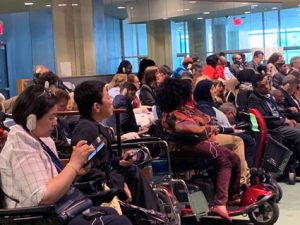
Tweet from Paige Burton: "Picket line at the UN protesting the fact that people in wheelchairs have not been allowed to enter the General Assembly hall for te #COSP12 regarding the rights of persons with disabilities"Through mobilisation and solidarity we as Disabled people disrupted the COSP and embarrassed the UN for their discriminatory practice in denying wheelchair users attendance at one of the most significant meetings about our lives. It was crucial that we showed the UN this was unacceptable behaviour and demonstrated double standards. The mantra of “Nothing About Us Without Us” was really put into action here and we saw the power and fearlessness of Disabled people in pushing for inclusion and human rights. This protest sent a clear message throughout the COSP but also to the rest of the world that it is not acceptable to segregate us, and that implementing decisions that discriminate against us is not just wrong but inhuman.A large group of wheelchair users

The conference – discussion on implementation of UNCRPD

The COSP was made up of both conference and side events on aspects of implementing the UNCRPD. It was designed to give people the chance to learn and focus on different areas of personal interest.

Over the four days I attended a range of side events on education, independent living, technology, representation & intersectionality, young people and unified voice. I also attended the relaunch of the Commonwealth Disabled People’s Forum which was held on the closing day of the COSP. The Forum will address issues around representation, reparations and colonialism.

Richard Rieser of World of Inclusion talking to another delegate

Coming out of the conference were some important messages relevant to ROFA:

Delegates at a side event

The lack of representation of Disabled young people under 20 was disappointing, reflecting the above point about the need to nurture Disabled young people as our next leaders. There was further poor representation from people with learning difficulties. Representation is something that we know all countries struggle with but those such as Australia, Britain, Canada, New Zealand and European nations need to be held to account with the same emphasis as others, particularly on race.

Domestically DPOs will welcome the conference’s message that DPOs must be the drivers for implementation of the UNCRPD as this is the only way we will achieve our human rights and full inclusion.

Some delegates at a side event

Many countries but one message

It became apparent from the global presence of Disabled people – which we are not usually accustomed to – that there is something beautiful and unique about the UNCRPD. It is an international instrument based on universal rights, it provides a common interest based on the social model of disability and it recognises the intersectionality of Disabled people.

The COSP is a very different platform from other meetings. It is about the ambition to fulfil the UNCRPD and the understanding that do so requires shared learning and knowledge at a global level. It certainly reinforced the importance of representing the UK Disabled people’s movement internationally and joining our Disabled sisters and brothers in political and legal campaign work for our human rights. The universality of our experiences and the need for solidarity were perfectly articulated by the newly appointed Chairwoman of the Commonwealth Disabled People’s Forum Rachel Kachaje from Malawi who commented that no matter where we live in the world Disabled people share the same experiences.

In solidarity!

Michelle Daley

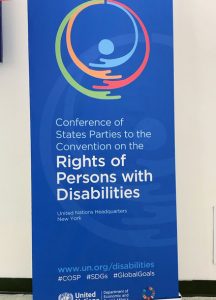
Rollup banner with the name of the event

Over 65,000 people have supported the Alliance for Inclusive Education (ALLFIE)’s 38 Degrees campaign ‘Don’t shut disabled people out of mainstream education’. Petitioners are calling on the Secretary of State for Education Damian Hinds and the Chancellor of the Exchequer Philip Hammond to increase funding for SEND support.

“Cuts to education budget are stripping disabled pupils of their right to be educated alongside their non disabled peers in local mainstream schools, denying them the same opportunities”, says Simone Aspis, ALLFIE’s Policy and Campaigns Coordinator.

The petition coincides this week with a ground-breaking legal case highlighting the plight of families whose disabled children are being excluded.

On 26 and 27 June the Secretary of State for Education and the Chancellor of the Exchequer will face charges that their cuts to education budgets have caused unlawful disability-related discrimination and breached disabled pupils’ human rights.

The case follows successful campaigning by ALLFIE and the findings of the UN Monitoring Committee in 2017 that the cuts to special education violated disabled pupils’ human rights set out in Article 24 of the United Nations Convention on the Rights of Persons with Disabilities (UNCRPD).

Mainstream schools are facing the brunt of the education cuts. The National Association of Head Teachers survey (2018) reported that 73% of mainstream schools found it harder to resource support for teaching assistants and pastoral staff for disabled pupils. Half of the respondents said that overall local authority top-up funding levels had decreased over the previous 12 months, showing a rapid deterioration in the ability of schools to support children with high levels of need.

Schools’ concern about this deterioration is echoed by the Local Government Association:

“… if councils do not receive sufficient funding to cover high cost SEND, they will not have the resources to allocate extra funds to highly inclusive schools… Equally, mainstream schools may find it difficult to accept or keep pupils with SEND because they cannot afford to subsidise the provision from their own budgets”  (LGA 2019).

Increasing school exclusions, off-rolling and inadequate SEND provision in mainstream schools as a result of cuts has led to a spike in unlawful disability-related discrimination practices often leaving pupils without a school placement. More children with special needs are now being educated outside of mainstream schools for the first time ever. Latest school census figures show that the majority – just over 50 per cent – of the 277,991 children and young people with Education, Health and Care Plans (EHCPs)/SEN statements in compulsory school education were placed in segregated education in 2019.

“We want the judge to set out clearly that the Government has a duty to develop a fully inclusive education system where disabled pupils and students’ rights are upheld”, say Simone.

People can support the 38 Degrees campaign created by ALLFIE here.


For editors

ALLFIE will be attending the court case and be available for interview on both days, 26th and 27th June 2019.

Simone Aspis’s contact details are on 07856 -213-837

Email address simone.aspis@allfie.org.uk


UN Committee on the Rights of Persons with Disabilities. Concluding observations on the initial report of the United Kingdom of Great Britain and Northern Ireland

Local Government Association Briefing House of Commons Debate: Special educational needs and disabilities funding House of Commons 12 February 2019

Empty Promises The Crisis In Supporting Children with SEN

Department for Education Statements of SEN and EHC plans: England, 2019

You can listen online below, or if you want to download the audio files, right click each article and choose “Save Link As”.


We recently wrote about the background to this case and this week we went along to add our voice to those protesting at the betrayal of disabled children’s human rights. We are waiting to hear the judgement but meanwhile we’d like to say a huge THANK YOU to the families for taking this case on behalf of disabled children all over the country and to SEND Action for the massive amount of hard work they have put in. We look forward to working together in future.

As supporters assembled outside the court, campaigners spoke about the issues:

ALLFIE’s Simone Aspis:

ALLFIE’s Interim Director, Michelle Daley:

Simone, Kevin Courtney from the National Education Union and one of the parent campaigners involved, Lorraine Heugh:

Visit to West Lodge Primary School

World of Inclusion went to visit the primary school, one of three in Harrow with resourced provision for children on the autistic spectrum.

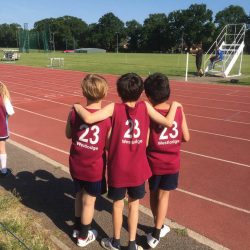
Three small boys with their arms round each other on an athletics track, backs to the camera     West Lodge Primary School in Pinner in the Borough of Harrow is an inclusive, diverse and high achieving school. Set in spacious grounds, this is a three form entry school with 648 children from reception to Year 6. 5.9% of pupils receive free school meals indicating that the school is in an area of low deprivation. The school has gained a reputation for being inclusive and has worked hard to develop a culture which is attachment aware and trauma informed. The school has a large number of pupils who are adopted from care – in fact the highest within the local authority – and has 34 pupils with an EHCP, 3.25 times the national average for a mainstream primary school, with a further 46 on SEND support. The school is one of three primary schools in Harrow with resourced provision for children on the autistic spectrum. Kaleidoscope has eighteen places, all for children with EHC Plans, and has been custom built with three low distraction classrooms, its own play area, a soft play room, a sensory room, a life skills room and a therapy room. The central corridor doubles as a sensory circuit.small boy in ballpit, wearing school uniform
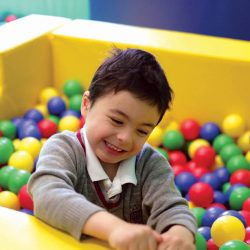
As Headteacher Jim Dees explained, the vision of the school is that each child finds the spark within them, which continues to grow, igniting the spark in others – but crucially this must all start with understanding and acceptance. The whole school is on a continuous learning journey with a rich and broad curriculum adapted to meet all learners. Pupils are encouraged to be autonomous learners and guided to making choices that ensure they are challenged. In 2009 the school was formed by the merger of a first and middle school. Set in spacious grounds they have a number of additional spaces that can be used for a variety of interventions covering social skills, play therapy, counselling and targeted intervention linked to specific subjects. The school also has a music, art and technology room.

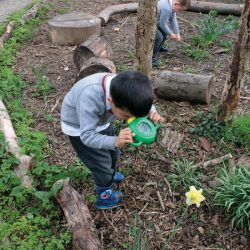
Jim small boy in garden looking at a daffodildid his initial teacher training in the London Borough of Newham, with placements at Selwyn Primary School in Plaistow and Scott Wilkie Primary School in Custom House where the inclusive approach rubbed off. Jayne Grant who featured in our last issue was SENCO here until last July and was a strong advocate of inclusive practice. The school has a positive reputation for working successfully with SEND pupils. As with all schools the SEND provision is threatened by budget reductions. These were due to come in last month and were successfully fought off by the school, but a reduction of approximately £80,000 in the funding for pupils with an EHCP is due to come into force in April 2020 due to changes introduced as part of the National Funding Formula. Under the formula, schools will receive a notional amount for SEND pupils based on deprivation indicators rather than actually following the specific needs of individual pupils. This will provide a huge challenge for the school.
Jim was keen to point out that Kaleidoscope was not a unit but a flexible resource base where each child has a personalised timetable. The children with the most complex needs spend a high percentage of their day within Kaleidoscope, with a few children spending all day, but most were on a timetable where they spend varying amounts of time in their mainstream classes. All the Kaleidoscope children are on the register of a mainstream class, starting their day there. A lot of work is done across the school on building relationships with buddies, playground PALs and many other opportunities. The school is a Rights Respecting School utilising the UN Convention on the Rights of the Child. Jim explained how under the guidance of the Kaleidoscope Lead the school has made a subtle progression from being autism aware to autism accepting. At a recent autism acceptance day, classes were taught at age appropriate levels about autism, and children on the autistic spectrum were encouraged to share how they feel. Alex Revens led a very well-received session for parents on autism acceptance in the evening. In the last year the school created a new post of a pastoral assistant; Caroline Kinsella who was previously a TA at the school but has specialised in dealing with attachment issues was appointed. Caroline has led whole staff training in this area and she works supporting around ten pupils and families from across the school in a variety of ways – including helping to provide flexible timetabling to facilitate active engagement and access to the curriculum. She is funded out of the Pupil Premium to work with the high number of children who have been adopted from care and others with social and emotional issues.

Assistant Headteacher Hilary Haines took me on a tour of the school which, like many 1950s built schools, was not very wheelchair friendly. We went first to Kaleidoscope where Alex Revens, the lead teacher of three, is backed by six learning support assistants. Each child has an individual workstation with three trays of work for the day in literacy and numeracy. They tend to work in short bursts on this, backed by flexible use of the sensory circuit, social skills group work, daily Attention Autism sessions, other specified activities and outdoor play. Each child has their own visual timetable, and a behaviour policy with a rewards and consequences (not sanctions) system operates here and across the school.

All staff within Kaleidoscope are Team Teach trained and have developed a range of de-escalation and positive handling techniques. When accessing the mainstream class the resource base children also have individual workstations. As we went around the school, we saw children from the resource base working with their peers and this is encouraged with flexible support from the resource base; the school are on a continuous journey of building capacity and skills across the school. For example a Year 3 girl was keen to show us her science experiment demonstrating that a plant with fewer leaves grew more slowly than one with all its leaves because it was less able to photosynthesise. Mrs Kambo, the Year 3 Leader, told us that the mainstream children were very respectful and welcoming to the resource base children because they see themselves as part of a rights respecting school.

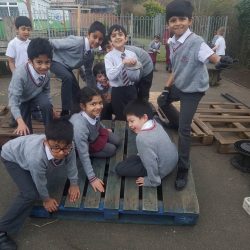
When it comes to trips, children are included. Year 3 go for a day to an Outdoor Education Centre, in Hook Hampshire – this helps build familiarity for when they go for a two night residential in Year 4. Those who need it get a great deal of preparation with social stories covering all aspects from food to sleeping arrangements to activities. Mr Revens has introduced the use of virtual reality to create social stories for trips and this has helped prepare children for a visit. The school uses its grounds well with a nature trail, a Celtic roundhouse the children helped build, a Forest School area and pond for nature study, and a creative play area which included a pile of old tyres, pallets, fabric, old computers alongside a mini-assault course with a ‘mud kitchen’.

Talking to Bridie McHaffie (Year 2 Leader), who was just returning with her class from using the nature trail, she made it clear that they use the outdoors as an extension of the classroom a lot. The school has worked with OPAL (Outdoor Play and Learning) which has tra group of children in uniform playing on a seesaw made of palletsansformed outdoor play experience for all the children. She has two children in her class from the resource base and the other children support them and see them as part of the class. When one of these children started he had no verbal language; now due to the social interaction with his peers he is very talkative.
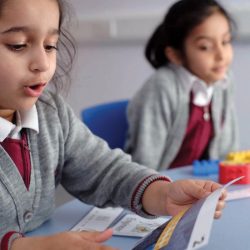

The school recently took part in an exciting arts project with a number of special schools within Harrow. A resident artist from CREATE was based in West Lodge for six days and the children from the resource base and other children from Year 4 worked on a large scale piece of art representing life under the sea. This led to lots of discussions on threats to the seas and oceans. The finished piece of work was presented at the Harrow Arts Centre as part of a festival to celebrate the work of the project. Art specialist Nisha Richardson and Art Leader Lucy Taylor helped co-ordinate this exciting project.Two small girls in school unifocm in class

I found my visit to the school very positive and proof yet again that inclusion is the best way to educate all children. However, it was evident that the 104 staff were well trained, supportive and friendly, but behind the scenes a lot of training and thinking had gone into producing a very purposeful, child friendly school with high involvement of parents and pupils.

“We never had any doubt”

Ethan Dunkley and his family talk about his journey through mainstream education so far.

Ethan Dunkley is in Year 12 at City of London Academy, Islington. He has cerebral palsy and his parents have struggled to keep him in mainstream state education for the last fourteen years. Ethan and his parents Maria Larrain and Ian Dunkley spoke to Inclusion Now about their experiences.

Maria: “We never had any doubt that Ethan should attend a mainstream state school. We as parents believed this strongly as we think mainstream is better provision and was the best way for Ethan to be part of the community. He was already in a mainstream nursery and we could not envisage him attending a special needs school. They are not stimulating, the work rate is really slow and he would not be mixing with a wide range of children. A friend suggested Grasmere, a one form entry primary school in Hackney, which had a stair lift. The head was very nice and welcoming and at that time Ethan was not using a wheelchair so we thought it would be OK. The school provided excellent teaching assistants.”

Ethan’s thoughts on primary school. “I remember Mum having to push me up the kerbs as they were not dropped on the way to school. I had to start again as none of my friends from nursery moved to this school with me. We had one teacher a year and subjects were not broken down as they are in secondary. Mostly I remember my teaching assistants, especially Luigina. She had great patience and she taught me to recognise letters and then read and spell and use bricks for counting”.

“We went on lots of trips which I was always included in. We went to the Rio Cinema a number of times and in Year 6 we went away for four nights to an outdoor centre called Kench Hill. We also had a trip to Parliament. The same sex marriage act was being debated. My TA managed to sneak me in my wheelchair into the Commons and I heard the debate. This was the main catalyst for my passion for politics.”

Did you have friends at the school? ‘’To start with no as I am quite shy, but later in KS2 yes. Aaron, Page, Luke and Arthur were my friends. They came to my house which is accessible, but I could not go to theirs when they had parties. We went bowling which is accessible and everyone can join in.

“I was given plenty of time over several days to do my SATs tests and got high grades, 5s and 6s. This set a high bar for what any secondary school I went to thought I could do: I could not reproduce that level of work as they did not give me the time.”

Maria: “I got involved with the Hackney Learning Trust and as a parent rep on the Complex Needs Panel. I wanted to improve things not just for Ethan, but other disabled children. This definitely helped when it came to transfer to the Year 3 class which was upstairs. By this time Ethan was a fulltime wheelchair user and he could not access the stair lift. So I started a letter writing campaign to get a lift into the school. Initially the borough said Ethan should move to a primary school further away that already had a lift. Eventually after many emails, they understood it was important for Ethan to stay at the school that worked for him and where he had friends and they agreed to put in a lift.”

Ethan: “You also fought Hackney Council to drop all the kerbs on my route to school so I could do the journey myself”.
Were there any things you did not like about the school, Ethan? “I did not like the fire alarm noise. It was too loud! And I did not like the food. I went and saw the headteacher and told him to send the cook on a cookery course.”

Maria: “Secondary transfer was a problem. Initially we thought Ethan would go to Stoke Newington School, our nearest and where all his friends were going, but the corridors were long, crowded and rowdy at lesson changes. The lift kept breaking down and this would disrupt his independence. We looked at Mossbourne Academy which had a good reputation. This was designed as a new build by Richard Rodgers, but the lift was too small and in the stairwell where there would be too many students. The special needs department said they would take Ethan, but we as parents should stay away and not be involved, with no say or input in Ethan’s schooling. This was not our way of doing things and we had heard of cases of wheelchair users being stopped from attending. We also went to Highbury Grove where the SENCO looked uninterested and questioned why we wanted a ‘normal school’, suggesting Ethan would be better off in a special needs school. She said there were too many children with behavioural issues as an excuse. The SENCO from Grasmere came with us and initially the Highbury Grove SENCO denied we had an appointment. Eventually a secondary head we knew suggested trying City of London Academy Islington (COLAI). Angela, the SENCO, met with us and a TA from Grasmere and was very welcoming.”

Ethan “A Year 9 student at COLAI, Keely, showed me round and was very friendly. Another kid with CP, Bayley, gave me a good feel about the school and it felt like the school wanted me. As I settled in I had two good TAs, Mahari and Tosin. The lift is easy to use, I have a fob and can use it on my own. I often choose to go to the Hub where I can do my work and concentrate as there is not so much going on. I speak and the TAs write what I say. Because of my previous experience of history, I was adamant I wanted to take it for GCSEs which I later regretted – the teacher I had sucked all the life out of the subject. During GCSEs I had a great sociology teacher, Neil Robertson, who was inspiring and an equally inspiring English teacher. They sent me notes and handouts by email, which helped a lot.”

Despite getting good GCSEs, the COLAI got nervous about Ethan doing three academic A levels and suggested a BTEC would be better. Ethan with his parents had several meetings with the school, bringing along an advocate from World of Inclusion to convince the school Ethan could do it.

Ethan: “The main problem was that they thought I could not keep up with the work, which I can and I am now getting good marks on my essays.”

Now it has been agreed as a reasonable adjustment that as time is one of Ethan’s big barriers, he will do his A levels over three years taking sociology and politics in Year 12 and Year 13 and psychology in Year 13 and Year 14 with any necessary retakes. The big problem is the length of time it takes Ethan to speak his ideas so an amanuensis writes them down. The school have referred Ethan for an assessment for switching such as eye or head pointing, so he can enter his thoughts independently onto the computer. This seems to be taking a very long time and is crucial for Ethan’s independence. A recent problem is that the punctuation and spelling is that of the amanuensis and not Ethan’s – if wrong he could be marked down in exams. Ethan will also need to check their work.

Ian: “Overall our experience of putting Ethan through mainstream has been positive. He has missed out on after school clubs as TAs are not available.”

Maria: “We employ an extra person out of Islington Direct Payments money to support him with homework. We have just employed Jacky, who is doing a PhD in Sociology, as his PA for two hours five nights per week, so that is very helpful to Ethan.”

Ethan: ‘’Yes. If I try and do my homework with my Mum we fight a lot. So this is better. I also have Chloe who is good. She comes for two nights and works at an ASD special school.”

What’s for the future? Ethan: “I have not thought about it. Probably university.’’

Ian and Maria: “We made the right choice with mainstream. Ethan goes to school with a smile on his face and usually comes back saying he had a great day. We do not recall him being unhappy and school has been a good experience. He has worked with a lot of different people and has self-confidence. Maybe he needs to socialise more and some sort of buddy system would help, but he does naturally like his own space and company. The future looks good for Ethan.”

For our DRILL-funded project, I held twelve focus groups in seven locations across the country, conducted five in-depth interviews, and obtained over 370 responses to our online questionnaires. The project has exceeded our expectations, and the data gathered reflects very insightful trends. Sometimes, the findings are reinforced by all three participant groups – Disabled young people, parents, and professionals – and at other times rigorously contradicted. As well as exploring questions about the strength of accessibility plans, the groups discussed admission, information, learning and teaching, and social life. Here I present a taster of some of our findings*.

Admission

Some professionals referred to unlawful practices of schools turning Disabled children away because of high needs. This was reinforced by parents. Adam talked about his frustration in this regard: “We had one headteacher tell us our child would effectively be too expensive. He said he could be instructed to take our child, but he’d prefer not to.”

Information

Parents talked about how, in the absence of accessible information from their schools about important events and activities, they must scour their school’s websites and newsletters or ask other parents for crucial details. This is particularly difficult for parents whose children are on ‘part-time’ contracts or have transport from home, because opportunities to meet other parents are limited. This contributes to a sense of isolation.

In the professionals’ groups, a speech and language therapist commented on the inaccessibility of school documents: “Documents outlining SEND and behaviour policy tend to be written in high level language suitable for individuals already highly familiar with the topics, procedures and provisions. They take little account of the possibility they may be needed by a parent trying to understand processes and provisions for a child for the first time.”

Learning and teaching

All groups expressed dissatisfaction about the inaccessibility of PE lessons for Disabled young people. Teachers were criticised for being unwilling to accommodate various needs in their PE lessons. Carley, one of our young participants, was unable to take PE in her first year at secondary school. Her mum said the school’s excuse was, “She couldn’t get changed, it was a health and safety issue…. Seeing as she dresses herself every day, we couldn’t figure out why”. Eventually the school relented, but did not offer alternative PE provision. Carley explained how the teacher made her climb the climbing frame despite not having strength in her legs. The more she said she couldn’t do it, the more the teacher pushed her up the ladders. The strain on her hands eventually broke her wrists.

Social life

Participants highlighted lack of transport and support for after school clubs as a key barrier to pupils’ participation in social life. Parents discussed how risk assessments are used as an excuse not to take Disabled children on school trips. Professionals spoke about how Disabled children are left out of or discriminated against during social activities. One professional went as far as saying: “This is the second highest area of discrimination after exclusions.”

What next?

Currently I am analysing all the contributions in detail. In Autumn 2019, we will publish a full report, including recommendations on a range of school practices. I am confident that the rich stories shared by all participants have the potential to provoke significant change in improving Disabled young people’s quality of schooling. I am driven to produce a report which will urge and motivate policy-makers and education professionals to implement changes needed to bring about genuine inclusion in mainstream education.

Dr Armineh Soorenian

*Names have been changed to protect participants’ identities

Supported by

ALLFIE’s campaign for Inclusive Education as a human right is backed by funders and donors who reject the systemic segregation of Disabled people from society.