Please ensure Javascript is enabled for purposes of website accessibility Skip to main content

The Alliance for Inclusive Education’s written submission to APPG’s SEND inquiry – the impact of Covid-19 on educational transitions for children and young people with SEND | Autumn 2020

Who is ALLFIE?

The Alliance for Inclusive Education (ALLFIE) is the only national organisation led by disabled people working on educational issues and, in particular, working to promote the right for disabled students (including those with special educational needs and disabilities; SEND) to be included in mainstream education, as set out in Article 24 of the UN’s Convention on the Rights of Persons with Disabilities (UNCRPD).

The principles of inclusive education apply to all disabled people with different impairments and health conditions, including those with significant learning difficulties. Consequently, our written and oral submissions will cover disabled children with communication and interaction, cognition and learning, social, emotional and mental health, and physical and sensory needs; the four categories of special educational needs.

ALLFIE’s work

Over the past 30 years, ALLFIE has successfully campaigned for changes in law so that disabled students have the right to inclusive education. Our achievements include:

In addition, ALLFIE has been invited to take part in leading court cases which raises questions about inclusive education practice. We have also provided:

ALLFIE’s focus during the coronavirus pandemic

ALLFIE has been raising awareness of the negative impact of the Government’s Coronavirus Act provisions upon disabled students, where many of them have been without access to mainstream education for over half a year. The ALLFIE website details our Covid-19 campaign work.

The Disabled Children’s Partnership supports ALLFIE’s survey findings that disabled pupils are being denied access to mainstream education through the withdrawal or reduction of special education needs provision alongside inaccessible remote education and alternative learning opportunities as a result of limited engagement between education institutions and disabled students and their parents. The Children and Families Act’s easements have been an absolute disaster for disabled students. The “reasonable endeavours” by local authorities in practice means “no endeavours” to secure SEND provision even in an alternative manner for disabled students during lockdown.

For more information about the negative impacts the Children and Families Act’s easements have had upon disabled students, our parliamentary briefings and written submissions for individual MPs and select committees can be examined.

We decided to focus our attention on remote education, an area of education overlooked within inclusive education practices. Education institutions’ duties around remote education have made a timely arrival, since schools will be under a statutory duty to provide remote education for compulsory school-aged children affected by Covid-19 from October 22nd, 2020. The Department for Education have published different guidance documents for schools, colleges and universities.

ALLFIE’s survey report: the impact of the coronavirus on disabled people’s education

ALLFIE has surveyed its members and invited Facebook posts to enlist disabled school, college and university students, as well as parents and educational professionals’ experiences of the provision of education services throughout the Covid-19 pandemic. Survey respondents identified online learning and assistive technology, accessibility of virtual platforms, in-person support and coursework assessment arrangements as being major barriers that disabled students experienced in participating in mainstream education during lockdown.

We discovered that there is currently no clear legal framework setting out who is responsible for the accessibility of online learning platforms, curriculum delivery, in-person support and the like under the Equality Act 2010, Public Sector Bodies (Website and Mobile Applications) (No 2) Accessibility Regulations 2018, UNCRPD Article 24 or the Human Rights Act 1998.

Unfortunately, the Coronavirus Act 2020’s Provision of Remote Education Temporary Continuity Direction places a duty upon schools to provide remote education for children affected by Covid-19 restrictions from October 22nd but will not provide any further clarity around who’s responsible for arranging inclusive remote learning opportunities for their disabled pupils.

The full “ALLFIE Survey Report: Coronavirus Impact on Disabled People’s Education” survey can be found on our website. Similarly, the Digital Exclusion/Inclusion Case Study for HEAR Equality and Human Rights Network is available here.

In the short-term, ALLFIE wants the following:

In the long-term, ALLFIE wants the following:

What the Covid-19 pandemic has highlighted is that the Government must take urgent steps to strengthen the legal framework that supports disabled students in participating in mainstream education both within mainstream educational settings and from home due to health and impairment-related issues.

ALLFIE’s inclusive education manifesto consisting of six demands would move us from the present situation to a fully inclusive education system, as recommended by UNCRPD’s Monitoring Committee. We believe disabled people have the right to:

A full copy of our manifesto can be viewed on our website.

As UNCRPD’s Monitoring Committee has recommended, the Government should work with organisations of disabled people like ALLFIE to develop the aforementioned fully inclusive education system. The Government must fulfil its Article 24 obligations around inclusive education by working with ALLFIE.

We would also welcome the opportunity to provide an oral submission.

For more information, please contact:

Simone Aspis | simone.aspis@allfie.org.uk | 0207 737 6030 | 07856 213 837

Michelle Daley | michelle.daley@allfie.org.uk
ALLFIE knows that the Government is intending to consult on major reforms to the university admissions system.  We want Disabled students views to inform our consultation response expected in the New Year.

Gavin Williamson (Secretary of State for Education) has announced his intentions to change the university admissions system through which students apply for higher education courses based on actual rather than predicted examination results. Such changes to university admissions would not be implemented until 2023/24

Present University Admissions System

In addition to its predecessors, University and College Admissions Service (UCAS) has managed a highly centralised system of full-time undergraduate admissions since 1961.

The United Kingdom is the only major country to base its university admissions system on students’ predicted grades.

Why Change the University Admissions System?

The main reason is so that all students can apply for university places based on their actual examination grades. Students will no longer have to rely upon teachers’ predicted grades to secure their chosen university place. Heavily relying on teachers’ predicted grades has placed some groups of students at a disadvantage when applying for highly sought-after university places.

University College London’s Institute of Education found that just 16% of predicted A Level results are correct; only one in six university applicants will achieve the grades they were predicted.

The Department for Business, Innovation and Skills found black applicants had the lowest predicted grade accuracy, with only 39.1% of predicted grades being accurate, while their white counterparts had the highest, at 53%.

The UK Universities and Sutton Trust found that students from Black, Asian and Minority Ethnic (BAME) and financially disadvantaged backgrounds were more likely than their counterparts to express unfairness with the present university admissions system, especially when racism and classism remains widespread throughout the UK education system. ALLFIE work has demonstrated that the current UK education system is unfair and disadvantages to Disabled students particularly for people with learning difficulties. While ALLFIE doesn’t have disaggregated data our anecdotal information shows that BAME Disabled students and Disabled students from other under-resourced backgrounds are further disadvantaged and unfairly treated through the university admission process.

It cannot be assumed that Disabled students think the present university admissions system is fair. It is unfortunate that neither UCAS, the Sutton Trust nor any UK universities have reported any feedback from Disabled students. During the summer term, we were contacted by Disabled students and parents expressing their concerns over GCSE and A Level predicted grades. We have heard of teachers predicting Disabled students’ grades without taking into account any applied-for or approved reasonable adjustments from examination boards.

The Office for Students (an independent regulator of higher education in England) held a consultation outlining three options for university admission reforms:

Option 1: Retain the existing university admissions system with reforms

Students would continue submitting their university application during the autumn term of their final level 3 course year. Students’ predicted grades combined with national subject-related and aptitude tests, in addition to their personal statement and academic references, could be used to make decisions about students’ offers. The use of national standard tests may give greater transparency in the university admissions system. Such reforms will cause minimum upheaval to the present system, which many students think is fair.

The second and third university admission systems would be based on post-qualification models, which have been proposed by UCAS

Option 2: Post-qualification offers (PQO)

Students would submit their university applications before they sit their level 3 examinations, but offers are not made until after the results of those examinations are released. University applications would be made before the end of the summer term so that education institutions are able to provide student support. The PQO could remove the need for predicted grades and unconditional offers from the system. Making offers on actual grades would reduce the emphasis on the students’ personal statement and academic references, which may facilitate greater transparency in the university admissions system.

Option 3: Post-qualifications applications (PQA)

Students would submit their completed university admissions form including their actual examination results after their release; universities could therefore only consider offering students a university place after such results. Having students be in possession of their examination results would mean they are in a better place to decide on the suitability of selected university and subject courses. Similar to PQO, PQA may promote greater transparency within the university admissions system.

Offering course places based on students’ results and university admission requirements may have unintended consequences where individuals’ personal circumstances may not be considered. A published contextual admissions policy with guiding principles could be used alongside students’ results during a transparent decision-making process.

Whilst the majority of students believe the admission system is fair, there is no evidence that Disabled students are in agreement. UK Universities, UCAS and the Office for Students have not undertaken any analysis of Disabled students’ perceptions of the university admissions system. We have asked all the relevant parties to provide us with specific feedback

If you want to know more about the Office for Students’ University Admissions Reforms, including advantages and disadvantages of the different options, please see their website.

We want to hear from Disabled students and Disabled applicants about your experiences of university admissions

We want to hear from you! We want to hear from recent higher education students and those who are applying this year for a university placement. In the New Year, we would like to organise a Zoom meeting to discuss your experiences and help us to formulate our response to the Department for Education’s consultation.

Please contact Simone Aspis

REFERENCES

BIS. (2011). RESEARCH PAPER NUMBER 37: Investigating the Accuracy of Predicted A Level Grades as part of 2009 UCAS Admission Process. Retrieved from https://assets.publishing.service.gov.uk/government/uploads/system/uploads/attachment_data/file/32412/11-1043-investigating-accuracy-predicted-a-level-grades.pdf

Holt-White, E., Montacute, R., & Cullinane, C. (2020). PQA: Reforming University Admissions. Retrieved from https://www.suttontrust.com/wp-content/uploads/2020/10/Reforming-University-Admissions-PQA.pdf

UCAS. (2020). Maps reforms of higher education admissions. Retrieved from https://www.ucas.com/corporate/news-and-key-documents/news/ucas-maps-reforms-higher-education-admissions

Universities UK. (2020). Fair Admissions Review. Retrieved from https://universitiesuk.ac.uk/policy-and-analysis/reports/Pages/fair-admissions-review.aspx

Wyness, G. (2016). Predicted grades: accuracy and impact. Retrieved from https://www.ucu.org.uk/media/8409/Predicted-grades-accuracy-and-impact-Dec-16/pdf/Predicted_grades_report_Dec2016.pdf

Making Things Happen Report: Amplifying Young Disabled People’s Voices

Making Things Happen; Young Disabled people; amplifying their voices.
Project summary report, August 2020.

Download full report (pdf): Making Things Happen Project Report

The Making Things Happen project is a 12 month project with a facilitated series of workshops and work experience for Young Disabled People within ALLFIE. The workshops explored how ALLFIE might better engage Young Disabled people in their campaigns work by understanding their current issues and enabling them to work with us to develop initiatives that promote inclusion and that are specifically relevant to Young Disabled people at a grassroots level.

Over August ALLFIE delivered a series of workshops, which presented a range of information covering identity, the social model of disability, understanding barriers and asserting solutions and rights. The purpose of the workshops was to enable Young people to share experiences while providing some key information about inclusion and rights relating to disability.

Due to the Covid-19 pandemic the workshops had to be delivered over Zoom. The five workshops were held during August 2020 and were attended by 8 participants. The project was funded by #iWill. ALLFIE recognised that holding a meeting remotely had advantages and disadvantages in terms of accessibility and digital exclusion.

All workshops were co-designed and co-facilitated with Young people. Young people led on the feedback of the all sessions and the production of this report. This report presents the key themes emerging from the discussions, lessons learnt, a summary of each workshop and some suggested future work initiatives.

When will Disabled Black Lives Matter?

Zahra Bei, No More Exclusions, shares one story of systemic disablism and racism children and families in Britain face daily – of structural oppression, struggle, solidarity and a rising collective resistance that must be told.

This is a painful story to tell during Black History Month or Disability History Month, or for that matter any month, or any year. We are now living through the second wave of a devastating global pandemic that has magnified social inequalities and injustices experienced by disadvantaged groups in society. It has been reported by UNISON that Disabled Black people are at the highest risk of loss of employment and access to support and care they are entitled to due to the restrictions implemented under emergency legislation. We are in the throes of a global recession, civil unrest, climate catastrophe, and rising authoritarianism is rearing its ugly heads, under many guises and in many languages across continents.  In spite of this blique backdrop, there are signs of resistance and organised efforts to ensure that the lives of disadvantaged and minoritized people that share multiple identities are not forgotten.

As Co-Founder of No More Exclusions I want to share with you one intersectional story amongst the thousands of stories of systemic, everyday disablism and racism that children and families face in Britain on a daily basis. It is a story of structural oppression, struggle, solidarity and a rising collective resistance that must be told.

No More Exclusions too have joined in support.

On October 7th, a family from Dudley, Birmingham, was celebrating a short reprieve. Their 22-year-old son, with various labels including autism, was released from prison after serving 2 and half years of a 5 year-sentence. Osime Brown was convicted as a teen for the theft of a mobile phone – a theft he had in fact tried to prevent – under the joint enterprise legislation. Osime is now facing imminent deportation to Jamaica, a country he has no memory of, having left age 4. At the time of writing, over 300,000 signatures have been collected through a petition by the campaigners trying to halt Osime’s deportation. Osime’s story is sadly an all-too common one. Apart from the lack of support from the school, and struggling his entire school career, Osime was diagnosed at the age of 17, after being permanently excluded from school, taken into care against his family’s wishes (Black children are disproportionately placed in care) and it was during this period that Osime – excluded, and away from home – was exposed to even more to criminal exploitation. Osime experienced what can be safely described as a textbook horror-themed catalogue of state systemic failures. At every turn, Osime and his family were prevented access to the education, care, protection, support and justice that all children are entitled to.

Osime’s mother, Joan Martin, told us that:

“Osime was not accommodated in school, firstly because his autistic behaviour was seen as a defiant and disruptive Black boy.  The system saw a Black boy, now a Black young man, and they cannot get beyond colour, to see the human crying out for help and understanding. They did not want to accommodate him, see his needs, nor believe me, his mother, that he needed support and to be understood as a lost young person who was in a different place from his peers and as one who understood the world with the mind of a child, who trusted people too easily.”

Osime’s future now lies in the hands of the Home Office. But there is hope.

Osime’s mother, her family and community campaigners are working tirelessly to halt Osime’s deportation. A big question remains.  Even, if their efforts are successful, how will the historical wrongs experienced by Osime and his family throughout his life at the hands of a cold and uncaring system and society be put right? How can we stop the enactment of a well-oiled school to prison pipeline that sucks in droves of Disabled Black people every day? How do we raise the alarm and get society to recognise and care about Disabled Black children’s lives caught up in the British school to prison pipeline? This is a pipeline that extends the punishment to include the permanent physical removal of individuals from British from British soil – a blatant disregard of human rights.

It is hard to fathom how this is happening to Osime (and to so many other minoritized individuals every day) and that it is happening in Britain in 2020 – a country with some of the most (apparently) progressive equality legislation in the world. The Equality Act 2010 establishes that equality must require adopting measures that account for disabled people’s impairments, including treating disabled people more favourably than others. The legislation places a duty on the public sector to have “due regard” to identified protected characteristics. Like many Disabled Black children and young adults, Osime was and continues to be multiply-marginalised and subject to exclusion instead of education, and punishment instead of protection. Disabled Black children are less likely to be afforded the benefit of childhood innocence. Isn’t it interesting that individuals such as Osime can get caught up, and wrongly accused and sentenced through the legal notion of ‘joint enterprise’ and yet his personal identities as a Disabled Black young person are denied in law? Succinctly, the issue of intersectionality is ignored, and individuals are left stranded.

The process of discrimination, exclusion, state violence, marginalization and pathologization start early, as soon as Disabled Black children enter the education system.

Osime is just one of thousands of Disabled Black children for whom the historical continuum of institutional abandonment and systematic exclusion are an everyday reality – all of which too often occurs intergenerationally. The experience of Osime highlights how immigration policies work alongside other discriminatory state systems to deprive Disabled Black individuals of their human rights as citizens, forcing many to be stateless with limited opportunity to legal recourse. Disabled Black children are either hyper-visible or invisible in society; their identities are perpetually constructed and reconstructed as either worthless, criminal or deficient. Their sense of self-worth and belonging are constantly under assault.

For Disabled Black people like Osime life is compounded by the overlapping of intersectional systems of oppression. For Osime equality, equity and inclusion are non-existent.  Osime’s experience highlights the discrimination inherent in education, health, social care, criminal justice and immigration systems. Multiple injustices are deeply entrenched. When will Disabled Black lives matter?

By Zahra Bei
Co-Founder, No More Exclusions

Disability History and Inclusive Education Campaigning

ALLFIE marks 30 years of campaigning alongside Disability History Month, with personal Inclusive Education histories – here’s Chloe McCollum’s story.

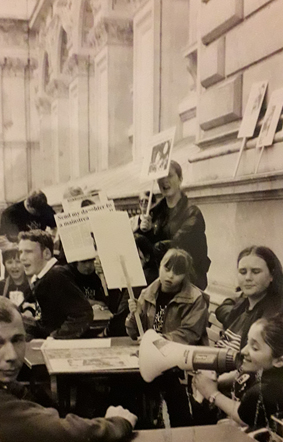
Early days campaigning for Inclusive Education: Chloe McCollum Historical image: a young and powerful demo at Downing street where a letter was delivered to Tony Blair with hundreds of signatures for Inclusion, in centre Chloe McCollum 1990sChloe’s story of her involvement with Allfie dates back to the 90’s.  Chloe has Down’s Syndrome and was born in 1982 midst a flurry of interest and changes in legislation making it slightly easier for disabled children to be included in mainstream schools. She enjoyed a 9 year rich and delightful experience in her ordinary neighbourhood primary school. This was followed by a painful battle with Lewisham council for her to carry on into a mainstream secondary school. It was very nasty and difficult with poor Chloe having assessment after assessment to deem her unable to cope in a mainstream school.

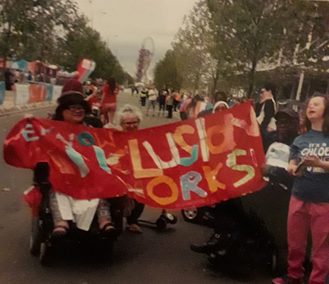
Historical image: Chloe McCollum, far right campaigns with ALLFIE for Inclusive Education at Olympic park eventHowever with many very negative experiences, came many positives. In particular the involvement  and support of ALLFIE, (Micheline Mason was Director at the time) Parents for Inclusion, a network of activists,  as well as friends, neighbours, staff from Chloe’s primary school, her fellow pupils and friends. After several activities, newspaper articles, meetings, petitions, appeals, demonstrations, and Chloe being homeschooled for 2 years; a deal was struck. Two days at a local secondary school and the other 3 at a special school. Not a great situation, but we do believe this paved the way for many more learning disabled children to go to secondary school in Lewisham afterwards.

This is the background for Chloe becoming a campaigner. At 38 she is now living in a supported living house, and up until the time of lock down she was working on a farm, being very involved with the creative arts group Heart N Soul, as well as enjoying classes at Morley College ( 2 activities which she carries on using zoom). She is also is a member Lewisham Speaking Up, a self advocacy group. She fervently believes in Inclusive Education and has joined many Allfie demonstrations over the years supporting this.

In a conversation about the importance of inclusion, Chloe said:

“Inclusive education is a good idea because it’s disability rights. I loved my primary school Lucas Vale and still hear from some of my friends. I liked my 2 secondary schools, but liked Deptford Green the best. All children should learn and be together. WE KNOW INCLUSION WORKS.”

We’ve included some photos of Chloe’s Allfie Involvement over the years.

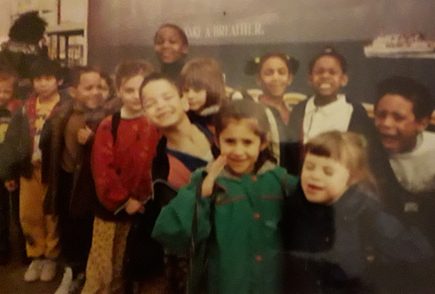
Historical image of Chloe McCollum at primary school with friends in the 1990s

By Zelda and Chloe McCollum

More on UK Disability History Month

ALLFIE Celebrates Children’s Rights on ‘World Children’s Day 2020’

Find out how Disabled Young people are being empowered by ALLFIE’s capacity building work, as we celebrate ‘World’s Children’s Day’ on 20th November 2020.

World Children’s Day 2020: Strengthening Disabled Young people’s voices

ALLFIE marks ‘World Children’s Day’ on 20th November 2020, highlighting our ongoing campaign for ALL children’s rights to education, through one Young person’s inclusion experience.

The Alliance for Inclusive Education (ALLFIE) campaigns for all Disabled Learners’ rights to education, with a keen focus on strengthening the voices of Disabled children and Young people through our capacity building work. This work brings services such as the Newham Special Educational Needs and Disability Information Advice Social Service (SENDIASS) and Disabled People’s Organisations (DPOs) together to better support Disabled Young People, like LT.

Special Educational Needs and Disability Information Advice Social Service (SENDIASS) is a statutory service provided by Local Authorities, offering impartial information and advice – empowering Disabled children, Young people, and their families. This service is also offered directly to Young people from 16 years upwards.

This is LT’s experience of the support she received from her local SENDIASS team

“The SENDIASS team were introduced to me while I was in college, as they help Young people with disabilities. At first, I didn’t think much of it as I haven’t used these types of services before. I was then introduced to Marcia and Tessa, they explained how they could help me.  I’ve usually been on my own when it came to doing things for myself, so this was amazing, as I struggle with paperwork. As I study media Tessa asked me to creative a poster to help them advertise, this helped me out as I could use it within my portfolio.

Then when my course was coming to an end, Marcia sat down with me to help me explore my options and helped me to make informed choices. I decided that I wanted to go to university as that was what my mum wanted. I wanted to stay close to home, Marcia helped me apply to the university and made sure I had everything that I was entitled to. This was a huge help as I was really worried and scared about messing this up.

SENDIASS then asked me to be part of the Chair of SENDIASS Newham Young people’s Steering Group that they were setting up. At first, I was apprehensive as I didn’t quite understand what they wanted me to do, however after I spoke to them, they explain the group would give disabled young people aged 14 – 25 years a voice. I agreed to do it and am now the Chair of SENDIASS Newham Young people’s Steering Group.  It has been amazing and the best decision I made I’m glad to help.” (LT, Chair of SENDIASS Newham Young people’s Steering Group, studying Media Production at University of East London)

By ALLFIE’s Justine Jones

Inclusive Education Research: Co-production in Practice

Armineh Soorenian discusses how coproduction and participatory approaches to inclusive education research can impact on its richness and quality, and challenge historic marginalisation of Disabled people’s voices and experiences.

Historically, disability research has been led by non-disabled academics, marginalising Disabled people’s voices and experiences, considering ‘disability’ as an individual or welfare problem. To challenge these oppressive power structures, in the recent decades, disability research has adopted participatory or, better still, co-productive emancipatory research methods.

Co-production involves different forms of knowledge being brought together. Academic researchers play a more facilitative role as research question and agenda-setting is increasingly driven by community and other partners. Participatory research aims to challenge and disrupt power relationships found in more conventional research that draws a rigid distinction between researchers and people ‘being researched’. In both methods, there is a significant shift of power from researchers to the ‘researched’. By involving non-researchers as experts in the exclusive process of research, co-production can make users feel empowered and included, increasing a sense of ownership.

As a Disabled researcher, I was recruited by ALLFIE to lead a research project into the effectiveness of Accessibility Plans in English secondary schools, exploring disabling barriers affecting the educational journeys of Disabled young people. To ensure co-production, I spoke directly with Disabled young people and their families, on behalf of ALLFIE, as a well-established Disabled People’s Organisation in the field of inclusive education. Disabled people are optimally placed to design, develop, and produce disability research with a commitment to improving Disabled people’s life opportunities. I firmly located the project within the social model of disability, presenting an alternative to mainstream analysis with a view to empower Disabled participants, adopting the ‘Nothing About Us Without Us’ approach throughout the project.

Disabled participants were involved in the various stages of data collection, validation, and dissemination. From the outset, a Project Advisory Group was formed, consisting of a parent of a Disabled young person, the ALLFIE director, a Disabled academic, and a researcher in the field of inclusive education. We met monthly to make collective decisions about the direction of the research and to support me in designing the research topics and questions as well as looking at complex ethical issues.

My personal experience of ‘Disability,’ and of attending both special and mainstream education as a Disabled young person, helped create a safe space in which participants felt comfortable to share detailed and personal accounts of their experiences. Disabled young participants were often thankful to have a platform through which their voices could be heard, and they also appreciated the empathy of a fellow Disabled person. The emancipatory approach of the project, and the commonality of ‘Disability’ experience amongst participants, benefitted both the participants and the research in equal measure.

The aim in carrying out the co-productive project in the field of inclusive education was to make a far-reaching positive change, so that Disabled young people may have entirely different and more positive experiences – not left behind by the system, instead be fully included in their school communities alongside their friends and non-disabled peers.

As this work has shown, coproduction and participatory methods are exciting approaches to research in inclusive education, and disability research as a whole, that can generate novel output, with the potential to have a profound impact on the richness and quality of the work.

By Armineh Soorenian

30 Years of Campaigning For Change: Past, Present and Future

ALLFIE’s Campaigns and Policy Coordinator, Simone Aspis, introduces 30 years of ALLFIE’s core work campaigning for inclusive education – the past, present and future.

I very much hoped that by now Disabled students would have had an unqualified right to inclusive education.

Historically, we have managed to secure several significant changes in law such as the presumption of mainstream education principle in the 1996 Education Act and accompanying Inclusive Schooling Guidance (2001), which is now replaced by the Children and Families Act (2014) which should have provided the majority of Disabled people with the right to a mainstream education. ALLFIE was also successful in securing changes to the Disability Discrimination Act (1995) and Special Education Needs and Disability Act (2001) before being replaced by the Equality Act (2010), so that disability discrimination in education was outlawed. However, education legislation has always allowed for Disabled students to be segregated and excluded for disability-related reasons. A clear observation was made (2017) by the UNCRPD Monitoring Committee that UK legislation is currently incompatible with its UNCRPD Article 24 obligations to promote inclusive education, as set out in comment 4.

With increasing opportunities for education to take place in a broader range of places – after all, no one expected professional football clubs, home education groups or mainstream academies with subject specialisms offering a broader range of learning opportunities – it provides us with a real chance to look beyond traditional institutions for the provision of inclusive education within community settings. Such a move will enable us to think much more critically about what constitutes segregation, exclusion, integration and inclusion. We have tended to discuss such ideas through our experiences of either working or learning within traditional educational institutional settings such as schools, colleges and universities offering a one-size-fits-all approach.

The Equality Act’s definitions of disability and reasonable adjustments – the concept of which has been left undefined in law – allow for the idea of disability and reasonable adjustments to evolve in the context of our own needs and society’s norms. Similarly, inclusive education has always been a dynamic concept, where our ideas about inclusion will evolve in light of the values of both society and the education system, as well as changes in learning and assessment styles and methods, learning environments and the like.

One of the core challenges we have going into the future is how to understand what is meant by inclusive education in contemporary times and how to translate that into legislation and accompanying guidance.

By Simone Aspis, ALLFIE Campaigns and Policy Coordinator

Simone leads ALLFIE’s campaigns and is active on current policy and legislation issues.

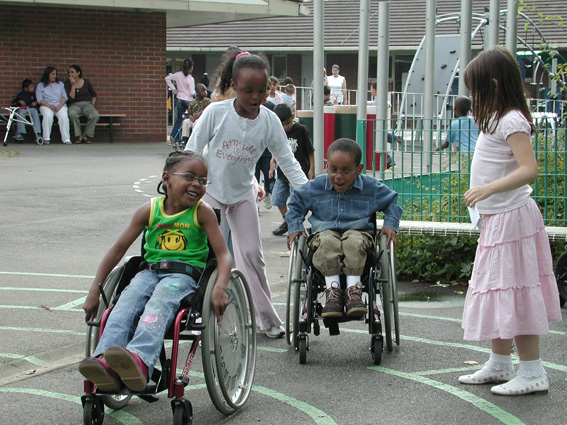
Children playing together, some in wheelchairs, some notWelcome to our November Covid-19 Campaign briefing and Call to Action!

This briefing covers:

Campaign News

Firstly, we would like to thank everyone who has supported ALLFIE’s continued campaign work in upholding Disabled students’ right to inclusive education during these challenging times. Since lockdown, we have focused our lobbying activity on how Disabled pupils are missing out on compulsory education because they are excluded from remote education or alternative curriculum activities.

We are pleased that the Government has now begun to take on board the notion that schools have a duty to provide remote education for children affected by Covid-19 restrictions. It is vital to note that the duty covers all Disabled pupils with or without education and health care plans.

Consequently, we now have a real opportunity to make sure that the Secretary of State for Education, Gavin Williamson, uses his powers to direct schools to provide remote education for pupils affected by Covid-19 if they failed to do so for Disabled pupils.[1]

The Department for Education have very limited good practice guidance to help schools comply with their duties to provide remote education for Disabled pupils.

What do we want you to do? Remote Education Survey

Please complete our Remote Education Survey

It’s been six months since the Covid-19 restrictions were put in place. We now want to know whether schools, colleges and universities are doing a better job in providing remote education for Disabled pupils who can engage with appropriate support in a meaningful manner.

If you are a Disabled pupil and want to share your experiences with us, please contact Simone Aspis on simone.aspis@allfie.org.uk or 07856 213 837. We will need to get permission from your parents if you are under 18.

We would like to hear from you if:

Please complete our survey

What Does ALLFIE Want To Do?

The Secretary of State for Education has the power to ensure that schools comply with their duties to provide remote education.

We want the Secretary of State for Education to use his powers where necessary to direct schools to provide remote education for all pupils affected by Covid-19 restrictions.

We would like to share good remote education practices with the Department for Education, with the aim of helping them to develop relevant guidance for schools.

We will therefore be asking your permission if we can share your experiences with the Department for Education to help them carry out their regulatory role and share good practice with schools, colleges and universities.

Easy to Read Version

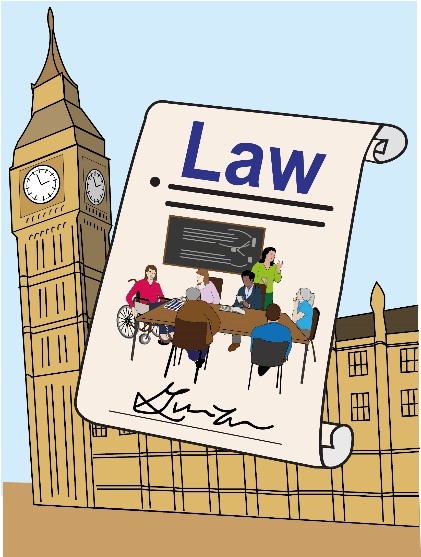
Education law and policy: image of education law document and ParliamentWe want to thank everyone who has supported our campaign to solidify Disabled students’ right to mainstream education during the Covid-19 outbreak.


Student working at a computerWith lots going on, we decided to focus on Disabled people’s access to education using their computers and tablets at home. This is called remote education.

Call to Action

Computers and tablets with a question markWe want to know if you think your school is doing a good or a bad job in helping your Disabled child to learn at home with a computer or tablet. Please complete our Remote Education Survey


Education law and policy: image of education law document and ParliamentThe Government has changed the law so that schools must provide remote education for all children, including Disabled children, if they are affected by Covid-19.


Student working at a computerWe want to know what you think about remote education, learning from home if you are meant to be in college or university?


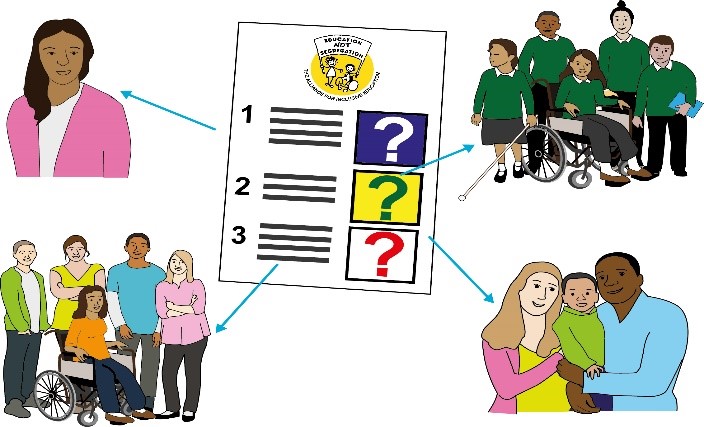
Survey image depicting Disabled learners, parents, carers and communityWith your consent, we want to share your remote education experiences with the Department for Education.


We want the Department for Education and Government to:


Image of a telephone


Contact

You can contact me on simone.aspis@allfie.org.uk or 07856 213 837


References

[1] The Alliance for Inclusive Education. (2020). Coronavirus Vital Education, Training and Childcare Provisions: Remote Education. Retrieved from: https://pedantic-shannon.91-238-163-161.plesk.page/news/briefing/coronavirus-vital-education-training-and-childcare-provisions-remote-education/

Celebrating 30 years of Campaigning for Inclusive Education: Why ALLFIE is Important

Alliance for Inclusive Education Trustee, Joe Whittaker, takes us through the history and introduces the principles of ALLFIE and Inclusive Education. We ask you to join our celebrations by sharing our Twitter messages with your followers, using hashtag #ALLFIE30

The Alliance for Inclusive Education (ALLFIE) is and has, for 30 years, been the reliable voice, consistently advocating Inclusive Education with Disabled learners and their families, to professionals, local authorities and national government. ALLFIE  remains the ‘Go To’  place because it is unique, as an organisation, created and led by Disabled people, specifically focused on campaigning for effective supports for all Disabled learners to be fully included in all sectors of mainstream education services.

After 30 years ALLFIE continues to articulate and apply key principles guided by a Disabled persons’ right to belong to their community and be free from segregation because of corrosive prejudices suggesting that Disabled learners are in some way faulty.

ALLFIE Principles

ALLFIE’s key principles for inclusive education:

ALLFIE has dislodged the mantra that people of a similar age learn in the same way, at the same time, at the same pace, with the same methods, with the same teacher, all at the ringing of a school bell.  People learn more effectively when they have full access to mainstream learning environments, where they feel safe, welcomed, valued and supported to navigate their individual journeys within a network of relationships that enhances their  confidence aspirations and imaginations.

ALLFIE knows inclusive education works, ALLFIE also knows Inclusive Education is not a simple destination, it is a continually evolving learning process throughout life. Such a process demands we work in collaboration with all interested parties, simple political alignment in this endeavour is an illusion. Sustainable change requires respectful engagements with participants who can hold radically different perspectives but can gather around key principles, it requires us all to be inclusive in our struggles.

The History: From Integration to Inclusive Education

ALLFIE is able to change in the light of experience and evidence.  Such a change happened with the language of the Integration of Disabled learners into mainstream schools. This integration was recommended by the Warnock Report  (1978) the recommendations of this report were largely incorporated in the 1981 Education Act.

ALLFIE recognised this application of ‘Integration’ was not working, it proved to be a huge disservice to many Disabled learners. Integration required a significant shift in thinking and practice. ALLFIE campaigned against an approach that integrated Disabled learners into mainstream schools, without the necessary supports for Disabled learners, not simply to be located into mainstream settings but to be fully supported to participate and contribute in mainstream settings.

It was wrong to integrate or place a learner using a wheelchair in a mainstream school when that school is only fully accessible to people who can climb stairs. Or where a learner, whose first language is British Sign Language (BSL) and there is no BSL interpretation available to fully access the curricula and the wider cultural relationships inside and outside the mainstream setting. These integrated ‘placements’ resulted in deeper isolation and continued segregation in mainstream settings for many Disabled learners.

Integration put the Disabled learner into mainstream schools without a corresponding emphasis on the supports they required to be fully included in that mainstream school. ALLFIE highlighted the weakness of integration as practiced in the late 1980s. That shift from integrated education to inclusive education was highly significant and is when ALLFIE changed its name in the early 1990s and subsequently influenced the national debate away from integration education to inclusion education. This was not simply a change in vocabulary but a conceptual shift that required mainstream settings to change, to value and provide essential supports to all Disabled learners and not expect the Disabled learner to ‘fit in’ to the mainstream setting as it was. This shift in emphasis to the supports available in mainstream settings changed the educational landscape. Effective supports brought into mainstream setting by Disabled learners included:

And many more personalised teaching/learning supports and education innovations, which highlighted the lack of support available to other learners. This transformation in the mainstream settings was a direct result of Disabled learners changing the educational landscape and from which all learners could benefit.

‘Inclusion Now’ magazine

ALLFIE included many features articles in ‘Inclusion Now’ magazine. Inclusion Now magazine was  first published in 2001, and continues today, created and published with important allies to show examples of inclusive education in mainstream settings from around the country.

Building Alliances: Disabled People’s Organisations

Disabled Peoples Organisations, (DPOs) are run by Disabled people for Disabled people, they started in the early 1970s, to fight the blatant discrimination against Disabled people in U.K. society. DPOs articulated the damaging consequences of disability discrimination for society. Disabled people activism was instrumental in bringing about Disability Discrimination Act (195). Inclusive Education however, was not high on the agenda of many DPOs. Some anecdotal evidence suggested that Disabled activists had been so oppressed by their schooling experiences, why would activists want to return to such issues, which they had survived only to have those oppressions re-stimulated?

ALLFIE understood the damage of segregated schooling for many disabled people from its powerful project  ‘How Was School?’, which, looks at Disabled People’s experiences of education over the last 100 years through the telling and recording of personal memories and histories of school. This truly unique collection designed and delivered by Disabled people has produced an oral history resource that will serve as an archive in the public interest but will also be a practical tool for schools, colleges, universities and other education providers that segregation can deepen the isolation of Disabled persons through all aspects of their lives.

Whilst this dialogue between ALLFIE and other DPOs continues, it is fair to claim Inclusive Education is on the agenda of many DPOs. The move to a wider Overarching DPO, Reclaiming Our Futures Alliance (ROFA) where ALLFIE is an enthusiastic partner with many other powerful DPOs. Such powerful alliance has achieved international collaborations with The United Nations Convention on the Rights of Persons with Disabilities (UNCRPD 2007) This comprehensive rights convention contains Article 24, fought for by and consistently advocated for by ALLFIE, which establishes the right to Inclusive Education around the world.

ALLFIE is currently engaged in the continued struggle to sustain the key principles of Inclusive Education which, despite the current political moves to systematically segregate rather than include,  ALLFIE will continue to campaign for the rights of all Disabled learners to enjoy and flourish in an Inclusive Education with all other participants around the world.

Joe Whittaker, ALLFIE Trustee

We ask you to join our November celebrations and support us by sharing our Twitter messages with your followers, using hashtag #ALLFIE30

Press Release: Alliance for Inclusive Education Launches 30th Anniversary Campaign

ALLFIE launches new online campaign to celebrate 30 years of campaigning for equal rights for ALL Disabled learners, over 30 days in November.

To mark 30 years of of campaigning for ALL Disabled people’s education rights, ALLFIE is hosting an online campaign ’30 years, 30 messages of inclusion’. The campaign will run over the 30 days of November 2020, alongside global events including Disability History Month. The initiative will reconnect with those who have been part of the charity’s history, and amplify ALLFIE’s vision of
‘a world where inclusive education is a right not a struggle’.

Hosted via ALLFIE’s Twitter platform using the hashtag #ALLFIE30, the social campaign will link to mixed media content, including blogs, quotes, images and videos, which will be collated and accessible on ALLFIE website. ALLFIE’s Twitter feed will be populated with messages of inclusive education including: Lobbying for change; capacity building; knowledge and information, and current campaigns including Disabled Black Lives Matter and Covid-19 and Disabled People’s Education.

The aim of the #ALLFIE30 campaign is to celebrate and give power to inclusive education, and galvanise ALLFIE’s network of supporters, allies, parents, Disabled students and Young people to share their own experiences, ideas and ALLFIE memories.

For 30 years, ALLFIE has worked with Disabled learners, their parents and carers, across a very wide range of educational needs, backgrounds and experiences, gaining strength from this diversity. We hope this campaign will inspire many more to get involved with the charity’s work, and help secure our future for the next 30 years!

#ALLFIE30 will enable those who have helped or been involved with ALLFIE to share their experiences or ‘hand raise’ themselves in events and activities, as well as upload their own ALLFIE memories from the last 30 years. The social media campaign is designed to encourage followers to share their stories and encourage others to get involved with their inclusive education experiences, and messages of support and solidarity.

The project will highlight the important impact ALLFIE has had on people’s lives, and many successes and achievements, including:

ALLFIE wishes to acknowledge the support of all the staff, volunteers, trustees, members, allies and funders, who empower us to end the educational segregation of Disabled people and help us achieve and remain committed to our principle: “educate, don’t segregate”.

Above all, we are committed to making inclusive education a right for all Disabled people and hope you will support us. We ask you to join our November celebrations and support us by sharing our Twitter messages with your followers, using hashtag #ALLFIE30

“Looking ahead, we have more work to do continue to campaign to remove disability discrimination in education at every level, whether this is schools, apprenticeship schemes, colleges or universities. Our determination is, and always has been, the creation of an inclusive education system, in which all learners are welcome, without question, period!” (Navin Kikabhai, ALLFIE Chairperson)

Power in solidarity.

About ALLFIE

Formed in 1990, we campaign for the right of all Disabled pupils and students to be fully included in mainstream education, training and apprenticeships with all necessary supports. We also create the resources that people and organisations need to advocate for inclusive education, training and apprenticeships and to develop good inclusive education practice.

As a Disabled people-led organisation, we build alliances with individuals and organisations who share our vision and goal: to end segregation of Disabled learners, including those with ‘special educational needs’ (SEN) labels, from the mainstream education system in the UK.

The main activity of the charity continues to be lobbying for changes to legislation, policy and practices that discriminate against Disabled learners, and that prevent inclusion. This involves campaigning work, capacity building with individuals and groups to create change at a grassroots level, training and information sharing work, fundraising for the core budget and engaging in new projects.

This issue is jammed with examples of the injustices towards Disabled children, Young people and their families caused by the ideology of the Government towards education. There have been and are funding gaps, though the Chancellor has shown he can print money when needed for businesses and furlough.

We see the spending of over a billion to set up more segregated provision which is the end point of a SEND system that is broken. Several contributors point to the aspirations of the Children and Families Act 2014, family focussed choice and the reality of a mainstream system that has narrowed its curriculum, its tolerance of difference and increased exclusion of Disabled children to meet crude league table targets, powered by increasing competition between privatised Multi Academy Trusts.

Yet there is hope in these pages. Hope that a young woman with Learning Difficulties can challenge discrimination, win at a Tribunal and maintain her ambition, then switching schools to get to her Dream of University. The fact that all the different Global Disability organisations have agreed on what they mean by Inclusive Education, albeit not all of us would agree with some of the detail. Such unity has made it possible for UNESCO and Governments to press ahead with implementing Inclusive Education.

There is ample evidence that parents and teachers are fighting the cracks of inequality and discrimination in our Education system, opened up by Covid-19 and that a real commitment to ‘Build Back Better’ is shown in Joe Whittaker’s blue sky thinking of opening up our education infrastructure to bring about inclusive, non-segregated life-long learning for all.
We need to keep our faith in Inclusive Education and organise to force the Government to back down from its damaging ideology. Every family can be won to this position.

Richard Rieser, World of Inclusion

Supported by

ALLFIE’s campaign for Inclusive Education as a human right is backed by funders and donors who reject the systemic segregation of Disabled people from society.