Please ensure Javascript is enabled for purposes of website accessibility Skip to main content

This year, the UK Government is due to have their performance in the implementation of the United Nations Convention on the Rights of Persons with Disabilities (UNCRPD) scrutinised by the UNCRPD Monitoring Committee. The Monitoring Committee will consider the UK Government’s progress in implementing the recommendations set out in the UNCRPD’s concluding observations report (2017). Overall, the United Nations concluded that there has been “systematic and grave violations” of Disabled people’s human rights by the UK Government.

United Nations Convention on the Rights of Disabled People – England Civil Society Shadow report

Inclusion London has taken the lead in preparing the UK’s UNCRPD England Civil Society Shadow Report on behalf of the Disabled People’s Organisation sector, which will inform the UNCRPD committee’s list of issues and areas of concern to raise with the UK Government.  The Alliance for Inclusive Education is taking the lead for reporting on the Government’s implementation of UNCRPD’s Article 24 recommendations. In doing so, we have held a number of consultation events with different stakeholders, Disabled people, parents, and education professionals, alongside conducting an online survey.

In relation to the UNCRPD Monitoring Committee’s observations and recommendations, and as many of you expected, ALLFIE failed to find any evidence of the Government’s progression in the implementation of UNCRPD’s Article 24 recommendations. On the contrary, ALLFIE concluded there has been further regression and violation of Disabled people’s rights to inclusive education.

What did ALLFIE say in its report to the UN?

ALLFIE made it clear that there had been no evidence of the Government making any attempt to either remove the reservation or interpretative declaration from Article 24.

ALLFIE’s submission highlighted the unacceptable continuation of the Government’s major legislative and policy attacks on Disabled people’s rights and access to mainstream education. We have thus identified the issues that have had the biggest negative impact upon Disabled people in England:

ALLFIE emphasised the following issues that would be incompatible with promoting Disabled people’s human rights to inclusive education, to be raised at the next scrutiny under Article 24:

  1. Despite there being an obligation to engage with Disabled people and their organisations, the Government has decided to work with big charities not run by Disabled people and who are paid to maintain the status quo. Unlike ALLFIE, education and children’s charities lack a strong human rights approach to their SEND engagement work.
  2. The Government has increasingly moved from a social model to a medical model approach of disability in their misguided attempts to support Disabled people within educational settings over the past decade. Educational institutions are being increasingly encouraged to focus on Disabled people’s specific SEND interventions rather than the whole school approach to inclusive education practices. The Department for Education has strengthened their zero-tolerance policy towards so-called ‘bad’ behaviour and discipline that has ultimately created a child-blaming culture where school disciplinary sanctions, exclusions, and segregation have become normalised.
  3. Furthermore, neither the Children and Families Act 2014 nor the Equality Act 2010 include an unqualified right to inclusive education. As a result, Disabled students still do not have an absolute right to a mainstream education placement, education course, or any form of assistance. We have provided various case studies on how Disabled students lack the necessary access to inclusive education despite being within mainstream education settings. We have also highlighted how the Government has resisted their duty to provide a definition of what constitutes inclusive education practice, as set out in Article 24’s General Comment 4.
  4. Similarly, the Government have done nothing to remove the infinitely harmful Children and Families Act clause that allows a Disabled child to be placed in a special school if their presence is not compatible with the efficient education of other children, despite the UNCRPD Monitoring Committee making a specific recommendation for its removal. As a result, the provision of segregated education continues to be permitted under UK legislation. Furthermore, the UK Government’s education policies, such as those concerning school exclusions, education funding arrangements, education inspections, and public examination regulations, have all had a further negative impact upon Disabled people’s right to inclusive education.

Education policy trends, under this Government in particular, have long been at odds with developing a comprehensive inclusive education system with a universal, streamlined, and integrated approach to supporting Disabled people’s learning throughout life in various mainstream education settings. Disabled people’s entitlements to disability-related support criteria is institution, age, and course based. Similarly, there are different criteria for inclusivity within public examinations, depending on the type and nature of the qualifications, and government Higher Education reforms are a current concern.

The UK Government’s education funding policy has been influenced, not by austerity, but by an ideological drive towards increasing the segregation and institutionalisation of Disabled people. The Government’s school capital funding schemes have been geared towards the establishment of the construction and expansion of existing special schools that will have the space to provide on-site education, health, and care provision, which is more difficult to accommodate for within mainstream schools. In recent years, new types of segregated education have been formulated, such as secure schools in which criminal courts can sentence young people; in practice, however, they are schools for children who are neuro-divergent.

We have also highlighted that the UK education system and education policy are not intersectional. For many Disabled people, gender, race, and sexual orientation issues are not sensitively reflected in UK education policies, which promote exclusive rather than inclusive  education practice. Amongst our case studies included Black Disabled people’s and racially minoritized communities’ experiences of systematic discrimination around the implementation of behaviour and uniform policies.

What’s next?

Inclusion London will be holding a launch of their shadow report in March. Further information can be found here.

Since going to press, the UNCRPD Monitoring Committee have now delayed the UK Government’s scrutiny until 2023 due to the COVID-19 pandemic.
Background

Mozambique is a country located in Southeastern Africa, bordered by the Indian Ocean to the east, Tanzania to the north, Malawi and Zambia to the northwest, Zimbabwe to the west, and Eswatini (Swaziland) and South Africa to the southwest.

Since 2001, Mozambique’s annual average GDP growth has been among the world’s highest. However, the country is still one of the poorest and most underdeveloped countries in the world, ranking low in GDP per capitahuman development, measures of inequality and average life expectancy. According to Worldometer data of 23 June 2021, Mozambique’s population is estimated at 32.102,539 people. The real number of Disabled persons is not known, but basing on World Bank’s conclusions, 15% of this number is of Disabled persons.

Disabled people face inequality in all national development spheres. They have no access to education, which is a fundamental human right and the basis to access all other rights. Many Disabled children and youth have never been to school (exclusion) and many of those who were enrolled do not finish the first circle of primary education. But the constitution of the Republic of Mozambique provides that: “Education shall be a right and duty of all citizens and the duty of the state to promote the extension of education to professional and continuing vocational training as well as equal access to the enjoyment of this right by all citizens.”

Mozambique’s education system is still dominated by traditional education forms, namely segregation form and integration form:

Inclusive education was introduced in 1998 and a number of initiatives have been realised since then, including adoption of national instruments that promote quality inclusive education, international partnerships, and ratification of regional and international human rights treaties and their protocols.

Inclusive Education Initiatives

In 1998 the Ministry of Education launched the ‘Inclusive Schools’ project, with UNESCO’s support, to combat exclusion and promote schooling for all children. The strategy was to raise awareness of diversity throughout the education structures. Activities consisted of short capacity building courses for provincial coordinators and teachers in pilot inclusive schools.

Following this project, Mozambique started implementing the resolutions of the 2nd World Congress on Education for All (EFA) in Dakar, April 2000.

The government has also established international partnerships with the Finnish and Swedish governments to support inclusive education in the country.

The government has a National Education Policy that emphasizes promotion of the principle of inclusive education through awareness raising and mobilization of regular schools and communities for support, as well as training teachers, providing materials and equipment and conception of flexible plans for children with particular education needs. The government also introduced free and compulsory primary education for all children.

Mozambique’s education policy is implemented through its 2020 – 2029 Strategic Plan. The plan has as its mission, implementing a national education system that is inclusive, equitable, efficient, competent, innovative and ensuring long life quality learning. In its general principles (2.1.1 a. the strategic plan ensures education, culture, training and a balanced and inclusive education as a right for all. 2.3.1. Ensures inclusion and equity in access, participation and retention.

These initiatives were to ensure that children and young people with different disabilities learn together with non-Disabled children in regular education system. Unfortunately the education system is not yet inclusive, after more than two decades of trial.

What I did on making schools accessible.

We implemented a project on inclusive education with financial and technical support from Power International between 2011 and 2013 in the provinces of Maputo, Sofala and Zambezia. I worked in Maputo, identifying Disabled children and youth at school going age that were not enrolled, realising accessibility audits in schools, and other public and private built places open for public use and thereafter presenting a report on each audit with recommendations for change. Changes had to be seen within an agreed period of time. As a DPO, we are advocating for accessible schools.


The wider barriers and what needs to change:

The initiatives that were taken in Mozambique totally failed because of the following reasons, among others:

“I am a Disabled student and have Dyslexia. My educational qualifications include a Bachelor’s Degree in History and GCSE Grades G in English and B in Maths. I failed to pass my level 2 functional skills in English on several occasions. I want to become a History secondary school teacher with Qualified Teacher status (QTS), so I have the opportunity to teach in both maintained and academy schools. The Initial Teaching Training (ITT) Provider rejected my application because I have not fulfilled the Literacy and Numeracy requirements. What are my options for legal challenge?” 

The Initial Teaching Training (ITT) provider can legally refuse applications if the applicant does not fulfil the entry requirements for the given course. This is because they are entitled to require specific qualifications to ensure applicants meet the minimum standard of subject knowledge and educational attainment. On the limited information provided, it does not appear that ITT has acted unlawfully in refusing your application because you do not fulfil the Literacy and Numeracy requirements.

It is, however, important to highlight that as a Disabled pupil, you could, and possibly should, have been granted access arrangements or reasonable adjustments when completing your GCSE and Functional Skills qualifications. Schools and colleges must comply with the Equality Act 2010 which includes a duty to make reasonable adjustments for Disabled pupils. If adjustments were appropriate in your circumstances, then your school or college could have made a request to the relevant examination board to grant specific access arrangements for your exams. This support would aim to ensure that you did not face an unfair disadvantage compared to your non-Disabled peers. For example providing you with additional time to sit the exam, or allowing you use of a laptop to write your answers.  The reasonable adjustments required as a Disabled student should have been implemented previously to support you to achieve your current qualifications. If your school or college refused to make an application, or you faced a detriment because of your disability compared to your non-Disabled peers, then it may have been possible to bring a disability discrimination claim. It is not possible to advise whether this would have been successful without knowing your specific circumstance, but unfortunately any claim should have been brought within 6 months of the incident in question.

Whilst it may be disappointing, if you do intend to re-take your English qualifications again, then you should make sure you are adequately supported in line with your impairment. If you do take this route, and are refused reasonable adjustments then you can seek legal advice on your individual circumstances. It is important to remember that up to date advice on your specific circumstances will always be beneficial.

Inclusion Now 61 | Spring 2022

Welcome to the latest edition of Inclusion Now, inclusive education news including: Charlotte Vuyiswa McClain-Nhlapo, World Bank Global Disability Advisor; Quiet Riot; UNCRPD progress; Levelling Up + more

Welcome to the 61st edition of Inclusion Now magazine. Text and audio versions are in the articles below, or you can read it in magazine format on Issuu.

To receive three issues of Inclusion Now a year, on the publication date, you can subscribe here. Subscribing supports our work and helps us plan for the future.

Inclusion Now is produced in collaboration with ALLFIEWorld of Inclusion and Inclusive Solutions

Media Review: CODA breaks new ground for disability equality onscreen

CODA breaks new ground for disability equality on screen.
(Apple TV Plus, 2021).
By Richard Rieser

CODA is a mainstream film in which the Deaf characters are played by Deaf actors, and it is funny, emotional, excellent, informative and entertaining. With a good portion of the dialogue in American Sign Language (with subtitles), it strikes a blow for Deaf and Disability equality.

CODA, which is an acronym of ‘child of deaf adults’, is written and directed by Sian Heder, and stars Emilia Jones as Ruby Rossi, a young girl who is the only hearing member of a Deaf family. Her parents—Frank, played by Troy Kotsur, and Jackie, played by Marlee Matlin—and older brother, Leo, played by Daniel Durant, are all culturally Deaf. The parents lean on Ruby, their only hearing family member, as they navigate the hearing world; she interprets everything from doctors’ appointments to business deals. Over the course of the movie, Ruby must decide between staying to help her parents and the dream of attending college on a music scholarship. Discrimination is shown as part of their lives. The story is quite staid, but the interactions of the four leads and the many sub plots are beautiful.  Emilia Jones had to learn American Sign Language and to sing to play the part so convincingly. Apart from the three Deaf actors, there were two Deaf ASL experts working on the film to develop the sign language used.

It is a remake of a French film from 2014, La Famille Belier, which featured a dairy farm with a deaf family and a hearing daughter who wanted to be a singer. The key difference is that all the main actors in the French film were hearing actors playing Deaf people. The producers of the original French film wanted an English version that was also different. Sian Heder (writer of smash TV series ‘Orange is the New Black’ set in a women’s prison), as writer/director, fought for casting Deaf actors to play the Deaf parts. Early on enlisting Marlee Matlin to play Jackie, Heder along with the veteran Deaf actor resisted all pressures to cast well known hearing actors and to alter the script. 40% of the film is in American Sign Language.

Marlee, at age 21, won an Oscar for ‘Children of a Lesser God’ (1986). She has had a long career including many movie and TV credits, from guest appearances on shows like Seinfeld, ER, and Desperate Housewives, to beloved recurring roles like The West Wing’s Joey Lucas, The L Word’s Jodi Lerner, and even a stint as Marlee the Librarian on Blue’s Clues. She has long wanted to share with audiences the beauty of an ensemble piece of Deaf actors using their sign language. In several interviews about casting the film, Matlin has said “being Deaf isn’t like a costume you can take on and off. Enough of that.”

Disabled characters are vastly underrepresented in film and television

Though about 25% of Americans are Disabled in 2019, only 3.1% of series regular characters were Disabled, and that was a record high. When Disabled characters do show up, they’re frequently created by non-Disabled writers and played by non-Disabled actors. Known in the Disabled community as “cripping up”, it’s a frustrating phenomenon not only because it takes work from Disabled actors, but also because it upholds inauthentic portrayals that perpetuate stereotypes. There are not many Disabled actors with name recognition who can generate interest in a project. The nomination of Crip Camp (2021) for best documentary was a welcome change and featured in our last issue. Now, CODA was picked up at Sundance for a record-breaking $25 million deal, proof that audiences and studios are hungry for inclusive and authentically made content.

CODA trailer

We are looking for an experienced Youth Officer to deliver a new project, to build the confidence and capacity of Young Disabled people (YDP), aged 16 – 30.  Overall, you will strengthen and amplify YDP’s voice within the Disabled People’s Movement, supporting them to campaign for disability equality in education, drawing on lived experiences. The project will help ALLFIE to deliver its strategic goal of ensuring future generations of YDP are free from a lifetime of disablism/ableism in education and receive the same life chances as someone who is not Disabled.

You will have experience of setting up and delivering projects to support YDP and create opportunities for youth-led movement for change.   You will be great at developing effective relationships with YDP using different platforms.

As an organisation run by and for Disabled people, we are seeking to recruit for a skilled and highly motivated Disabled person for this key role.

The Alliance for Inclusive Education (ALLFIE) has led the lobby for change in inclusive education for over 30 years, as the only national Disabled people’s campaigning organisation working on this issue.

ALLFIE’s vision is to create an inclusive society, by ensuring inclusive education within mainstream settings for ALL Disabled people. We campaign for ‘a world where inclusive education is a right not a struggle’, and for Disabled pupils and students to be fully included in mainstream education, training and apprenticeships, with all necessary support. We also create the resources that people and organisations need to advocate for inclusive education, training and apprenticeships and to develop good inclusive practice.

We support flexible working and large aspects of the role could be done remotely, however some travel to attend face-to -face meetings will be required.

ALLFIE is committed to promoting equality of opportunity, intersectionality and human rights. If you are a Disabled person and we need to make any adjustments to our recruitment process to enable you to apply for this role please let us know.

Responsible to: ALLFIE’s Director
Salary: £28,907 per annum, pro rata
Hours: 19 hours per week
Contract length: Fixed term contract – 3 years
Annual Leave: 25 days per year plus bank holidays pro rata

How to apply

Please follow the ‘Guidance notes – How to apply’ document.

Attached is:

  1. Job Description & Person Specification
  2. Application Guidance Notes
  3. Equal Opportunities Monitoring Form

Please return your CV, cover letter, data consent and recruitment monitoring forms to info@allfie.org.uk together with the supporting statement.

Closing date for applications: 5pm, Wednesday 4 May 2022

Applications will be reviewed on rolling basis

This role is funded by Paul Hamlyn Foundation

ALLFIE is seeking to recruit an experienced project leader to uphold and strengthen our campaign for inclusive education. The post-holder will develop, coordinate and manage all aspects of the “Stronger Voices” project to influence London Disabled People’s Organisations (DPOs) to get involved in ALLFIE’s campaigning and lobbying work, and ensure timely delivery of project goals. You will build capacity and skills within the Disabled People’s Movement.

The project is London-based and funded by Trust for London, to build the capacity and skills of DPOs to campaign for inclusive education locally to ensure that Young Disabled People escape a lifetime of segregation and poverty.

You will have knowledge or relevant experience working in the field of social justice. The role will be focused on improving inclusive education policy and practice to tackle poverty.  You will be great at developing effective relationships across different sectors and working with a diverse audience.

As an organisation run by and for Disabled people, we are seeking to recruit a skilled and highly motivated Disabled person for this key role.

The Alliance for Inclusive Education (ALLFIE) has led the lobby for change in inclusive education for over 30 years, as the only national Disabled people’s campaigning organisation working on this issue.

ALLFIE’s vision is to create an inclusive society, by ensuring inclusive education within mainstream settings for ALL Disabled people. We campaign for ‘a world where inclusive education is a right not a struggle’, and for Disabled pupils and students to be fully included in mainstream education, training and apprenticeships, with all necessary support. We also create the resources that people and organisations need to advocate for inclusive education, training and apprenticeships and to develop good inclusive practice.

We support flexible working and large aspects the role could be done remotely, however some travel to attend face-to-face meetings will be required.

ALLFIE is committed to promoting equality of opportunity, intersectionality and human rights. If you are a Disabled person and we need to make any adjustments to our recruitment process to enable you to apply for this role please let us know.

Responsible to: ALLFIE’s Director
Salary: £35,057 per annum, pro rata
Hours: 21 hours per week
Contract length: Fixed term contract – 3 years
Annual Leave: 25 days per year plus bank holidays, pro rata

How to apply

Please follow the ‘Guidance notes – How to apply’ document.

Attached is:

  1. Job Description & Person Specification
  2. Application Guidance Notes
  3. Equal Opportunities Monitoring Form

Please return your CV and supporting statement, data consent and recruitment monitoring forms to info@allfie.org.uk.

Closing date for applications: 5pm, Wednesday 4 May 2022

Applications will be reviewed on rolling basis

This role is funded by Trust for London

Trust for London logo with the slogan: Tackling poverty and inequality

SEN green paper suggests government is finally dumping Cameron’s ‘end the bias’ policy

Welcome to ALLFIE’s latest campaign briefing, covering:

  1. Campaign news: ALLFIE’s response to the SEND Review Green Paper
  2. What’s next? Get involved in upcoming ALLFIE open consultation events
  3. Background: Previous articles and resources

1. Campaign news

On Tuesday 29th March the Government published its long awaited SEND Green Paper

ALLFIE’s Director was quick to respond and critical, in this article published by Disability News Service.

Michelle Daley stated ALLFIE’s key concerns:

“The SEND Green Paper presents as being progressive, through its recognition that the system is failing Disabled children and young people which was echoed in a catalogue of reports published in 2019 as noted in the SEND Review.

The realisation soon hits you that the report is not focused on rights and justice for all Disabled people. The messaging is steeped in social injustice and inequality; not just in education, but also reinforcing discriminatory practices in other areas of society. There is no reference to inclusive education as a human right, nor a commitment to making mainstream education work. Additionally, the report is riddled with biases towards segregated education for Disabled children and young people.

We are concerned that the new National Standards is likely to promote disability discrimination, where some Disabled children (particularly those with high needs) will be forced into segregated education. This is incompatible with the government’s obligations under Article 24 of the UNCRPD.

We should not be surprised that the report was received with a huge disappointment: it gives a green flag to upholding ableism and has erased intersectional identities. The segregation of Disabled children and young people in the UK education system reinforces other forms of social injustice. The government have acknowledged in the report the current failures of the education system, however, the response to such failures is to increase / improve special schools and alternative provisions. This will only continue to intensify the gaps in society between Disabled people and non-disabled people and thus helps to further marginalise communities.

Disabled people need action taken so that the government implement their commitment to Article 24 to end segregation of Disabled people in education.

ALLFIE would hope that after so much harm and trauma experienced by children and Young people through failures by the state in education, this SEND Green Paper would have been the ideal opportunity for the government to co-produce a fully National Inclusive Education system with Disabled people and their allies, as recommended by the UNCRPD Monitoring Committee. This would have a social justice approach, aligned to the report to the UNCRP and delivered on their own commitment under Article 24 (on inclusive education within mainstream settings) of the UNCRPD. This report gives Disabled people no hope for the future and continues to uphold a divided society that disadvantages Disabled people.”

(Michelle Daley, ALLFIE Director)

2. What’s next?

Over the next three months ALLFIE will be holding a series of events for Disabled people and allies, to support and contribute to the Green Paper open consultation. We will update ALLFIE Members via email as soon as the dates are announced.

Not a Member yet? Join our campaign for inclusive education

3. Background

This issue kicks off with two interviews given by prominent Disabled people, both reflecting on their early educational experiences and the need for inclusive education.

On page 3, we hear from veteran US campaigner, Judy Heumann, describing her lifelong fight for the rights of Americans with disabilities. If you want to learn more about Judy’s remarkable career, be sure to watch the film, “Crip Camp“.

On page 9, the spotlight falls on Baroness Tanni Gray-Thompson, distinguished Paralympian, TV personality and member of the House of Lords. Following this summer’s Olympics, members of ALLFIE’s Our Voice Project ask Tanni about her life and public attitudes to disability both inside and outside the sporting arena.

In Billie Dolling’s article (page 14), we hear about the struggles for educational inclusion within the UK’s Gypsy and Traveller community.

This November it’s Disability History Month and, on page 19, Richard Rieser introduces this year’s twin themes: the right of Disabled people to have family relationships and to express their sexuality; and the difficulties forced upon those with hidden impairments.

The UK Government has a habit of signing up to international agreements that it doesn’t understand and doesn’t mean to implement. On page 24, Louise Arnold reflects on our Government’s failure to promote inclusive education and progress towards a more inclusive society, focusing on the part that academics can play in bringing about change.

We end this issue with our regular legal question: this time from a grandmother seeking an EHC Plan and appropriate educational support for her grandson.

Enjoy.

Judy Heumann: “The battle is so much bigger than we thought it was. Unless all Disabled people are liberated, none of us can be liberated.”

By Micheline Mason, Michelle Daley and Melody Powell

Judy Heumann describes herself as a white, Jewish, 73-year-old, Disabled Woman. Judy was 18 months old when she contracted Polio. When she was 2 years old, a doctor recommended that it was in Judy’s best interest for her parents to place her in an institution, which they ignored.

She now lives in Washington DC and is a lifelong activist for Disabled people’s human rights. From 2010 to 2017, Judy served as the first Special Advisor for International Disability Rights under President Obama in the US.

In 2020, Judy was featured in one of the most talked about, revolutionary films, titled “Crip Camp”.

“Crip Camp” is an American award-winning film which followed the journey of an unconventional summer camp of Disabled Young people. Many of the Young people that attended the camp went on to become activists and prominent leaders within the Disabled People’s Movement.

In September 2021, Michelle Daley (ALLFIE Director), Micheline Mason, (Founder of ALLFIE), and Melody Powell (Inclusion Now editorial member), had the pleasure of interviewing Judy to talk about her activism, the film ‘Crip Camp’, disability justice and inclusive education.

Activism and Leadership

We wanted to know a bit more about how Judy became an activist and her decision to take leadership. We had watched the film ‘Crip Camp’ which most definitely was not the regular summer camp for Disabled children and Young people. We asked Judy:

What led you to wanting to be involved in ‘Crip Camp’?

Judy Heumann (JH): “I have been an activist since before we were using the word with other friends: working on identifying the different expectations that people had of us because we had disabilities. When I was nine, I started going to camp: Camp Oakhurst then Camp Jened, the Camp featured in ‘Crip Camp’. My overall experience of being with Disabled people my age, from when I was 9, is that it has always been very influential [for] me. Really enabled me to begin to meet other people who had disabilities, not necessarily my disability but others. There is a different type of communication that we had. …but I think there’s something very special, it has always been about being with Disabled people… I could have discussions about… things happening where I felt the disability might have been a cause for denial of the right to go to regular school, not having images of who we were, not able to think about our futures in a way non-disabled people think about their futures. Members of the people in the film we’re still friends with today.”

Judy was already aware of the different forms of social injustice based on being Jewish – “My parents are German Jewish immigrants and from Germany. They lost their families during the Holocaust” – and a girl. However, the level of injustice was to become compounded further by ableism. The educational inequality Judy experienced continues to remain a poignant moment in her life.

Fight for Inclusive Education

Like we see with parents at ALLFIE, Judy’s parents were also concerned that she received inclusive education in a mainstream school. There were obvious global parallels in the struggles of Judy’s parents asserting their rights for her to receive an inclusive education in a mainstream school back in the 1950s, as today:

JH: “Like in the UK, there were no laws on the books that made it illegal to discriminate or laws that affirmed the right to be educated, having a disability. None of that was in place [for Disabled people]”

“My Mom took me to school when I was 5 years old, [but] I was denied the right to go to school because I was a ‘fire hazard’”.

For four years Judy was home-schooled:

JH: “The New York City Board of Education sent a teacher to our house for two and a half hours a week. It wasn’t until the fourth grade when I was 9 years old that I actually started going to special classes, not in the neighbourhood school. The school programme was heavily medically focussed on speech therapy, physical therapy (PT), occupational therapy (OT). I didn’t get speech therapy, but I got OT and PT, and we had a lunch period at 11 and a rest period at 12. And at 2 o’clock we were packing up to leave. So on best days, you could get three hours of education, which you typically didn’t get for various reasons. Teaching – there were no standards, we were not being taught or using the same books as kids in the rest of school”.

“One of the interesting things that was happening was my Mom was learning to become more of an advocate, when I finally did get to go to school in these segregated classes. My Mom and other mothers learned that none of the high schools in New York City were accessible, and so if you used a wheelchair or couldn’t walk up or down steps, you were supposed to go back onto home instruction. So, a number of the mothers got together to work with the Board of Education, to address the issue and demanded that they make schools accessible, and actually it happened!”

“There were three high schools in the area where I lived in Brooklyn, but they were old and really not easily made accessible. But there was a new school that had been built and it actually did have a ramp and bathrooms that were reasonably accessible. That’s the high school I went to, with other Disabled kids.”

ALLFIE knows that the struggle for inclusive education is tied up with the legal system which is inconsistent with the United Nation’s Convention on the Rights of Persons with Disabilities (on education). Judy commented that:

JH: “The reality is the principles of inclusive education are the same for each country. The way things get implemented will in many ways depend on the socio/economic reality within the country. But the main objectives are getting children into school, getting them an inclusive setting, working with teacher training, helping people to learn how to accommodate children who have various disabilities to be able to benefit from learning, and an expectation that children can grow up to get jobs… I don’t believe that we have achieved what we need to have achieved, in terms of schooling and accommodation.”

504 Demonstrations

We had read about Judy’s campaigns and were interested to hear from her which campaign stood out to her the most and why?:

JH: “The 504 demonstrations in 1977 definitely were an amazing set of activities that went on and really engaged many people from the disability community and allies from around the country, in ultimately letting us get this major piece of legislation passed in the United States, or regulations signed to implement this particular piece of legislation. It’s called Section 504, the provision of law in the United States that says if an entity is getting money from the federal government, they may not discriminate based on disability. It took 3 to 4 years to be able to get those regulations developed because, when the law was passed there were no definitions of, for example, who were ‘Disabled people’, what is ‘discrimination’, what would be the remedies to address some of these issues.”

“We took over a floor of a federal building and it was the longest takeover of a federal building in the history of the US, still today, and we had a lot of support. Even from the mayor of San Francisco. It was kind of a ‘California Bay Area’ activity, which ultimately benefitted the Disabled people who were involved in the working groups and staying in the building and supporting and going to demonstrations outside.

There was an amazing amount of activity, and so many that were involved and not just from the disability community. One of the members of the committee that worked on the demonstrations was a founding member of the Black Panthers and he was in the building. He was able to get the Black Panther who had a kitchen – they were feeding kids in a place called Oakland California – and they were bringing food in, so people had a warm meal and food everyday… which was really important. People appreciated it and it was really one of the reasons why people were able to stay.”

“You will learn a lot about the history [from Crip Camp] of those demonstrations and the activities around getting the 504 regulations ultimately signed. That was a real high point for a lot of reasons. We have made very important changes in all of our countries. I also believe that the laws that we have, people need to continually learn about these laws and how they work, or they can’t use them.”

Intersectional oppression

Judy moved the conversation to address intersectional discrimination in more detail, which is a concern in education, particularly for Disabled people from marginalised, and under resourced communities. For example, the Department for Education (DfE) in 2019 reported that Disabled girls in English schools are exposed to a higher rate of exclusion than their non-Disabled peers [https://bit.ly/3eVWROX]:

JH: “Certainly, there are issues also around race, where kids who are Black or Brown are more likely to be in segregated programmes, particularly if they have mental health disabilities or developmental disabilities – those are still ongoing issues.

I think, also because of the diversity of our communities – you’re not just a Disabled person. You’re a Disabled person plus, plus, plus… Like I define myself as a Disabled Jewish Woman. I have spent time within the Jewish community talking about the kinds of discrimination that Disabled people face…”

“We’re not where we need to be but, certainly, I think we are making more progress.”

Global solidarity

As we approached the end of the interview, we asked Judy how she saw the future, when she started in the movement, compared to how it is now?”

JH: “It’s not better than I expected, but it is certainly much better than it was when I was growing up. For me what is better is a growing movement of people. When we look from then to today, like in all of our countries, we’re seeing a growth of our movements across disability and I think the voices of many Disabled people in our communities, and families and others are really understanding more clearly the types of discrimination that people are experiencing. And I think our movements are becoming definitely bigger – intergenerational, more people with invisible disabilities who are beginning to see the value and importance of them identifying as having a disability – which is ultimately very important.”

“Kids are still experiencing way more discrimination than they should, certainly in both our countries [in UK and America]. It is much more likely that those with [physical impairments] would be in regular programme now – not guaranteed but much more likely. Kids with other forms of disabilities [e.g. autism, mental health] are more likely to be in segregated or less integrated classes.”

“I do believe things have been changing over the last decades, because of people like us and many others. But obviously the discussion we’re having today around education is because we don’t believe we’ve achieved what we want to be able to achieve, and to ensure that Disabled children get to go to school with other kids with appropriate accommodations.”

“We still don’t see the Individuals with Disability Education Act or Section 504 of Americans with Disabilities Act being implemented to the extent that many of us believe that it needs to be, so we are still seeing children that are being segregated and not receiving an appropriate education.”

“We’ve learnt a lot about what can work. At the same time, we also know a lot that can work isn’t working because the will is not there and the laws that are there aren’t being implemented appropriately in countries like ours. More people are benefiting but not to the degree that they could or should be.”

“Over my lifetime, it has really made me feel very aligned with other Disabled people in the US and around the world because it doesn’t matter where you live, the problems – the underlying views of Disabled people – are the same.”

“The battle is so much bigger than we thought it was. Unless all Disabled people are liberated, none of us can be liberated.”

References:

‘Our Voice’ Project Participants interview Baroness Tanni Grey-Thompson.

On the 13th of September 2021, ‘Our Voice’ project members Tasnim Hassan, Melody Powell, Matthew Smith and Samuel Bartley had the fantastic opportunity to interview Tanni Grey-Thompson.

Baroness Grey-Thompson is a member of the House of Lords and Paralympian with Spina Bifida. Tanni was born in Wales, July 1969, and by the age of 6 her spine collapsed, causing her to be paralysed. Her parents had a long battle with their local authority for Tanni to be included in a mainstream school. We were keen to learn more about her experience battling the education system and to find out why she thinks inclusive education is necessary.

We began by discussing Tanni’s primary education, where she explained how the headmaster at her primary school “knew that special schools just weren’t very good and didn’t educate their children”. He kept quiet about her impairment in case she was pulled out of mainstream education and forced into segregated schooling. Tanni feels that attending ‘special school’ would have prevented her from achieving most things in her life, as it would have “shut down any opportunity I had”. When it became time for her transition to secondary education, Tanni realised that she didn’t have the same privileges as her older sister and wouldn’t be going to the same school: “I was about 10 when I realised that wasn’t going to happen”.

Accepting that she might be forced into segregated education, she visited a ‘special school’. Tanni mentioned that when looking around the school, her parents stated, “you’re not going there because they have children at 14, 15 playing with sand and water”. This was quite a stark difference from the school life she knew and wanted, so her parents began fighting to get Tanni into mainstream school. During this fight, her parents discovered the written work of Baroness Warnock on inclusive education and used it to “threaten to sue the Secretary of State for Wales for my right to go to mainstream school”. Tanni is clearly “very much in favour of inclusive education” and strongly feels we need to work on “treating children like human beings and looking at their needs”.

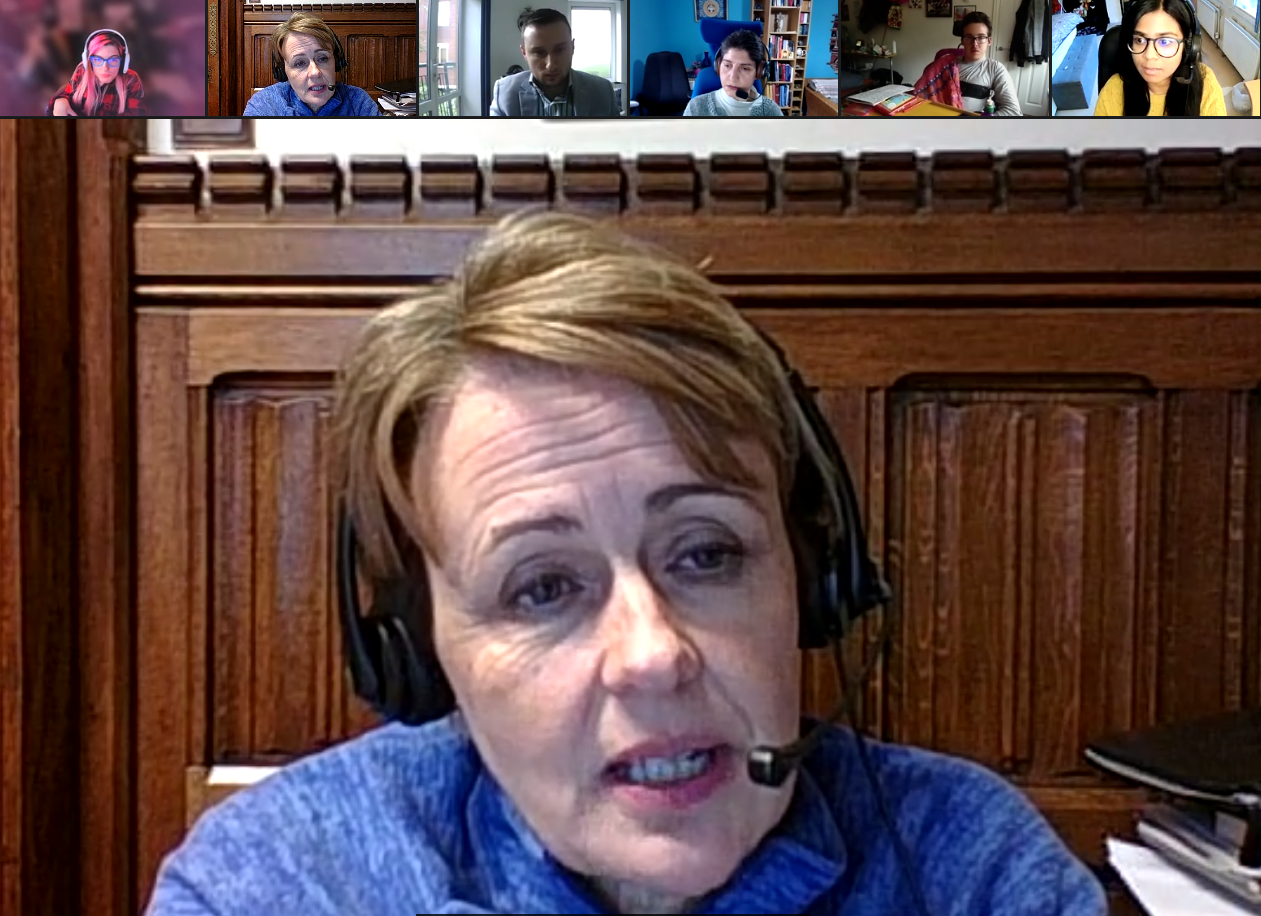
'Our Voice' participants interview Baroness Tanni-Grey Thompson via Zoom. (Top row L-R) Melody Powell, Tanni Grey-Thompson, Matthew Smith, Armineh Soorenian, Samuel Bartley, Tasnim Hassan (Main image) Tanni Gery-Thompson.
‘Our Voice’ participants interview Baroness Tanni-Grey Thompson via Zoom. (Top row L-R) Melody Powell, Tanni Grey-Thompson, Matthew Smith, Armineh Soorenian, Samuel Bartley, Tasnim Hassan (Main image) Tanni Gery-Thompson.

Being A Paralympian Is Not The Answer To Everything

On the topic of education, we wondered if Tanni’s experience with physical education (PE) at school impacted her journey to becoming a Paralympian. The PE teacher at school had a significant influence on Tanni’s relationship with sport: “I was lucky that the PE teacher for my year when I joined, Mrs. Cogbill, was just really inclusive”. Tanni spoke about her school swimming pool and how her PE teacher was confused about why she was just watching others swim, so she encouraged her to participate. Tanni suggests that the inclusion Mrs Cogbill created by allowing her to join in “sent shock waves through loads of people”. When discussing how society could normalise Disabled people’s fitness, Tanni suggested that rather than focussing purely on Physiotherapy, “you can do physical activity but get the benefits of physio, which is more interesting. Because the more physically active you are, the more you’re able to do things”.

Tanni’s relationship with sports was a positive one, but not all children have the same experience. Disabled children are often encouraged to sit out of sporting activities unless they show enough skill to train for the Paralympics. Baroness Grey-Thompson showed concern that “the only option given to Disabled Young people is to “be a Paralympian”. PE is compulsory within the education system, regardless of whether children are skilled in the activities. Yet, Disabled students don’t have this privilege “Disabled people [should] have the right to be really bad at sport”. Tanni feels that people need to understand that “being a Paralympian is not the answer to everything” and all children deserve access to fulfilling physical or sporting activity.

Disabled Representation in Media

The media we consume is a major part of all of our lives; often, Disabled people can feel underrepresented or misrepresented. Tanni felt that “growing up, the only Disabled people on TV weren’t Disabled”, and although there have been some improvements within the UK, we still have a long way to go. She continued to elaborate: “The fact that I can probably either name most people who are on TV or I know them personally is a real problem… I should be seeing Disabled people on TV that I don’t know, and I don’t”.

Non-Disabled actors playing Disabled roles aren’t the only negative within the media representation of Disabled people; the storylines behind the characters can often be quite damaging. For example, Tanni brought up the topic of Chris Tate on Emmerdale: “he was evil, so there was a lot of coverage around how he ended up as a wheelchair user, and that was his just reward for being an evil person”. When you begin to layer that on everything we know about the historical portrayal of Disabled people, like The Hunchback of Nôtre Dame or Phantom of The Opera, “Disability is linked to being evil”.

Our conversation with Tanni Grey-Thompson then delved into Paralympic marketing campaigns over the years and whether these improved or undermined Disabled people’s experiences. When referring to the 2010 ‘Freaks of Nature’ campaign, she expressed her concern stating that: “so much of the time Disabled people are called freaks”. She further elaborated that: “you need to understand the journey, the life experience of Disabled people, the discrimination… that Disabled people are called and treated like freaks”. While agreeing the 2012 ‘Superhumans’ campaign was a slight improvement, Tanni nonetheless explained this narrative only goes so far because “when it’s a Paralympian who’s a superhuman, it means everyone who’s not a Paralympian… they could be treated as if they’re subhuman”.

This year’s Paralympic slogan, ‘It’s rude not to stare’, also raised some interesting discussions with Tanni. She reflected on her own experience, saying that “I’m quite comfortable with that [people staring], I think my training as an athlete and as a parliamentarian has helped me deal with it”. However, she additionally affirmed that “people going about their daily lives is not something that should be stared at”. Grey-Thompson concluded that “I don’t think it moves the debate on”, asserting that this narrative has only led to more intrusive encounters such as being asked “what’s wrong with you?” or “how did you get pregnant?” She explained that people “think that’s a legitimate question, and that’s the stuff I got in the 70s. We were moving away from that to questions like ‘why are you in a wheelchair?’”.

We wanted to further discuss Tanni’s views regarding representation within the Paralympics, to which she commented that “there is something wrong where our British team is not more representative of British society”. One example she gave acknowledged the price that comes with elite sports whereby “the average cost of being on the talent pathway is about £10,000 a year”. She additionally pointed out that within the Paralympic team of 222 athletes, only 17 were non-white. This led to further engaging conversations about the equality agenda in which Grey-Thompson noted that “there are some things where it’s very easy to have tokens or badges to show your inclusion or show your allyship”. She expanded saying that disability “does get lost” within conversations that aim to support inclusion for any protected characteristic and that changing lives for Disabled people “doesn’t necessarily take money but it takes effort”.

Looking to the future, Tanni Grey-Thompson strives towards a future where Disabled people experience “an equality of opportunity” whereby she says “I just want Disabled people having the same miserable experience of commuting as everyone else”. Another change she would also like to see is building stronger networks of Disabled people in which she explains that: “you’d have thought with social media and online there’d be more communities of Disabled people, but I don’t think they’ve necessarily gone from the campaigning groups that used to gather on the streets of London to actually connecting together”. Connecting with other disability rights activists has truly “made a difference” as it reaffirms the message that “it’s not just me who thinks that this is wrong, there are other people who think it’s wrong and that for me has been incredibly helpful”.

From discussing segregated education to the broader implications of the Paralympics, we thank Tanni Grey-Thompson for taking the time to speak with ALLFIE’s ‘Our Voice’ members. There truly was so much to learn from her wealth of experience as a disability activist, Paralympian and parliamentarian. When asked if we could count on her support with future inclusive education campaigns led by ALLFIE, she replied with

“I’ve been kind of around sort of some of the work of ALLFIE over so many years, really happy to support anything that you do – and it’s really great to get Young people’s voices and different voices as part of this”.

By Tasnim Hassan, Melody Powell, Matthew Smith and Samuel Bartley

Supported by

ALLFIE’s campaign for Inclusive Education as a human right is backed by funders and donors who reject the systemic segregation of Disabled people from society.