Please ensure Javascript is enabled for purposes of website accessibility Skip to main content

The Green Paper and Inclusion: A view from Dame Christine Lenehan

Christine is the Director of the Council for Disabled Children

The SEND and Alternative Provision (AP) Green Paper is very clear about the poor outcomes and experiences of Disabled children and those with special educational needs:

It also lays out the problems with the current system that is caught in vicious of cycle of late intervention and increasing demand:

The vicious cycle is well known to children and families as over stretched, as under resourced, and with unresponsive services which sees families moved up through levels of crisis – often into a ‘solution’ for their child that they would not have sought themselves.

Most families want all of their children, regardless of SEND labels, to go to the local school, build local friendships and be part of the local community. The system’s approach, which escalates to crisis management, often undermines that early on. Once this is broken it is very hard to restore.

On first reading, the Green Paper rightly identifies that the solution to these challenges lies in a more inclusive mainstream education system. The Green Paper’s proposal to develop standards on what support should be made available universally in mainstream settings is bold and could drive a far more consistent approach across the country. However, to truly deliver an inclusive system we must make changes to the wider framework that schools operate in. This includes the rigid and narrow mainstream curriculum, behavioural policies that take little account of difference, and accountability measures that penalise inclusive schools. Neither the SEND Green Paper or Schools White Paper appear to have actively sought to address these mainstream policies.

The Green Paper has bold ambitions, but we need to understand how it will be delivered:

The Green Paper is surprisingly light on the ‘hows’:

  1. How will we make SEN Support a process that is embedded and ensures children get their needs identified and met at the earliest opportunity?
  2. How will we incentivise schools to engage?
  3. How will we ensure MATs focus on supporting children in the mainstream rather than moving children to special and AP?

The Alternative Provision measures in the Green Paper are welcome. The Government should make sure that children in AP get a consistent, quality education, and are regarded as children who are expected to succeed and thrive rather than fail. But we also need to make sure that improving AP does not provide the basis for moving more children with SEND labels into this provision and away from mainstream.

There is much to think about in reforming SEND policy and legislation, and we need to ensure that the Green Paper consultation process is fully utilised. There are glimmers of hope for inclusion. We need to make sure they are magnified.

The Special Educational Consortium have laid out 20 asks for the Send Review and Department for Education (DfE).

The Special Educational Consortium (SEC) welcomes the overall ambition of the Green Paper to identify needs early, provide consistent support and improve outcomes for all children and Young people with SEN and Disabilities. Although the ambition is welcome, SEC is not persuaded that the proposals will deliver the intended improvement or, for some of the proposals, that there is sufficient detail to know whether they could. In the context of successive rounds of legislation since 1981 (or arguably 1970), which have failed to deliver the intended outcomes, nothing could be more important than getting these proposals right.

SEC is committed to working with the DfE to contribute to the development of the proposals throughout the consultation process.

SEC’s initial response to the Green Paper is to welcome:

However:

There is significant concern in SEC about:

Inclusion Now 62 | SEND Review supplement 2022

Welcome to Inclusion Now 62 SEND Review supplement- an extra edition of the magazine with news about Special Educational Needs and Disability (SEND) reforms, and the Government’s Green Paper consultation.

Welcome to the 62nd edition of Inclusion Now magazine. Text and audio versions are in the articles below, or you can read it in magazine format on Issuu.

To receive three issues of Inclusion Now a year, on the publication date, you can subscribe here. Subscribing supports our work and helps us plan for the future.

Inclusion Now is produced in collaboration with ALLFIEWorld of Inclusion and Inclusive Solutions

SEND Review Green Paper Consultation: May 2022 briefing

Welcome to our latest campaign briefing, covering: News about the consultation timeframe and publication of accessible formats; What ALLFIE’s doing; Get involved – complete our inclusive education survey

Welcome to our latest SEND Review campaign update, covering:

  1. Campaign news: Accessible formats
  2. What you can do: Members’ responses
  3. More information: ALLFIE’s SEND Review campaign homepage

1. Campaign news

The SEND Review consultation deadline has been extended 21 days, until Friday 22nd July 2022. The Department for Education has extended the closing date for the Government’s SEND Green Paper consultation period by three weeks to Friday, following publication of accessible resources.

Accessible versions of the green paper:

2. What can you do? Members’ responses

We need your assistance to help ALLFIE make the strongest case for why and how the SEND system must change, to recognize and realize Disabled children and Young peoples’ rights to inclusive education. The Department for Education needs to hear from you about the impact the proposed SEND reforms will have for Disabled children and Young people’s right to inclusive education.

Call to action – What you can do:

  1. There’s still time to attend one of our on-line consultation events, including our 17th May event, open to all ALLFIE Members – book now
  2. Complete our SEND Review survey
  3. We also encourage our Members to write their own response to the Government’s SEND Green Paper
  4. Please submit case studies to simone.aspis@allfie.org.uk

We recognise that answering all 22 questions or selecting which questions you should answer in the SEND Review Green Paper may be a daunting task. We hope we have made this task easier to do by providing a suggested list of questions and areas to cover in your answers. Please feel free to answer one or more questions.  As discussed in our members’ briefing for this SEND Review Green Paper, we ask that any responses focus on the following areas:

If possible, it’s helpful if you can draw upon your personal experience and ideas as a disabled student/person, parent, education practitioner, or in another professional capacity.

If you would like to have a chat about the SEND Review Green Paper, please feel free to contact Simone at simone.aspis@allfie.org.uk or on 07856-213-837.

Question 1: What key factors should be considered when developing national standards to ensure they deliver improved outcomes and experiences for children and young people with SEND and their families? This includes how the standards apply across education, health, and care in a 0-25 system.

Focusing on Chapter 2 on the Green Paper, this question allows you to tell the Department for Education why a list of appropriate placements for disabled children and young people with different needs is wrong and will increase disability discrimination in education. Instead, what is needed are National Inclusive Education standards so that all children and young people can be included within mainstream educational settings. Some suggested areas to cover within your answer are:

Question 4: What components of the EHCP should we consider reviewing or amending as we move to a standardised and digitised version?

Again, focusing on Chapter 2 of the Green Paper, this question allows you to tell the Department for Education how EHCAs and EHCPs can be improved so that they can be used to support disabled children and young people within mainstream education settings. Some suggested areas to cover within your answer are:

Question 12: What more can be done by employers, providers, and government to ensure that those young people with SEND can access, participate in, and be supported to achieve an apprenticeship, including through access routes like traineeships?

Focusing on Chapter 3 of the Green Paper, this question allows you to tell the Department for Education whether the focus should be on providing inclusive apprenticeships from the outset. The apprenticeship schemes should be flexible enough to accommodate any reasonable adjustments needed in performing the job role and undertaking the course (including curriculum differentiation) and assessment arrangements. Apprenticeships provide more choices and broader opportunities on completion than traineeships and internships. Some suggested areas to cover within your answer are:

Question 15: To what extent do you agree or disagree that introducing a bespoke alternative provision performance framework, based on these five outcomes (effective outreach support, improved attendance, reintegration, academic attainment and successful post-16 transitions), will improve the quality of alternative provision?

Focusing on Chapter 4 of the Green Paper, this question allows you to tell the Department for Education that alternative provision such as Pupil Referral Units, Hospital Schools and Alternative Provision schools are just other forms of segregated education where disabled children and young people leave with poorer outcomes than their non-disabled peers.   Some suggested areas to cover within your answer are:

Question 17: What are the key metrics we should capture and use to measure local and national performance? Please explain why you have selected these.

Relating to Chapter 5 of the Green Paper, this question allows you to tell the Department for Education which key measures should be used to assess the quality of inclusive education provision. Some suggested areas to cover within your answer are:

Question 18: How can we best develop a national framework for funding bands and tariffs to achieve our objectives and mitigate unintended consequences and risks?

Again, referring to Chapter 5, this question allows you to tell the Department for Education the barriers that funding policies create and how they prevent disabled students from being supported in mainstream placements. Some suggested areas to cover within your answer are:

Question 22: Is there anything else you would like to say about the proposals in the green paper?

This question allows you to tell the Department for Education what key proposals are missing that will support disabled children and young people’s rights to inclusive education. Some suggested areas to cover with your answer are:


“Today the Department for Education has published accessible versions of the green paper, including:

The department is committed to ensuring the SEND and Alternative Provision Green Paper and consultation process is fully accessible.

On the day of publication, we provided a ‘request alternative formats service’ to provide everyone the opportunity to engage with the green paper and consultation, this includes provision of Braille, audio and other language translations. We apologise that a full range of accessible resources was not available from the first day of the consultation.

We are extending the consultation period by 3 weeks, to 22 July 2022, to ensure everyone has the opportunity to take part in the consultation.

All resources are available on gov.uk: https://www.gov.uk/government/consultations/send-review-right-support-right-place-right-time

https://www.youtube.com/watch?v=Ut_LI2sK1R4 | A short video explaining the proposals set out in the SEND and alternative provision green paper.


ALLFIE SEND Review Consultation flyer

Welcome to our latest campaign briefing, covering:

  1. Introduction: The SEND Review Green Paper
  2. What’s in the Green Paper: ‘SEND review: right support, right place, right time?’
  3. ALLFIE’s view – what do we want?
  4. What you can do? Consultation events and survey

1. Introduction

Dear friends,

In March 2022, the Government published its long-awaited Green Paper: SEND review – right support, right place, right time.[1]. This sets out the Government’s proposed changes to the SEND framework, addressing the negative experiences that Disabled children, Young people and parents’ have when securing appropriate education provision.

The Department for Education’s public consultation will be open for responses until Friday 1st July 2022.

ALLFIE’s team will be analysing the SEND proposals and how they might impact Disabled children and young people’s rights to inclusive education. We will also be analysing the Government’s alterations to the existing SEND legal framework under the Children and Families Act 2014.[2]

We will be writing up our analysis as we go along and would welcome any thoughts from our members:

Have your say

2. What’s in the Green Paper ‘SEND review: right support, right place, right time?’

Chapter 1: The Case for Change

The SEND Review was commissioned in September 2019 in response to growing concern about the challenges facing the SEND system in England, and the future of the children and young people it supports. The review reported the following:

ALLFIE is very disappointed that the SEND review and the SEND Green Paper proposals make no attempt to address the lack of implementation of Disabled children and young people’s rights to inclusive education, as set out in the UNCRPD Article 24.3 There is a glaring absence regarding how the Government will remove the injustices that Disabled children and young people face in accessing mainstream education through the barriers that this Government continues to put in place. 

Chapter 2: A Single National SEND and Alternative Provision System

There are currently 153 individual, local authority decision-making processes for implementing the SEND framework. These local processes cover the provision of education, health, and care assessments and plans, SEND funding allocation, and education placement arrangements. Disabled children and young people with similar needs can and will be placed in different types of education placements by different local authorities depending on the family’s residence. Consequently, parents have been highly critical of this postcode lottery, where residency will determine how the SEND framework will be implemented for their Disabled children.[4]

National SEND Standards

In the new Green Paper, the Government is proposing to reduce local authorities’ discretion over school placement decisions. It will do this by introducing national SEND standards which set out appropriate provisions and placements for children with similar needs. The national SEND standards will decide:

Local SEND partnerships will bring together education, health, care, local government, and other partners. These partnerships will be legally required to help parents make informed choices regarding the suitability of education placements for their own child. It will do this by publishing  local inclusion plans, including tailored lists of appropriate schools and colleges which meet different educational needs.

ALLFIE is very disappointed that the national SEND standards are not national, inclusive education standards. They do not set out the obligations of public bodies within an education remit, or their role in supporting the inclusion of all disabled children and young people, regardless of background and location within all mainstream education settings, as set out in the UNCRPD Article 24. 

The proposed SEND standards reinforce a medical view on disability – whereby a medical diagnosis determines the type of SEND provision and type of education placement. National SEND standards have the potential to ignore the complexity of needs of Disabled children and young people with individual profiles of academic, physical, social, and emotional abilities within mainstream education settings and with pre-determined support provision. Suggesting some Disabled children should not be in mainstream education from the outset is ableist and discriminative, both of which are incompatible with the Government’s UNCRPD Article 24 obligations.

The school placement proposal ignores the wide range of social factors (i.e. siblings, existing friendship groups, location) parents take into account when considering an appropriate mainstream setting for their Disabled child. We do not agree that the national SEND standards, as set out in the consultation, will increase the number of disabled children being appropriately supported within mainstream education. Instead, we anticipate that an increasing number of disabled children will experience segregated education as a result of being placed in SEND units attached to mainstream schools and special schools and colleges. Disabled children and young people and their parents will be more likely to be forced into segregated education, which is less likely to be the case under existing law and policy around parental choice. The presumption of segregated education for certain disabled children and young people is a violation of their human rights to inclusive education, as set out in Article 24.         

Simplify Education, Health, and Care Needs Assessments and Plans

Whilst the Children and Families Act legally prescribes education, health, and care plan (EHCP) sections, each local authority uses their own education, health, and care needs assessment (EHCA) and EHCP templates. The quality and quantity of information within the EHCP varies between local authorities. The Government proposes the introduction of national standards for EHCA needs and EHCP arrangements, including the use of digitalised templates. The national standards will include how needs are identified, met, and reviewed at every stage of a child’s journey across education, health, and care. To facilitate greater transparency within the EHC needs and child social care assessment processes, the Government is proposing the introduction of some independence into the decision-making arrangements.

The proposed statutory local multi-agency panels will be set up to review and make recommendations on requests for EHCAs and EHCPs, the needs assessments themselves, and any consequent placement and funding decisions. Panels will include representation from schools and colleges, health and social care workers, and parents and carers, taking a holistic view of the child. The panels will also make recommendations in line with the national SEND standards which local authorities must take into account when making their final decision.

Naming a School in an EHCP

Currently, parents and young people are able to name any school or post-16 placement preference unless it’s incompatible with the provision of efficient education for others. Local authorities are required to document the placement in the EHCP. During the drafting stage of the aforementioned EHCP, parents will be provided with a tailored list of education settings able to meet the needs of their child as set out in the Inclusion Plan.

Young people will be able to request a preference for a named post-16 placement from a similarly tailored list of appropriate 16-plus education providers that will meet their needs. Parents will still retain the right to request a preferred school that is not named in the tailored list of education settings. Parents can also still request a mainstream setting for their child even when they are eligible for a special school placement. The same legal provisions will be in place for young people if they want to attend a mainstream school or college rather than a special school or college for post-16 education. Local authorities must name the parents’ preferred school or young person’s college unless it is incompatible with the provision of efficient education for others in line with current legislation.

Parents and Young People Dispute Resolution and Redress

Dispute resolution can take up a significant amount of time, months or more, if disagreements about the child’s SEN arrangements between the parents/young person and local authority cannot be resolved before the tribunal hearing. The Government wants to speed up the dispute resolution process so that disagreements can be resolved at an earlier stage.

A proposed three stage dispute resolution process is being considered in the Green Paper. It would require mandatory mediation and a local independent panel hearing before a tribunal appeal could be registered by the parents or young person. The parents or young person will only be allowed to appeal if they feel the young person’s needs or proposed provision arrangements would not be in line with the new national SEND standards.

Tribunals will:

It’s the Government’s intention that all remaining maintained schools will become academy schools within existing or new multi-academy trusts by 2030. The academy trusts will include special schools and alternative provision schools. Unlike maintained schools, local authorities cannot direct an academy school to admit a disabled child with an EHCP. Subsequently, the Government is proposing to give local authorities a back stop power to direct academy trusts to admit the child to avoid a situation in which the child has no school to attend.

Currently, each local authority is required by law to commission a SEND Independent Advice Service (SENDIAS) for parents and young people.  National SEND standards will include a SENDIAS remit, including their role in dispute resolution between local authorities and the parents/young disabled person.

It’s unclear whether children and young people attending an appropriate school or college in line with SEND standards will rely upon the school to arrange such provision out of their own resources; if this is the case, children’s rights to SEND provision will be weakened.

Whilst ALLFIE would also consider streamlining the EHC needs and EHCP system, we do not think that the proposals will build the confidence needed to support Disabled children and young people in mainstream education. 

The EHCA and EHCP processes are guided neither by the social model of Disability or the identification of needs, barriers, and solutions that will enable the Disabled child or young person to flourish within mainstream education settings. Thus, they are not framed around promoting Disabled people’s human rights to inclusive education, as set out in UNCRPD Article 24.

Chapter 3: Excellent Provision from Early Years to Adulthood

The Government has set out its plans to offer “excellent provision” for Disabled children and young people. The Government wants schools and colleges to be more inclusive of a broader range of students, with the aim of increasing the numbers of Disabled children and young people within mainstream education settings. The main focus is on workforce professional development. This covers:

For young people aged 16-25, the Government’s proposals are to:

Whilst ALLFIE recognises that having a highly trained workforce is needed, this alone will not achieve the ultimate goal of improving Disabled children and young people’s learning experiences within mainstream educational settings. Achieving excellent inclusive education for all will require radical changes to our education system, including the phasing out of segregated education. 

As long as the law legislates for the segregation of Disabled children and young people, schools and colleges will justify their continuing arguments regarding their perceived inability to provide excellent education for certain Disabled children, particularly those with complex needs. The UNCRPD Monitoring Committee has already said that a dual education system is incompatible with Disabled students’ rights to inclusive education, as set out in Article 24. 

Chapter 4: A Reformed and Integrated Role for Alternative Provision  

The majority of children and young people being educated within alternative provision have SEND and most have been permanently excluded from school or are undergoing medical treatment requiring hospital school provision. Alternative provision covers education outside mainstream and special schools. Pupil Referral Units, hospital schools, alternative provision academies and free schools, independent schools and unregistered providers will be covered by the national SEND standards. The Government is proposing to refocus alternative provision so that it is used to support children to re-integrate or stay within existing or new mainstream schools or post-16 settings.

The proposed alternative provision performative framework is based on five key outcomes:

ALLFIE is concerned that the Government wants to expand rather than discontinue alternative provision, despite it having failed to keep Disabled children and young people from exploitation and trauma.  Similarly, in special schools all forms of segregation are harmful for Disabled students as the traumatic effects of feeling excluded and rejected by local communities can have long-term impacts. 

Private and charity-run alternative and segregated education provision, alongside psychiatric hospitals, have been heavily criticised for leaving many Disabled people traumatised and ill-prepared for the real world.  Outsourced placements and support arrangements remove responsibility and accountability from education providers and local authorities to provide the high-quality support and education young people require to flourish, especially when placements are not required to be named in an EHCP.

Alternative provision is therefore a form of segregated education that the UNCRPD Monitoring Committee would consider as incompatible with the Government’s obligation to promote inclusive education for all. 

Chapter 5: System Roles, Accountabilities, and Funding Reforms

Parents of Disabled children are highly critical of the accountability arrangements within the SEND framework. Currently, local authorities and EHC providers are held to account by various independent inspection bodies. Current proposals include:

The Government will work with the SEND sector to identify the most informative and appropriate data across themes against the national SEND standards at both the national and local authority levels. Such data and matrices may cover, for example, attainment and absence rates, tribunal appeal rates, proportion of children with SEN excluded, the percentage of young people in education, employment and training, the identification of needs, and value for money.

The Government will also:

ALLFIE believes that the Government’s proposal to give the Department for Education greater oversight monitoring and accountability regarding the SEND system will not increase, or improve, the quality of inclusive education practices within mainstream education settings.

Indeed, the UNCRPD Monitoring Committee made it very clear that the Government has a duty to monitor and evaluate the effectiveness of mainstream education settings, which would include setting out the criteria for the inspection of the quality of inclusive education practice and leadership. The standards of inclusive education are set out in UNCRPD Article 24, comment No. 4.[8]       

SEND Funding Banding and Tariffs with the Aim of Building a More Financially Sustainable System

The Department for Education is responsible for school and college funding policy, including the allocation of grants for public bodies that are themselves responsible for the inspection and delivery of education services. The Dedicated Schools Grant consists of four blocks of funding to cover schools, central school services, high needs, and early years. These are allocated through a nationally-determined formula to local authorities.[9]  To place the SEND spending on a more long-term, financially-sustainable footing, the Government is proposing to introduce national funding banding and tarriffs with the aim of creating better value for money. Unlike at present, the Government is proposing to introduce upper limits for the cost of school placements:

ALLFIE does not agree that the proposed funding banding and tarrif system will lead to higher quality inclusive education for Disabled children and young people within mainstream education settings. We are concerned that Disabled children requiring EHC support will be placed in a special school in receipt of a higher rate per pupil after being assigned to a higher funding band. Additionally, Disabled children and young people may well receive inadequate levels of EHC support within full-time education as the mainstream school is likely to be in receipt of a lower rate per pupil associated with being placed within a lower funding band.

Thus, the continuation of the funding of segregated education is incompatible with the Government’s duties to promote inclusive education under UNCRPD Article 24.

Chapter 6: Delivering Change for Children and Families

The Department for Education wants to strengthen its strategic role in the delivery of both the SEND and wider school reforms. As set out in the Green Paper under analysis, the proposed SEND delivery board will oversee the development of new national SEND standards. The Department for Education and Department for Health and Social Care will work with relevant health and care bodies to align these with expectations for health and adult social care.

The national SEND delivery board will bring together relevant Government department bodies and national delivery partners, including parents. The SEND delivery board will oversee:

3. ALLFIE’s View

ALLFIE is very concerned that the “SEND review: right support, right place, right time” paper does not draw upon the UNCRPD Monitoring Committee’s recommendations to focus on developing a national inclusive education system. Instead, it will result in the further regression of Disabled children and young people’s human rights to inclusive education, as set out in UNCRPD Article 24.  Furthermore, the proposals are in conflict with the Government’s responsibilities under the Equality Act Public Sector’s Equality Duty and Reasonable Adjustments duties.  Whilst the Government says that parents can state a preference for a mainstream school placement, this right will be severely weakened within the Children and Families Act if the National SEND standards become law.

The SEND review’s proposals are thus inherently discriminative. The homogenisation of the experiences of Disabled people and families results in the failure to recognise issues such as the intersection of ableism, racism and classism within the education system, departments and wider society. Therefore, the SEND Review assumes some groups of Disabled children and young people must be placed in segregated education, perpetuating division and segregation between communities.

What is the purpose of this SEND review and green paper? Is it to uphold practices of separation or is it to eradicate failures discrimination in education system for all Disabled children and young people?

What does ALLFIE want?

ALLFIE wants the Government to have National Inclusive Education Standards that are in line with UNCRPD Article 24 comment 4.  We need your thoughts on what inclusive education standards are needed and what else must to be done to develop inclusive education practice.

4. What you can do

We will be uploading materials that will help you to:

We will provide you with email updates (including any proposals for new education legislation): Register

By Simone Aspis, ALLFIE Campaigns and Policy Coordinator 

References

[1] Department for Education. (2022). SEND review: right support, right place, right time. Retrieved from https://assets.publishing.service.gov.uk/government/uploads/system/uploads/attachment_data/file/1063620/SEND_review_right_support_right_place_right_time_accessible.pdf

[2] Children and Families Act. (2014). Retrieved from https://www.legislation.gov.uk/ukpga/2014/6/contents/enacted

3 United Nations. (2006). Article 24 – Education. Retrieved from https://www.un.org/development/desa/disabilities/convention-on-the-rights-of-persons-with-disabilities/article-24-education.html

[3] Department for Education. (2015). Special educational needs and disability code of practice: 0 to 25 years. Retrieved from https://assets.publishing.service.gov.uk/government/uploads/system/uploads/attachment_data/file/398815/SEND_Code_of_Practice_January_2015.pdf

[4] Nuffield Foundation. (2021). The level of support offered to children with special educational needs is decided by a ‘postcode lottery’. Retrieved from https://www.nuffieldfoundation.org/news/the-level-of-support-offered-to-children-with-special-educational-needs-is-decided-by-a-postcode-lottery

[5] Equality Act. (2010). Retrieved from https://www.legislation.gov.uk/ukpga/2010/15/contents

[6] Ofsted. (2019). Education inspection framework (EIF). Retrieved from https://www.gov.uk/government/publications/education-inspection-framework

[7] Department for Levelling Up, Housing and Communities. (2022). Levelling Up the United Kingdom. Retrieved from https://www.gov.uk/government/publications/levelling-up-the-united-kingdom

[8] United Nations. (2016). General comment No. 4 on Article 24 – the right to inclusive education. Retrieved from https://www.ohchr.org/en/documents/general-comments-and-recommendations/general-comment-no-4-article-24-right-inclusive

[9] Education and Skills Funding Agency. (2021). Dedicated schools grant (DSG): 2022 to 2023. Retrieved from https://www.gov.uk/government/publications/dedicated-schools-grant-dsg-2022-to-2023

[10] Department for Education. (2022). Sustainable high needs systems: learning from the ‘safety valve’ intervention programme. Retrieved from https://www.gov.uk/government/publications/creating-sustainable-high-needs-systems/sustainable-high-needs-systems-learning-from-the-safety-valve-intervention-programme

[11] Cabinet Office. (2020). Our plan to rebuild: The UK Government’s COVID-19 recovery strategy. Retrieved from https://www.gov.uk/government/publications/our-plan-to-rebuild-the-uk-governments-covid-19-recovery-strategy

[12] Department for Education. (2022). Schools White Paper delivers real action to level up education. Retrieved from https://www.gov.uk/government/news/schools-white-paper-delivers-real-action-to-level-up-education

[13] Department for Education. (2022). Independent review of children’s social care. Retrieved from https://www.gov.uk/government/groups/independent-review-of-childrens-social-care

We begin with an article that profiles the life and work of Charlotte Vuyiswa McClain-Nhlapo, Global Disability Advisor at the World Bank.  It’s an inspirational piece in which Charlotte explains how her “early exposure to racism and inequality influenced [her] life’s work for social justice and equality for all”.

On page 9, Thiandi Groof describes her legal training in the Netherlands and how this has informed her views on “Dignity, Discrimination and Accommodation in Education”.  She concludes that: “Fulfilling the rights of Disabled persons is the litmus test for civilisation”.

On page 21, Simone Aspis looks ahead to the United Nations next Assessment of our Government’s progress toward implementation of the United Nations Convention on the Rights of Persons with Disabilities.  She explains how ALLFIE has been gathering evidence in preparation for this event and describes what’s in the report that we’ll be presenting to the UN Monitoring Committee.

This February saw the publication of our Government’s flagship white paper on Levelling Up.  In his article (page 17), Richard Rieser provides some detailed analysis on how these measures – with their emphasis on increased academisation and rigid testing regimes – are likely to impact disabled children and students.

Finally, on page 24, Kennedy Nhengu describes the many challenges facing those trying to develop Inclusive Education in Mozambique.

Mike Lambert (ALLFIE Trustee and member of the Inclusion Now Editorial Board)

PROFILE: Charlotte Vuyiswa McClain-Nhlapo, World Bank Global Disability Advisor

Q&A with Questions by ALLFIE Director, Michelle Daley

1. Tell us about yourself and what led you into your field of interest?

I am a Black Woman with a disability; I identify as African-American. I use a wheelchair due to having been involved in a car crash that left me paralyzed from the waist down. I am also an omnivert. I relish my introverted self and similarly love people. I was born in the tiny African Kingdom of Eswatini; I grew up in Zambia, Lesotho, and went to High School in Eswatini- very much third culture. My father is a white American from Indiana, my mother is Black, and Xhosa from South Africa. This factoid is relevant because my parents were active anti-apartheid activists, and I grew up understanding the hideousness of apartheid as an unjust and vicious system of oppression. I felt the consequences of segregation and racism brought on by the apartheid state. For example, my parents could not travel together in South Africa because of the colour of their skin; there was a law called the Immorality Act that made it a crime for interracial couples to be together. And then, of Charlotte in actioncourse, my mixed siblings and I would be classified as coloured- so no, we never went to South Africa as a family. I only really went there just before the democratic elections. Growing up I spent most summers visiting my family in Indiana, Montana, and Germany.

I would have to concede and say the experience of growing up in a highly politicized environment, with a father who was a law professor, shaped my interest in studying law. I knew that I wanted to fight against the discrimination and inequality the majority of South Africans experienced every day because they were Black. I saw the law as a tool for social change. So I went on to study public international law, and focused on the law of the sea and then human rights law. Having a background in human rights law provided me with a solid intellectual basis for the work I went on to do.

I started as a senior legal researcher working on the South African constitution, focused on children’s rights. I then went on to work in the Mandela Administration, United Nations Children’s Fund (UNICEF), the South African Human Rights Commission as a Commissioner, and the World Bank. I also served in the Obama Administration at U.S. Agency for International Development (USAID), as the Senior Coordinator for Disability Inclusive Development. After that assignment, I returned to the World Bank to the position I currently hold as Global Disability Advisor. It is clear to me that my early exposure to racism and inequality influenced my life’s work for social justice and equality for all. Over the years, my choice of study and jobs/positions fundamentally sought to ensure equal access to services, amplify voice and participation of marginalized groups and change social norms that impede equality for all.

2. What are your views about how segregated education shapes societal behaviours?

I depart from the premise that education is not exclusively about your educational achievement, but also very much about building cohesive societies and communities. It’s where we learn to be social and how diverse we are as a people. Segregated education, by definition, separates people. It calcifies this notion of them and us, and usually has an underlying dominance built into it as a system. For example, South Africa’s Apartheid system created racial inequalities by introducing race classification for schools. Policies and funding disparities underpinned the four racial classifications of the education system.

Similarly, segregated education was also in place in the United States until the seminal Supreme Court Case of Brown vs. the Board of Education. These segregated systems used education as a tool to subjugate populations and dictate what they learn and how they learn. They were by design unequal; the Young people of SOWETO recognised this ploy, and fought gallantly to bring down Bantu Education which was segregated, inferior, and premised on racial superiority.

I mention this because I see remarkable similarities with segregated education for children with disabilities. During the Apartheid years, Black children with disabilities were in separate schools based on their race and disability. These schools were typically underfunded, did not use the same curriculum as the ‘regular’ schools, and were often very far away from their communities, which meant children were separated from their families for long stretches of time. In my opinion, the system buttresses the misperception that persons with disabilities are different, incapable, and not part of the mainstream of society. These systems and the beliefs espoused in segregated settings influence how we interact with each other, establish bonds, networks, social capital, and educational achievement. They create a parallel system that is often inferior and more costly. But ultimately, for me, I believe that segregated education systems feed inequality and foster exclusion. By way of example, let me say that children with disabilities during the Apartheid years were typically excluded from regular education services. However, white children with disabilities had a lot more access to special schools. Their education was free, they benefitted from specialised rehabilitative services and had more access to resources that were determined based on being white. This was bolstered by the Special Schools Act, that essentially codified exclusionary practices in the education of children with disabilities. As a result, Black children with disabilities were more likely not to be in school.  If in school, the schools were underfunded and students had to pay fees. Black children were also less likely to access health care services, and this was so much worse for children who did not live in the townships set up to service the whiteness of urban South African cities. Many of the schools specifically for children who were blind or deaf were established by religious groups and charities.

What is also important to note is that the disability movement in South Africa pre-1994 was also divided along racial lines, with the white disability organisations mainly focused on access to services, while the Black organizations like Disabled People South Africa (DPSA) were more geared to fighting for voice, representation and advocated for equality before the law for all Disabled South Africans.

Today, White Paper 6 on Inclusive Education seeks to build an inclusive education system. However, discriminatory practices remain a reality for children with disabilities, white and Black, and progress towards inclusion is timid at best.

3. Why is inclusive education important for human rights?

  1. First, I think inclusive systems that address the particular needs of children with disabilities provide a better quality education for all children, and are instrumental in changing discriminatory attitudes. They also enable siblings to go to school together in their communities, and be part of the broader community.
  2. Second, we know that human rights are interlinked and interdependent. The right to education is linked to a host of other rights, like access to health care services in school, in many places, nutrition, and opens the way for every child to reach their best potential. Without inclusive and equitable education for all, we risk not achieving the world’s goals of gender equality, and would likely mean we perpetuate exclusion and discrimination. Ensuring every child has access to an inclusive and equitable education contributes to breaking the cycle of poverty and leaving no one behind.
  3. Third, inclusive education is boldly written into Article 24 of the UN Convention on the Rights of Persons with Disabilities (CRPD). The CRPD states that States parties must ensure the realization of the right of persons with disabilities to education through an inclusive education system at all levels, including preschool, primary, secondary and tertiary education, vocational training and lifelong learning, extracurricular and social activities, and for all students, including persons with disabilities, without discrimination and on an equal basis with others. 184 State Parties have ratified the CRPD. In addition, Sustainable Development Goal (SDG) 4 affirms the value of inclusive, quality, and equitable education. Both the CRPD and SDG 4 recognize that inclusive education is central to achieving high-quality education for all learners, including those with disabilities, and developing inclusive, peaceful, and fair societies. However, for inclusive education to be equitable, it does mean ensuring that teaching and the curriculum, school buildings, classrooms, playgrounds, schools transport, and toilets are accessible and appropriate for all children. The delivery of the curriculum also must be inclusive. I conclude with a point that there is an educational, social, and economic case to support inclusive education.

    4. What is the best part of your job?

    That’s a difficult question because I enjoy so many different aspects of my job. For example, I relish the opportunities of meeting new people and thought leaders working on some of the most challenging aspects of ending poverty and boosting shared prosperity. In addition, due to the global nature of my work, and I should note before COVID-19, I travelled a lot for work and was constantly learning about different cultures and stakeholders. But ultimately, what I treasure most and what motivates me to keep doing what I do- is that the World Bank work can and does influence change. For example, it might be that the technical assistance provides expert support to a country that then goes on to ratify the CRPD, influencing policy direction or providing support to governments to advance disability inclusion. Given my remit, I work across most sectors, and that is both energising and comes with a steep learning curve. Knowing that I can contribute to addressing exclusion and non-discrimination is the best part of what I do.

    5. What is the World Bank currently doing to advance the inclusive education of Disabled children and Young people in mainstream settings (also what work is being done in the UK)?

    There is quite a bit going on at the Bank around inclusive education. For example, the Bank made ten ambitious commitments at the first Global Disability Summit in London in 2018. The Education commitment was to ensure that all our education investment lending projects are disability-inclusive by 2025. To support this work, I manage the Inclusive Education Initiative [https://www.inclusive-education-initiative.org/], a Multi-Donor Trust Fund (supported by Foreign, Commonwealth and Development Office [FCDO] and Norwegian Agency for Development Cooperation [Norad]), which aims to improve the educational participation and learning outcomes of children with disabilities. To achieve this, the Inclusive Education Initiative focuses on enhancing stakeholder capacity and service delivery at the country level, improving coordination, collaboration, and knowledge sharing, and investing in innovative and catalytic interventions via three pillars:

  1. Global and regional communities of practice on the multifaceted elements of an inclusive education system.
  2. Identifies knowledge gaps and commissions research.
  3. Has built a dedicated knowledge hub [https://www.inclusive-education-initiative.org/knowledge-repository/iei-research-exchange-summary-reports-visual-notes] that serves as a knowledge repository, blogging platform, networking tool, and source of new partnerships.

Some high-impact global public goods from IEI includes Issues Paper Pivoting to Inclusion-Lessons learnt from the COVID-19 Crisis for Learners with Disabilities, Learners with Disability and COVID-19 School Closures [https://openknowledge.worldbank.org/handle/10986/34237] – Survey Report, upcoming Landscape review of ICT for disability-inclusive education and the Study on Disability, Gender, and Education.

There are quite a few. One of the main challenges is operationalising inclusive education as enshrined in the CRPD and SDG4. There remains much discussion around how we define Inclusive Education. In my view the parameters have been set out in Article 24 of the CRPD. And we should be focused on operationalising this article. To do that, we need more trained teachers, more inclusive school curricula, and learning materials that support inclusive education. We also need to work with parents, and other stakeholders to see the value of inclusive education and, most importantly, ensure the child’s best interest. Another challenge is that the current systems are often not working for children with disabilities, leading to the proliferation of segregated schools in many countries. Inclusive education settings that do not address the needs of learners with disabilities make it difficult to advance inclusive education. A huge challenge is ensuring that funds are in place to support education systems to be more inclusive. To effect impact, we will require transformational changes to the education system to make it truly inclusive, equitable, and of good quality. We also need to work together – to share information, analysis and collect more robust disaggregated data.

While there has been some progress, we must keep making the case for inclusive education. This cannot be done by one group or by an organization alone; it requires that we continue to build a global coalition to operationalize inclusive education and ensure that no child is left behind.

7. How do you see the future?

Globally, there is a lot more knowledge and a suite of good practices about inclusive education even if the debate on how to define it persists in some quarters. We now have frameworks like the CRPD, we have the Sustainable Development Goals or Global Goals [SDGs] [https://sdgs.un.org/goals] and increasing domestic laws that require all children access an education, often with supporting policies on inclusive education. But we need to do better, we must collect better data to make more informed decision and that’s why including disability in the Education Management Information Systems is so important. It is clear to me that going forward we need to invest more in country implementation, including support for teachers, empowering parents and ensuring that there is financing in place to make this happen. In my opinion, this requires taking a multisectoral approach to inclusive education. It necessitates that we all stay engaged, develop strong and evidence based policies, continue to advocate for inclusion and listen to the voices of children with disabilities themselves.

More from Charlotte:

 TEDx presentation

Blogs related to inclusive education:

Dignity, discrimination and accommodation in education

By Thiandi Groof, International and Human Rights Master of Laws (LL.M)

I am Thiandi Grooff, 31 years old. I just finished my advanced Masters in International and European Human Rights law in Leiden University. In this curriculum they didn’t pay attention to the Convention on Rights for People with Disabilities (CRPD), but general discrimination law was very interesting and helpful for my thesis. I live in my own apartment in Amsterdam with 24/7 personal assistance. Communication for me is difficult, because I need a facilitator for it and facilitators are difficult to find.

I hope to be able to contribute more to ALLFIE and for the inclusive education movement in the Netherlands. Alas, the Dutch movement is small, and I miss a group like Quiet Riot here.

Without inclusive education, emancipation will never emerge.

In order to finish the masters programme of European and International human rights law, I wrote the thesis ‘Dutch legal protection of the right to education for children with disabilities’.

My conclusion was that there is no legal protection of this right for children with disabilities.

This thesis challenged me to think about the relation between dignity, discrimination and accommodation in education. The pain that I always had felt, when again and again I was excluded from mainstream schools, I now saw described by scholars like Degener (Degener, T. Disability in a human rights context 19.  Laws 2016, 5, 35); and in court cases like Brown versus the Board of education (347 U.S. 483 §494 (1954)). In this last case the US Court concluded that ‘separate is not equal’, because of the violation of dignity when a person is excluded on whatever ground. This made my hurt feelings touchable and hopefully these written words make it easier to convince people that exclusion is a violence for the dignity of all people who are excluded, even when the medical model declares that segregation in special institutes will deliver them better services. The human rights model requests that these services must be delivered in mainstream settings.

What is dignity?

Dignity is the right to be valued, respected and welcomed in the community. Every form of discrimination is an infliction of this dignity and a devaluation of the person because the discriminating institute, people or community, judges you not to be valuable enough to be a member of their community.

The right to dignity, without discrimination, is the central principle in the human rights treaties. The Convention on the Rights of Persons with Disabilities, the CRPD, signed and ratified by the UK, elaborates on this principle of dignity and other principles  in Article 3, which are:

(a) Respect for inherent dignity, individual autonomy including the freedom to make one’s own choices, and independence of persons. Inherent dignity means that every human has the right to dignity because he/she is human. From not giving this dignity follows that the provider or community declares you not to be human (enough).

(b) Non-discrimination;

(c) Full and effective participation and inclusion in society; And providing the support or accommodation to achieve this, like roads to a faraway house, wheelchair ramps, free entrance for the necessary assistant.

(d) Respect for difference and acceptance of persons with disabilities as part of human diversity and humanity;

(e) Equality of opportunity;

(f) Accessibility;

(g) Equality between men and women;

(h) Respect for the evolving capacities of children with disabilities and respect for the right of children with disabilities to preserve their identities.

Is all selection discrimination?

This is a good question. If I prefer one person to be my partner over another one, is that discrimination? No matter yes or no, the other person will feel rejected. Have you ever applied for a job and not been selected? You will feel rejected. It is normal to feel rejected and less valuable to the person selected. Therefore, each society and community must try to avoid selection where it is possible. In education it is possible to avoid selection.

If selection is not necessary, then selection is discrimination.

Telling parents that their child in a wheelchair cannot come because there is no elevator, is selecting the non-wheelchair users over the wheelchair users and is discrimination. The school must find a solution, preferably an elevator.

Does racial discrimination intersect with selection in education?

An important argument to abandon selection in education is the, often hidden, indirect discrimination. Statistics in the US and in the Netherlands show that non-whites are overrepresented in special education.

What is reasonable accommodation?

The CRPD treaty points out sharply that in order to show this respect and dignity for every community member and to avoid discrimination, the institution, community and the persons belonging to it, must accommodate the needs of their fellows, to the amount that they can participate on an equal foot with everyone. It is natural for a parent or friend to console a crying baby or a crying friend. This is accommodation. It is accepted that the government build dykes to provide safety against high waters. This is accommodation. For wheelchair users it means, for example, building ramps and wide enough doors. Schools must apply universal design for accessibility (see article 2 CRPD) and universal design for teaching. Read, for example, Reading Rockets Universal Design for Learning (2018), online. This means that schools must be built in such a way that they are accessible also for deaf/blind/wheelchair using persons. The teaching methods must be such that they easily can adapt to various levels and learning methods for each child. Cooperative learning is such a method, as is creating opportunities to learn from and imitate peers. The P.E teacher knows how this works because often she/he will ask a student to demonstrate the required action, instead of the teacher demonstrating the action.

The better the universal design, the less need for accommodation, but of course specific accommodation like braille computers will remain necessary.

When you don’t get this accommodation, the government gives the message to the community and to you, that you are not valuable enough to belong. Not providing this accommodation is discrimination, according to the definition of the CRPD in Article 2. This is the difference with discrimination on the grounds of race; abolishing discrimination on the ground of race requires a change in attitude, abolishing discrimination on the grounds of disability requires more. It requires not only a change in attitude, but also requires spending money and energy on accommodating the diverse needs of persons with disabilities in order to function on an equal foot with everyone. Often it requires a change in the structure, like transforming the provider centered educational system into a student-centered system, accompanied with merging the special schools into the mainstream schools. It can be done as the Newham story has shown (Jordan & Goodey, 2002, Human Rights and School change: The Newham Story. ISBN-1-872001-25-4)

The Netherlands.

In the Netherlands, there are laws to protect you against discrimination. Disability, however, is not only about being different; it is also about needing specific accommodation. Not providing accommodation amounts to discrimination and to an infliction on dignity.

This obligation to provide accommodation is less understood in the Netherlands. All kinds of reasons are put forward for not providing accommodation. When a school decides that the trouble of accommodating the child with a disability surpasses the benefit for the school and subsequently refuses to admit the child, the board is protected by Dutch laws. If accommodating public transport cost too much money, Dutch law accepts this argument for denial of accommodation.

The important question is of course: Is it ethical to present dilemmas to service providers?

Is it ethical to present dilemmas to service providers like schools, to decide which option should prevail: the right to education with the cost of accommodation on one side or the avoidance of the cost of accommodation by denying the accommodation, and thus excluding the person who needs the accommodation from their community?

My answer is no.

Where dignity and discrimination are involved, there should be no choice. Human rights should be paramount and established in laws. Fulfilling the rights of Disabled persons is the litmus test for civilization, because it requires not only respect but also efforts, transformation of the structure and sometimes money to let them function on equal foot with others. Countries have signed and ratified the CRPD, now they must act on it and provide this accommodation in order to give persons with disabilities the enjoyment of the right to dignity in education.

Good experience

This past week I visited my old school in Porretta Terme, Italy. Only two bidelle, janitors, were the same as twenty years earlier. All the other staff and teachers work elsewhere or are retired. Nevertheless, I was welcomed as an old friend, although I couldn’t express myself, overwhelmed as I was by emotions. I felt dignified by them and this emotion means a lot to me. It makes me feel human and valuable. This is the message I want to bring the world. Giving dignity to a person does not cost money and brings love for you and everyone.

What can we do?

For each of us: It is in our power to give dignity to each person by welcoming her or him, independent of how she looks, behaves, her abilities or opinions. Giving this dignity to each other creates love and the solidarity, needed to change laws and society. Emphasizing the value of dignity may change the perspective of policy makers and legislators because everyone knows the hurt of being rejected as a partner, solicitor or sports(wo)man.

Let’s start our dignity giving future.

Sculpture


The lassie and her load

The lassie in these lines strides,

Undisturbed by her load

Mirthful, radiating like gold,

Bravely through life

In spite of barriers

Which sometimes act like knives.

I feel like that lass

I carry the load, but not alone

I see the people near my home.

Willing to share my load

And, as a team on this capricious road

to learn how to modify the weight

into a valuable and precious freight.

My team, the neighbours from around

included those, with whom it rubs on other grounds.

commit their better half and clutch

to give a helping hand without a grudge

because everyone can use a nudge

to thrive in dignity

ah, such a beautiful symphony.


As such the lassie with her load

Forges the neighbours on her road

into a community

with a joined grand potency

Which helps me to progress

as a strong, proud-hearted lass.

©Thiandi Grooff Dec 2021, translated from Dutch Jan 2022.original title: De deerne en haar dracht

On Letting Everyone Belong: Why Inclusive Education Matters To Me

Maresa McKeith is a Nottingham-based writer, educator, activist and observer of the world. She’s led workshops and talks in a wide range of educational and community settings.

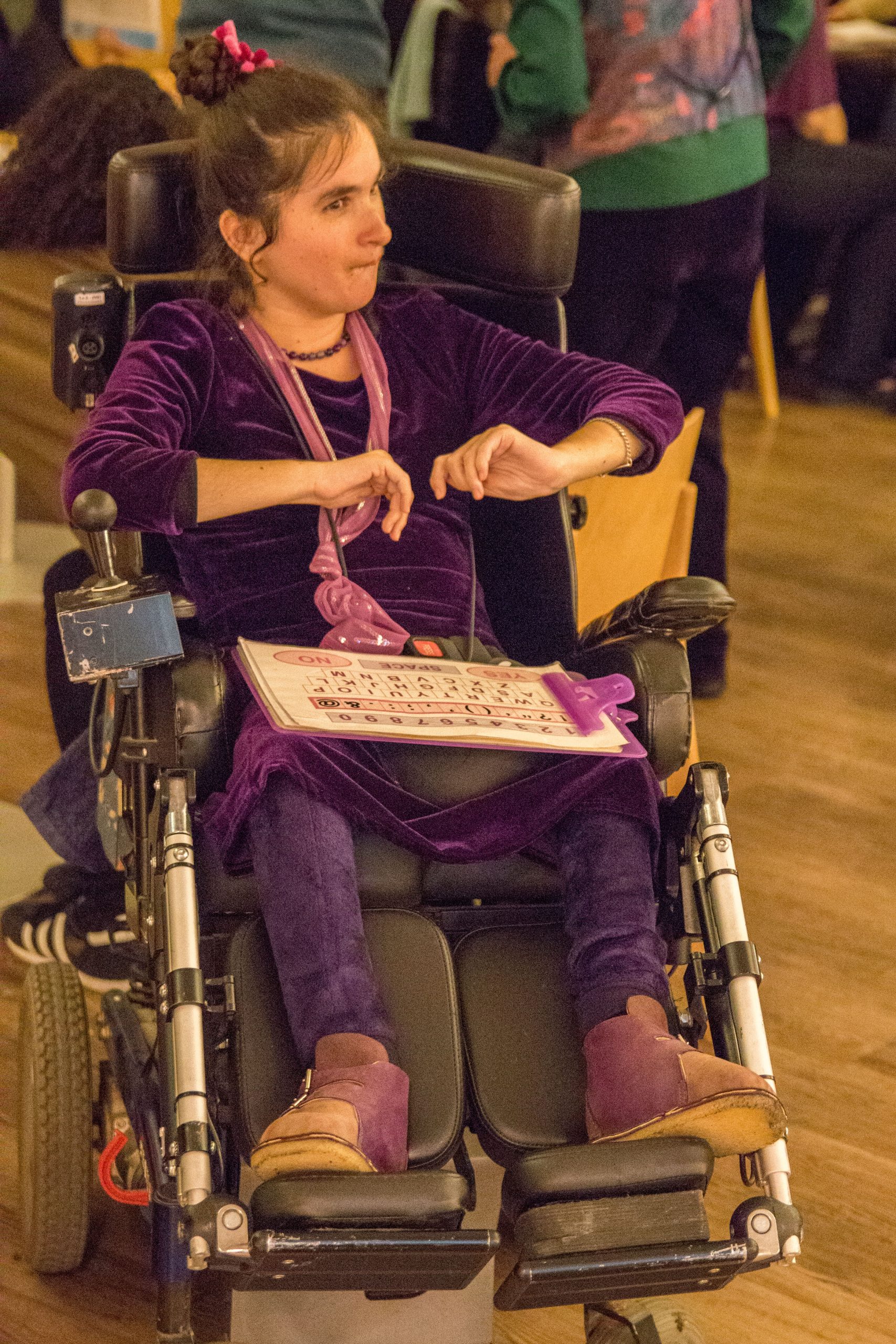
Maresa McKeithI express myself non-verbally, through alternative communication. I hope that my work challenges, comforts, and gives hope. As a Disabled Woman, I know what it is like to feel completely alone in spaces where others appear to be excelling. I have not merely witnessed that sense of isolation, I have felt it. In schools, many Disabled children need help, but there is never enough quality help around, and so it becomes more about survival, than thriving. My school journey was challenging and complicated. I needed friends to help me get through it, along with other key staff, personal assistants, and my mum. In segregated settings, it is often impossible for children who can’t talk or move to form relationships with each other, as there is nobody to assist those relationships. Friendship is not even on the agenda.

What fuels my work as a writer, poet, and educator, centres around the potential isolation that begins when a Disabled child is not seen as an active part of a school, and the long-lasting impact that this can have. Not just on their own sense of worth, but as to how they are seen by other children. Or worse: not seen at all.

All Young people deserve to be in spaces in which people like myself are not only present, but actively welcomed in – are given the opportunity to make, build and maintain diverse, loving friendships. These friendships, it is important to note, should not be restricted to Disabled people being with other Disabled people only. We are not sheep to be herded into one space with the belief that, due to our collective ‘differences’, we will surely find common ground.

I feel most connected to the world when I hear Young people (Disabled and non-Disabled), share their hopes and dreams with me, as part of the workshops I deliver in schools.

We need to make more space in school life for something as simple, yet invaluable, as time to listen and fully ‘be’ with one another. It is through this time, we can transform fear around disability, into curiosity. To help build a world where inclusive education becomes a given, rather than a battle, I am going to continue to share my story and facilitate spaces in which every young person, no matter what, feels safe, brave and like they belong.

What are you going to do?

Co-production: Disabled Young people and greater equality

By Blake Williamson, Quiet Riot

As a non-verbal communicator I encounter a different experience of connection and often have to demonstrate my capacity before being heard. Being a member of Quiet Riot gives me the space to lose all of these issues and encourages me to continue to expect a level playing field elsewhere.

I often share my lived experience of what it’s like to live with an impairment in a disabling world. I do this through lots of different organisations via consultation, discussion, and training. As co-production is my passion, and I believe the way the world should work, it is my preferred method. Where we are all seen as equal, coming together with a shared passion to exchange our knowledge and experiences, in an open and nourishing environment. The necessity to explore something has to begin with an open gathering to see what can be found out, with no preconceptions from anyone who presumes more power than others.

I feel this is important because many people do not understand how we live. My hope is that it helps others in similar situations when they feel that no one is listening or understanding the reality of their positions. The philosophy of ‘nothing about us without us’, underpins the real idea of co-production, where nothing is decided without everyone’s involvement.

Very often systems are reworked on a regular basis, for example, assessment processes, with very little real understanding of the impact those decisions have on the very people they are supposed to assist. Even if this is done through co-production, often the delivery is a postcode lottery for recipients. When guidance is woolly and caveats allow diverse delivery options, the bias that exists for that ‘organisation’ allows the embedded culture to dominate.

It is important these narratives are heard, to assist with the changes necessary for a more equitable rationale to exist.

Published at the beginning of February 2022, at the height of the ongoing saga of whether Boris Johnson should go or stay, some might cynically argue that the Levelling Up White Paper was released to take the pressure off the Prime Minister. However, the approach taken is likely to give up clues about what will be in the forthcoming (Easter) and much delayed Department for Education SEND Review.

Levelling Up does not offer new money but instead consists of proposed solutions, based on a historical, geographical and multi variable statistical analysis of the social, economic, educational and health disparities across the UK, and in particular England. Solutions that are largely leading to repackaging and redistribution of funds, in already announced Government initiatives. It proposes 12 new initiatives including several measures for education. These include setting up 55 Educational Investment Areas (EIA) where in normative KS 2 test results of 65% of pupils meeting standards in reading, writing and maths with a pledge that 90% will be achieving these levels by 2030 with similar improvements in KS 4 Standard 8 measures. Schools in these areas that repeatedly require improvement by Ofsted, will be handed over to ‘strong’ Multi Academy Trusts (MATs). The Oak online platform developed during the COVID-19 pandemic will be nationalised to provide ‘high quality curriculum and learning support.’

The existing Supported Internships for young people with Education Health and Care Plans will be doubled, providing learning placements in workplaces with job coaches for 6 months to 1 year, to prevent them just revolving on schemes and make real progress towards economic independence. Parents will welcome extra funding for respite and £45million to get the SEND system working more effectively.

The 55 areas selected as Education Investment Areas to raise school standards include: Bedford, Blackpool, Bolton, Bradford, Bury, Cambridgeshire, Central Bedfordshire, Cornwall, County Durham, Coventry, Darlington, Derby, Derbyshire, Doncaster, Dorset, Dudley, East Sussex, Halton, Hartlepool, Isle of Wight, Kirklees, Knowsley, Leeds, Lincolnshire, Liverpool, Luton, Manchester, Middlesbrough, Norfolk, North Northamptonshire, North Somerset, North Yorkshire, Nottingham, Nottinghamshire, Oldham, Peterborough, Plymouth, Portsmouth, Rochdale, Rotherham, Salford, Sandwell, Sefton, Somerset, South Gloucestershire, South Tyneside, St. Helens, Stoke-on-Trent, Suffolk, Sunderland, Swindon, Tameside, Wakefield, Walsall and Wirral.

To achieve this, Science and Maths teachers will be paid a retention bonus of £3000 per annum and schools that have repeatedly been shown by OFSTED to require improvement will be forced to join successful Academy School chains. They will also be given support to tackle attendance issues.

The National Education Unions, who represent the largest group of teachers and those who work in schools, commented  “Whilst the National Education Union welcomes any new investment in schools it is vital to note, as the National Audit Office (NAO) has pointed out, “there has been a relative re-distribution of funding from the most deprived schools to the least deprived schools.” (1) “We can see that many of the areas now targeted for support have been among the hardest hit by education cuts over the last decade – on the Government’s own watch, and entirely of its own making”.

None of these measures will make a great impact on the growing disparity on attainment of Disabled and non-Disabled students in mainstream schools, which remains a gap of around 50%, or improve social and creative outcomes.

Twelve years of this Government austerity has led to school cuts, which have largely destroyed the support structures in schools provided by teaching assistants and seen centrally employed specialist teams of teachers greatly diminished. Government ideology against inclusion, of creating a market place in education, using normative test results as the currency, together with mantras of choice, effectively removing Local Authority powers to plan rationally for need and replacing it with undemocratic, expensive and failure prone academies, has created a toxic situation for children and young people with disability or special educational needs.

Behind all this is a failure to understand what needs to happen to create an equal and inclusive school system in England. Several of these failures of understanding were masterminded by Mr Gove when he was Education Secretary, and now seem to be being replicated as he leads Levelling Up. A narrow curriculum which emphasises retaining knowledge, rather than skills and understanding which should be taught in a flexible, child-centred manner and flexibly assessed is the biggest barrier to inclusion. The normative testing regime, which has been likened to an ‘exam factory approach’ leads to the internal, external and informal exclusions currently rife in our schools, especially in academies. Disabled students, including those from black and racially minoritized groups as well as students from deprived and under resourced backgrounds are more likely to experience institutional prejudice leading to very unequal outcomes. Equality is about understanding the barriers that lead to differential outcomes and putting in place effective solutions and resources to resolve these barriers. The Government continues to fail to understand that their ideological stance on education is the root cause of the systems failure.

If we examine the 55 Education Investment Areas on 2 variables 1) percentage of 2-18 population in special schools [average for Local Authorities in England 1.33percent] and 2) percentage of children with Education Health and Care Plans [average for Local Authorities in England 3.25 percent], then it becomes very clear that any blanket strategy could be disastrous for the inclusion and life chances of Disabled  children and young people and children and young people with SEN labels. The figures are from the DFE 2021 School Census. If we divide the 55 up by whether they are above or below average on these 2 variables, we find the following.

The low segregating Authorities: 8 have lower than average numbers on EHCP plans and 12 have above average numbers on EHC Plans. The largest Group of 33 Authorities are above average segregators and also have above average numbers on EHC Plans. These 33 Authorities will need to reduce reliance on use of special schools and improve their inclusive teaching at school support levels to bring down reliance on EHC Plans and segregated provision. Apart from being very expensive in terms of Higher Needs Budgets it also leads to poorer outcomes for the cohort and children less able to transition to useful adult lives.

The low segregating authorities  include: Bedford, Bradford, Cambridgeshire, Central Bedfordshire, Cornwall, Derbyshire, Doncaster,  Kirklees, Leeds, Luton, Norfolk, North Somerset, North Yorkshire, Nottingham, Nottinghamshire, Peterborough, Plymouth,  Sandwell, Somerset, South Gloucestershire, Suffolk, Swindon, Wakefield,  and those just above average such as East Sussex, Bury, Walsall; all in the past have either had a conscious policy of developing inclusion or by virtue of their geography have funded inclusion in their mainstream schools such as Cornwall, Norfolk, Suffolk or North Yorkshire. What has been achieved here needs to be preserved and built upon.

The Government is putting their faith in academies to bring about improvement. The Education Data Lab have questioned the idea that moving weak schools to strong MATs as an answer, showing that in the EIA many of the existing academies are performing below par. Brahm Norwich and his colleagues at Exeter, analysing the National Pupil data base that in the last 10 years, those schools that have become academies have reduced the numbers of students identified with SEN at a faster rate than the community schools and has partly led to the big acceleration of numbers in special schools. This does not bode well for those schools and Local Authorities that are more inclusive. Is inclusion to be sacrificed for meaningless league table results?

What is needed is a new approach from the forthcoming Green Paper that values inclusive practice and rewards schools for each individual student’s achievements. This would require a social model of disability/human rights approach to education.

Table: The 55 education investment areas (below)


The 55 education investment areas  
SEN2 2021 %  in special school of 2-18 popln % of 2-18 population with EHC plans  
England 1.33% 3.25%  
 
Bedford 0.99% 3.28% Nottingham 0.93% 1.83%    
Blackpool 2.23% 4.35% Nottinghamshire 0.88% 1.86%    
Bolton 1.57% 4.01% Oldham 1.77% 4.29%    
Bradford 1.16% 3.44% Peterborough 0.61% 4.09%    
Bury 1.36% 4.67% Plymouth 1.34% 4.59%    
Cambridgeshire 1.18% 4.00% Portsmouth 1.45% 3.94%    
Central Bedfordshire 1.20% 3.44% Rochdale 1.52% 4.10%    
Cornwall 0.58% 3.12% Rotherham 1.66% 4.31%    
County Durham 1.64% 3.69% Salford 1.87% 4.42%    
Coventry 1.53% 3.00% Sandwell 0.95% 3.18%    
Darlington 1.49% 3.72% Sefton 1.54% 3.87%    
Derby 1.69% 4.56% Somerset 0.96% 3.19%    
Derbyshire 0.86% 2.69% South Gloucestershire 1.13% 3.86%    
Doncaster 1.11% 3.50% South Tyneside 2.12% 5.08%    
Dorset 1.35% 4.45% St Helens 1.40% 3.39%    
Dudley 1.67% 4.07% Stoke-on-Trent 2.04% 4.43%    
East Sussex 1.39% 3.53% Suffolk 1.06% 3.99%    
Halton 1.79% 3.76% Sunderland 1.70% 3.62%    
Hartlepool 1.42% 3.70% Swindon 1.33% 4.23%    
Isle of Wight 1.45% 5.08% Tameside 1.59% 3.63%    
Kirklees 0.95% 3.61% Wakefield 0.89% 3.28%    
Knowsley 2.14% 5.31% Walsall 1.34% 3.91%    
Leeds 1.07% 2.89% Wirral 1.93% 4.72%    
Lincolnshire 1.50% 4.43%  
Liverpool 1.79% 3.57%  
Luton 1.34% 3.51%  
Manchester 1.68% 4.33%  
Middlesbrough 2.01% 4.12%  
Norfolk 1.22% 4.65%  
North Northamptonshire 1.44% 2.90%  
North Somerset 1.21% 3.04%  
North Yorkshire 1.09% 3.10%  

Supported by

ALLFIE’s campaign for Inclusive Education as a human right is backed by funders and donors who reject the systemic segregation of Disabled people from society.